Kalpana Chawla: Journey of India’s First Woman in Space
Kalpana Chawla stands as an enduring symbol of inspiration in global space exploration, breaking barriers as the first Indian-born woman and first South Asian American woman to travel to space. From humble beginnings in Karnal, India, Chawla’s determination, academic brilliance, and fearless pursuit of her passion led her to NASA, where she became a pioneer and role model for aspiring scientists, especially girls in STEM.
This article details Chawla’s influential life—her upbringing, education, groundbreaking NASA career, tragic loss on the space shuttle Columbia, and her lasting legacy.
Early Life and Education
Kalpana Chawla was born on March 17, 1962, in Karnal, Haryana, India. Growing up in a traditional setting, she was fascinated by flight and the nighttime sky, often gazing at planes above the city and dreaming of reaching the stars.
Her family encouraged her curiosity, and she showed academic prowess early on. She graduated from Tagore Baal Niketan Senior Secondary School in Karnal and pursued a Bachelor of Engineering degree in Aeronautical Engineering at Punjab Engineering College in Chandigarh in 1982. Despite suggestions from faculty to change her major—due to limited opportunities for women in aerospace engineering—her perseverance prevailed.
- Nickname: “K.C.” among friends and colleagues.
- Degree: Bachelor of Engineering (Aeronautical).
- Emigration to the U.S.: Moved in 1982 for higher studies.
- Graduate Studies:
- M.S. in Aerospace Engineering, University of Texas at Arlington, 1984.
- Second M.S. in Aerospace Engineering, University of Colorado Boulder, 1986.
- Ph.D. in Aerospace Engineering, University of Colorado Boulder, 1988.
- Became a naturalized U.S. citizen during her time abroad.
- Pilot Licenses: Trained and certified for airplanes, gliders, and seaplanes.
Path to NASA
After earning her doctorate, Chawla began her journey at NASA Ames Research Center in 1988 as vice president of Overset Methods, Inc. She specialized in computational fluid dynamics, working on vertical/short takeoff and landing (V/STOL) aircraft concepts.
Her technical proficiency and academic achievement propelled her into the NASA Astronaut Corps in March 1995. By 1996, she was selected for her first shuttle flight, joining a small group of international female astronauts. Colleagues admired her for her sharp intellect and humility, which became evident throughout her missions.
- NASA Research: Powered-lift computational fluid dynamics at Ames Research Center.
- Astronaut Training: Selected in 1994, started official astronaut career in 1995.
- Flight Instructor: Held certifications for airplanes, gliders, and seaplanes.
First Space Mission: STS-87
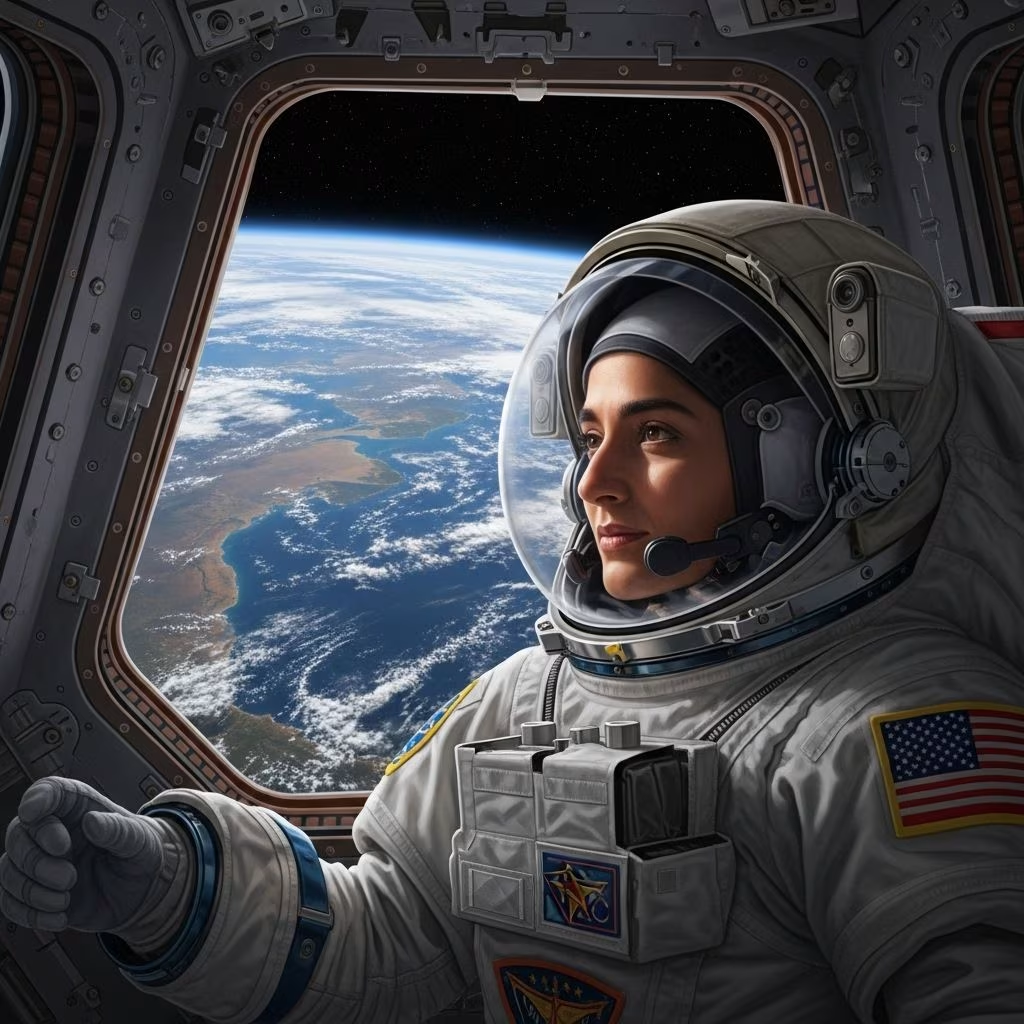
Chawla’s inaugural journey into space was aboard the Space Shuttle Columbia, mission STS-87, which launched on November 19, 1997. As a mission specialist and primary robotic arm operator, she was responsible for crucial satellite deployments and scientific experiments.
- Mission Duration: 16 days in orbit.
- Orbits: 252 times around Earth.
- Distance Covered: Over 10.4 million miles.
- Role: Deployment of the Spartan satellite (responsible for satellite experiments).
- Challenges: The Spartan satellite failed to operate correctly, leading to a spacewalk by Winston Scott and Takao Doi to recover it. A NASA investigation later exonerated Chawla of error, citing software and procedural failures.
- Historic Achievement: First Indian-born woman and second person of Indian ancestry in space (after Rakesh Sharma).
Chawla spent over 372 hours in space during this mission. Her performance was recognized post-flight, earning her special commendation from her astronaut peers for her technical work on the space station.
Second Space Mission and Columbia Disaster
Chawla returned to Columbia for her second mission, STS-107, which launched in January 2003. This mission was intensely focused on science, with more than 80 experiments conducted by the crew, often split into shifts to maximize productivity.
- Duration: Just over 16 days, ending on February 1, 2003.
- Experiments: Covered topics in biology, physics, and materials science.
- Team: Crew included Rick Husband, Laurel Clark, Ilan Ramon, David Brown, William McCool, and Michael Anderson.
On February 1, 2003, tragedy struck as Columbia was re-entering Earth’s atmosphere. Hot gases entered a breach in a wing, resulting in catastrophic depressurization. All seven crew members, including Chawla, died instantly, marking one of the most somber days in space history.
Contributions and Experiments
Across both missions, Chawla and her team played vital roles in dozens of scientific and technological experiments. These included advancing knowledge in microgravity conditions, life sciences, and materials engineering.
- Robotic Arm Operations: Managed critical satellite deployments and retrievals.
- Science Investigations: Oversaw biological and physics research crucial for long-duration human spaceflight.
- Experiment: Oversaw deployment of the Spartan satellite, which tested solar corona observing tools.
Her expertise contributed valuable data for future space missions and engineering concepts vital to international science communities.
Awards and Honors
- NASA Space Flight Medal for her contributions and dedication to science.
- K.C. Scholarships established at University of Texas-Arlington and University of Colorado-Boulder.
- Numerous Indian and international recognitions posthumously for her legacy.
- Multiple buildings, lunar craters, and satellites named in her honor.
- Kalpana Chawla Hall: Residence hall at University of Texas, Arlington.
Legacy and Influence
Chawla’s legacy is best defined by her commitment to education and the possibilities of science.
- Empowering Girls: Regularly mentored girls from her hometown, organizing visits to NASA programs and hosting traditional Indian meals at her home in Houston.
- Outreach: Frequently returned to speak at universities and high schools in India and the U.S., urging students—especially young women—to pursue STEM fields.
- Inspiring Scholarships: Initiated and inspired academic funds and programs worldwide, supporting aerospace engineering students.
- Honors in Education: Academic awards, memorials, and educational institutions named after her continue her spirit of scientific pursuit.
- Personal Impact: Rimpy Singh, a recent aerospace graduate from India, voiced how Chawla’s journey inspired her own academic path in the U.S..
Kalpana Chawla’s life story exemplifies the power of dreaming big, challenging conventions, and impacting generations to come. Her legacy is etched into the annals of science and continues to fuel the pursuits of astronauts and engineers around the world.
Kalpana Chawla: Key Facts Table
| Field | Details |
|---|---|
| Date of Birth | March 17, 1962 |
| Place of Birth | Karnal, Haryana, India |
| Degrees | B.E. Aeronautical Engineering (India), M.S. & Ph.D. Aerospace (USA) |
| Pilot Licenses | Airplanes, gliders, seaplanes |
| NASA Missions | STS-87, STS-107 (Space Shuttle Columbia) |
| Total Space Time | Over 30 days |
| Major Awards | NASA Space Flight Medal, multiple posthumous honors |
| Legacy | Scholarships, schools, memorials, global inspiration |
Frequently Asked Questions (FAQs)
Q: What was Kalpana Chawla’s primary field of study?
A: Chawla specialized in aerospace engineering, earning her Doctorate from the University of Colorado Boulder.
Q: What were her major achievements in NASA?
A: She participated in two shuttle missions—STS-87 and STS-107—and was the first Indian-born woman in space. She logged over 30 days in orbit and led several key science and technology experiments.
Q: How did the Columbia disaster occur?
A: During re-entry on February 1, 2003, a breach in one of Columbia’s wings allowed hot gases into the shuttle, causing rapid depressurization and the loss of all crew members.
Q: How does Chawla’s legacy continue today?
A: Chawla continues to inspire students globally through scholarships, memorials, and outreach programs, particularly for women in STEM fields.
Q: What lessons can be learned from her life?
A: Her life teaches the importance of persistence, breaking barriers, and encouraging the pursuit of education and science regardless of background or gender.
Conclusion
Kalpana Chawla’s story encapsulates the triumph of determination over adversity, the pursuit of excellence in science, and the hope she brings to countless future explorers. Her commitment to her craft and her legacy continue to resonate, fostering new generations of scientists who dare to reach for the stars.
References
- https://en.wikipedia.org/wiki/Kalpana_Chawla
- https://www.britannica.com/biography/Kalpana-Chawla
- https://www.nasa.gov/wp-content/uploads/2020/09/chawla_kalpana.pdf
- https://airandspace.si.edu/stories/editorial/kalpana-chawla
- https://www.kcgmc.edu.in/KCGMCHome/about_kalpana_chawla
- https://airandspace.si.edu/support/wall-of-honor/dr-kalpana-chawla
- https://www.amfcse.org/michael-p-anderson-1-1
- https://sd2.org/who-is-kalpana-chawla-the-first-indian-born-woman-in-space/
- https://spacecenter.org/astronaut-friday-kalpana-chawla/
- https://www.aakash.ac.in/blog/kalpana-chawla-biography-early-life-and-education-space-missions-death/
- http://www.astronautix.com/c/chawla.html
- https://byjus.com/kids-learning/kalpana-chawla-essay/
- https://www.ebsco.com/research-starters/biography/kalpana-chawla
- https://www.jagranjosh.com/general-knowledge/kalpana-chawla-biography-1643707710-1
- https://infinitylearn.com/surge/biography/kalpana-chawla/
- https://jerseystem.org/reaching-for-the-stars-the-life-and-legacy-of-dr-kalpana-chawla/
- https://www.quotagebiography.com/kalpana-chawla-biography/
- https://raisingsmartgirls.com/kalpana-chawla/
- https://www.tpointtech.com/kalpana-chawla