Quantum Physics: Essential Truths You Need to Know
Quantum physics, also known as quantum mechanics or quantum theory, stands at the frontier of science, describing the behavior of matter and energy at the smallest scales. Unlike the familiar rules of classical physics, quantum laws are fundamentally counterintuitive, leading to phenomena that puzzle even the greatest minds. This article delves deep into the structure and concepts central to quantum physics, addressing why it is so strange, the revolutionary discoveries it enabled, and how it continues to shape our understanding of reality.
What Is Quantum Physics?
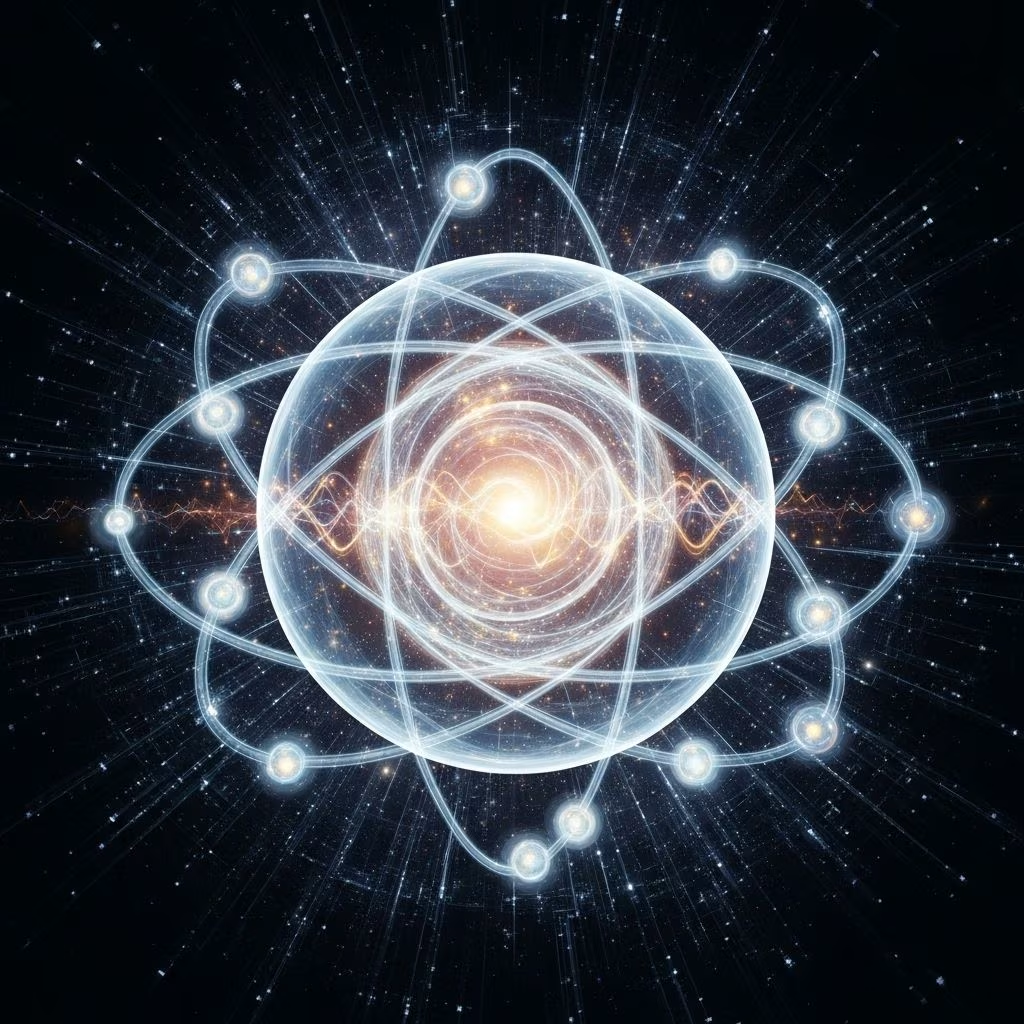
Quantum physics is the branch of science that explains the nature of matter and energy at the atomic and subatomic level. It encompasses principles and mechanics governing particles such as electrons, protons, photons (particles of light), and more. Unlike classical physics, which operates on deterministic laws, quantum physics introduces probabilities, uncertainties, and dualities that seemingly defy common sense.
- Origin: Quantum physics emerged in the early 20th century from experiments and theories that classical physics could not explain.
- Main contributors: Max Planck, Albert Einstein, Niels Bohr, Werner Heisenberg, and Erwin Schrödinger, among others.
- Application: Quantum physics underpins much of modern technology, including lasers, transistors, and computers, as well as our understanding of the cosmos.
Key Principles of Quantum Physics
The evolution of quantum theory throughout the 20th century revealed several principles that still shape our understanding today.
- Quantization: Some properties, like energy, can only exist in discrete values (quanta).
- Wave-Particle Duality: Light and matter exhibit both wave-like and particle-like qualities.
- Uncertainty Principle: There are fundamental limits to the precision with which certain pairs of physical properties, such as position and momentum, can be known simultaneously.
- Quantum Superposition: Particles can exist in multiple states at once until observed.
- Quantum Entanglement: Particle states can become correlated so that the state of one instantly influences another, regardless of distance.
The Birth of Quantum Theory: Key Experiments and Ideas
Quantum physics arose from a series of groundbreaking experiments and radical theoretical insights:
- Planck’s Quantum Hypothesis (1900): Max Planck introduced the concept that energy is quantized in discrete packets, or quanta.
- Einstein’s Photoelectric Effect (1905): Albert Einstein explained the emission of electrons from materials when exposed to light, showing that light itself comes in quantized packets called photons.
- de Broglie Hypothesis (1924): Louis de Broglie proposed that particles like electrons also have wave-like properties.
- Double-Slit Experiment: Demonstrated that particles such as electrons can create interference patterns like waves, but only when unobserved; adding a detector collapses the pattern into discrete points, behaving as particles.
Wave-Particle Duality: The Paradox at Quantum’s Heart
Wave-particle duality is one of the most counterintuitive aspects of quantum physics. At the quantum level, entities can behave as both waves and particles depending on how they are measured or observed.
- Electrons, photons, and other subatomic entities show interference patterns in laboratory experiments, acting as waves.
- When measured, these same entities appear as localized particles.
- This phenomenon implies that reality at the quantum level is not fixed but contingent upon observation and interaction.
| Property | Wave Behavior | Particle Behavior |
|---|---|---|
| Electron | Interference patterns | Localized impacts |
| Photon | Diffraction and superposition | Individual light quanta |
Quantum Superposition: Reality in Multiple States
Quantum superposition is the principle that particles can exist in several possible states at once. Only when observed does the particle ‘collapse’ into one of its possible states.
- Schrödinger’s Cat: A famous thought experiment illustrates superposition, suggesting a cat in a box can be simultaneously alive and dead until the box is opened.
- This challenges classical ideas about objective reality, suggesting observation itself plays a fundamental role in determining outcomes.
The Uncertainty Principle: Limits to Knowledge
Werner Heisenberg’s Uncertainty Principle states that it is impossible to precisely measure both a particle’s position and momentum at the same time.
- This inherent uncertainty is not due to limitations of measurement but is a fundamental property of nature.
- It sets a natural limit on what can be known, undermining the traditional notion of determinism in physics.
- Uncertainty at the quantum level explains phenomena such as electron orbitals in atoms.
Quantum Entanglement: Spooky Action at a Distance
Quantum entanglement describes how two or more particles become linked so that the state of one affects the other instantly, regardless of distance.
- Einstein called this “spooky action at a distance” and doubted its validity, yet experiments consistently confirm its existence.
- Entanglement underpins potential quantum technologies, including quantum computers and secure quantum communication.
- The famous Einstein–Podolsky–Rosen (EPR) paradox and subsequent Bell experiments established entanglement as a core quantum feature.
Probability and Quantum Mechanics: The Role of Chance
Unlike the certainty of classical physics, quantum mechanics predicts probabilities for outcomes, not definite values.
- Quantum states are represented by mathematical wave functions, which encode probabilities.
- When particles are measured, their wave function collapses to one of the possible outcomes, chosen at random but with predictable probabilities.
Quantum Space and Noncommutative Geometry
Quantum physics introduces the concept of quantum spacetime, where space and time are not continuous and smooth, but can exhibit discrete, noncommutative properties under certain conditions[10].
- At very small scales (Planck length), the usual rules of geometry may break down and become quantized[10].
- This concept is essential for attempting to reconcile quantum mechanics with general relativity.
The Quantum Measurement Problem: Observer and Reality
Quantum mechanics suggests that reality is fundamentally linked to the act of measurement or observation. Before measurement, a system exists in a range of possible states; measurement collapses these possibilities into one outcome.
- This concept remains one of the most debated aspects of quantum physics.
- Several interpretations exist, including the Copenhagen Interpretation (which stresses the importance of measurement) and the Many-Worlds Interpretation (which posits that all possible outcomes occur in branching universes).
Applications of Quantum Physics
Quantum physics is not just an abstract theory; it underpins a wide array of technologies and scientific advances.
- Semiconductors: Modern electronics, including computers and smartphones, depend on quantum effects in semiconductors.
- Lasers: Operate based on quantum emission of light.
- Magnetic Resonance Imaging (MRI): Uses quantum properties of atomic nuclei for medical imaging.
- Quantum Cryptography: Promises secure communication methods based on quantum mechanics.
- Quantum Computing: Envisioned as a revolution in processing power by exploiting superposition and entanglement.
Quantum Physics and the Universe
Quantum theory is intertwined with cosmology and our understanding of the universe.
- Matter and energy are both governed by quantum principles.
- Quantum fluctuations in the early universe seeded the structure observed in the cosmos today.
- Efforts to build a quantum theory of gravity aim to unify quantum mechanics and general relativity, potentially explaining phenomena like black holes and the Big Bang.
Frequently Asked Questions About Quantum Physics
-
Q: Why is quantum physics so strange?
A: Quantum physics defies everyday intuition by allowing particles to exist in many states at once, be instantly correlated over enormous distances (entanglement), and behave both as waves and particles depending on how we measure them.
-
Q: What is wave-particle duality?
A: Wave-particle duality is the phenomenon whereby particles such as electrons and photons display properties of both waves and discrete particles, depending on the experiment and observation.
-
Q: Is quantum mechanics complete?
A: Quantum mechanics accurately predicts experimental results, but its interpretation is still debated. Some physicists believe it is incomplete and advocate for a deeper underlying theory.
-
Q: How does quantum physics relate to technology?
A: Quantum physics enables technologies like lasers, MRI machines, semiconductors, quantum computers, and secure quantum communications.
-
Q: Will quantum mechanics be unified with gravity?
A: Scientists are actively searching for a quantum theory of gravity; while progress is being made, unification remains one of the greatest open challenges in physics.
Conclusion: Quantum Physics, the Puzzle of Reality
Quantum physics reveals that the universe is much stranger and more interconnected than our everyday experience suggests. With continually developing technology and ever-deeper philosophical debates, quantum theory remains one of humanity’s most profound achievements, reshaping how we explore existence at the deepest level. Whether revolutionizing computers, fighting for cryptographic security, or probing the mysteries of the cosmos, the world of quantum physics is both a challenge and an inspiration for present and future generations.
References
- https://www.space.com/7157-quantum-astronomy-information-universe.html
- https://www.space.com/the-universe/new-recipe-for-gravity-could-unite-einsteins-general-relativity-with-quantum-physics-and-probe-the-dark-universe
- https://www.spaceandmotion.com/Physics-Quantum-Theory-Mechanics.htm
- https://arxiv.org/abs/2108.01435
- https://arxiv.org/html/2312.14932v1
- https://www.scribd.com/document/641632462/QUANTUM-SPACE
- https://quantumzeitgeist.com/category/space/
- https://en.wikipedia.org/wiki/Quantum_mechanics
- https://giirj.com/index.php/giirj/article/download/376/356
- https://en.wikipedia.org/wiki/Quantum_spacetime
- https://www.science.org/content/article/quantum-experiment-space-confirms-reality-what-you-make-it-0
- https://modernscientificpress.com/Journals/ViewArticle.aspx?JPF%2FPs8mjDEax1K7MijWRM+%2FNqfTdby3RohnnLikBqsMXXKCDT4KgW52xmT+Y9iw
- https://inspirehep.net/files/1ee8614160c1ef4edf123bfc93d040e0
- https://pure.strath.ac.uk/ws/portalfiles/portal/124451702/Belenchia_etal_ArXiv_2021_Quantum_physics_in_space.pdf
- https://www.grafiati.com/en/literature-selections/quantum-space/journal/
- https://elib.dlr.de/193249/1/Quantum-physics-in-space_2022_Physics-Reports.pdf
- https://www.scirp.org/html/17-7501892_49266.htm