Tycho Brahe: Biography of a Revolutionary Astronomer
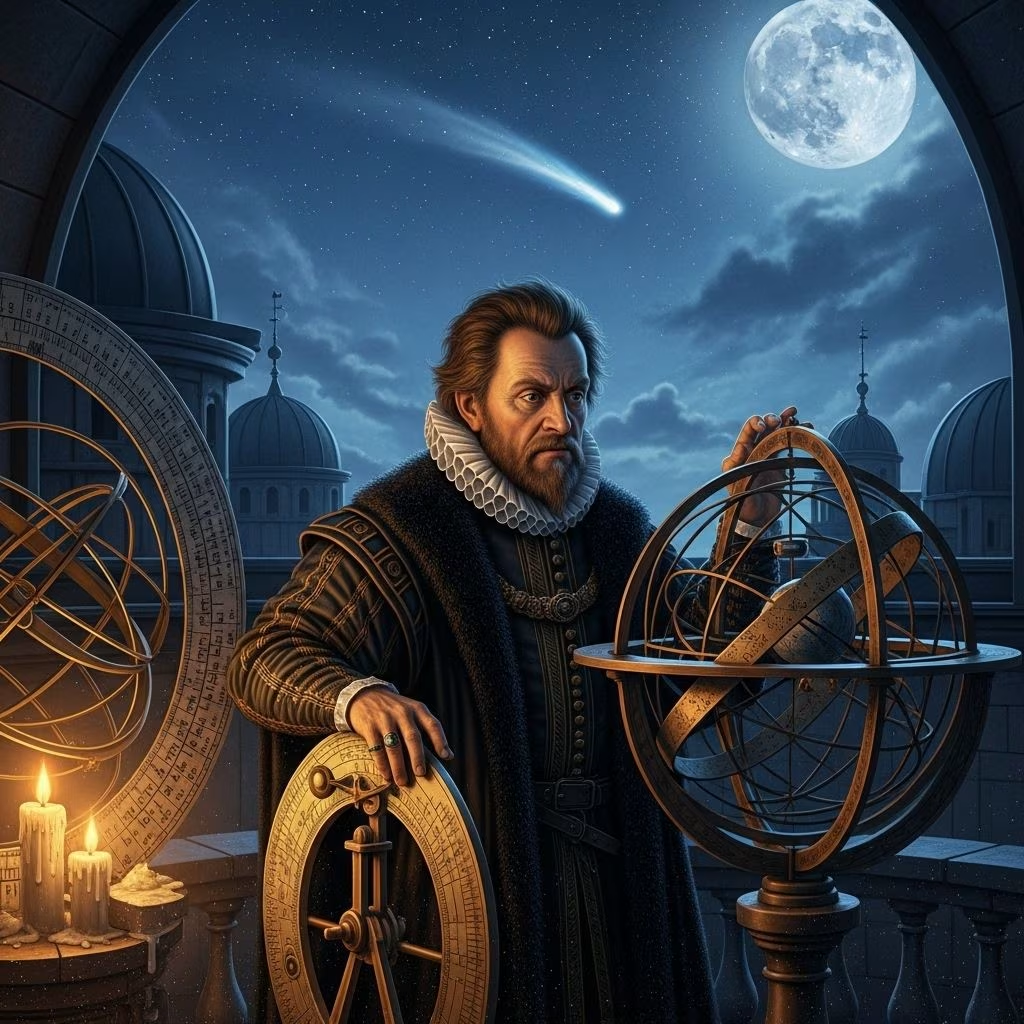
Tycho Brahe (1546-1601) remains one of history’s most influential astronomers. His meticulous astronomical observations before the telescope’s invention, innovative instruments, and challenges to ancient science fueled progress in astronomy and ushered in the Scientific Revolution. Brahe’s life story encompasses noble birth, dramatic personal incidents (including the loss of his nose in a duel), world-class scientific teamwork, and groundbreaking discoveries that changed human understanding of the cosmos.
This article explores Tycho Brahe’s background, notable achievements, inventions, and enduring legacy.
Tycho Brahe’s Contribution to Astronomy
Tycho Brahe’s contributions fundamentally shaped modern astronomy. He established standards for empirical observation and data accuracy, setting the groundwork upon which later astronomers built their theories.
Key contributions include:
- Comprehensive star catalog: Brahe meticulously compiled stellar positions, setting records for precision in the era before telescopes were invented.
- Observational rigor: He insisted on systematic, repeatable measurements, turning astronomy into a discipline based on reliable, repeatable data rather than speculation or tradition.
- Debunking Aristotelian views: Tycho’s observations of supernovae and comets challenged the ancient concept of an unchangeable heavens, demonstrating that celestial change occurred beyond the Moon[15].
- Influencing Kepler: Brahe’s teachings and observational data directly enabled Johannes Kepler’s formulation of the laws of planetary motion.
What Did Tycho Brahe Do and Where?
Tycho Brahe was born Tyge Ottesen Brahe on December 14, 1546, at Knudstrup Castle in Denmark, into a noble family[15]. Initially intended for a legal career, Tycho’s interest shifted irreversibly toward astronomy while studying at the University of Copenhagen and later in Leipzig, Wittenberg, and Rostock.[15]
- He studied law, but his passion for astronomy led him to pursue scientific studies rigorously, traveling through Germany for educational opportunities.
- In 1566, a student duel at Rostock cost him part of his nose, which he replaced with a brass prosthesis for daily life and a gold-silver version for ceremonial occasions[15].
In 1572, Tycho witnessed a celestial event that shaped his future: a new, brilliant star (supernova) appeared in Cassiopeia. Realizing its significance—contradicting the prevailing view that the heavens were immutable—he committed himself to ever more precise observation, inventing instruments capable of unprecedented accuracy[15].
With royal patronage from King Frederick II, Tycho built the world’s premier scientific facility:
- Uraniborg Observatory (on Hven Island):
- First large observatory in Europe, with state-of-the-art equipment and dedicated staff.
- Hosted scientists from diverse backgrounds, regardless of religion or nationality.
- Became a hub for pioneering research and instrument innovation from 1576 onward.
- Stjerneborg:
- Underground research labs designed for increased instrument stability and accuracy.
Discoveries of Tycho Brahe
Tycho Brahe’s discoveries undermined centuries-old beliefs about the cosmos. His skill as a careful observer made these revelations possible even without a telescope[13][15].
- Supernova of 1572:
- Documented a stellar explosion in Cassiopeia; demonstrated parallax absence, proving it was a celestial event and not atmospheric[15].
- Disproved Aristotelian doctrine of unchanging heavens[15].
- Great Comet of 1577:
- Through parallax measurements, Brahe showed the comet traveled through space and was not merely an atmospheric phenomenon, further undermining ancient theories[15].
- Most accurate pre-telescopic star and planetary observations:
- Brahe’s planetary data was far more precise than any of his contemporaries, later crucial for Kepler’s laws of planetary motion[13][15].
Table: Tycho Brahe’s Key Discoveries
| Year | Discovery | Significance |
|---|---|---|
| 1572 | Supernova (Cassiopeia) | Proved celestial change; challenged immutable heavens |
| 1577 | Great Comet | Proved comets move in celestial sphere, not Earth’s atmosphere |
| 1576–1591 | Star Catalog | Recorded positions of 777 stars with unmatched accuracy |
Inventions of Tycho Brahe
Tycho Brahe was not only an astronomer but also a founder of modern observational science through his inventive spirit[13].
- Tychonian Quadrant: The first European mural quadrant, capable of measuring angles precisely and facilitating accurate stellar and planetary position charts.
- Improved Armillary Spheres and Sextants: Refined traditional tools for measuring star angles, establishing standards that persisted into the telescopic era.
- Innovative observatory design: Uraniborg and Stjerneborg featured dedicated instrument rooms and underground chambers for increased precision.
- Specialized tools for parallax measurement: Enabled more accurate assessments of celestial objects’ locations relative to Earth.
Other Accomplishments of Tycho Brahe
Brahe’s impact extended far beyond instruments and discoveries:
- Empirical methods: Instituted systematic observation and recordkeeping, shaping modern scientific methodology[13].
- Scientific teamwork: Assembled multi-national and multi-faith research teams, pioneering inclusive knowledge creation.
- Mentorship: Provided opportunities for young scientists, including Johannes Kepler and several women in science.
- Astrology, alchemy, and cosmology: Brahe investigated astrological predictions and alchemical processes, characteristic of Renaissance science, and developed a hybrid cosmology model—the ‘Tychonic system’—which merged Copernican and Ptolemaic ideas[15].
Tycho Brahe’s Tychonic System:
- Proposed that the Earth sat at the universe’s center, with the Sun and Moon orbiting it; planets orbited the Sun.
- This model accommodated detailed observations but maintained some traditional geocentric views, reflecting the era’s transitional cosmology[13].
Fascinating Facts about Tycho Brahe
- Lost his nose in a duel: Received a brass prosthesis for daily use and a gold/silver nose for formal occasions[15].
- The last great pre-telescope astronomer: Achieved historically unmatched accuracy using only unaided instruments, just before Galileo’s telescope transformed the field.
- Noble lineage and stunning estate: Descended from Danish nobility, Brahe’s Uraniborg was one of Europe’s grandest research centers.
- Collaborated with Kepler: Brahe’s records directly enabled Kepler’s laws, which underpinned Isaac Newton’s gravitational theory[13].
- Scientific inclusivity: Supported multi-faith and even female researchers—a rarity for the time.
- Death and legacy: Died in Prague in 1601, likely due to urinary retention, having profoundly influenced generations of astronomers.[15]
Frequently Asked Questions (FAQs)
Q: Did Tycho Brahe discover astronomical objects using a telescope?
A: No. Tycho Brahe was the last major European astronomer to conduct observations without a telescope, which was invented a few years after his death.
Q: Why did Tycho Brahe have a metal nose?
A: Tycho lost part of his nose in a sword duel as a student at Rostock. He wore a brass prosthetic nose daily and a gold-silver nose on formal occasions[15].
Q: What were some of Tycho Brahe’s most important discoveries?
A: The supernova of 1572, precise star catalogs, parallax measurements disproving the unchangeability of the heavens, and observing the Great Comet of 1577, which led to new understandings of cometary movement[13][15].
Q: What is Uraniborg?
A: Uraniborg was Tycho Brahe’s world-class research observatory and scientific laboratory built on the island of Hven, funded by King Frederick II. It was designed for astronomical observations, scientific experiments, and training researchers from across Europe[13][15].
Q: How did Tycho Brahe influence Johannes Kepler?
A: Brahe mentored Kepler, providing him with detailed planetary data that formed the basis for Kepler’s laws of planetary motion.
Q: Did Tycho Brahe support women in science?
A: Yes. Tycho provided opportunities for several female scientists to participate in research at Uraniborg, advanced for his time.
Lesson Summary
Tycho Brahe’s legacy is defined by his dedication to precision, innovation, and empirical science. By questioning accepted cosmology and demonstrating the power of careful observation, he reshaped astronomy’s trajectory. His team approach, technical advances, and groundbreaking discoveries laid the foundation for the scientific advances of Kepler, Galileo, and Newton, making him a central figure in the history of science.
Quick Reference: Brahe’s Impact
- Established empirical standards for data collection
- Built the era’s most advanced observatory
- Refuted centuries-old theories with direct observation
- Mentored the next generation of astronomers
Explore Further
- The shift from geocentric to heliocentric models
- Relationship between Tycho Brahe and Johannes Kepler
- Evolution of astronomical instruments
References
- https://www.britannica.com/biography/Tycho-Brahe-Danish-astronomer
- https://en.wikipedia.org/wiki/Tycho_Brahe
- https://www.space.com/19623-tycho-brahe-biography.html
- https://mathshistory.st-andrews.ac.uk/Biographies/Brahe/
- https://study.com/academy/lesson/tycho-brahes-contribution-to-astronomy.html
- https://galileo.library.rice.edu/sci/brahe.html
- https://www.famousscientists.org/tycho-brahe/
- https://www.britannica.com/biography/Tycho-Brahe-Danish-astronomer/Mature-career
- https://starchild.gsfc.nasa.gov/docs/StarChild/whos_who_level2/brahe.html
- https://chandra.harvard.edu/edu/formal/icecore/The_Astronomers_Tycho_Brahe_and_Johannes_Kepler.pdf
- https://www.uni-rostock.de/en/university/history/anniversary-of-the-university-2019/information/tycho-brahe-exhibition/biography/
- https://www.worldhistory.org/Tycho_Brahe/
- https://study.com/academy/lesson/tycho-brahe-discoveries-facts-contributions-to-astronomy.html
- https://famousastronomers.org/tycho-brahe/
- https://www.astro.umontreal.ca/~paulchar/grps/site/anglais/biographies/brahe.htm
- https://www.oerproject.com/-/media/BHP/PDF/Unit2/U2_Tycho-Brahe_2014_1080L.pdf
- https://astronoo.com/en/biographies/tycho-brahe.html
- https://lib.arizona.edu/special-collections/collections/tycho-brahe-collection
- https://localhistories.org/a-biography-of-tycho-brahe/
- https://handwiki.org/wiki/Biography:Tycho_Brahe