


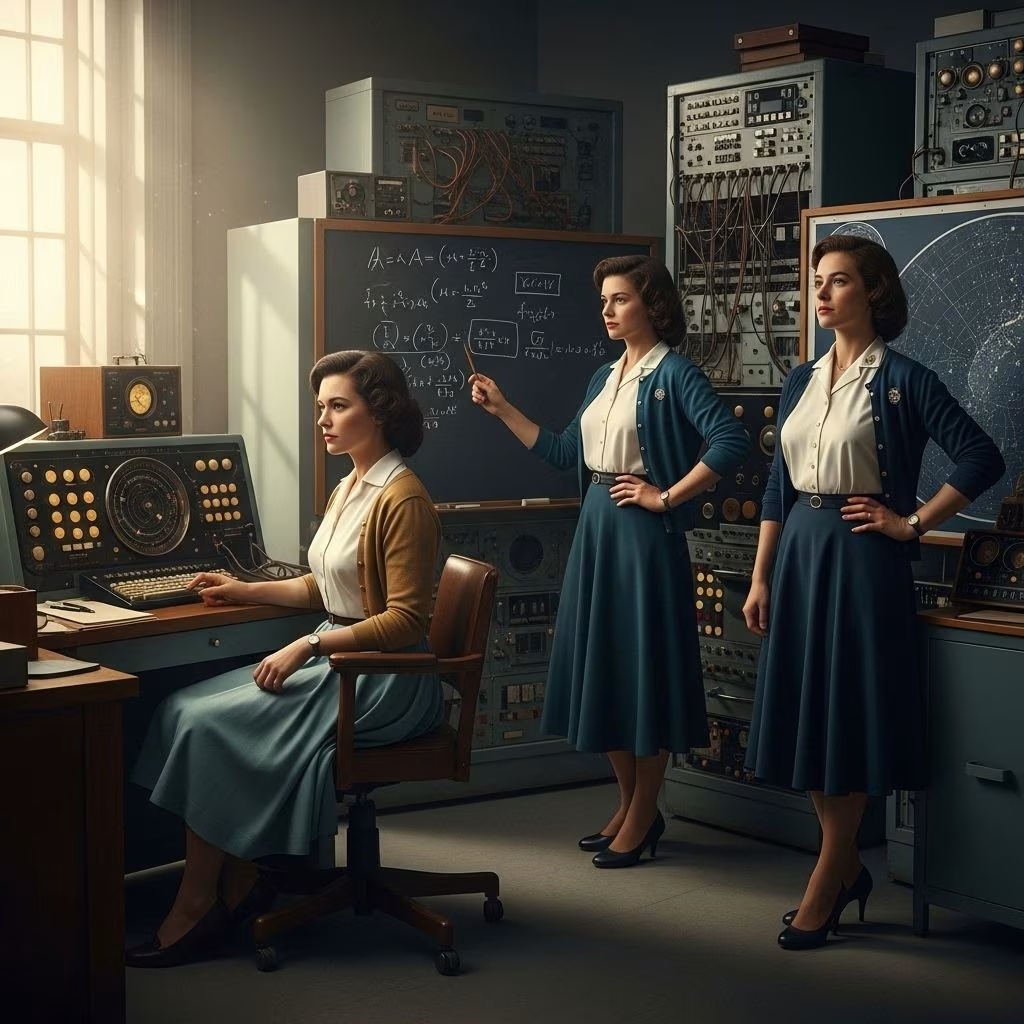
NASA’s Real Hidden Figures: Pioneers Behind America’s Journey to Space
While astronauts like John Glenn and Neil Armstrong are celebrated as heroes of space exploration, their historic achievements would have been impossible without the hidden work of women mathematicians and engineers at NASA. Many of these women were African American and worked behind the scenes as “human computers,” performing vital calculations in an era of social segregation and overlooked contributions. Their story, brought to light by Margot Lee Shetterly’s book and the acclaimed film Hidden Figures, reveals both their professional brilliance and the personal challenges they overcame. This article uncovers the real history and legacy of NASA’s hidden figures, focusing on the contributions of Katherine Johnson, Dorothy Vaughan, Mary Jackson, and their colleagues.
A Segregated Start: Women Join the Space Program
During World War II, the National Advisory Committee for Aeronautics (NACA)—predecessor to NASA—faced an urgent need for skilled mathematicians. This led to the recruitment of women, many of whom were Black, as “computers” at Langley Memorial Aeronautical Laboratory in Virginia. These women analyzed complex data, reduced wind tunnel results, and performed essential math to support aeronautical research. Despite the critical nature of their work, segregation policies relegated Black computers to separate workspaces and facilities, such as the West Area Computers.
- Katherine Johnson: Renowned for her brilliance in analytic geometry, Johnson’s calculations charted the trajectories that helped launch and safely return the first American astronauts.
- Dorothy Vaughan: A mathematician who became the first Black supervisor at NACA and a key advocate for integration and professional opportunities for her team.
- Mary Jackson: Overcoming institutional barriers, she became NASA’s first Black female engineer and fought for equal rights within the agency.
This “experiment” in hiring female computers quickly proved successful. According to NASA historians, the women were “much more accurate, much faster, and did a better job—and didn’t complain. And you could pay them less,” highlighting both their professional superiority and the gender wage gap of the time.
The Role of Human Computers: Precision and Perseverance
In an era before electronic computers, a “computer” was a person, not a machine. Their daily work consisted of:
- Reducing complex aircraft and spacecraft data for research reports.
- Using mechanical calculators and slide rules for advanced math—calculating trajectories, launch windows, and orbital mechanics.
- Analyzing wind tunnel data to help design safer, more efficient aircraft and, later, spacecraft.
Their names rarely appeared on reports, and their work remained largely invisible to the public. Yet their calculations formed the backbone of every successful mission.
Breaking Barriers: Life and Work at Langley
Segregation shaped the experiences of Black women at Langley. They were assigned to the West Area and used separate facilities—restrooms, cafeterias, and even libraries. Despite these obstacles, the women persevered, building camaraderie and professional excellence. Their expertise soon made them vital to key projects, including supersonic flight research and, as the Space Race dawned, the Mercury, Gemini, and Apollo missions.
Katherine Johnson’s rise to prominence came when she was assigned to the Flight Research Division and handpicked to double-check John Glenn’s Friendship 7 orbital mission calculations—the first American to orbit Earth. Glenn specifically requested, “Get the girl to check the numbers,” referring to Johnson, before trusting the fledgling IBM mainframe’s results. Her work ensured the accuracy and success of the mission, saving lives and powering American advances in space.
From Hidden Work to Historic Triumphs
As the U.S. strove to catch up with the Soviet Union in the Space Race, the work of NASA’s women became indispensable. The “human computers” helped:
- Calculate the precise trajectories for Project Mercury, allowing for the safe launch, orbit, and return of astronauts.
- Determine launch windows and reentry paths critical to spaceflight safety.
- Support atmospheric reentry calculations and satellite launches in the era before electronic computation reached reliability.
Despite facing both racial and gender discrimination, these women earned the respect of engineers and astronauts alike. Their innovations contributed directly to NASA’s most celebrated achievements—including the moon landing of Apollo 11.
Profiles of Excellence: The Women Who Changed NASA
| Name | Key Achievements | Role at NASA |
|---|---|---|
| Katherine Johnson | Calculated trajectories for numerous missions, including John Glenn’s flight | Mathematician; aerospace technologist |
| Dorothy Vaughan | First Black supervisor, expert in FORTRAN programming | Mathematician; head of West Area Computers |
| Mary Jackson | NASA’s first Black female engineer; advocated for equal rights in STEM | Aerospace engineer and human resources advocate |
Their relentless drive and technical acumen ripped down barriers, forced changes in workplace policy, and inspired generations of future scientists and engineers.
Recognition, Legacy, and Cultural Impact
For decades, these women’s names were left out of history books. The 2016 release of the film Hidden Figures and Shetterly’s book brought their stories to an international audience, prompting a reevaluation of NASA’s legacy and highlighting the need for diversity and inclusion in STEM.
- Katherine Johnson received the Presidential Medal of Freedom in 2015, the nation’s highest civilian honor, for her contributions to space flight.
- Naming of facilities and scholarships in honor of Johnson, Vaughan, and Jackson has ensured their legacy is woven into NASA’s present and future.
- NASA established the “From Hidden to Modern Figures” initiative, recognizing contributions of women and minorities to the space program.
Inspiring a New Generation in STEM
The story of NASA’s hidden figures serves as both a testament to individual perseverance and a catalyst for cultural change. It illustrates how:
- Talent transcends race and gender, and diversity fuels innovation.
- Breaking down barriers leads to greater institutional strength and scientific advancement.
- Telling untold histories inspires new generations from all backgrounds to pursue STEM careers.
NASA continues to spotlight the achievements of women through programs and outreach, building on the groundwork laid by these trailblazers. Their journey from “hidden” to “modern” figures is a reminder that true progress arises only when every contributor is recognized and valued.
Human Computers: A Glimpse Into Their Working Life
What did the daily tasks of these women look like? According to archival NACA memos and oral histories, their responsibilities included:
- Arriving early to process reams of flight data by hand, sometimes working overtime for critical deadlines.
- Collaborating with engineers, though often through intermediaries due to the segregation policies of the time.
- Adopting new technologies quickly, as Dorothy Vaughan did by becoming an expert in programming the agency’s first electronic computers with FORTRAN.
Though working in relative obscurity, their accuracy and commitment ensured not only NASA’s advancement but the safety of its astronauts and the legitimacy of scientific research.
The Broader Movement: Women, Minorities, and the Space Race
The story of the hidden figures is not an isolated phenomenon. It is part of a broader narrative of women and minorities striving for professional inclusion during some of America’s most tumultuous decades. Their triumphs—and their stories of overcoming discrimination—continue to reverberate in today’s efforts to build an equitable STEM workforce.
- The West Area Computers contributed to a model for integrating the federal workforce.
- Advocacy by pioneers like Vaughan and Jackson paved the way for further desegregation of NASA facilities.
- Efforts to revisit and retell these histories, both in formal recognitions and public discourse, have informed diversity initiatives at government agencies and private corporations alike.
Frequently Asked Questions (FAQs)
Q: Who were the real “hidden figures” at NASA?
A: The real hidden figures were Black women mathematicians and engineers—including Katherine Johnson, Dorothy Vaughan, and Mary Jackson—who performed critical calculations and research in support of America’s earliest space missions.
Q: Why was their work called “hidden”?
A: Their work was mostly uncredited at the time due to the intersection of racial segregation and gender bias, limiting their visibility in both the media and within NASA itself.
Q: How did their work influence space exploration?
A: Their calculations were essential in plotting flight trajectories, launch windows, and reentry paths, directly enabling successful missions like John Glenn’s orbital flight and contributing to the Mercury, Gemini, and Apollo programs.
Q: What is the significance of the Hidden Figures film and book?
A: The film and book brought global attention to these women’s stories, prompting broader acknowledgment of their impact and sparking new interest in diversity within STEM disciplines.
Q: What is NASA doing today to honor these pioneers?
A: NASA has launched initiatives like “From Hidden to Modern Figures,” named research facilities after these women, and continually invests in programs to support women and minorities in aerospace careers.
The Enduring Message of NASA’s Hidden Figures
The untold histories of NASA’s Black women mathematicians and engineers are more than just stories—they are foundational to America’s achievements in space. Through expertise, resilience, and a relentless pursue of excellence, these hidden figures transformed not only NASA, but the landscape of opportunity for future generations. Their lasting impact is a beacon for all who dare to reach for the stars, reminding us that great journeys are shaped by the courage, intellect, and persistence of those often out of the spotlight.
References
- https://www.space.com/35247-why-everyone-should-watch-hidden-figures.html
- https://www.space.com/35430-real-hidden-figures.html
- https://www.nasa.gov/from-hidden-to-modern-figures/
- https://www.nps.gov/articles/000/places-of-hidden-figures.htm
- https://en.wikipedia.org/wiki/Hidden_Figures
- https://appel.nasa.gov/2016/12/21/nasas-hidden-figures-helped-the-agency-make-history/
- https://airandspace.si.edu/stories/editorial/glenn-johnson-hidden-figures
- https://www.aviationfile.com/hidden-figures-the-true-story-of-four-black-women-and-the-space-race/
- https://airandspace.si.edu/stories/editorial/hidden-figures-and-human-computers
- https://skyandtelescope.org/astronomy-news/the-hidden-figures-who-helped-win-the-space-race/
- https://defendernetwork.com/community/history-of-blacks-in-space-hidden-figures-and-beyond/
- https://www2.x-plane.com/AboutDocuments/a-hidden-figure-of-the-space-race-answer-key.pdf
- https://galaxyaerospaceghana.com/history-of-blacks-in-space-hidden-figures-and-beyond/
- https://www.shortform.com/blog/space-task-group-hidden-figures/
- https://www.tamug.edu/nautilus/articles/Hidden_Figures.html
- https://www.shortform.com/blog/nasa-hidden-figures/
- https://paminy.com/book-review-hidden-figures/


