Eagle Nebula (M16): Hubble Images & Pillars of Creation
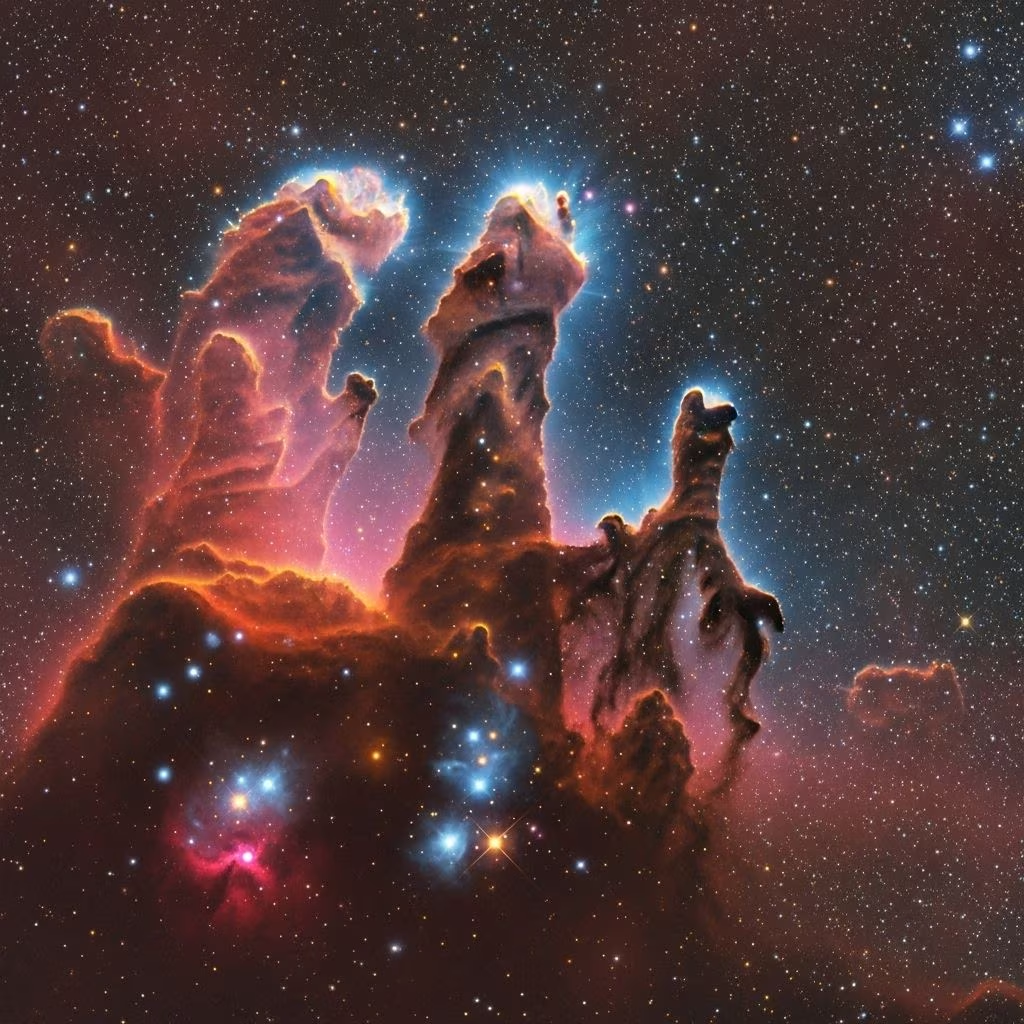
High above Earth, nestled in the serpentine stretches of the Milky Way, lies one of the great cosmic showpieces: the Eagle Nebula (M16). This breathtaking region of interstellar gas and dust is a stellar nursery, nurturing the birth of new stars. The Pillars of Creation, immortalized by the Hubble Space Telescope, have become an iconic emblem of the power and beauty of star formation.
The Pillars of Creation: A Star-Birth Factory
Perhaps the nebula’s most famous feature, the Pillars of Creation consist of towering columns of cool gas and dust. These structures are not only visually stunning—they’re cosmic forges, where gravity and time combine to create new suns from airy clouds of hydrogen and dust. Located about 7,000 light-years from Earth in the constellation Serpens, these tendrils stretch 4 to 5 light-years tall.
- Height of pillars: About 4 to 5 light-years (comparable to the distance between the Sun and its nearest stellar neighbors).
- Composition: Mainly hydrogen, with traces of oxygen, nitrogen, and sulfur, colored blue, green, and red respectively in Hubble images.
- Role: Enshroud young, forming stars within their dense cores, protecting them from the fierce ultraviolet radiation of nearby massive stars.
The nebula as a whole is much larger than these pillars, spanning roughly 70 by 55 light-years across.
Stellar Origins: The Science of the Eagle Nebula
The Eagle Nebula is categorized as an emission nebula—a region where energetic young stars illuminate clouds of hydrogen, causing them to glow. The core of the nebula is an active star-forming region, distinguished by:
- Emission nebula: Glows brightly because high-energy photons emitted by newborn stars ionize surrounding gas.
- Open star cluster (NGC 6611): Many hot, young stars are embedded in the region, contributing to the nebula’s glow.
- Star cluster discovery: The region’s star cluster was first discovered in 1745 by Swiss astronomer Jean-Philippe Loys de Chéseaux.
The cluster and nebula are collectively designated M16 in the Messier catalog. The nebula’s apparent magnitude of 6.0 enables it to be seen through small telescopes under dark skies—and with large telescopes, the Pillars of Creation themselves can be resolved.
Hubble’s Revolutionary Images: A Deep Space Portrait
Although astronomers had long studied the Eagle Nebula, it was the Hubble Space Telescope that truly unveiled its secrets. Hubble’s first images, released in 1995, stunned the world and have since become among astronomy’s most celebrated visuals. Subsequent Hubble observations, including a 2014 revisit in higher definition, revealed remarkable detail:
- Color mapping: In Hubble’s composite images, blue traces oxygen emission, green marks nitrogen and hydrogen, and red indicates sulfur.
- Physical insight: Wavelength data shows newborn stars and embryo-like clumps (‘eggs’) where proto-stars are hidden inside the pillars.
- Dynamic processes: Ultraviolet radiation and strong stellar winds from the youngest, hottest cluster stars carve and erode the pillars—an ongoing cosmic sculpting process.
These images not only inspire awe but also informed scientific understanding of the lifecycle of stars and the evolution of molecular clouds in our galaxy.
Breaking Down the Pillars of Creation
At the heart of the Pillars of Creation, dense pockets called ‘EGGs’ (Evaporating Gaseous Globules) conceal embryonic stars. These ‘eggs’ represent the initial stages of star formation:
- Star birth regions: Inside the EGGs, gravity compresses gases until nuclear fusion ignites, producing new stars.
- Evaporation: Intense UV radiation erodes the pillar edges and exposes the embedded newborn stars.
- Lifespan: Astronomers have found that the pillars themselves are transient—some estimates suggest they may dissipate within a few million years due to the harsh environment.
The Context: Eagle Nebula in the Night Sky
The Eagle Nebula sits within the constellation Serpens, visible through much of the year but best seen in late summer, particularly August. For backyard observers and astrophotographers:
- Best viewing time: Late July through August, highest in the northern hemisphere’s southern sky.
- Required equipment: Pillars can be resolved only with large telescopes and clear skies, though the nebula itself is visible with small telescopes.
- Coordinates: Approximate center at Right Ascension 18h 18m 48s, Declination -13° 49′
Modern telescopes easily locate the Eagle Nebula using Messier or NGC catalogue numbers (“M16” or “NGC 6611”), making it accessible for amateur astronomers.
Messier 16: Facts and Figures
| Fact | Details |
|---|---|
| Messier Catalog Designation | M16 (Messier 16) |
| Common Name | Eagle Nebula |
| Other Identifiers | NGC 6611 (star cluster), IC 4703 (emission nebula) |
| Distance from Earth | 7,000 light-years |
| Apparent Magnitude | 6.0 |
| Constellation | Serpens |
| Size | Approx. 70 x 55 light-years (entire nebula); Pillars are 4-5 light-years tall |
| Star Cluster Discovery | Jean-Philippe Loys de Chéseaux (1745) |
Cosmic Evolution: What the Eagle Nebula Teaches Us
Images and studies of the Eagle Nebula inform astronomers about star formation processes throughout the universe:
- Lifespan of molecular clouds: Pillars and clouds are temporary structures, subject to destruction by radiation from massive stars.
- Star formation: Observations reveal how dense pockets in nebulae trigger the birth of new stars, shaping galactic evolution.
- Feedback cycles: Newly formed stars change their nurseries, often halting further star formation by dispersing the surrounding gas.
Interesting Facts about the Eagle Nebula
- The region’s vast colorful clouds are home to thousands of stars in many stages of their stellar lifecycle.
- The Pillars of Creation were first photographed in detail by Hubble in 1995 and revisited for even more clarity in 2014.
- The Eagle Nebula is one of the brightest emission nebulae observable from both hemispheres.
- Despite appearances, the pillars are merely one small section of the nebula, yet their scale dwarfs our solar system.
Frequently Asked Questions (FAQs)
What is the Eagle Nebula?
The Eagle Nebula, also known as Messier 16 (M16), is a massive region of gas and dust located 7,000 light-years away in the constellation Serpens. It is famed for its active star-forming regions and stunning Hubble images, especially the Pillars of Creation.
Why are the Pillars of Creation important?
The Pillars of Creation are iconic because they visually represent star birth, showcasing how interstellar clouds collapse to form new stars. Hubble’s images revealed intricate details of the star formation process, revolutionizing our understanding of cosmic nurseries.
How big are the Pillars of Creation?
These pillars stretch 4-5 light-years in length, much larger than our entire solar system. They are relatively small compared to the full nebula, which spans about 70 by 55 light-years.
Can I see the Eagle Nebula with a telescope?
Yes—the nebula’s core cluster is visible with small to medium amateur telescopes under dark skies, especially in August. However, resolving the Pillars themselves requires a large aperture and excellent viewing conditions.
What causes the colors seen in Hubble’s images?
Hubble uses special filters to assign colors to various elements: blue for oxygen, green for hydrogen and nitrogen, and red for sulfur. These colors help astronomers study the physical conditions and composition of the nebula.
Further Exploration and Resources
- Hubble Goes High Def to Revisit the Iconic ‘Pillars of Creation’
- Hubble Celebrates 15th Anniversary With Spectacular New Images
- Embryonic Stars Emerge From Interstellar “Eggs”
For more in-depth information, NASA and ESA’s Hubble catalogue pages offer extensive galleries and technical details on the Eagle Nebula’s structure, physical processes, and astrophotography techniques.
Summary Table: Eagle Nebula vs. Other Messier Objects Nearby
| Name | Messier Catalog | Type | Distance (ly) | Constellation |
|---|---|---|---|---|
| Eagle Nebula | M16 | Emission Nebula | 7,000 | Serpens |
| Omega Nebula | M17 | H II Region | 5,000 | Sagittarius |
| Messier 15 | M15 | Globular Cluster | 33,600 | Pegasus |
Conclusion: The Legacy of the Eagle Nebula
The Eagle Nebula and its Pillars of Creation stand as testament to the wonders of our universe and the legacy of the Hubble Space Telescope. Through stunning images and rigorous science, we peer into the very heart of star birth and the forces that shape galaxies, illuminating the ongoing story of cosmic evolution—a story written in light and dust, on scales both grand and intimate.
References
- https://en.wikipedia.org/wiki/Eagle_Nebula
- https://science.nasa.gov/mission/hubble/science/explore-the-night-sky/hubble-messier-catalog/messier-16/
- https://www.space.com/16396-eagle-nebula-m16-hubble-images-pillars-of-creation.html
- https://esahubble.org/images/heic1501e/
- https://science.nasa.gov/asset/hubble/eagle-nebula/
- https://astrobackyard.com/m16-eagle-nebula/
- https://esahubble.org/images/opo9544b/
- https://chandra.harvard.edu/photo/2007/m16/more.html
- https://viewspace.org/interactives/unveiling_invisible_universe/star_formation/eagle_nebula
- https://www.youtube.com/watch?v=fNeM3S6b1Ts
- https://www.space.com/space-exploration/hubble-space-telescope/colorful-eagle-nebula-glows-in-stunning-new-image-from-hubble-telescope
- https://www.skyatnightmagazine.com/astrophotography/nebulae/eagle-nebula
- https://telescope.live/gallery/eagle-nebula-hubble-palette
- https://www.messier-objects.com/messier-16-eagle-nebula/
- https://www.cloudynights.com/topic/616263-m16-the-eagle-nebula-in-sho-hubble-palette/
- https://telescope.live/gallery/m16-eagle-nebula-15
- https://www.fortlewis.edu/observatory/image_detail.asp?ID=226
- https://illuminateduniverse.org/2020/10/01/hubble-heritage-archive-the-eagle-nebula-m16-ngc-6611/