


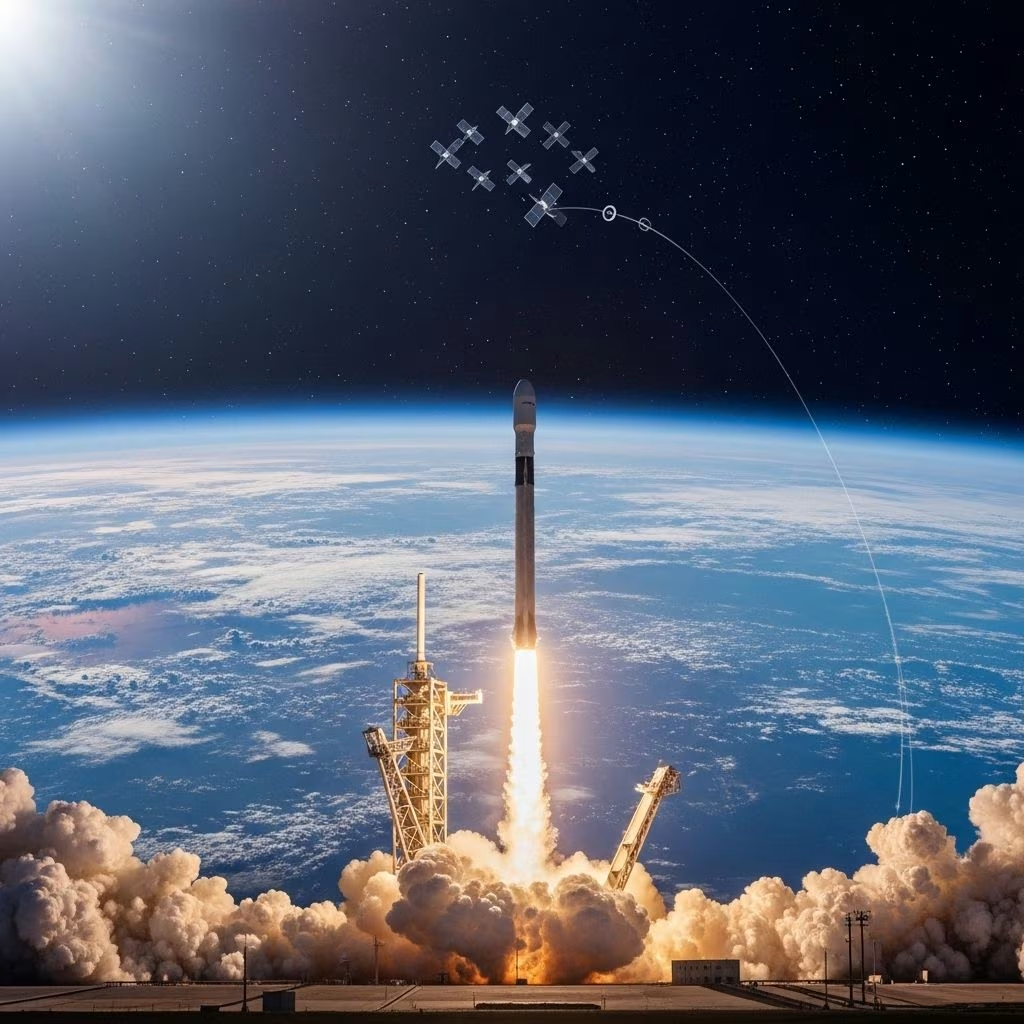
SpaceX: Charting the New Frontier in Space Exploration
Founded in 2002 by visionary entrepreneur Elon Musk, Space Exploration Technologies Corp—better known as SpaceX—has dramatically reshaped the landscape of global spaceflight. From pioneering reusable rockets to launching vast constellations of internet satellites, SpaceX’s story is one of ambition, innovation, and disruption. This article explores the company’s history, technological breakthroughs, major launches, ambitions for Mars, and the challenges ahead.
Overview and Mission
SpaceX is a private spacecraft manufacturer, launch provider, and satellite communications company headquartered in Hawthorne, California. Its primary mission is to reduce space transportation costs and ultimately enable the colonization of Mars. With over 559 successful launches and an expanding portfolio, SpaceX now stands among the world’s most influential space companies.
- Founded: 2002
- Founder and CEO: Elon Musk
- Headquarters: Hawthorne, California, USA
- Purpose: Lower cost of space transport, expand human presence beyond Earth
SpaceX’s Evolution: Key Milestones
From its inception, SpaceX has achieved a series of industry firsts that have reshaped the possibilities of spaceflight. The company’s trajectory is marked by steady progress, growing reliability, and bold innovation:
- First private entity to reach orbit (Falcon 1, 2008)
- First commercial spacecraft to visit the International Space Station (Dragon, 2012)
- First vertical rocket landing and re-use (Falcon 9, December 2015)
- Launch of the world’s largest commercial satellite constellation (Starlink, beginning 2019)
- Demo-2: First crewed launch by a commercial spacecraft to ISS (Crew Dragon, 2020)
- Development of Starship: Next-generation, fully reusable super-heavy launch system
Early Days and First Successes
SpaceX’s journey began with the modest Falcon 1, its first rocket. The company’s focus on creating a lower-cost, partially reusable vehicle resulted in multiple failures before achieving success. This persistence set the stage for subsequent developments.
Reusable Rockets: The Game Changer
SpaceX’s greatest impact arguably comes from its mastery of reusability. By landing and reusing Falcon rocket boosters, SpaceX slashed launch costs, increased launch cadence, and opened space access to a global market. Since 2010, SpaceX has launched nearly 500 Falcon 9 rockets with a success rate over 99%—and regularly recovers first stage boosters for reuse, sometimes completing three launches within 24 hours.
SpaceX Launch Vehicles: Falcon, Starship, and More
| Vehicle Name | Type | Purpose | Reusability | Status |
|---|---|---|---|---|
| Falcon 1 | Small lift | Initial launch vehicle, retired | No | Retired |
| Falcon 9 | Medium lift | Satellites, crew, cargo to orbit | Partial | Active |
| Falcon Heavy | Heavy lift | Large payloads to LEO/ISS & beyond | Partial | Active |
| Dragon | Crew/Cargo capsule | ISS delivery (cargo, crew) | Yes | Active |
| Starship | Super-heavy lift | Interplanetary, large payload, Mars initiative | Full | Development |
Falcon 9
Falcon 9 is SpaceX’s medium-lift, partially reusable workhorse. It launches satellites—including Starlink—supplies cargo and crew to the International Space Station (ISS), and offers commercial and national security launch services. The Falcon 9’s reliability and rapid turnaround energize the company’s aggressive launch schedule.
Falcon Heavy
As one of the most powerful operational rockets, Falcon Heavy can carry large payloads to low-Earth orbit and beyond. Its partial reusability and competitive pricing disrupt the heavy-lift launch market and make ambitious missions possible.
Starship: Next Generation Space Transport
Starship represents SpaceX’s grandest ambition—a fully reusable, super-heavy-lift vehicle designed to deliver people and cargo to Earth orbit, the Moon, Mars and beyond. Starship leverages advanced Raptor engines burning methane and oxygen, promising rapid turnaround. When operational, Starship is expected to lower costs dramatically and enable large-scale Mars settlement.
Launch Sites: Where SpaceX Reaches for the Stars
- Cape Canaveral Space Force Station: Historic U.S. site, key for military and NASA launches
- Kennedy Space Center: NASA’s iconic Florida launch site, home to Crew Dragon missions
- Starbase (Boca Chica, Texas): Test and development facility, hub for Starship launches
- Vandenberg Space Force Base: California site for polar and sun-synchronous launches
- Ronald Reagan Ballistic Missile Defense Test Site: Specialized launches and missile testing
Major SpaceX Missions and Accomplishments
Starlink: Global Internet from Space
SpaceX’s Starlink constellation aims to deliver affordable, high-speed internet to users worldwide, especially those in remote regions. To date, over 8,400 Starlink satellites have been launched, representing more than a third of all spacecraft ever launched. The network could eventually grow to 34,400 satellites—radically expanding internet access.
Crewed Spaceflight and National Security
SpaceX’s Crew Dragon program restored America’s ability to launch astronauts from U.S. soil in 2020. The company regularly performs crew rotation and cargo missions to the International Space Station, collaborating closely with NASA and the Space Force. SpaceX also supports national security launches using Falcon 9 and Falcon Heavy.
- May 2020: Demo-2 mission carried NASA astronauts to the ISS
- Falcon 9 and Heavy certified for National Security Space Launch (NSSL)
- Rapid booster recovery supports cost and schedule efficiency for government missions
Group Launches: Democratizing Space
Through Transporter and Bandwagon rideshare missions, SpaceX enables dozens or even hundreds of small satellites to be launched together. These launches have lofted 1,100+ satellites, lowering barriers for startups, universities, and other organizations to access space.
Starship and The Dream of Mars
Elon Musk’s vision for SpaceX centers on human expansion beyond Earth. Starship’s development aims to make interplanetary settlement practical and affordable. Musk has publicly stated his dream of landing one million people on Mars, creating a self-sustaining civilization, and taking the first steps toward a multi-planetary future.
- Starship is designed to launch frequently—up to three times per day
- Each Starship could deliver as much mass to orbit in a year as all launches since 1957
- First Florida launch from LC-39A anticipated in late 2025 (pending regulatory reviews)
Finances, Ownership, and the Path Forward
As a privately held company, SpaceX’s financial details are closely guarded. The Wall Street Journal reported a surge in value—SpaceX’s valuation increased from $12 billion in 2015 to $350 billion by the end of 2024, rivaling corporate giants like Oracle and Coca-Cola. Nevertheless, questions about profitability, sustainability, and financing interplanetary voyages persist.
- SpaceX is primarily owned by Elon Musk
- Shares are held by a small group of insiders and private investors; not publicly traded
- Financial transparency is limited—only major partners and insiders see full data
- Profitability remains unclear; Starlink’s commercial success could be crucial
Remaining private lets SpaceX avoid stock market pressures, but also keeps its finances a matter of speculation. Can its rapid pace, innovation, and ambition remain sustainable without broader investment and oversight?
Challenges and Controversies
- Technical hurdles: Developing fully reusable, safe, and ultra-large launch vehicles is complex and risky
- Financial opacity: Lack of public data about costs and profits prompts ongoing questions
- Regulatory issues: Launch site expansion and orbital clutter from Starlink raise environmental and policy concerns
- Competitive landscape: Rivals like Blue Origin, Rocket Lab, and traditional aerospace firms push SpaceX to keep innovating
- Ambitious Mars goals: Building infrastructure for human settlement remains speculative and massively expensive
FAQs: Understanding SpaceX’s Methods, Missions, and Ambitions
Q: What makes SpaceX’s rockets different?
A: SpaceX developed partially and fully reusable rockets, enabling lower launch costs and higher launch frequency compared to competitors.
Q: How does Starlink benefit the world?
A: Starlink expands global internet access, especially in underserved regions, and offers high-speed connectivity at competitive prices.
Q: Can anyone launch with SpaceX?
A: Yes, SpaceX offers rideshare missions that let startups, universities, and even private individuals launch payloads into orbit.
Q: What are SpaceX’s plans for Mars?
A: SpaceX is developing Starship for large-scale Mars shipments and human migration, with the goal of establishing a permanent colony.
Q: Who owns SpaceX?
A: SpaceX is privately owned, primarily by Elon Musk and select private investors. No public shares are available.
Q: What is the significance of reusable boosters?
A: Reusable boosters drastically reduce costs and environmental impacts, making space more accessible and launch schedules more flexible.
The Road Ahead: Toward a Multi-Planetary Civilization
As SpaceX continues to launch ever more missions, refine Starship, and drive the commercialization of space, its influence extends well beyond rockets and satellites. Its pioneering spirit encourages other companies, governments, and innovators to aim higher, move faster, and expand humanity’s horizons. The company’s greatest achievements may lie in the years— and decades—ahead, as the dream of Mars settlement moves closer from science fiction into reality.


