


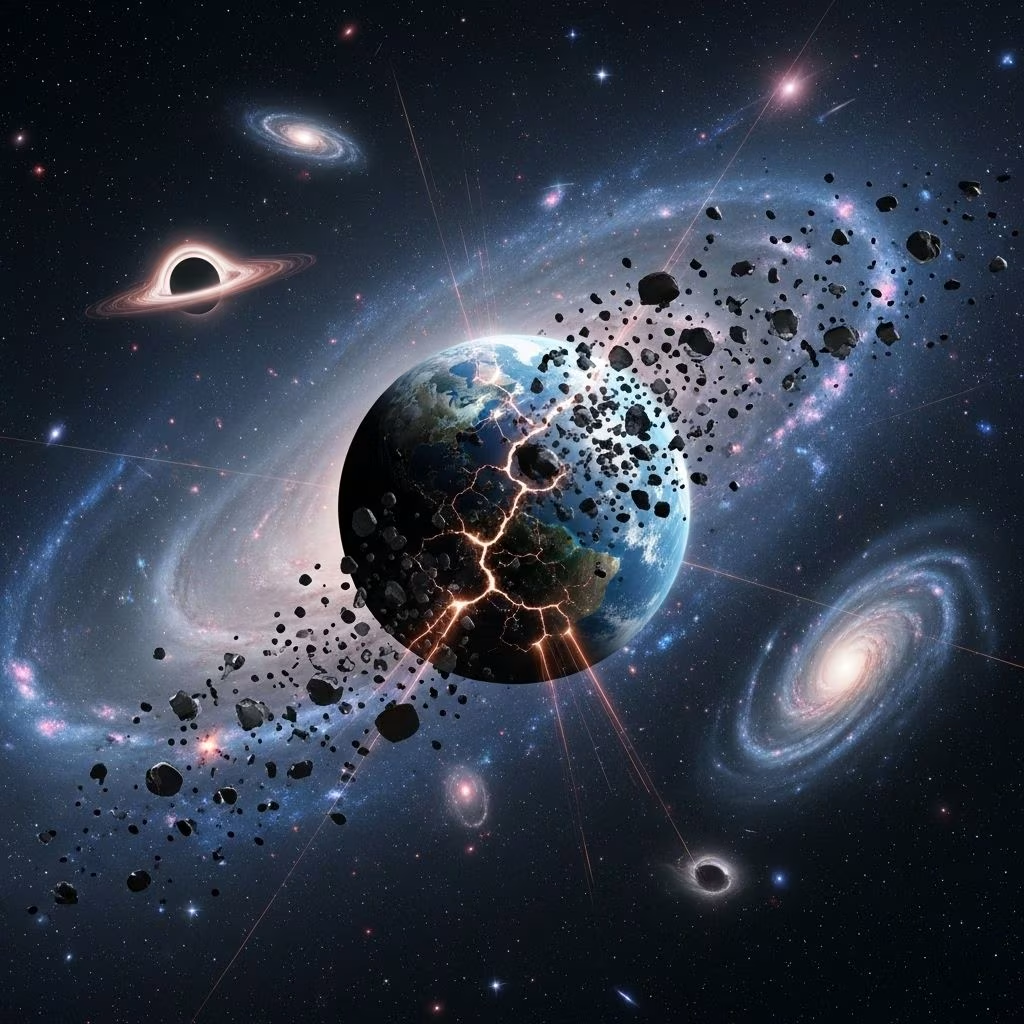
Scientists Calculate When the Universe Might End—and It’s Sooner Than Expected
For decades, the distant expiration date of the universe was considered a riddle with a solution so far in the future as to be almost irrelevant to our existence. However, new research spearheaded by theoretical astrophysicist Heino Falcke and colleagues has upended earlier projections, now suggesting that the cosmos could reach its demise far sooner than previously calculated.4
The Fate of the Universe: An Age-old Question
From ancient stargazers to modern cosmologists, the ultimate fate of the cosmos has been a source of profound wonder and speculation. Astrophysicists have long debated whether the universe will end with a bang (a contraction) or a whimper (eternal expansion to lifeless coldness). The most prominent ideas include:
- Big Freeze: Perpetual expansion leads all objects to grow so distant and cold that no thermodynamic work can be done.
- Big Crunch: Expansion eventually halts and reverses, ultimately collapsing the cosmos into a fiery singularity.
- Big Rip: Dark energy grows stronger, eventually tearing apart galaxies, stars, and even atoms.
Each theory’s plausibility hinges on how fast space is expanding and the still-enigmatic role of dark energy.2
Cosmic Timelines: Previous vs. New Calculations
Old estimates for the universe’s lifespan weren’t just long—they verged on being almost futile to comprehend. Some calculations put the end around 101,100 years from now—a figure so large it dwarfs the number of particles in the observable cosmos.
But in recent years, scientists have updated these models, incorporating advanced mathematics and data from major surveys. The latest study by Falcke’s group at Radboud University delivers a more refined—yet still astronomical—expiration date.
- Old estimate: 101,100 years
- New estimate: 1078 years
This suggests the universe may “die” nearly a googol years (10100) before previous expectations, yet still on timescales no human or star could survive to see.14
| Event | Previous Estimate | New Estimate |
|---|---|---|
| Universe End | 101,100 years | 1078 years |
| Stars Burn Out | ~1014 years | ~1014 years |
| Last Black Hole Evaporates | After 10100 years | After 1078 years |
“The ultimate end of the universe comes much sooner than expected, but fortunately it still takes a very long time,” explained Heino Falcke.4
The Science of Cosmic Decay: Hawking Radiation & Beyond
The heart of the new calculation lies in rethinking how objects like white dwarfs, neutron stars, and even black holes lose mass over time. The group focused on the process similar to Hawking radiation—where black holes emit energy and eventually evaporate over vast timescales.
- Stephen Hawking theorized in the 1970s that black holes are not eternal but slowly lose mass by emitting particles, a process now confirmed as Hawking radiation.
- The new study extends this process to other dense remnant objects—the glowing cores left behind after stars explode. Over unimaginable timescales, these celestial embers will fade, too.
The key leap in the new research is calculating how fast these “stellar corpses” lose their energy and disappear, driving a faster timeline for the universe’s demise.5
How Hawking Radiation Sets the Timeline
- Black holes shrink and vanish in bursts of high-energy radiation over trillions upon trillions of years.
- Neutron stars and white dwarfs, though not traditionally thought to evaporate, also undergo a similar but slower process. Eventually, all remnants of stars fade away.
- This ultimate dimming of the cosmos is what now defines the final epoch: the Era of Darkness, when not even black holes remain.
The Puzzles of Dark Energy and the Universe’s Expansion
Predicting when the universe ends also depends on the cosmological constant—a term in Einstein’s equations thought to describe the mysterious dark energy accelerating cosmic expansion. However, the true nature of dark energy remains unknown.
- Some models hypothesize dark energy is made up of axions, ultra-light particles that may give clues to universal fate.2
- If these models are correct, the universe could ultimately stop expanding and begin to contract, culminating in a “Big Crunch.”
- Other possibilities remain, depending on whether dark energy is stable, constant, or varies over time.
“Whatever the nature of dark energy is, it will shape the future of our universe,” says Michael Levi, an expert on cosmic surveys.3
What Happens to Stars, Planets, and Remnants?
In the grand arc of cosmic time, all familiar structures fade:
- Stars will exhaust their nuclear fuel and wind down, leaving behind white dwarfs and neutron stars.
- Planets will orbit cold, dark embers or be flung into interstellar depths.
- Galaxies will slowly dissolve as stars die, and their remains drift apart as space itself expands.
- Black holes—the last significant structures—will eventually evaporate entirely via Hawking radiation.
- When all of this matter is gone, the universe fades to black.
Despite the accelerated timeline, the end is still vastly remote and far beyond the scale of biological or planetary ages.
Why These New Findings Matter
Although 1078 years is still an incomprehensible duration, reducing the cosmic lifespan by a factor of hundreds of orders of magnitude fundamentally reshapes our picture of eternity. This new work illustrates:
- How cosmic fate can shift dramatically as scientific models and observations advance.
- That even the most “eternal” aspects of the universe are subject to change and decay.
- An ongoing need to understand core forces such as dark energy and the true behavior of space-time itself.
Ultimately, while humanity won’t be around to witness the end, this research deepens the great existential and philosophical questions of physics: What is the universe’s fate? What, if anything, follows its darkness?
Frequently Asked Questions (FAQ)
Q: Should we worry about the end of the universe?
A: No. The end date, even in the new calculation, is so distant—1078 years from now—that it is far beyond any practical or biological time frame.1
Q: What is Hawking radiation and why does it matter?
A: Hawking radiation is a process by which black holes (and now thought, all dense stellar remnants) lose mass over time by emitting particles. Understanding this process enables physicists to estimate when the last vestiges of matter disappear from the cosmos.5
Q: Is the universe going to collapse or freeze?
A: The fate of the universe depends on the properties of dark energy. If dark energy weakens or reverses, a “Big Crunch” (collapse) could occur. If it remains constant or strengthens, a “Big Freeze” (heat death) or even a “Big Rip” (tear-apart) may happen. Current estimates vary between scenarios.2
Q: How are these estimations made?
A: Cosmologists use a combination of theoretical physics, astronomical surveys, and mathematical models. For the new estimate, Falcke and colleagues incorporated updated data and refined their calculations using quantum theory and observations of cosmic remnants.45
Q: Will future discoveries change this timeline again?
A: Almost certainly. As our understanding of fundamental forces and cosmic observations improve, the timeline for the universe’s end may be revised again. New discoveries about dark energy, black hole evaporation, or even completely novel phenomena could alter our expectations.2
Key Takeaways
- The universe’s lifespan may be dramatically shorter than prior estimates—”only” 1078 years before total decay, compared to past guesses of 101,100 years.
- Revised models include new thinking about Hawking radiation’s impact on all compact objects, not just black holes.
- The fate of the cosmos is intimately linked to the still-mysterious nature of dark energy.
- Space as we know it will persist on timeframes vastly longer than all stars, planets, and life, but even the “eternal” universe is finite.
Explore Further
- Cosmic Destiny: What might be beyond the end of our universe? Philosophers and physicists debate whether another universe could emerge from the ashes of this one.
- Astronomical Frontiers: Surveys like the Dark Energy Survey (DES) and Dark Energy Spectroscopic Instrument (DESI) will further clarify the role of dark energy and the fate of all things cosmic.
References
- https://www.usatoday.com/story/news/world/2025/05/13/when-is-the-universe-ending/83606463007/
- https://www.livescience.com/space/cosmology/the-universe-may-start-dying-in-just-10-billion-years-alarming-new-model-predicts
- https://www.unilad.com/technology/space/when-will-big-crunch-end-universe-501229-20250720
- https://www.space.com/astronomy/scientists-calculate-when-the-universe-will-end-its-sooner-than-expected
- https://www.sciencedaily.com/releases/2025/05/250512105214.htm
- https://scitechdaily.com/new-research-reveals-that-the-universe-could-end-way-sooner-than-we-thought/
- https://phys.org/news/2025-05-universe-decay-years-sooner-previously.html
- https://studyfinds.org/scientists-calculate-earlier-end-to-universe/
- https://www.popularmechanics.com/space/a64782043/end-of-the-universe/


