


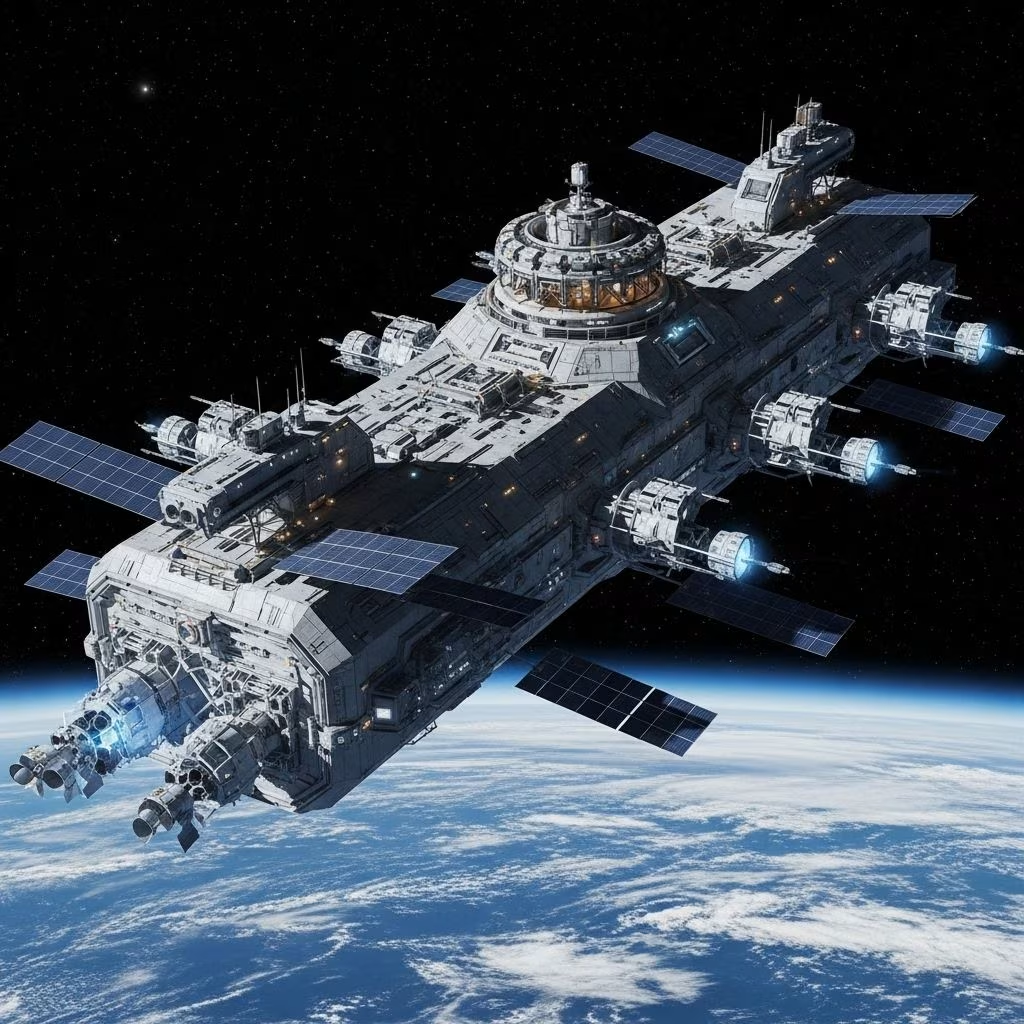
US Space Force Eyes an ‘Orbital Carrier’ to Revolutionize Spacecraft Deployment
The US Space Force is investing in the development of a groundbreaking ‘Orbital Carrier’ spacecraft, designed to function as an in-space launch pad for satellites and other maneuverable vehicles. This ambitious initiative, led by private company Gravitics with up to $60 million in SpaceWERX funding, aims to grant the military unmatched responsiveness and flexibility in rapidly deploying assets to Earth orbit during emergent threats or operational requirements.
Background: The Race for Space Superiority
Since its formation in 2019, the US Space Force has worked to address growing national security concerns in Earth orbit. The emergence of advanced counter-space capabilities by rival nations, including reported “dogfighting in space” exercises by China and Russia, has accelerated the push for new technologies that can assert and preserve American space superiority.
General Chance Saltzman, the Space Force’s chief, recently emphasized the urgency of these developments, stating, “Space superiority is our prime imperative… and we do not yet have the service we need.” Existing launch and response strategies can be too slow and costly to ensure that the US retains a competitive edge in rapidly evolving orbital environments.
The Orbital Carrier: Concept and Design
The Orbital Carrier is envisioned as a large, maneuverable spacecraft that acts as a mothership or space-based aircraft carrier. Stationed in Earth orbit, it will be capable of carrying and deploying multiple smaller spacecraft and satellites as operational needs dictate.
- Designer: Gravitics, Inc., a Seattle-based space infrastructure company.
- Funding: Up to $60 million through SpaceWERX, the Space Force’s technology innovation division.
- Key Features: Room for various maneuverable satellites, modular delivery of additional vehicles, pre-positioned in orbit for immediate mission deployment.
Colin Doughan, Gravitics CEO, described the carrier as a “game-changer… acting as a pre-positioned launch pad in space” and allowing mission planners to select deployment orbits on demand.
Role and Purpose of the Orbital Carrier
The primary function of the Orbital Carrier is to serve as a pre-positioned, in-space launch platform. This would enable the Space Force to quickly deploy satellites and other spacecraft for a variety of missions, including:
- Responding to on-orbit threats against US assets or commercial satellites
- Rapidly replacing or augmenting existing satellite constellations after anti-satellite attacks or unexpected failures
- Conducting surveillance, reconnaissance, and other defense missions where speed and positioning are essential
Because it bypasses the time and complexity of ground-based launches, the Orbital Carrier could enable responses measured in hours instead of days or weeks.
Deployment, Flexibility, and Rapid Response
Conventional satellite deployments require meticulous planning, preparation, and expensive launches atop rockets from terrestrial facilities. This process is not only time-consuming—often measured in months or years—but is also subject to launch scheduling delays and potential geopolitical vulnerabilities.
By contrast, the orbital carrier model promises:
- Agility: Satellites and other vehicles are pre-positioned, ready for near-instant deployment
- Reduced reaction times: Enables military, intelligence, or commercial missions to adapt to threats far more quickly than ground launches allow
- On-demand orbit selection: Launch from space lets mission planners deploy payloads into a wide range of orbits without needing to wait for suitable ground-based launch windows
- Lower operational risk: Reduces dependence on vulnerable terrestrial infrastructure that could be targeted in a conflict
As Gravitics outlined, “This carrier will provide the US Space Force with unprecedented flexibility and speed for in-space operations, significantly enhancing the nation’s space defense posture.”
Table: Ground-Based Launch vs. Orbital Carrier Deployment
| Aspect | Ground-Based Launch | Orbital Carrier Deployment |
|---|---|---|
| Reaction Time | Weeks to months | Hours to days |
| Flexibility | Limited by launch windows | On-demand, variety of orbits |
| Cost | High per launch | High up-front, lower recurring |
| Operational Risk | Exposed ground facilities | Reduced reliance on ground infrastructure |
| Sustainability | New launch needed for each mission | Multiple missions from one carrier |
Strategic Use: Defensive and Offensive Potential
The Orbital Carrier will become a cornerstone of a more responsive, resilient space defense strategy. Its versatility enables both defensive and offensive mission profiles:
- Defensive use: Quickly replace satellites damaged in attacks, deploy decoy or countermeasure satellites, or maintain surveillance coverage during crises.
- Offensive capacity: Enable the Space Force to outmaneuver adversaries, potentially deploying assets for electronic warfare, anti-satellite operations, or jamming simulations.
- Space superiority: Maintain a ready reserve of satellites to ensure continuous data, communication, navigation, and intelligence—even during hostile action.
Commentary by Space Force Generals and analysts point to increasing worry over the sophistication of foreign space capabilities, including simulated on-orbit combat, satellite targeting exercises, and electronic jamming.
Development, Industry Collaboration, and Challenges
The US Space Force’s decision to fund the Orbital Carrier through SpaceWERX highlights a broader trend toward defense collaboration with private industry. Gravitics was chosen for its expertise in space infrastructure and the technical ambition of its carrier proposal.
- Partnership structure: Gravitics leads engineering and construction, guided by military requirements and Space Force feedback.
- Funding: Up to $60 million in direct support for the project’s development phase, with potential for future contracts if the demonstration is successful.
- Logistical challenges: The carrier, potentially as large or larger than existing space stations, will require modular assembly—likely through a series of launches delivering components to Earth orbit, akin to how the International Space Station was built.
- Supply and resupply: Spacecraft intended for later deployment from the carrier will need to be delivered to its orbit by dedicated launches, creating new logistical pathways for military operations in space.
- Operational hurdles: Reliability, self-sufficiency, security, and maintenance in the harsh environment of space are ongoing design and engineering concerns.
Despite these challenges, the vision is clear: reposition national defense from reactive, ground-based responses to preemptive, in-orbit readiness.
Future Opportunities and Evolution
Once operational, the Orbital Carrier could open the door to new concepts of space infrastructure and defense:
- Enable routine resupply and refurbishment, turning the carrier into a permanent asset in space defense
- Possibility for allied nations to utilize carrier services for rapid satellite deployment, expanding coalition capabilities
- Foster a new industry sector specializing in “spaceport services” entirely decoupled from Earth-based launch infrastructures
- Advance modular and autonomous systems for assembling, operating, and refitting carriers in orbit
- Potential for dual-use: commercial rapid deployment of satellites or scientific instruments, as well as purely military operations
Frequently Asked Questions (FAQs)
Q: What is the US Space Force’s Orbital Carrier?
A: It’s a large space platform, being developed by Gravitics and funded by the US Space Force, designed to act as a mothership for rapid-launch of satellites directly from orbit.
Q: Why is an orbital carrier needed instead of normal rocket launches?
A: Ground-based launches are expensive, delayed by weather and logistics, and slower to respond to sudden threats; an orbital carrier allows for near-instant deployment of on-board satellites in case of emergencies.
Q: How large will the Orbital Carrier be?
A: Detailed designs are still under development, but the carrier will need to be at least as large as today’s space station modules, with capacity to dock and store multiple satellites and vehicles.
Q: Who is building the Orbital Carrier?
A: Gravitics, a private space infrastructure startup based in Seattle, is leading the design and construction under a US Space Force contract.
Q: Is this carrier for offensive or defensive operations?
A: It is designed for both: offering faster defensive responses to orbital threats, as well as the potential to deploy satellites for offensive electronic warfare or preemptive operations if needed.
Q: What’s the timeline for deployment?
A: No fixed launch date has been announced, but the phased approach—testing, modular assembly, and gradual deployment—means years of development lie ahead before operational missions begin.
Q: Could this technology be used by countries other than the US?
A: While the current program is strictly American, future collaborations or allied deployments are plausible as the technology becomes proven and operationally valuable.
References
- https://nationalsecurityjournal.org/orbital-aircraft-carriers-could-be-the-u-s-militarys-next-super-weapon/
- https://www.skyatnightmagazine.com/news/us-space-force-orbital-carrier
- https://www.space.com/us-space-force-orbital-carrier-spacecraft-launch-pad-in-space
- https://www.energy-reporters.com/news/60-million-orbital-platform-us-space-force-and-gravitics-develop-aircraft-carrier-that-launches-satellites-directly-from-earths-orbit/
- https://www.gravitics.com/news/orbital-carriers-stratfi


