


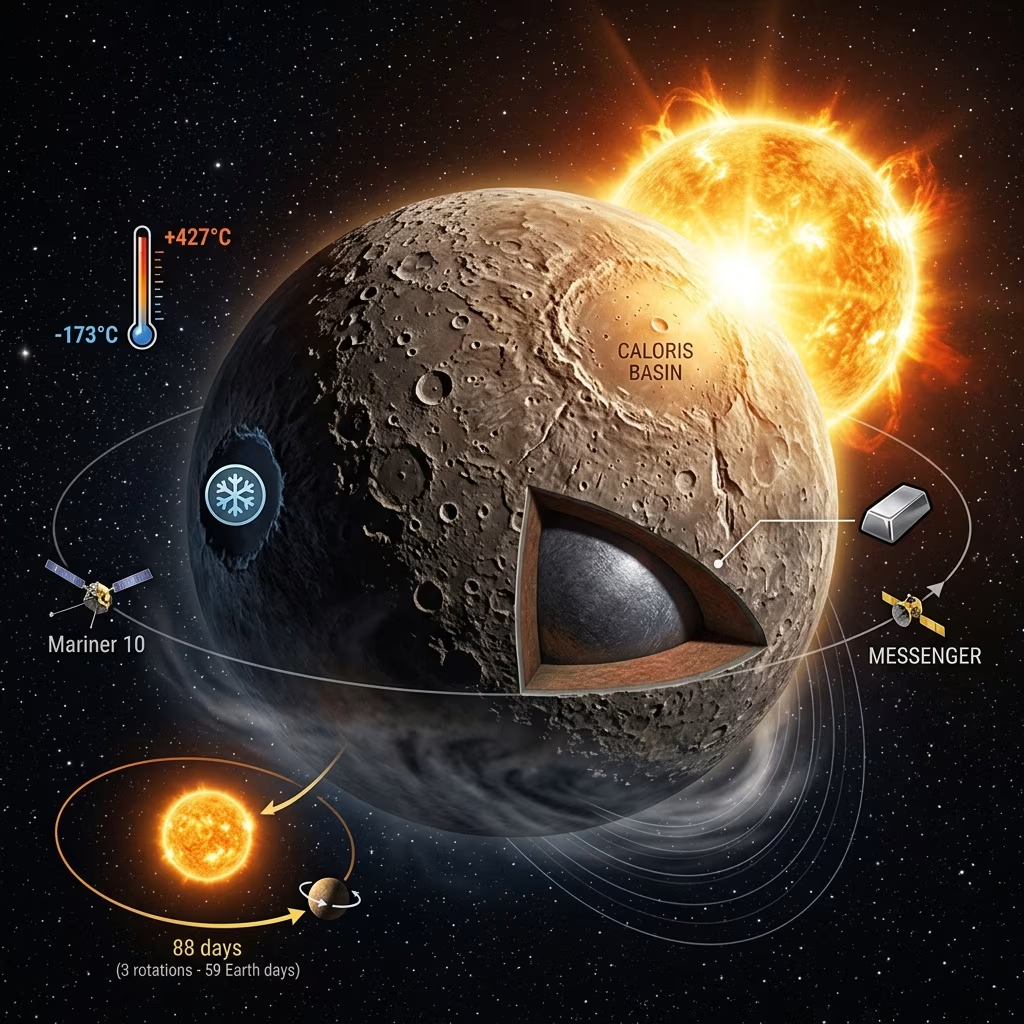
Mercury, the closest planet to the Sun, has long captured the imagination of astronomers and curious minds alike. Though it’s small and difficult to observe from Earth, recent missions and new discoveries have revealed a planet full of unexpected features, from its wild temperature extremes to bizarre flashes of sodium, massive impact scars, and dynamic magnetic phenomena. Here, we explore 10 of the weirdest and most intriguing facts that make Mercury one of the solar system’s most unique worlds.
Mercury’s Biggest Surprises at a Glance
- Mercury boasts the largest temperature fluctuations in the solar system.
- It is the smallest planet but has a gigantic iron core.
- Mercury survived a cataclysmic asteroid impact.
- Its orbit and rotation are truly bizarre.
- Despite immense heat, ice persists at its poles.
- Mercury features powerful magnetic tornadoes and comet-like tails.
- It has the thinnest atmosphere among all planets.
- NASA’s missions have mapped its entire surface.
1. The Largest Temperature Fluctuations in the Solar System
Mercury experiences extreme temperature swings more drastic than any other planet. Its proximity to the Sun means daytime surface temperatures soar up to 430°C (800°F), while at night, the lack of a substantial atmosphere causes these temperatures to plummet to -180°C (-290°F). In other words, Mercury’s surface endures a temperature change of over 600°C between day and night. This double-edged thermal reality is due to both slow rotation (a single day on Mercury is nearly 59 Earth days) and a barely-there atmosphere incapable of trapping warmth.
2. The Smallest Planet in the Solar System
After Pluto’s reclassification, Mercury is the smallest planet in the solar system. It measures just 4,879 kilometers (3,032 miles) in diameter, making it only slightly larger than our Moon. Despite its diminutive size—about 38% the diameter of Earth—Mercury’s mass and internal density make it surprisingly robust compared to its neighbors.
3. A Giant Asteroid Impact Survivor
One of Mercury’s most distinctive landmarks is the Caloris Basin, a colossal impact crater nearly 1,550 kilometers (960 miles) in diameter—among the largest in the solar system. This massive scar, caused by a cataclysmic collision with an asteroid early in Mercury’s history, nearly reshaped the planet. Shockwaves from the impact were so powerful that they created chaotic terrain directly opposite the basin’s location on the planet.
Such a violent history isn’t limited to Caloris Basin. Mercury’s surface is riddled with countless craters, valleys, and giant cliffs called lobate scarps, evidence of an active and dramatic geological past. Some cliffs are thought to have formed as the planet cooled and contracted over billions of years, wrinkling its surface like the skin of an aging apple.
4. A Bizarre Orbit
Mercury’s orbit and rotation are unlike anything else in our solar system. It orbits the Sun every 88 Earth days—the shortest year of any planet. However, its day (one full rotation) takes nearly 59 Earth days. Even stranger, because of the way its rotation and orbit synchronize, the Sun appears to pause, reverse direction, and resume its path from the surface during a Mercurian day.
| Characteristic | Mercury | Earth |
|---|---|---|
| Orbit Period (1 year) | 88 days | 365 days |
| Day Length (rotation) | 59 days | 1 day |
This strange orbital effect means that on Mercury, there are only about 1.5 days per year—that is, it rotates three times for every two orbits around the Sun.
5. Surface Ice Located Near the Poles
Despite its proximity to the Sun and scorching daytime heat, Mercury harbors water ice in permanently shadowed craters at its poles. These regions never receive sunlight due to the planet’s slight tilt (just about 0.03 degrees), keeping them frigid enough to preserve ice for millions of years. Scientists believe the ice arrived on comets or asteroids that crashed into the planet. This surprising discovery was confirmed by radar imaging and later MESSENGER spacecraft data.
Radar-bright deposits—consistent with water ice—are found inside craters in the polar regions, shielded from the Sun’s relentless heat and preserved as a geological time capsule on Mercury’s surface.
6. Mercury Possesses an Enormous Iron Core
Proportionally, Mercury has the biggest metallic core in the solar system. Its iron core occupies about 85% of its radius, which is enormous compared to the tiny mantles and crusts wrapped around it. This immense core contributes to Mercury being the second densest planet in our solar system, after Earth. Scientists believe that a giant impact may have blown away much of Mercury’s lighter, outer material billions of years ago, leaving behind the dense metal-rich body we see today.
7. Its Entire Surface Has Been Mapped
For centuries, Mercury’s remote and Sun-drenched location kept its features mysterious. Recent decades, however, have changed everything. NASA’s MESSENGER probe (Mercury Surface, Space Environment, Geochemistry, and Ranging) orbited the planet for over four years, transmitting close-up images and collecting vital data from 2011 to 2015. For the first time in history, scientists mapped Mercury’s entire sun-blasted surface in rich detail, unlocking countless geological secrets and revealing its landscape of ancient craters, volcanic plains, steep cliffs, and odd hollows formed by lost volatile materials.
8. Mercury Has the Thinnest Atmosphere in the Solar System
Mercury’s “atmosphere”—more properly called an exosphere—is the most tenuous of all planets. It is so barely-there that even the molecules making it up rarely collide. Mercury’s exosphere consists mainly of oxygen, sodium, hydrogen, helium, and potassium. It provides no significant greenhouse effect or protection from solar radiation, which explains the planet’s volatile temperature swings and eroded, battered surface.
The constant stripping away of its thin exosphere by the Sun’s solar wind means Mercury is continually losing atoms but also replenishing them, especially from the planet’s surface and during meteorite impacts.
9. Weird ‘Tails’ Stream Off Mercury Like a Comet
Another oddity: Mercury sometimes sports a visible tail like a comet. Long-exposure telescopic images reveal that sunlight striking Mercury excites and ejects sodium atoms from its surface. Solar radiation pressure then pushes these glowing atoms away from the planet, creating a shimmering “tail” that can stretch for millions of kilometers in the anti-sunward direction. This peculiar phenomenon, discovered by Earth-based astronomers, remains a focus of research on how Mercury interacts with space weather.
10. Magnetic Tornadoes: Stunning Interactions With the Sun
Incredibly, Mercury also exhibits magnetic tornadoes—intense twisters of magnetic energy formed as the solar wind’s magnetic field briefly links with Mercury’s own. This creates powerful funnels filled with charged particles, swirling from space and slamming directly into the planet’s surface. Mercury’s magnetic field is weak (about 1% of Earth’s) but still effective enough to produce these dynamic storms despite its tiny size.
These magnetic tornadoes, discovered by the MESSENGER mission, highlight just how complicated—and surprisingly active—Mercury’s environment really is, even without a thick atmosphere or the protective magnetosphere we enjoy on Earth.
Mercury in Ancient and Modern History
Mercury is visible without a telescope and known to humans for millennia. The Sumerians mentioned it as early as the 2nd millennium BC, and the Babylonians called it Nabu. The Romans named it Mercury after their fleet-footed messenger god, a reference to the planet’s rapid passage across the sky. Galileo Galilei was the first to observe it through a telescope in the early 17th century. Since then, space missions such as NASA’s Mariner 10 and MESSENGER have dramatically expanded our understanding. In the near future, the European-Japanese BepiColombo mission will continue the exploration.
Remarkable Surface Features
- Lobate Scarps: Gigantic curved cliffs formed as Mercury’s core shrank and the crust buckled.
- Great Valley: The longest valley (about 1,000 km) on any planet.
- Hollows: Mysterious pits possibly created by the vaporization of surface materials.
- Craters Named for Artists: Many craters bear the names of famous figures like Shakespeare, Bach, and Joplin.
Comparison Table: Mercury vs. Earth
| Feature | Mercury | Earth |
|---|---|---|
| Distance from Sun | Approx. 57.9 million km | Approx. 149.6 million km |
| Diameter | 4,879 km | 12,742 km |
| Surface Gravity | 0.38 g | 1 g |
| Year (Orbit Period) | 88 days | 365 days |
| Atmosphere | Exosphere (very thin) | Thick nitrogen-oxygen |
| Moons | None | One (the Moon) |
| Magnetic Field | Weak | Strong |
Frequently Asked Questions (FAQs) About Mercury
Q: Why does Mercury have such extreme temperature swings?
A: Mercury’s lack of a substantial atmosphere allows surface heat to dissipate rapidly at night, resulting in massive differences between daytime and nighttime temperatures.
Q: How do scientists know there’s ice on Mercury?
A: Ice was first detected by Earth-based radar, then confirmed by NASA’s MESSENGER spacecraft, which used neutron spectrometers and imagers to spot reflective deposits in permanently shadowed craters at the poles.
Q: What causes Mercury’s comet-like tail?
A: The Sun’s ultraviolet light excites sodium atoms on Mercury’s surface, ejecting them into space. Solar pressure then pushes these glowing particles into a tail millions of kilometers long, visible in specialized telescopes.
Q: Does Mercury have any moons or rings?
A: No. Mercury is one of only two planets (along with Venus) that does not have any natural moons or ring systems.
Q: How does Mercury generate its magnetic field?
A: Scientists theorize that Mercury’s weak magnetic field is due to a partially molten iron core moving inside the planet, creating a dynamo effect, though this is still an active area of research.
Conclusion: Mercury Remains a Planetary Mystery
Mercury’s small size belies its fascinating complexity. As technology and exploration advance—with upcoming missions like BepiColombo—we continue to uncover new mysteries about this innermost world. Its unique blend of ancient scars, active exosphere, icy craters, and dynamic magnetic storms ensures that Mercury will remain an astronomical enigma for generations to come.
References
- https://www.space.com/27013-strange-mercury-facts-photos.html
- https://www.youtube.com/watch?v=Oivp_sUr9ko
- https://science.nasa.gov/mercury/facts/
- https://www.space.com/36-mercury-the-suns-closest-planetary-neighbor.html
- https://listverse.com/2024/02/13/10-strange-facts-about-the-planet-mercury/
- https://en.wikipedia.org/wiki/Mercury_(planet)
- https://www.astrogirl-au.com/post/facts-about-mercury
- https://www.rocketstem.org/2020/03/26/mercury-facts-questions-history/
- https://www.youtube.com/watch?v=SBU70yNao6I
- https://space-facts.com/mercury/
- https://www.astronomy.com/science/weird-object-mercury/
- https://www.nhm.ac.uk/discover/planet-mercury.html
- https://www.skyatnightmagazine.com/space-science/guide-to-the-planets-mercury
- https://www.britannica.com/place/Mercury-planet
- https://www.funkidslive.com/learn/top-10-facts/top-10-facts-about-mercury/
- https://www.planetary.org/worlds/mercury
- https://www.livescience.com/14675-greatest-mysteries-mercury-space.html
- https://10linesabout.com/10-facts-about-mercury/


