


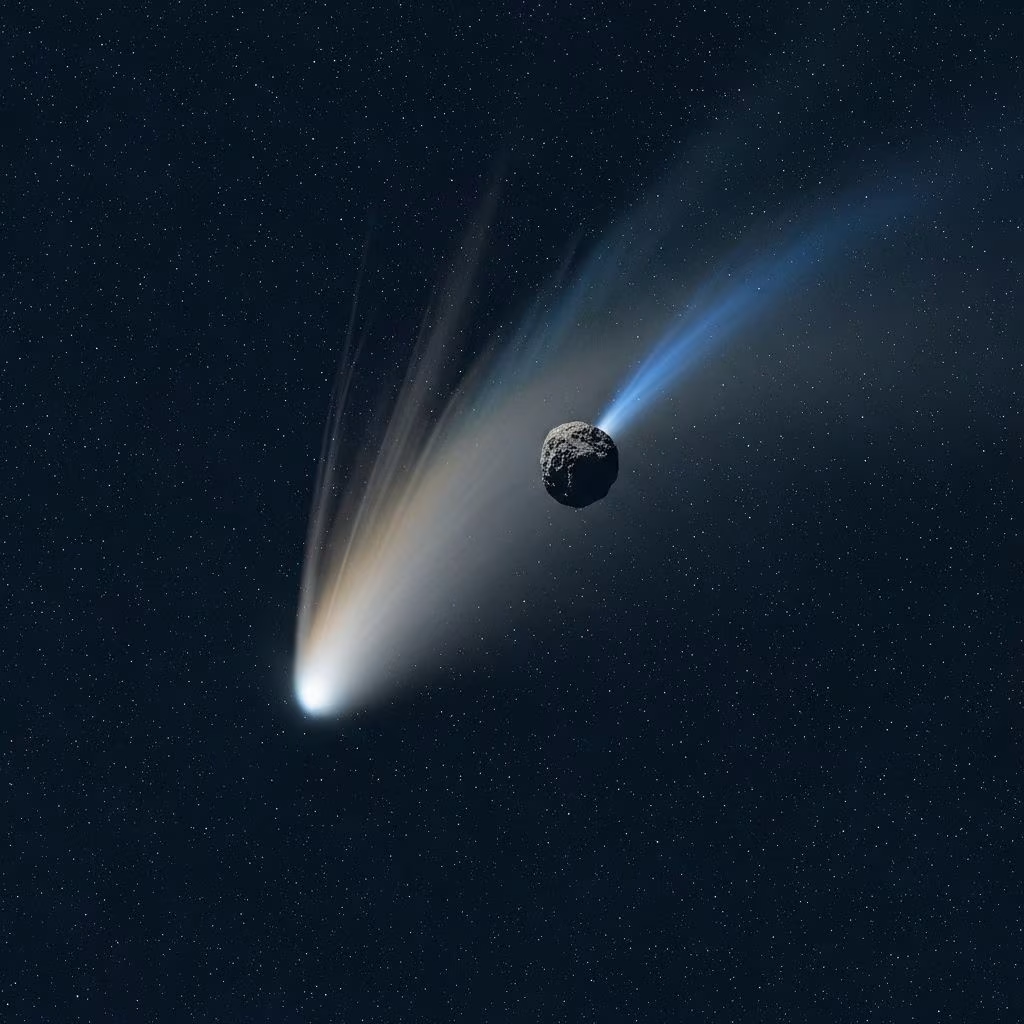
Halley’s Comet: The Solar System’s Most Famous Visitor
For centuries, Halley’s Comet has captured the imagination of sky-watchers, astronomers, and the general public alike. As the most celebrated periodic comet, it stands out not just for its brilliant appearances in the night sky but also for its pivotal role in shaping our understanding of the solar system. This article offers a comprehensive look at Halley’s Comet: its history, orbital behavior, physical structure, scientific investigations, and lasting legacy in both astronomy and human culture.
What Is Halley’s Comet?
Halley’s Comet, officially designated as 1P/Halley, is a short-period comet distinguished by its visibility to the naked eye from Earth during its recurring returns every 75–76 years . It is the only known comet with such a predictable pattern that is bright enough for mass observation without telescopes. The comet’s international fame and historical continuity make it a unique celestial object that bridges the worlds of ancient myth and modern science.
Key Facts About Halley’s Comet
- Orbital Period: About 75–76 years per journey around the Sun
- Last Perihelion (closest approach): 1986
- Next Perihelion: Expected in 2061
- Diameter: Roughly 11 kilometers (6.8 miles)
- Comet Type: Short-period (returns in less than 200 years)
- Variable Appearance: Brightness and visibility can differ with each return
The Historical Mystery of Halley’s Comet
For most of recorded history, comets were considered unpredictable, one-time visitors. Ancient observers—ranging from Chinese astronomers in 240 BC to medieval Europeans—documented striking appearances but did not realize these sightings marked the return of the same object .
Edmond Halley’s Discovery
In 1705, English astronomer Edmond Halley used newly developed Newtonian physics to analyze historical comet records. He noted striking orbital similarities among comets seen in 1531, 1607, and 1682, hypothesizing they were recurrent visits by the same comet. Halley boldly predicted the comet’s return for 1758—an event that, upon fulfillment (after his death), revolutionized the understanding of comets .
This was the first time a comet was recognized as a periodic visitor, fundamentally demonstrating that comets are not mere atmospheric anomalies but celestial bodies orbiting the Sun, bound by the same gravitational laws as planets.
- First Known Periodic Comet: Halley’s recognition established the concept of periodic comets, leading to subsequent discoveries of similar objects.
- Named in His Honor: The comet was officially named ‘Halley’s Comet’ in recognition of his groundbreaking prediction.
Historic Sightings Across the Centuries
With its orbit traced back through millennia, Halley’s Comet appears in diverse historical sources:
- Chinese records date back to 240 BC.
- The comet appears in the Bayeux Tapestry, documenting the events surrounding the 1066 Norman conquest of England.
- References in medieval European chronicles and artwork, with each return interpreted as an omen or portent.
As modern astronomy began to flourish, new generations of scientists and the public would anticipate the comet’s return, associating its appearance with major cultural and scientific milestones.
Table: Historic Apparitions of Halley’s Comet
| Year of Return | Historical Context |
|---|---|
| 240 BC | Earliest recorded sighting in Chinese annals |
| 1066 AD | Bayeux Tapestry; associated with Norman Conquest |
| 1301 AD | Appeared in Giotto’s fresco “Adoration of the Magi” |
| 1910 AD | Mass public anticipation; scientific observation; media sensation |
| 1986 AD | First spacecraft encounters; international scientific campaign |
| 2061 AD (expected) | Next predicted perihelion |
Understanding Halley’s Orbit
Halley’s Comet travels along a highly elliptical orbit that periodically brings it close to the Sun before sending it far beyond Neptune—an odyssey that stretches across the entire solar system . The comet’s orbital characteristics are pivotal to its unique observation frequency and pattern.
Key Orbital Features
- Orbital Period: 75–76 years (typical but can range between 72 and 80 years due to gravitational effects from planets)
- Aphelion: Farther than Neptune; reaches the farthest point from the Sun before beginning its journey back toward the inner solar system
- Perihelion: Comes closest to the Sun and Earth—this is when it is most visible
The changing position of Earth and the comet during perihelion means each appearance looks a little different, with varying levels of brightness and visibility that have been recorded for over two millennia.
Scientific Investigation: Spacecraft Encounters
The 1986 apparition marked a new era in cometary science. An international fleet of spacecraft was dispatched to study Halley up close, yielding invaluable scientific results :
- ESA’s Giotto Mission: Provided the first detailed images of a comet nucleus and close-up observations of the surface structure.
- Vega 1 & Vega 2 (Soviet): Supplied data on the comet’s dimensions, shape, temperature, and surface features.
- Japan’s Suisei and Sakigake: Contributed to study the comet’s environment and plasma tail.
- ISEE-3/ICE and NASA’s Pioneer Probes: Helped monitor the solar wind interaction and supplied further contextual data.
These missions redefined our understanding of comets, transforming them from mysterious apparitions to concrete, scientifically understood members of the solar family.
The Structure and Composition of Halley’s Comet
Observations by spacecraft provided the first granular look at a comet nucleus. Halley’s core is a roughly peanut-shaped conglomerate of rock, dust, and ice, confirming the “dirty snowball” hypothesis formulated by astronomer Fred Whipple .
Main Structural & Physical Properties
- Nucleus: Approximately 11 km long, 8 km wide, and 8 km thick; low density (about 0.55 g/cm³) suggesting a porous “rubble pile” structure
- Rotation Period: Complex, possibly around 7.4 days but with irregularities due to the nucleus shape and jets
- Surface: Rugged with hills, depressions, craters, and active jets releasing gases and dust
- Material: Mixture of volatile ices (water, carbon dioxide, ammonia), organic compounds, and mineral dust—icy regions are seen only on some surface patches
When Halley nears the Sun, these volatile ices sublimate (turn straight to gas), creating the iconic glowing coma and the spectacular tails that can stretch millions of kilometers.
Coma and Tail Formation
- The coma is a vast, visible envelope of gas and dust surrounding the nucleus, often growing to enormous size as Halley approaches the Sun.
- The dust tail is formed as solar radiation pushes solid particles away from the coma.
- The ion/gas tail develops as solar wind drags ionized gases away, often pointing directly away from the Sun.
Complex solar activity can cause Halley’s tail to break off and reform in phenomena known as tail disconnection events.
The Life Cycle of Halley’s Comet
Each circuit around the Sun strips Halley’s surface of a thin layer of material. This ongoing erosion—estimated at up to 1–3 meters per orbit—gradually reduces the comet’s size and brightness . Scientists estimate that periodic comets like Halley can survive about 1,000 total orbits before their reserves of volatile ices are exhausted.
- When its volatile content is depleted, Halley will cease to display a bright coma and tails, eventually becoming an inert mass of dust and rock or dispersing completely into dust.
- Despite its estimated age (16,000 years in its current orbit), Halley has not shown significant signs of fading in recent centuries.
Societal and Cultural Impact
Few celestial objects have exerted as strong an influence on culture, science, and the public as Halley’s Comet:
- Historic Omens: In pre-modern eras, its arrival was interpreted as a harbinger of disaster or great change.
- Art and Literature: Featured in famous works, including Giotto’s 14th-century painting and 20th-century novels and films.
- Modern Excitement: The 1910 and 1986 apparitions sparked global media frenzies and inspired new generations of scientists.
The Comet’s Future and Next Return
After its most recent close approach in 1986, Halley is currently hurtling through the outer solar system, having reached its aphelion—the farthest point from the Sun—before embarking on its return journey toward the inner regions. Its next perihelion, and prime viewing from Earth, is projected for 2061 .
Scientists and amateur astronomers eagerly anticipate this return, hoping advances in technology will offer even deeper insights.
Frequently Asked Questions (FAQs)
Q: How often does Halley’s Comet appear to the naked eye from Earth?
A: Every 75–76 years, though the interval has ranged from 72 to 80 years due to gravitational influences on its orbit.
Q: What makes Halley’s Comet unique among all comets?
A: It is the only short-period comet visible to the naked eye on a regular, predictable cycle and the first whose periodic returns were calculated and predicted.
Q: Who discovered Halley’s Comet?
A: While observed since antiquity, its periodic nature was first recognized and predicted by Edmond Halley, after whom it is named.
Q: What did the Giotto spacecraft discover about Halley’s Comet?
A: Giotto provided the first close-up images of a comet nucleus, revealing a dark, rugged core with jets of material streaming from it.
Q: When will Halley’s Comet return?
A: The next perihelion—and best chance for observation from Earth—is projected for 2061.
Halley’s Comet in Perspective: Why It Matters
Halley’s Comet is more than an astronomical curiosity; it is a bridge between past and present, human culture and cosmic science. Each return galvanizes public imagination, serves as a benchmark for scientific progress, and connects generations under one starry sky. As we await its next appearance, the comet endures as a symbol of both cosmic rhythm and human curiosity.
References
- https://en.wikipedia.org/wiki/Halley’s_Comet
- https://science.nasa.gov/solar-system/comets/1p-halley/
- https://www.space.com/halleys-comet-return
- https://www.space.com/comets.html
- https://www.space.com/11340-skywatching-southern-hemisphere-stars-halleys-comet.html
- https://www.space.com/5802-strange-comet-explains-mystery.html
- https://www.space.com/25194-cosmos-recap-comet-space-facts.html
- https://www.space.com/25180-capturing-comet-halley.html
- https://www.space.com/20958-meteor-shower-halleys-comet-sunday.html


