Taurus Constellation: The Bull in the Night Sky
Taurus is one of the most recognizable and ancient constellations in the northern sky, towering above the horizon as a symbol of strength, fertility, and cosmic wonder. Known for its iconic V-shaped formation that forms the “bull’s head,” Taurus is rich in both mythological history and astronomical significance. Visible during the winter months, it is a prime target for observers and astrophotographers alike, offering brilliant stars and some of the most famous star clusters in the heavens.
Quick Facts about Taurus
- Abbreviation: Tau
- Symbol: ♉ (resembles a bull’s head)
- Location: Zodiac constellation, northern celestial hemisphere
- Best viewing months: November through March (peaks in January)
- Key stars: Aldebaran, Elnath, Alcyone
- Major deep-sky objects: Pleiades, Hyades, Crab Nebula
Where to Find Taurus
Taurus is located on the ecliptic, the path the Sun appears to trace across the sky, making it one of the twelve zodiac constellations. Its neighbors include Aries to the west, Gemini to the east, Perseus and Auriga to the north, and the striking Orion to the southeast. Observers can spot Taurus in the evening sky at northern latitudes as early as November, with its highest point reached in January. By March, Taurus is setting near sunset and disappears from view from May to July.
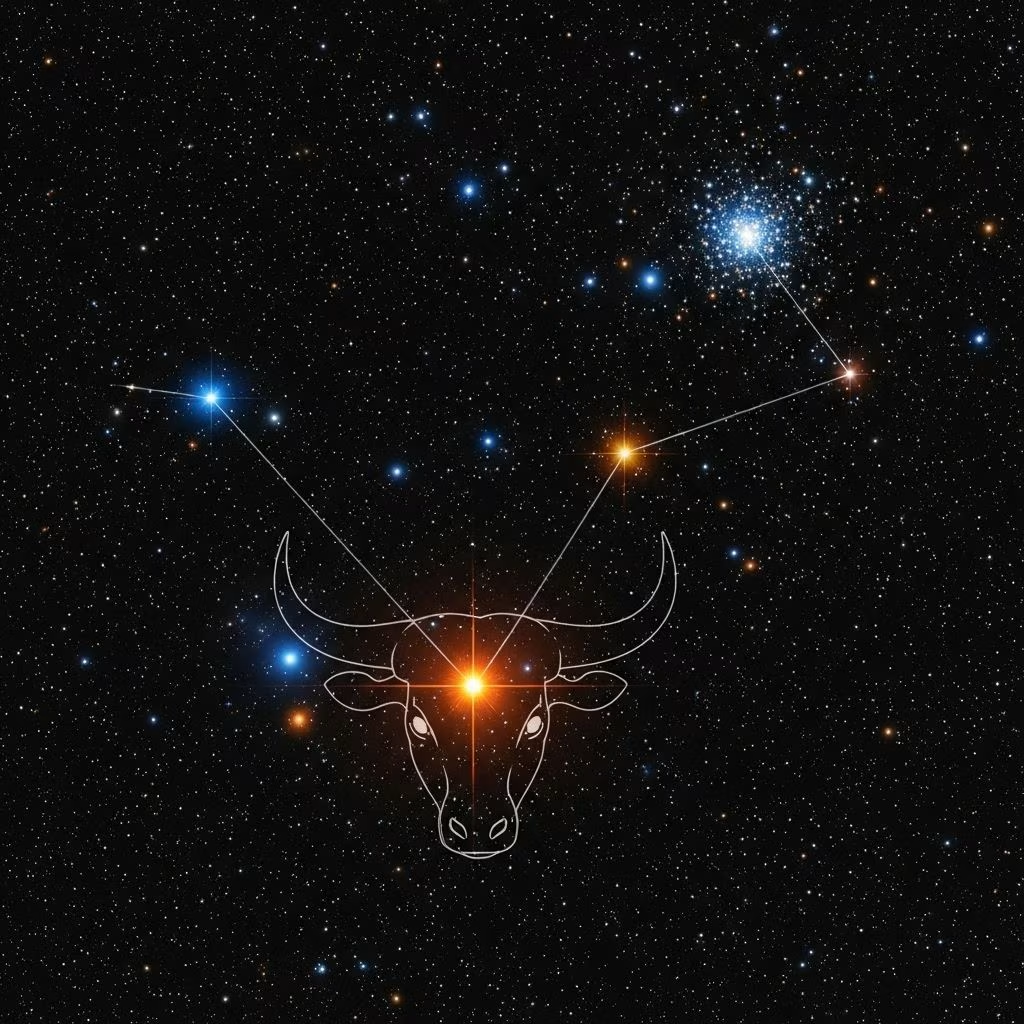
The constellation is visible between latitudes 90° North and 65° South. Its most obvious feature is a bright, V-shaped asterism outlining the bull’s face, punctuated by the dazzling red giant Aldebaran—the “eye” of the bull.
Key Stars and Structure
Taurus contains a remarkable arrangement of bright stars and star clusters, giving the illusion of a bull’s head, horns, and powerful frame.
- Aldebaran (α Tauri): A vivid orange-red giant, Aldebaran is the fourteenth brightest star in the night sky. Roughly 65 light-years away and forty times the diameter of our Sun, it anchors the face of the bull and is mythically regarded as its eye.
- Elnath (β Tauri): A blue-white star at the tip of the bull’s northern horn, it forms the second brightest point in Taurus.
- Alcyone (η Tauri): The brightest member of the Pleiades cluster, representing the shoulder of the bull.
- Hyadum I (γ Tauri): Part of the Hyades cluster, helping to outline the V-shape.
- Ain (ε Tauri): Along with other stars like Theta, Kappa, Sigma, Phi, and Chi Tauri, these double and binary stars add to the intricate structure of Taurus.
Famous Star Clusters
Taurus is particularly celebrated for being home to two of the closest and most visually stunning open star clusters: the Hyades and the Pleiades.
The Hyades:
- Shaped like a V, this open cluster defines the bull’s face.
- At approximately 153 light-years from Earth, it is the nearest open star cluster to our solar system.
- Contains dozens of stars, including Aldebaran (though Aldebaran itself is not physically a member, just aligned by perspective).
- The cluster’s members form a wedge shape, illuminating the bull’s visage and blending with the night sky.
The Pleiades (Messier 45):
- Also known as the Seven Sisters, it’s a compact group of hot, blue stars.
- Easily visible to the unaided eye and one of the most observed and written-about star clusters in the sky.
- Located about 444 light-years away, the cluster boasts over a thousand members, though only six to nine are readily visible from Earth without optical aid.
- Famed for its ethereal blue reflection nebula, visible in long-exposure photographs or with powerful amateur telescopes.
Table: Prominent Stars and Clusters in Taurus
| Name | Type | Magnitude | Distance (ly) | Notes |
|---|---|---|---|---|
| Aldebaran | Red giant (Alpha Tauri) | 0.85 | 65 | Eye of the bull |
| Elnath | B-type giant (Beta Tauri) | 1.65 | 134 | Tip of the northern horn |
| Pleiades | Open star cluster | 1.6 (cluster combined) | 444 | Messier 45, Seven Sisters |
| Hyades | Open star cluster | 0.5 (as group) | 153 | Forms the V-shape |
| Alcyone | B-type giant | 2.85 | 444 | Brightest star in Pleiades |
Deep-Sky Objects in Taurus
Taurus offers several notable deep-sky objects, prized by both amateur and professional astronomers:
- Crab Nebula (Messier 1): The remnant of a supernova observed by Chinese and Arab astronomers in 1054 CE. This glowing cloud of gas and energetic particles stretches over 10 light-years and is the expanding aftermath of a massive stellar explosion. At its center is the Crab Pulsar, a rapidly spinning neutron star.
- Taurus-Auriga star-forming region: This is one of the closest active regions of star birth, filled with young T Tauri stars and dark interstellar clouds. The presence of pre-main-sequence stars here has helped astronomers study stellar evolution up close.
- T Tauri: A variable star and the prototype for a class of very young, unstable stars. These ‘T Tauri stars’ mark a developmental stage just before a star settles into the main sequence of hydrogen burning.
Meteor Showers in Taurus
Taurus is linked with two annual meteor showers:
- Taurids: This bright meteor show occurs in late October and early November. Though not as prolific as the Perseids, the Taurids are noted for their slow-moving, often bright fireballs and are thought to be associated with Comet Encke.
- Beta Taurids: An unusual daylight meteor shower peaking in June and July, best detected using radar rather than visual observation.
Mythology and Cultural Significance
Taurus has captured imaginations and marked calendars across cultures for millennia:
- Ancient Greece: Taurus is identified with the bull form of Zeus in the myth of Europa, whom he abducted after transforming into a magnificent bull.
- Egyptian Mythology: Taurus represented the sacred bull and was associated with resurrection and the afterlife.
- Babylon and Sumer: Connected to gods of fertility and agriculture, reflecting Taurus’s rising in spring and its link to planting and productivity.
- Zuni People of North America: The constellation signaled the start of the planting season and was vital in agricultural ceremonies.
Archaeological findings, such as the famous cave paintings of Lascaux dated to 15,000 BC, depict the outline of a bull resembling the modern star pattern of Taurus, highlighting its ancient roots and widespread cultural reach.
Astronomical Characteristics and Coordinates
Taurus is a cornerstone of the zodiac and the only constellation crossed by the ecliptic, galactic equator, and celestial equator. The galactic anticenter (opposite the center of the Milky Way) is found near its boundary with Auriga. The constellation spans right ascensions from 3h 23.4m to 5h 53.3m and declinations from +31.10° to -1.35°, covering over 797 square degrees. Its official boundaries were established by Belgian astronomer Eugène Delporte in 1930.
The recommended three-letter abbreviation by the International Astronomical Union (IAU) is “Tau.” Taurus is notable for being part of Gould’s Belt – a ring of bright, massive stars stretching across the Milky Way.
Observing Taurus: Tips for Stargazers
- To locate Taurus, look for the V-shaped Hyades cluster to the right of Orion’s three-star belt in the winter sky.
- Binoculars easily reveal dozens of stars in the Hyades and Pleiades clusters.
- Clear, cold January evenings around 9:00 PM provide the most spectacular views.
- Aldebaran stands out as a reddish, twinkling beacon among its white and blue neighbors.
- The Crab Nebula appears as a subtle smudge in small telescopes and is best seen under dark skies.
Frequently Asked Questions (FAQs) about Taurus
Q: What does Taurus represent in the night sky?
A: Taurus represents the mythological bull, and its V-shaped formation illustrates the bull’s head, with Aldebaran as its eye and the Hyades forming its face.
Q: When is the best time to see Taurus?
A: Taurus is most visible and highest in the sky between November and March, with January providing ideal viewing conditions in the Northern Hemisphere.
Q: What is the significance of the Pleiades and Hyades?
A: The Pleiades and Hyades are two of the closest and most recognizable open star clusters to Earth, located within Taurus and notable for their visual brilliance and importance in many world mythologies.
Q: What astronomical features are unique to Taurus?
A: Taurus contains the Crab Nebula, a supernova remnant; the Taurus-Auriga star-forming region; the prototype variable star T Tauri; and is crossed by the ecliptic, galactic and celestial equators.
Q: How did ancient civilizations interpret Taurus?
A: Ancient Greeks associated Taurus with the bull form of Zeus; Egyptian, Sumerian, and Babylonian cultures linked it to fertility and agriculture; and Native American peoples saw it as a sign of seasonal change and a celestial marker for their calendars.
References
- https://en.wikipedia.org/wiki/Taurus_(constellation)
- https://www.ebsco.com/research-starters/astronomy-and-astrophysics/taurus-space-science
- https://theplanets.org/constellations/taurus-constellation/
- https://www.space.com/17101-taurus-constellation.html
- https://www.space.com/39378-taurus-constellation-skywatching-guide.html
- https://www.youtube.com/watch?v=maQdqtPGaLw
- https://www.youtube.com/watch?v=hksaUcXk004
- https://theskylive.com/sky/constellations/taurus-constellation
- https://www.skyatnightmagazine.com/advice/taurus-constellation