How Big is Neptune?
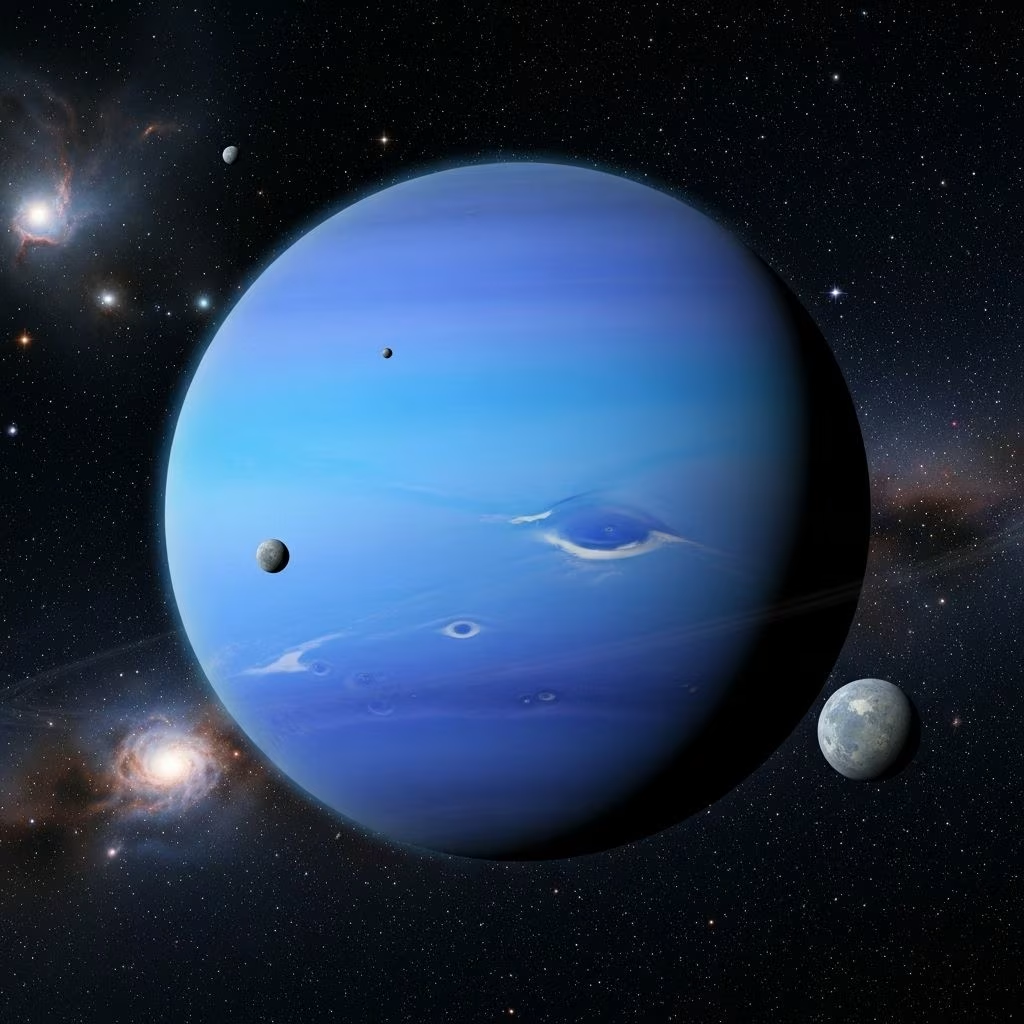
Neptune, the eighth and most distant planet from the Sun, is a giant ice planet whose sheer size and unique features place it among the most intriguing worlds in our solar system. Though it is the fourth largest by diameter and the third most massive planet, Neptune is more than just a distant blue sphere—it is a dynamic world with a history of discovery, an intricate structure, and characteristics that set it apart from both terrestrial and gas giants.
Neptune Overview and Discovery
Neptune holds the title of the most distant major planet from the Sun. As an ice giant, it is primarily composed of hydrogen, helium, water, and ammonia ices. Neptune was the last planet in the solar system to be discovered, not through direct observation, but via mathematical prediction arising from unexplained perturbations in Uranus’s orbit. This led astronomers to its location in 1846, making it unique as the only planet discovered by calculation rather than by telescope alone.
Key facts about Neptune:
- Type: Ice Giant
- Order from Sun: Eighth planet
- Orbital Period: 165 Earth years
- Number of Moons: 14
Physical Dimensions of Neptune
Neptune is the fourth largest planet in terms of diameter but is the smallest when compared to the rest of the gas giants. Despite being almost four times the diameter of Earth, Neptune is slightly smaller in diameter than Uranus.
Neptune’s Diameter, Radius, and Circumference
| Measurement | Value |
|---|---|
| Equatorial Diameter | 49,244 km (30,598 miles) |
| Polar Diameter | 48,682 km (30,251 miles) |
| Mean Radius | 24,622 km (15,299 miles) |
| Equatorial Radius | 24,764 km (15,388 miles) |
| Polar Radius | 24,341 km (15,125 miles) |
| Equatorial Circumference | 154,705 km (96,129 miles) |
Neptune’s average diameter is nearly four times Earth’s, yet it remains the smallest of the four gas giants by diameter. The difference between its equatorial and polar radius is due to its rapid rotation, causing a flattening at the poles and a bulge at the equator—a shape termed oblate spheroid.
Density, Mass, and Volume
While smaller in size than Uranus, Neptune is actually more massive. Its mass and density are key to understanding its internal structure and classification.
- Total Mass: 1.02 × 1026 kg (about 17 times that of Earth)
- Mean Density: 1.638 g/cm3
- Volume: Approx. 62 trillion km3 (15 trillion mi3), or nearly 58 times Earth’s volume
Neptune’s relatively low density (though higher than Saturn and Jupiter) signals its composition as an ice giant, with a greater proportion of ices relative to gases.
Surface Area and Circumference
If you could somehow walk around Neptune’s equator (despite its lack of a solid surface), the trip would be about 96,129 miles (154,705 km). Its total surface area is 2.9 billion square miles (7.6 billion square kilometers), offering nearly 15 times as much area as Earth.
The Rings of Neptune
Neptune possesses a system of faint, clumpy rings made primarily of dust and ice particles. The outermost ring extends up to 39,105 miles (62,933 km) from the planet’s center.
- Neptune’s rings are less prominent than those of Saturn, but distinctly visible.
- The ring system contains several arcs—dense clumps—which are unique in the solar system.
These rings are named after astronomers who contributed to Neptune’s discovery or study, such as Adams, Le Verrier, and Galle.
Internal Structure and Composition
Unlike Jupiter and Saturn—the gas giants—Neptune (along with Uranus) is classed as an ice giant due to its higher concentration of volatile substances (ices) like water, ammonia, and methane.
- Core: Believed to be rocky and metallic, similar to Earth but much larger and denser.
- Mantle: A thick, hot layer comprising water, ammonia, and methane ices.
- Atmosphere: Derived mainly from hydrogen and helium, with notable methane that gives Neptune its rich blue hue.
The planet lacks a true solid surface. Atmospheric temperature ranges between -218°C to -200°C, and the deep interior may be heated by remaining formation heat and gravitational contraction, perhaps affecting the planet’s strong winds and storms.
Gravity and Comparison to Other Planets
Despite its icy nature and relatively low density, Neptune maintains a strong gravitational pull, surpassed only by Jupiter among the solar system planets.
| Planet | Surface Gravity (compared to Earth) |
|---|---|
| Earth | 1.00 g |
| Jupiter | 2.53 g |
| Neptune | 1.14 g |
| Uranus | 0.89 g |
| Saturn | 0.92 g |
Standing on Neptune (if you could!), you would feel a little heavier than on Earth due to its gravity of approximately 11.15 m/s².
- Mass: 17.15 × Earth’s mass
- Surface gravity: 1.14 × Earth’s gravity
Rotation and Oblate Spheroid Shape
Neptune rotates quickly, with the equator taking about 18 hours to complete a spin and the poles about 12 hours. Because Neptune is not a solid body, this difference is more pronounced than on any other planet, causing a significant “equatorial bulge.”
- The planet’s rapid rotation causes it to bulge at the equator and flatten at the poles, making it an oblate spheroid.
Such a spin also helps generate the highest sustained winds found in our solar system, with speeds reaching up to 2,100 km/h (about 1,300 mph).
Distance from the Sun and Orbit
- Average Distance from Sun: 4.5 billion km (2.8 billion miles)
- Orbit Period: 165 Earth years
This immense distance means that, even though Neptune has significant mass and size, it is only visible by telescope and manifests as a small bluish disk when seen from Earth.
- Neptune’s discovery relegated Pluto to the status of the solar system’s most distant object only for a short time, as Pluto’s orbit sometimes brings it closer to the Sun.
Frequently Asked Questions (FAQs)
Q: How does Neptune’s size compare to other planets?
A: Neptune’s diameter is almost four times greater than Earth’s, yet among the giant planets, it’s the smallest by size but the third most massive due to its density.
Q: Why is Neptune called an ice giant?
A: Scientists classify Neptune as an “ice giant” because it is made primarily of heavier elements and molecules (such as water, ammonia, and methane ices) rather than gases like hydrogen and helium.
Q: Does Neptune have a solid surface I could stand on?
A: No. Like the other giant planets, Neptune lacks a true solid surface; it transitions from a dense, turbulent atmosphere into deeper layers of ices and finally a rocky core.
Q: What color is Neptune and why?
A: Neptune is strikingly blue due to the presence of methane in its upper atmosphere, which absorbs red light and reflects blue wavelengths. The precise reason for its intense coloring—darker than Uranus—remains a topic of research.
Q: How many Earths could fit inside Neptune?
A: Roughly 58 Earths would fit inside Neptune by volume, and it has about 17 times the mass of Earth.
Q: How strong is Neptune’s gravity?
A: Neptune’s surface gravity is about 1.14 times that of Earth, which means you would feel 14% heavier than on Earth.
Q: When was Neptune discovered?
A: It was discovered in 1846 after mathematical calculations by astronomers predicted its position based on disturbances in Uranus’ orbit.
Key Neptune Facts at a Glance
- Diameter: 49,244 km (30,598 miles)
- Mass: 1.02 × 1026 kg (17 Earth masses)
- Mean Density: 1.638 g/cm³
- Circumference at Equator: 154,705 km (96,129 miles)
- Surface Gravity: 11.15 m/s² (1.14 × Earth’s)
- Distance from Sun: 4.5 billion km (2.8 billion miles)
- Length of Year: 165 Earth years
- Surface Area: 7.6 billion km² (2.9 billion mi²)
- Number of Moons: 14
- Rings: Yes, 5 primary names with arcs
- Explorer: Voyager 2 (1989 flyby)
Discover more about Neptune and the mysteries of our solar system’s edge—studying these distant worlds deepens our understanding not only of other planets, but also of the history and future of our own.
References
- https://www.space.com/18924-how-big-is-neptune.html
- https://coolcosmos.ipac.caltech.edu/ask/141-How-big-is-Neptune-
- https://en.wikipedia.org/wiki/Neptune
- https://www.asc-csa.gc.ca/eng/astronomy/solar-system/neptune.asp
- https://www.britannica.com/place/Neptune-planet
- https://science.nasa.gov/neptune/
- https://www.astronomy.com/science/neptune/
- https://space-facts.com/neptune/
- https://earthhow.com/planet-neptune-facts/