


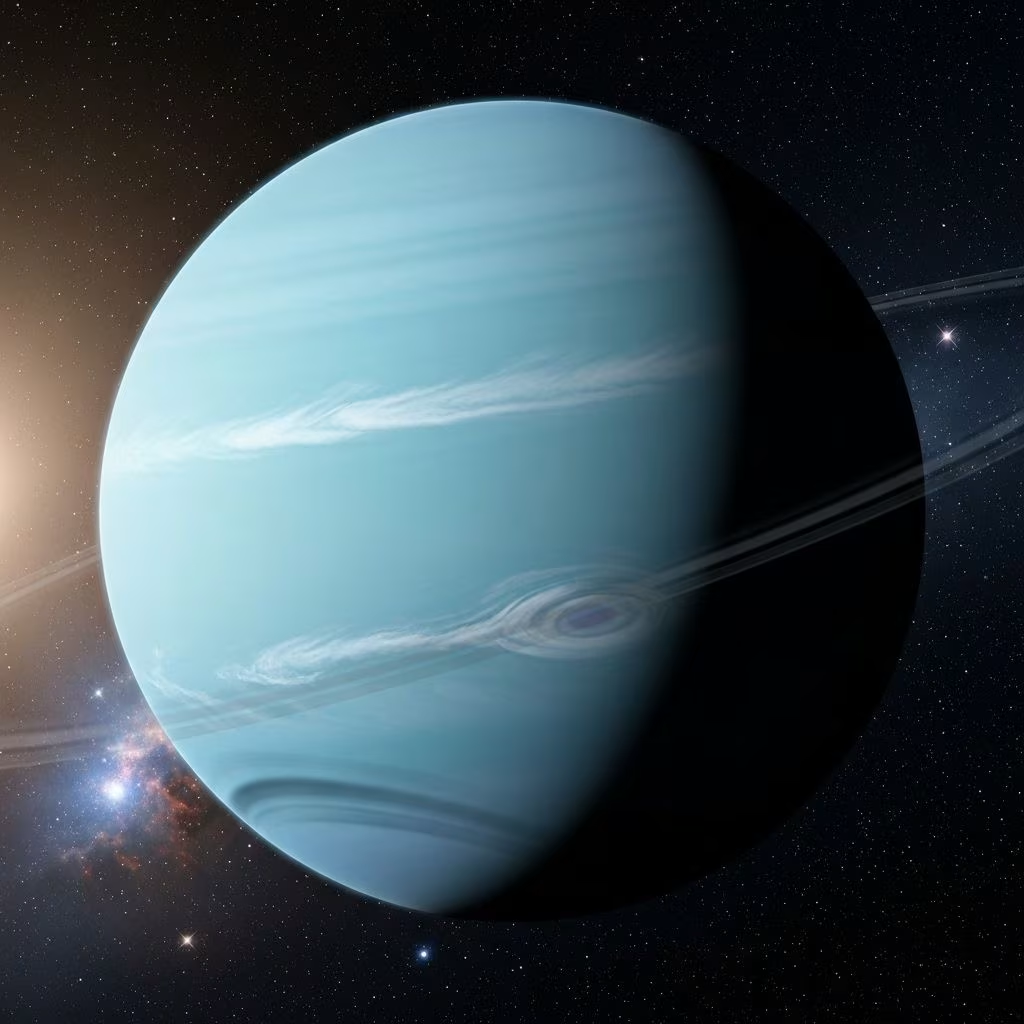
Uranus: Unveiling the Ice Giant’s Composition and Character
Uranus, the enigmatic seventh planet from the Sun, challenges our understanding of planetary science with its icy mass, peculiar rotation, and striking pale blue appearance. Unlike its more visually dramatic neighbor Neptune, Uranus often appears understated—a quality belied by its dynamic interior and atmosphere. This comprehensive overview synthesizes current knowledge about Uranus’s makeup, atmospheric intricacies, seasonal changes, rings, and its role in the solar system.
Overview: Discovery and Distinction
Uranus was discovered in 1781 by astronomer William Herschel in Great Britain, marking the first planetary discovery in modern history with a telescope. With its faint visibility and bland appearance compared to other planets, Uranus eluded naked-eye observation until Herschel’s breakthrough. Unlike any other planet in the solar system, Uranus rotates on its side, presenting a 98-degree axial tilt that fundamentally alters its seasons and magnetic field.
Fast Facts:
- Distance from Sun: Seventh planet in our solar system
- Diameter: 50,724 km (slightly larger than Neptune)
- Discovered: 1781 by William Herschel
- Voyager 2: The only spacecraft to visit Uranus
Internal Structure and Composition
Uranus is classified as an ice giant, distinct from gas giants like Jupiter and Saturn. Its interior is dominated by dense, hot fluids composed of water, methane, and ammonia, constituting more than 80% of the planet’s mass. Beneath these fluids lies a small rocky core, which heats up to approximately 9,000°F (4,982°C).
- Core: Small, rocky, surrounded by high-pressure icy layers
- Icy Mantle: Predominantly water, methane, and ammonia in superheated fluid states
- Atmospheric Envelope: Hydrogen and helium dominate, with subtle traces of methane and other ices
A spacecraft attempting to reach Uranus’s core would encounter overwhelming pressures and temperatures, which would obliterate even the most robust metal materials.
Surface and Physical Properties
Uranus, unlike terrestrial planets, lacks a true solid surface. Its “surface” is best described as a transition zone where the dense fluid interior merges with the gaseous atmosphere. The planet’s density is surprisingly low—it is the second least dense planet in our solar system, with Saturn being the only planet less dense.
Atmospheric pressure and temperature: Within Uranus’ troposphere (the lowest atmospheric layer), temperatures dip as low as -370°F (-218°C), making Uranus the coldest planet in the solar system. These extremes preclude any possibility of landing or surviving on Uranus.
Atmospheric Layers and Climate
The atmosphere of Uranus is a complex cocktail, unique in its layered separation and dynamic weather patterns. Its main constituents are:
- Molecular hydrogen (H2): 82.5%
- Helium (He): 15.2%
- Methane (CH4): 2.3%
Trace amounts of water, ammonia, and hydrocarbons are also present. This composition makes Uranus’s outer envelope similar to Jupiter’s and Saturn’s, with the crucial difference that the rocky interior is less abundant under light gases.
Cloud Layers
The atmosphere of Uranus can be stratified into distinct layers:
- Troposphere: 30 miles (50 km) thick; contains multiple cloud layers.
- Cloud types (from lowest to highest):
- Water clouds (deepest)
- Ammonium hydrosulfide clouds
- Ammonia and hydrogen sulfide clouds
- Thin methane clouds (topmost layer)
Despite its bland overall appearance, Uranus’s atmosphere is not devoid of interest. Voyager 2 observed a Great Dark Spot and ephemeral discrete clouds in the 1980s, but subsequent research has shown far more dynamic activity near equinox, such as rapidly changing bright features and complex wind circulation patterns.
Atmospheric Winds
Winds on Uranus can reach up to 560 miles per hour (900 km/h). These winds are retrograde at the equator, moving in opposition to the planet’s rotation, while near the poles, they flow in the same direction as Uranus’s rotation.
The Pale Blue Hue: Role of Methane and Haze
The planet’s pale blue tint has puzzled astronomers for generations. Uranus’s methane absorbs red wavelengths from sunlight, leaving blue and green wavelengths to be scattered and reflected back into space. This phenomenon gives Uranus its recognizable color, although its shade differs from that of Neptune—a planet very similar in mass and overall composition.
| Planet | Atmospheric Methane | Haze Concentration | Visible Color |
|---|---|---|---|
| Uranus | Depleted at the poles, higher at mid-latitudes | High—”stagnant,” leads to whiter cyan hue | Pale blue, almost white-cyan |
| Neptune | More evenly distributed | Lower—leads to richer blue | Vivid cerulean blue |
Recent research utilizing ultraviolet and near-infrared wavelengths revealed Uranus’s sluggish atmosphere enables haze particles to build up, leading to its lighter coloration. Methane is not evenly distributed—it is significantly lower at the poles, while haze concentrations remain high across the planet. This interaction fundamentally sets Uranus apart from its sibling Neptune.
Rings and Moons
Uranus possesses 13 known rings, primarily composed of narrow, dark inner rings and brighter, more visible outer rings. These rings, while not as magnificent as Saturn’s, provide further evidence of Uranus’s idiosyncratic structure. Their composition likely consists of water ice intermixed with darker materials, as indicated by studies of Uranus’s moons.
Moons: Uranus has 28 confirmed moons, ranging from icy small bodies to potential rocky mixtures. The inner moons are believed to be roughly half water ice and half rock, while the composition of the distant outer moons remains largely unknown.
- Significant Moons: Miranda, Ariel, Umbriel, Titania, Oberon
- Features: Heavily cratered surfaces, canyons, icy mantles
Seasonal Dynamics and Recent Observations
Uranus’s axial tilt results in pronounced seasonal effects. Each of its poles experiences decades of continuous sunlight or darkness as the planet progresses through its 84-Earth-year-long orbit. Hubble Space Telescope studies tracking Uranus over twenty years have detailed how polar regions darken and brighten as they enter winter and summer, respectively.
- Summer brings brighter polar latitudes.
- Winter submerges polar regions into prolonged shadow.
- Seasonal transitions reveal dynamic changes in cloud patterns and aerosol distribution.
- Methane concentrations and haze concentrations present stable trends at mid-latitudes, but polar regions exhibit greater variability.
The planet’s unusual axis means Uranus essentially “rolls” around the Sun, making its seasonal system unlike any other planet. This has a profound impact on everything from weather patterns to the visibility of atmospheric phenomena.
Frequently Asked Questions (FAQs)
-
Q: Why does Uranus spin on its side?
A: Uranus’s tilt of 98 degrees may have resulted from a massive collision early in its history, causing it to rotate nearly perpendicular relative to its orbit.
-
Q: What gives Uranus its pale blue color?
A: Methane in the atmosphere absorbs red sunlight and reflects blue and green wavelengths, while haze adds a whitish touch to the blue color.
-
Q: Does Uranus have a solid surface?
A: No. Uranus is composed mainly of icy and gaseous materials and lacks a true solid surface.
-
Q: How cold is Uranus?
A: Temperatures in Uranus’s atmosphere reach minus 370°F (minus 218°C), making it the coldest planet in the solar system.
-
Q: What is the difference between Uranus and Neptune?
A: Both are ice giants with similar mass and composition, but Uranus appears paler due to high haze concentration and uneven methane distribution, while Neptune’s deeper blue color results from lower haze and evenly distributed methane.
-
Q: Has Uranus been visited by any spacecraft?
A: Voyager 2, in 1986, is the only spacecraft to have visited Uranus.
Conclusion: Uranus’s Enduring Mysteries
Despite its bland appearance and distant location, Uranus continues to intrigue scientists. Its tilted rotation, complex atmospheric chemistry, icy core, rings, and moons each tell a story of cosmic violence, chemical processes, and seasonal drama. As new telescopic observations and next-generation spacecraft missions loom, Uranus may yet yield deeper secrets—potentially reshaping our understanding of planetary formation and evolution in the outer solar system.
References
- https://spaceplace.nasa.gov/all-about-uranus/en/
- https://science.nasa.gov/uranus/facts/
- https://www.space.com/18708-uranus-atmosphere.html
- https://www.space.com/space-exploration/hubble-space-telescope/2-decades-of-hubble-space-telescope-data-track-changing-seasons-on-uranus
- https://www.space.com/uranus-haze-neptune-layers-different-colors
- https://www.space.com/the-universe/uranus/uranus-passed-between-earth-and-a-distant-star-this-month-and-nasa-caught-the-rare-event
- https://www.space.com/18706-uranus-composition.html
- https://www.space.com/22201-uranus-moons.html
- https://www.space.com/space-exploration/missions/the-yearning-for-uranus-a-far-out-world-with-a-tale-to-tell


