Gamma rays are the most energetic form of electromagnetic radiation known, enabling astronomers and physicists to probe the most extreme environments in the universe. This article delves into the nature of gamma rays, their extraterrestrial origins, how scientists detect them, and the crucial role they play in expanding our understanding of cosmic evolution and physics.
What Are Gamma Rays?
Gamma rays are photons with the shortest wavelengths (<0.01 nanometers) and the highest energies (exceeding 100 kilo-electronvolts, or keV) in the electromagnetic spectrum. Their energy can reach millions to billions of electronvolts (MeV to GeV), far surpassing X-rays, which have lower energies and longer wavelengths.
- Wavelength: Less than 0.01 nanometers.
- Energy Range: Above 100 keV, commonly reaching MeV and GeV ranges.
- Origins: Produced in extreme, high-energy cosmic environments.
Unlike visible light or even X-rays, gamma rays are not generated by transitions of electrons within atoms, but by nuclear reactions and other processes involving subatomic particles moving at relativistic speeds.
How Are Gamma Rays Produced?
Gamma rays are generated in regions of exceptionally high temperature, pressure, and density, often under the influence of powerful magnetic fields. Key processes that give birth to gamma rays include:
- Radioactive decay: Nuclei of unstable isotopes emit gamma-rays to reach stable states.
- Matter-antimatter annihilation: When particles like electrons and positrons collide, they annihilate each other, releasing energy as gamma photons.
- Particle acceleration: Charged particles, especially protons and electrons, accelerated by magnetic fields (as in pulsars, black holes, or supernova remnants), emit gamma rays through processes such as synchrotron radiation or the inverse Compton effect.
- Neutral pion decay: Extremely energetic interactions, such as cosmic rays hitting interstellar hydrogen, produce neutral pions (π⁰), which decay into gamma photons.
The Astrophysical Sources of Gamma Rays
The universe is dotted with violence and extremes, and gamma rays act as heralds from these locations. Notable gamma ray sources include:
- Supernovae and Hypernovae: When massive stars explode, they release colossal bursts of gamma rays.
- Neutron Stars and Pulsars: Densely packed remnants of supernovae with powerful magnetic fields accelerate particles to emit gamma rays.
- Black Holes: Both stellar-mass and supermassive black holes in galaxies (including their active accretion disks and relativistic jets) generate energetic gamma-ray emissions.
- Blazars and Active Galactic Nuclei (AGN): Massive black holes powering luminous galactic centers can outshine their host galaxies, and their jets fire gamma rays across vast distances.
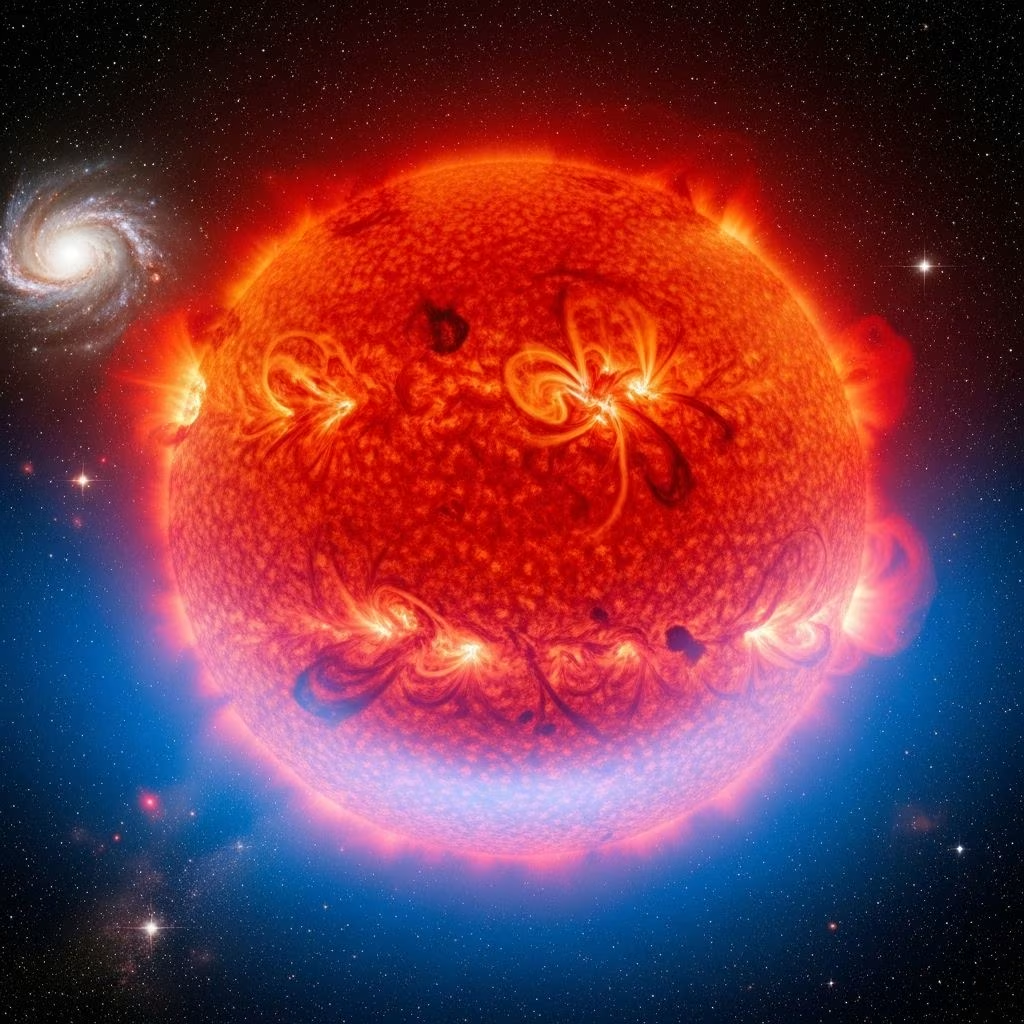
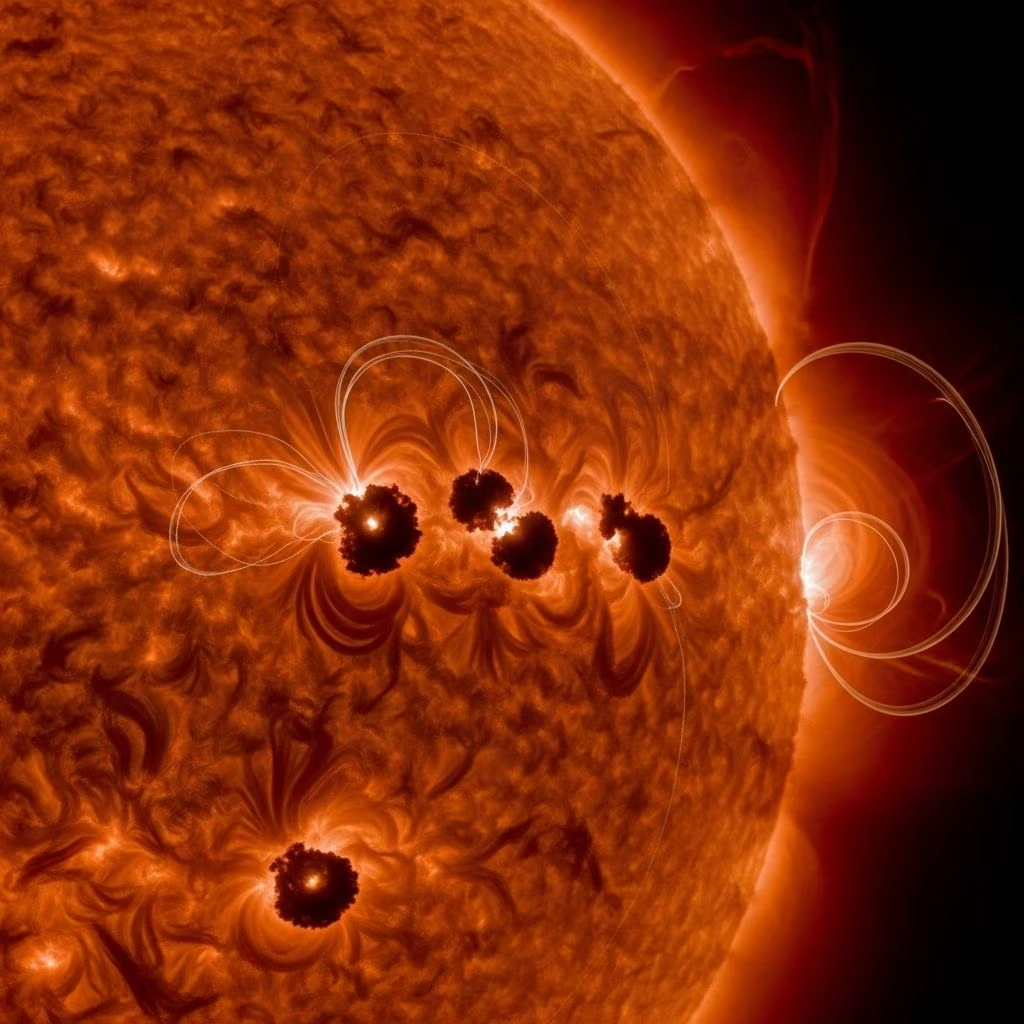
- Solar Flares: Our own Sun is capable of producing gamma rays in powerful flare events, especially during intense particle acceleration episodes.
- The Milky Way’s diffuse glow: Collisions between galactic hydrogen and cosmic rays create a widespread, diffuse gamma-ray background along the plane of our galaxy.
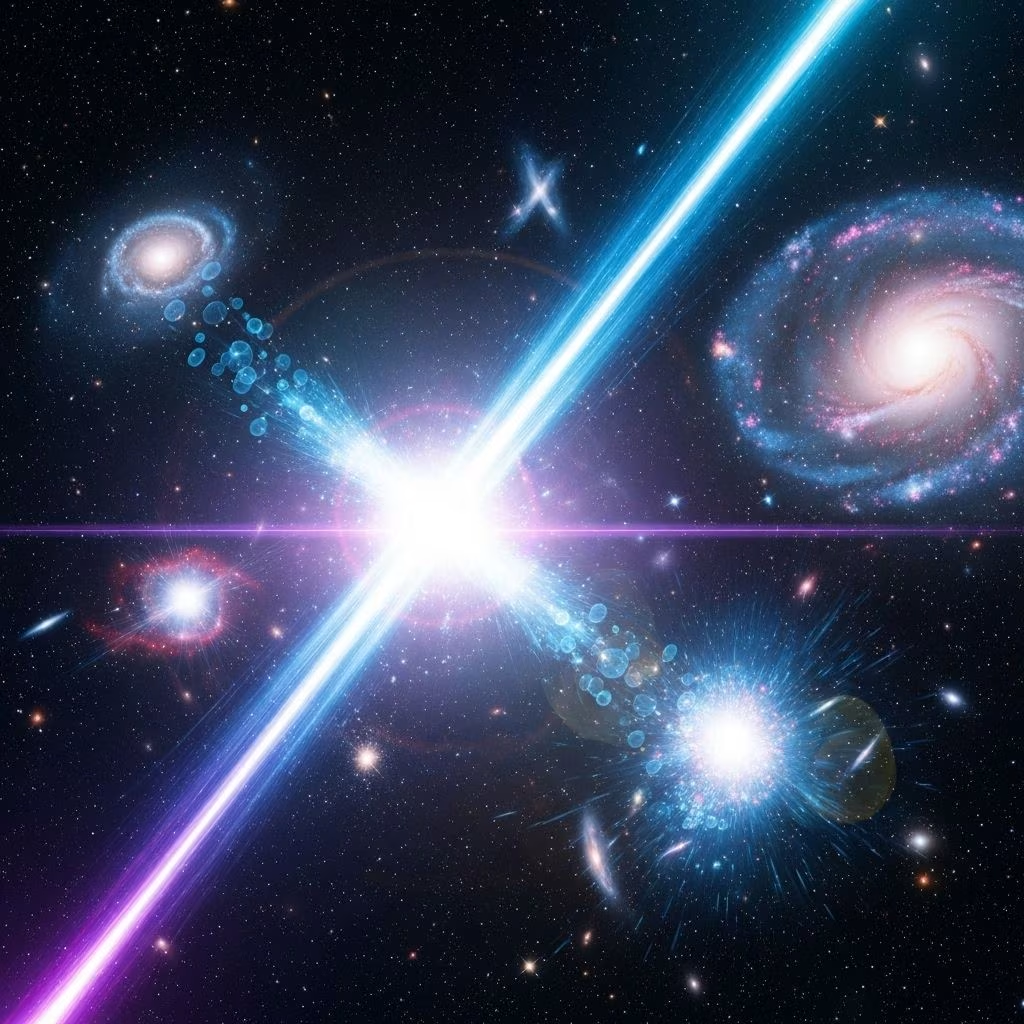
- Gamma-Ray Bursts (GRBs): The brightest known gamma-ray sources, often linked to hypernovae or neutron star mergers, GRBs can outshine entire galaxies for a brief period, ranging from microseconds to hundreds of seconds.
Table: Key Cosmic Gamma Ray Sources
| Source Type | Gamma Ray Production Mechanism | Example Object |
|---|---|---|
| Supernova Remnant | Shock-accelerated particles, neutral pion decay | Crab Nebula |
| Pulsar | Magnetosphere particle acceleration | Vela Pulsar |
| Black Hole (AGN/Blazar) | Relativistic jet emission | Blazar Markarian 421 |
| Gamma-Ray Burst | Compact binary mergers, hypernovae | GRB 190114C |
| Solar Flare | Particle acceleration during magnetic reconnection | Extreme solar flare (e.g., 2005 X17) |
The Challenges of Detecting Gamma Rays
Gamma rays are so energetic that they cannot be focused by traditional optical lenses or mirrors, and Earth’s atmosphere effectively blocks them. This inherent property leads to two major challenges:
- Atmospheric Absorption: Almost all gamma rays are absorbed or scattered by Earth’s atmosphere, protecting life but making ground-based detection impossible for most energies.
- Indirect Detection: To study cosmic gamma rays, astronomers must use balloon-borne, satellite, or space-based telescopes. For the most energetic gamma rays, ground-based detectors can observe secondary “air showers” produced when gamma rays strike the atmosphere, generating cascades of particles and light.
Modern Detection Techniques
- Space-based gamma-ray telescopes: These platforms, such as NASA’s Fermi Gamma-ray Space Telescope, directly detect gamma photons using high-energy detectors in orbit.
- Imaging Atmospheric Cherenkov Telescopes (IACTs): Ground-based observatories (e.g., H.E.S.S., MAGIC, VERITAS) detect the brief flashes of visible Cherenkov light caused by particle cascades initiated by gamma rays entering the atmosphere.
- Balloon experiments: High-altitude scientific balloons carry detectors above most of the atmosphere for short-duration observations.
Detection technologies are rapidly advancing, making gamma-ray astronomy one of the most dynamic fields in astrophysics.
Why Are Gamma Rays Important?
Gamma rays act as cosmic messengers, offering a unique insight into the most energetic and extreme phenomena in the universe. They are crucial for several reasons:
- Gamma rays reveal events and environments invisible in other parts of the electromagnetic spectrum.
- They allow scientists to study the birth and death of stars, supernovae, black hole activity, and the behavior of matter at fundamental levels.
- By analyzing gamma-ray emissions, researchers can test theories of particle physics under conditions impossible to reproduce on Earth.
- Some gamma-ray bursts provide valuable information about the early universe, cosmic expansion, and even dark matter through their energy signatures.
- The study of gamma rays complements observations in gravitational waves and neutrinos, enabling a multi-messenger approach to cosmic phenomena.
Advances in Gamma-Ray Astronomy
Gamma-ray astronomy has rapidly evolved since the first cosmic gamma rays were detected. Key innovations and future directions include:
- Integration with gravitational wave and neutrino observatories. This “multi-messenger” approach uncovers the full picture of neutron star mergers and other cataclysmic events.
- New telescopes and detector technologies: Improved camera technologies, photon detectors like Silicon Photomultipliers (SiPMs), advanced mirror systems, fast-readout electronics, and sophisticated data-processing algorithms increase sensitivity and resolution.
- Application of machine learning and big data analytics to process vast astronomical datasets, recognize patterns, and identify both known and novel gamma-ray sources.
- Upcoming facilities such as the Cherenkov Telescope Array, poised to increase sensitivity by an order of magnitude, expanding the catalog of known high-energy emitters.
- Exploration of prospects for lunar gamma-ray observatories, leveraging the Moon’s lack of atmosphere and seismic quietness for prolonged observations.
Astrophysical Impact
- Discovery of pulsars and the mapping of diffuse gamma-ray backgrounds has changed our understanding of cosmic ray propagation within and beyond our galaxy.
- Observation of blazars, neutron stars, and gamma-ray bursts continues to yield surprises and challenge existing theoretical frameworks.
Gamma Rays and Life on Earth
Earth’s thick atmosphere effectively blocks harmful cosmic gamma rays, shielding all life. However, certain rare events, such as very powerful solar flares or theoretical nearby gamma-ray bursts, could have significant effects on the atmosphere (for example, by triggering ozone depletion). On a practical level, gamma rays have important applications in medicine (e.g., cancer radiotherapy), industry, and science, harnessed for everything from sterilization to imaging.
Frequently Asked Questions About Gamma Rays
Q: What’s the difference between gamma rays and X-rays?
A: Gamma rays have higher energy and shorter wavelengths than X-rays. X-rays often originate in electron transitions, while gamma rays typically arise from nuclear reactions or subatomic particle processes.
Q: Can gamma rays be seen with the human eye?
A: No. Gamma rays are far beyond the visible spectrum and cannot be seen by human eyes or standard optical telescopes.
Q: Are gamma rays dangerous?
A: Yes, exposure to very high doses is extremely dangerous to living tissue. However, Earth’s atmosphere blocks nearly all naturally occurring cosmic gamma rays.
Q: What is a gamma-ray burst?
A: Gamma-ray bursts (GRBs) are sudden, incredibly bright flashes of gamma radiation, typically lasting from milliseconds to minutes. They are the most energetic events known since the Big Bang, linked to massive star collapses or neutron-star mergers.
Q: How do scientists detect gamma rays?
A: Detection requires specialized satellites, space telescopes, high-altitude balloons, or ground-based Cherenkov telescopes that use particle cascades formed in the atmosphere to infer the presence of cosmic gamma rays.
Summary: The Future of Gamma-Ray Research
As technology advances, so does our capability to unlock the secrets of the high-energy universe. Next-generation detectors will refine our view of gamma-ray sources, help answer compelling mysteries about black holes, neutron stars, and the evolution of cosmic structure, and uncover new physics where matter and energy reach their ultimate limits. Gamma rays stand at the frontier of discovery, illuminating the universe’s most powerful phenomena.
References
- https://en.wikipedia.org/wiki/Gamma-ray_astronomy
- https://science.nasa.gov/ems/12_gammarays/
- https://en.wikipedia.org/wiki/Gamma_ray_telescope
- https://imagine.gsfc.nasa.gov/science/toolbox/gamma_ray_astronomy1.html
- https://www.ebsco.com/research-starters/astronomy-and-astrophysics/x-ray-and-gamma-ray-astronomy
- https://www.mpe.mpg.de/~rod/tvuniv.htm
- https://www.britannica.com/science/gamma-ray-telescope
- https://www.britannica.com/science/gamma-ray-astronomy
- https://sci.esa.int/web/astrophysics/-/35909-gamma-ray
- https://sentinelmission.org/astrophysics-glossary/gamma-ray-astronomy/
- https://web.williams.edu/Astronomy/Course-Pages/418/MRSpaper.html
- https://www.space.com/gamma-rays-explained
- http://arxiv.org/pdf/2207.02248.pdf
- https://www.encyclopedia.com/science-and-technology/astronomy-and-space-exploration/astronomy-general/gamma-ray-astronomy
- https://modern-physics.org/gamma-ray-astronomy/