


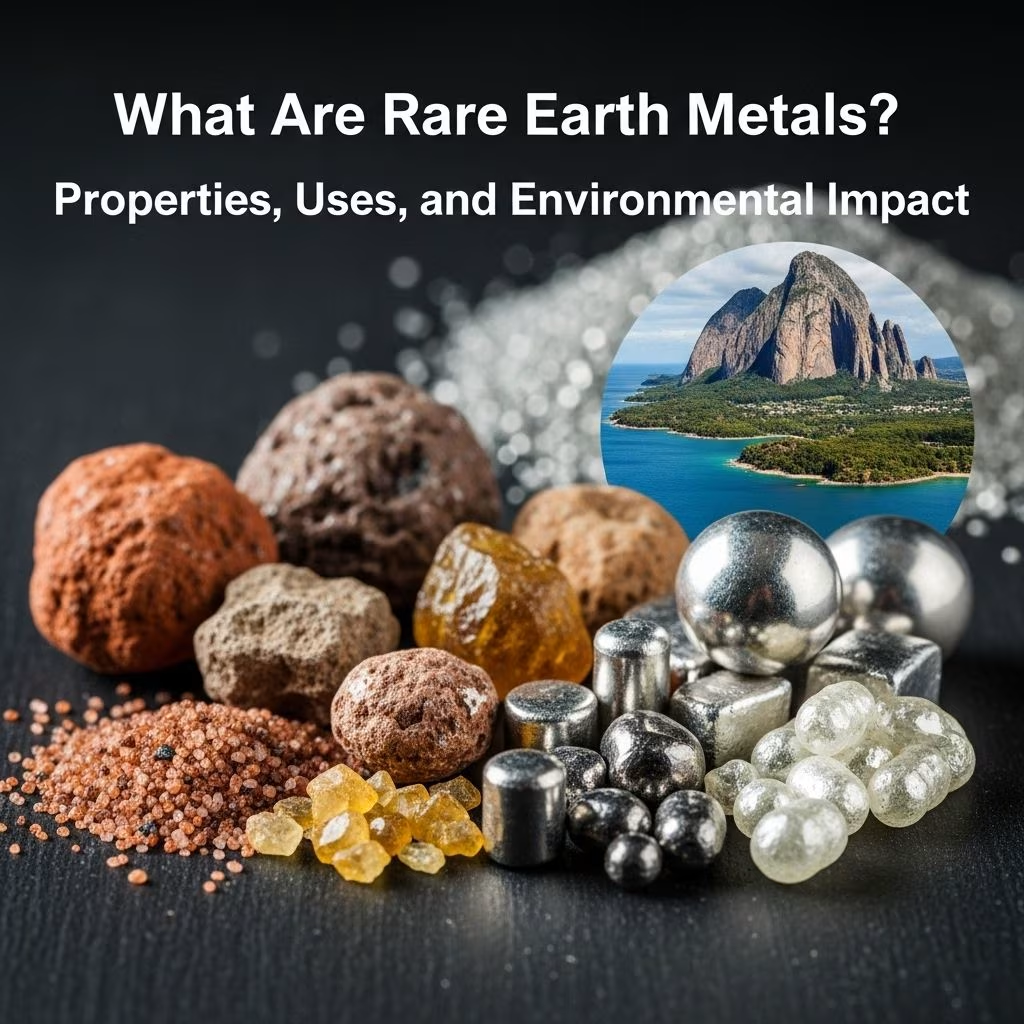
Rare earth metals, also known as rare earth elements (REEs), comprise a group of seventeen chemical elements crucial to the manufacture of many modern technologies. From wind turbines and electric vehicles to smartphones and defense applications, these metals enable significant advances in renewable energy, electronics, and medical devices. Despite their name, rare earths are not truly rare in terms of natural abundance; however, their extraction and processing present complex environmental, economic, and geopolitical challenges.
Definition and Classification
Rare earth metals are defined as the fifteen lanthanide elements (atomic numbers 57 through 71) plus scandium and yttrium. These seventeen elements share similar properties, including high magnetic strength, luminescence, and catalytic capabilities. They are mostly soft, silvery-white heavy metals, often appearing side by side in the Earth’s crust and usually found together in mineral deposits.
- Lanthanides: Lanthanum (La), Cerium (Ce), Praseodymium (Pr), Neodymium (Nd), Promethium (Pm), Samarium (Sm), Europium (Eu), Gadolinium (Gd), Terbium (Tb), Dysprosium (Dy), Holmium (Ho), Erbium (Er), Thulium (Tm), Ytterbium (Yb), Lutetium (Lu)
- Scandium (Sc)
- Yttrium (Y)
Scandium and yttrium are included because they commonly occur in the same ores as the lanthanides and possess similar chemical attributes.
The Name ‘Rare Earth’: History and Misconceptions
The term “rare earth” is misleading. These elements are not especially rare; for instance, cerium is more abundant in Earth’s crust than copper. The confusion arises because they typically do not form concentrated, economically mineable deposits, and are instead dispersed in trace amounts within larger ore bodies, making extraction and purification costly and labor-intensive.
The story begins in 1787, when the mineral gadolinite—containing several then-unknown rare earths—was discovered in a mine in Ytterby, Sweden. Four rare earths (yttrium, terbium, erbium, and ytterbium) owe their names to this locality. Since then, numerous rare earth minerals, such as bastnasite and monazite, have become commercially important sources.
Physical and Chemical Properties
Rare earth elements exhibit several shared features that make them valuable across a range of industries:
- Magnetic Strength: Elements like neodymium and samarium are critical for producing the strongest known permanent magnets.
- Luminescence: Europium and terbium are essential in phosphor coatings for TV and LED screens.
- Catalytic Activity: Cerium and lanthanum are used in catalytic converters, petroleum refining, and glass manufacturing.
- Conductivity: Their ability to conduct electricity and interact with light makes them integral to many electronic components.
These distinctive qualities arise from their electron configurations—specifically, the progressive filling of 4f orbitals in the lanthanides—which leads to subtle but useful variations among the elements.
Types of Rare Earth Metals and Their Uses
Each rare earth element plays a unique role in technology, industry, and healthcare. Some of the most important are:
| Element | Main Uses | Key Properties |
|---|---|---|
| Neodymium (Nd) | Permanent magnets (motors, wind turbines, electronics) | Very strong, high coercivity |
| Lanthanum (La) | Rechargeable batteries, camera and telescope lenses | Enhances glass properties, alloy strengthener |
| Cerium (Ce) | Catalysts, glass polishing, self-cleaning ovens | Redox reactions, polishing agent |
| Yttrium (Y) | Phosphors in LEDs and televisions, ceramics, lasers | Stabilizes compounds, red phosphors |
| Samarium (Sm) | Magnets, nuclear reactors, headphones | High magnetic strength, absorbs neutrons |
| Gadolinium (Gd) | MRI contrast agents, neutron capture in reactors | Strong neutron absorber, magnetic properties |
| Europium (Eu) | Red phosphorescent coatings, currency, LEDs | Intense red luminescence |
| Dysprosium (Dy) | Magnets, lasers, hard disk drives | Thermal resistance, increases magnet durability |
| Scandium (Sc) | Aerospace components, sports equipment, lighting | Low density, high melting point |
| Lutetium (Lu) | Cancer therapy, PET scans, catalysts | Stable isotopes, precise radiation |
Specialized and Emerging Applications
- Praseodymium: Used in magnets, high-strength alloys, aircraft engines, and green glass.
- Terbium: Green phosphors in display screens and lasers.
- Thulium: Portable X-ray devices, lasers, superconductors.
- Holmium: Nuclear control rods, medical lasers.
- Promethium: Radioactive; only produced artificially for use in luminous paint and nuclear batteries.
Why Rare Earth Metals Are Important
Rare earth elements are considered the backbone of modern technology and the renewable energy sector. Without them, many green and high-tech innovations would not function efficiently. Some of the most important applications include:
- Clean Energy: High-performance magnets for wind turbines and electric vehicle (EV) motors.
- Consumer Electronics: Smartphones, screens, earbuds, and hard disk drives all rely on rare earths for compact, high-efficiency components.
- Healthcare: MRI imaging, portable X-rays, cancer treatment.
- National Defense: Guidance systems, lasers, radar, and specialized alloys for strategic military hardware.
Everyday Life Examples
- Vibration motors in mobile phones and tablets (neodymium, dysprosium)
- LED lighting and displays (europium, terbium, yttrium)
- Batteries for hybrid and electric cars (lanthanum, cerium, praseodymium)
Mining, Extraction, and Refining Challenges
Despite their abundance in the Earth’s crust, rare earths are rarely found in high concentrations, making extraction technically challenging and often environmentally damaging. The process typically includes:
- Mining: Extracting rare earth-containing minerals, often from open-pit mines.
- Processing: Crushing, grinding, and chemically treating ores to separate rare earth oxides (REOs).
- Refining: Purifying individual rare earth elements using advanced chemical or physical methods.
This process produces large amounts of radioactive waste, toxic byproducts, and requires considerable water and energy. Many deposits are associated with naturally occurring thorium and uranium, which presents significant waste disposal problems.
Environmental and Social Impact
The production of rare earths raises serious environmental concerns:
- Soil and Water Pollution: Mining and processing can contaminate water supplies with radioactivity or toxic chemicals.
- Landscape Disruption: Open-pit mining changes landscapes and disrupts habitats.
- Waste Disposal: Handling and storing radioactive waste from mining operations is a persistent challenge.
- Health Risks: Mine workers and nearby communities face exposure to hazardous substances.
Socially, the rare earth industry has drawn criticism for unsafe working practices, use of child labor in some countries, and poor regulation, leading to human rights abuses in vulnerable communities.
Supply Chain and Global Production
China currently dominates the global supply of rare earths, providing over 80% of the world’s output. Its leadership is driven by large reserves, low labor costs, and historic prioritization of mining and refining infrastructure. Other countries with significant reserves include the United States, Australia, Russia, India, Brazil, and Myanmar.
Efforts to diversify supply are underway. New mines have opened in Australia and the US, and recycling programs are gaining traction. However, the re-establishment of rare earth supply chains outside China faces economic, technical, and regulatory hurdles.
Table: Major Rare Earth Producers (2024 estimates)
| Country | Approximate Share of Global Production |
|---|---|
| China | ~80% |
| United States | ~12% |
| Australia | ~7% |
| Other (Russia, India, Brazil, Myanmar) | ~1% |
Recycling and Alternatives
Recycling rare earths from electronic waste (e-waste), magnets, and industrial scrap is an emerging field. Although economically and technically challenging, such closed-loop systems can help reduce reliance on primary mining and lower environmental impacts. Scientists are also developing technological substitutes for certain rare earths in electronics and energy systems, although complete replacements for their unique properties remain elusive.
Future Outlook
The future of rare earth metals is closely linked to clean energy and digital transformation. As electric vehicles, wind power, and high-performance electronics proliferate, global demand is set to rise further. Key issues for the future include:
- Technological innovation: More efficient extraction and recycling.
- Policy and regulation: Ensuring cleaner, safer, and more sustainable practices.
- Geopolitics: Balancing global supply and demand, especially given China’s dominance.
Meeting these challenges will require international cooperation, robust research, and strong regulatory oversight to reduce harm and ensure continued technological progress.
Frequently Asked Questions (FAQs)
Q: Why are rare earth metals called ‘rare’?
A: The term comes from their discovery in rare minerals and the difficulty in extracting and purifying them, not from scarcity in the crust.
Q: What products use rare earth metals?
A: They are used in smartphones, wind turbines, electric car motors, batteries, computers, defense technologies, televisions, MRI scanners, and more.
Q: Is China the only supplier of rare earth metals?
A: While China is the dominant supplier, other countries like the US and Australia also have production, and global diversification is increasing.
Q: Can rare earth mining damage the environment?
A: Yes. Mining and processing often lead to pollution, waste, habitat destruction, and health risks if not properly managed.
Q: Are there alternatives to rare earth metals?
A: For some applications, yes. Efforts to recycle rare earths or develop alternatives continue, but many of their unique properties remain irreplaceable in current technologies.
References
- https://www.xometry.com/resources/materials/rare-earth-metals/
- https://en.wikipedia.org/wiki/Rare-earth_element
- https://pubs.usgs.gov/fs/2014/3078/pdf/fs2014-3078.pdf
- https://profession.americangeosciences.org/society/intersections/faq/how-do-we-use-rare-earth-elements/
- https://www.sciencehistory.org/education/classroom-activities/role-playing-games/case-of-rare-earth-elements/history-future/
- https://profession.americangeosciences.org/society/intersections/faq/what-are-rare-earth-elements-and-why-are-they-important/


