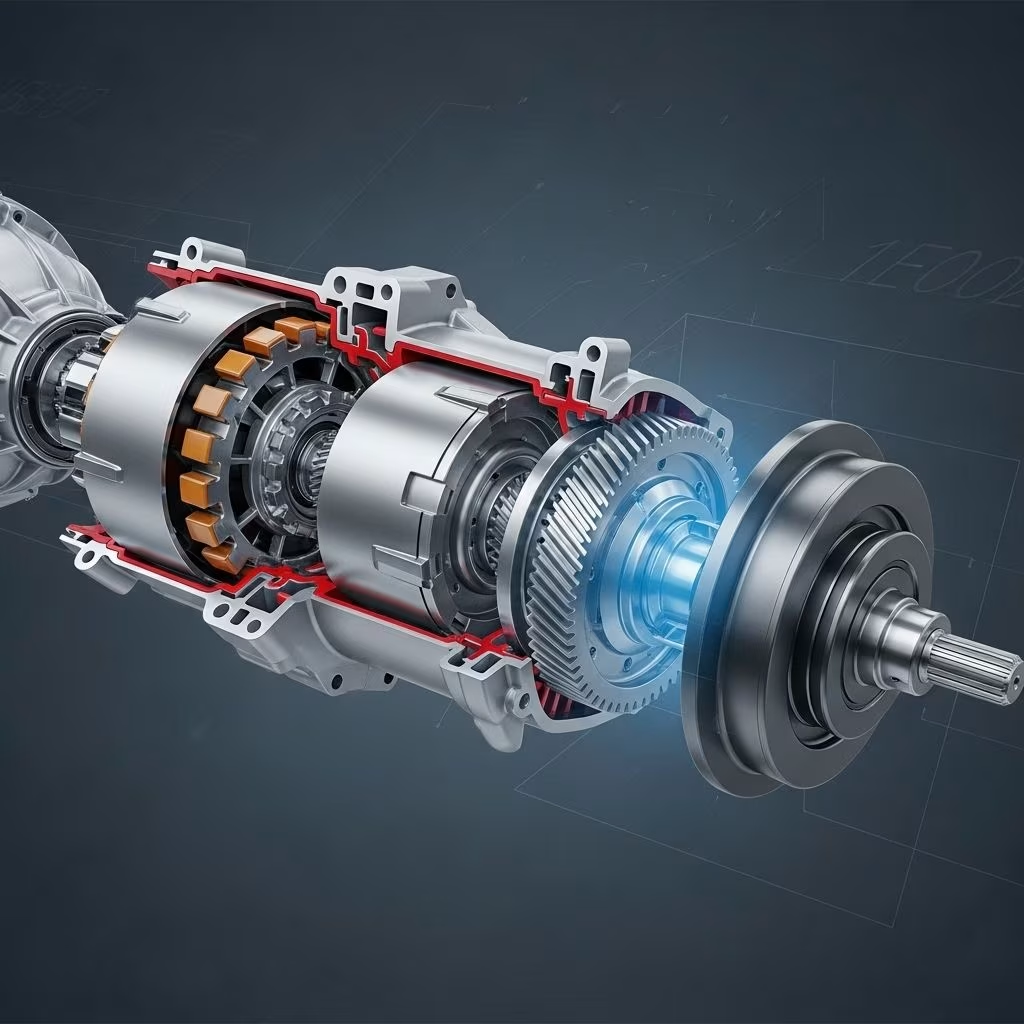
Electric vehicles (EVs) are changing the fundamentals of automotive engineering, especially when it comes to the transmission system. Unlike traditional internal combustion engine (ICE) cars, EVs often simplify or even eliminate many components found in conventional drivetrains. But do electric cars actually have transmissions? If so, how do they compare to those in gasoline-powered vehicles, and what benefits do they offer for driving dynamics, efficiency, and sustainability?
What Is a Transmission?
Before diving into electric drivetrains, it’s vital to understand the role of a transmission in a car. In any vehicle, the transmission is the mechanical system that transmits power from the engine (or motor) to the wheels. By adjusting gear ratios, it helps keep the engine operating in its optimal range of revolutions per minute (RPM), allowing for efficient acceleration, cruising, and torque delivery for different driving conditions.
- Traditional multi-speed transmissions select the best gear for the engine’s speed and vehicle load.
- Automatic and manual transmissions perform similar functions, though they differ in how gears are engaged.
- Transmissions are crucial in vehicles with ICEs because these engines have a narrow range of RPM in which they efficiently deliver torque.
How Transmissions Work in Internal Combustion Engine (ICE) Vehicles
In ICE vehicles, a transmission—often a multi-speed gearbox—connects the engine to the wheels. It matches the limited torque and power band of the engine to the demands of the road by shifting between different gear ratios:
- Multi-speed transmission: Uses several gears to keep the engine within its peak power band as speed increases or decreases.
- Manual transmission: The driver physically selects gears using a clutch and gear lever.
- Automatic transmission: Sensors and hydraulic systems shift gears based on speed and load.
- Transmissions allow ICE vehicles to accelerate, climb hills, and cruise efficiently.
- ICE engines generate torque over a specific and narrow RPM range, necessitating gear shifting for smooth and efficient operation.
How Transmissions Work in Electric Vehicles (EVs)
Unlike their gasoline counterparts, most electric vehicles don’t need multi-speed transmissions. Instead, they almost always use a single-speed transmission, sometimes referred to as a reduction gear.
- Instant torque delivery: Electric motors generate maximum torque nearly instantaneously from a standstill, unlike ICEs that must ‘ramp up’ to a torque peak.
- Wide RPM range: Many electric motors can efficiently operate anywhere from 0 up to 20,000 RPM or more.
- No gears needed for power band management: Since the motor can spin rapidly and maintain torque, a single fixed gear suffices for all normal driving conditions.
- Simple ‘gearbox’: Rather than several gears, a fixed ratio reduction gear steps down the rapid motor speed to a lower RPM for the wheels while boosting torque.
This design is not just a cost-saving measure but also improves the overall driving experience, reduces mechanical complexity, and typically results in less maintenance.
Single-Speed Transmissions: The Norm for Most EVs
The vast majority of production EVs, including popular models from Tesla, Nissan, Chevrolet, and others, use a single-speed, fixed-ratio transmission. Here’s how it works:
- The driver presses the accelerator, sending a signal to the motor controller.
- The motor controller draws power from the battery and supplies it to the electric motor.
- The electric motor’s rotating shaft turns a set of reduction gears (single-speed gearbox).
- This gearbox reduces the high-speed rotation of the motor to a manageable speed for the wheels, greatly multiplying torque at the same time.
- The output shaft connects to the differential, distributing power to the wheels. When cornering, the differential allows the wheels to spin at different speeds, just like in gas cars.
This setup allows for seamless acceleration, regenerative braking, and instant response. The system is also inherently reversible: the electric motor can easily change direction to move the car backward, which is why reverse gear is often just a button press in EVs.
Why Electric Motors Don’t Need Multi-Speed Gearboxes
- Broad torque curve: Electric motors can deliver consistent torque across a very broad speed range.
- High maximum RPMs: Unlike combustion engines, which might max out at 7,000 RPM, EV motors typically handle upwards of 15,000–20,000 RPM comfortably.
- Direct connection: The motor’s output can be efficiently matched to road wheels with just a single gear ratio, covering everything from standing starts to highway speeds.
- Simplicity: Removing the complex set of gears and shifting mechanisms reduces weight, mechanical losses, and repair costs.
Exceptions: Multi-Speed Transmissions and Their Use in EVs
While almost all EVs use single-speed transmissions, there are exceptions. Some automakers and high-performance models use multi-speed gearboxes for specific purposes:
- Performance optimization: Certain sports cars (like the Porsche Taycan) or racing EVs use two-speed gearboxes to improve acceleration at low speed and efficiency at high speed.
- Truck and commercial applications: Heavier electric vehicles sometimes use two or more gears to provide extra torque for hauling or improve range at highway speeds.
- Experimental and hybrid designs: Some future concepts and high-performance hybrids integrate multi-speed solutions to better leverage both electric and gasoline powertrains.
However, even in these cases, the gearboxes are vastly simpler than the traditional 6–8-speed automatics found in modern ICE cars.
Electric Vehicle Transmission Types Explained
| Transmission Type | How It Works | Main Use Case |
|---|---|---|
| Single-Speed (Fixed Ratio) | One gear ratio reduces high-speed motor rotation to usable wheel speed | Standard for most EVs |
| Dual-Speed | Two gears for balancing off-the-line torque and higher top speed or efficiency | High-performance models; select trucks |
| Continuously Variable Transmission (CVT) | Provides infinite ratios between set ranges; rare for pure EVs | More common in hybrids |
Transmission Systems in Plug-in Hybrids, PHEVs, and Hybrids
Not all vehicles with electric propulsion use the same drivetrain approach. Plug-in Hybrid Electric Vehicles (PHEVs) and hybrid vehicles combine a gasoline engine and an electric motor, and their transmissions are correspondingly more complex. These vehicles can use:
- Traditional multi-speed automatic or continuously variable transmissions (CVTs).
- Powersplit devices combining gear trains from both power sources.
- Electronically controlled clutches or planetary gears to shift seamlessly between power sources.
This allows for smooth blending or switching between electric-only, hybrid, or gas-only operation, but adds mechanical complexity compared to pure electric cars.
Benefits of Reduced (or Eliminated) Transmissions in EVs
- Smoother driving experience: With only a single gear, acceleration is seamless, with no breaks for shifting.
- Higher reliability: Fewer moving parts mean fewer opportunities for mechanical failure or wear.
- Lower maintenance: No gear oil changes, fewer repairs, and less susceptibility to transmission-related breakdowns.
- Improved efficiency: Less friction and reduced drivetrain losses increase range per charge.
- Enhanced packaging: Simpler drivetrain designs open up opportunities for more interior space, flat floors, and creative chassis layouts.
Are There Any Downsides to Single-Speed Setups?
The single-speed design is not without some minor compromises, though these are negligible for most drivers and outweighed by the benefits:
- Possible limited top speed: Fixed gear ratios may technically cap top speed, though this exceeds reasonable highway speeds for most vehicles.
- Efficiency at all speeds: Two or more gears could slightly improve efficiency at very low or very high speeds, especially for heavy-duty or high-performance uses.
- Towing and extreme loads: Trucks and commercial EVs sometimes require multiple gears for heavy hauling across varied terrain.
Transmission Maintenance in Electric Vehicles
Because of their simplified design, electric vehicle transmissions require significantly less maintenance. There is no clutch to replace, no gear synchronizers to wear out, and typically no fluid to change. As a result, electric cars can often go much longer between scheduled services and tend to incur lower lifetime maintenance costs.
How Do Electric Motors Reverse?
In ICE vehicles, a transmission must include a special reverse gear. In contrast, EVs simply reverse the direction the electric motor spins, achieved by changing the polarity of the electricity supplied to the motor. This means:
- Going in reverse is as simple as pressing a button or shifting a lever.
- No complex gearing or dedicated reverse mechanisms required.
Future Trends: Will Multi-Speed Transmissions Return?
Some automakers are experimenting with two-speed or more complex gearboxes in high-performance or specialty EVs. However, for the vast majority of passenger cars, vans, and even most trucks, single-speed transmissions will remain the norm due to their simplicity, efficiency, and reliability.
Frequently Asked Questions (FAQs)
Q: Do all electric cars have only one gear?
Most EVs use a single-speed reduction gear, but some performance or specialty models can have two-speed or multi-speed gearboxes for specific purposes.
Q: Why don’t electric cars need traditional transmissions?
Because electric motors provide high torque across a wide RPM range, eliminating the need for multiple gears to match engine output to vehicle speed.
Q: Is reversing in an EV different than in a gas car?
Yes. Reversing an EV typically just reverses the direction of the motor, without requiring a separate reverse gear.
Q: Are there any EVs that use multi-speed transmissions?
Yes, though they are rare. Cars like the Porsche Taycan use a two-speed gearbox to improve performance, especially at high speeds.
Q: What maintenance do EV transmissions require?
Single-speed reductions in EVs require minimal maintenance—typically much less than multi-speed transmissions in ICE vehicles, and often only require routine inspection for wear or lubrication checks.
Conclusion: Simplicity Is the Future
Electric vehicles are at the forefront of a transportation revolution, and their transmissions (or lack thereof) are a key reason why. By leveraging the unique characteristics of electric motors, most EVs deliver power more simply, efficiently, and reliably than their fossil-fueled predecessors. As electrification progresses, expect further innovations—but for most drivers, the single-gear EV is here to stay.
References
- https://www.youtube.com/watch?v=daY5TGQGLn4
- https://www.evtechnician.com/news-blog/ev-acceleration-how-transmission-works-and-why-its-unique
- https://www.youtube.com/watch?v=3gRYUYqCdEg
- https://www.mazdausa.com/resource-center/do-electric-cars-have-transmissions
- https://afdc.energy.gov/vehicles/how-do-all-electric-cars-work
- https://www.edmunds.com/electric-car/articles/do-electric-cars-have-transmissions.html