


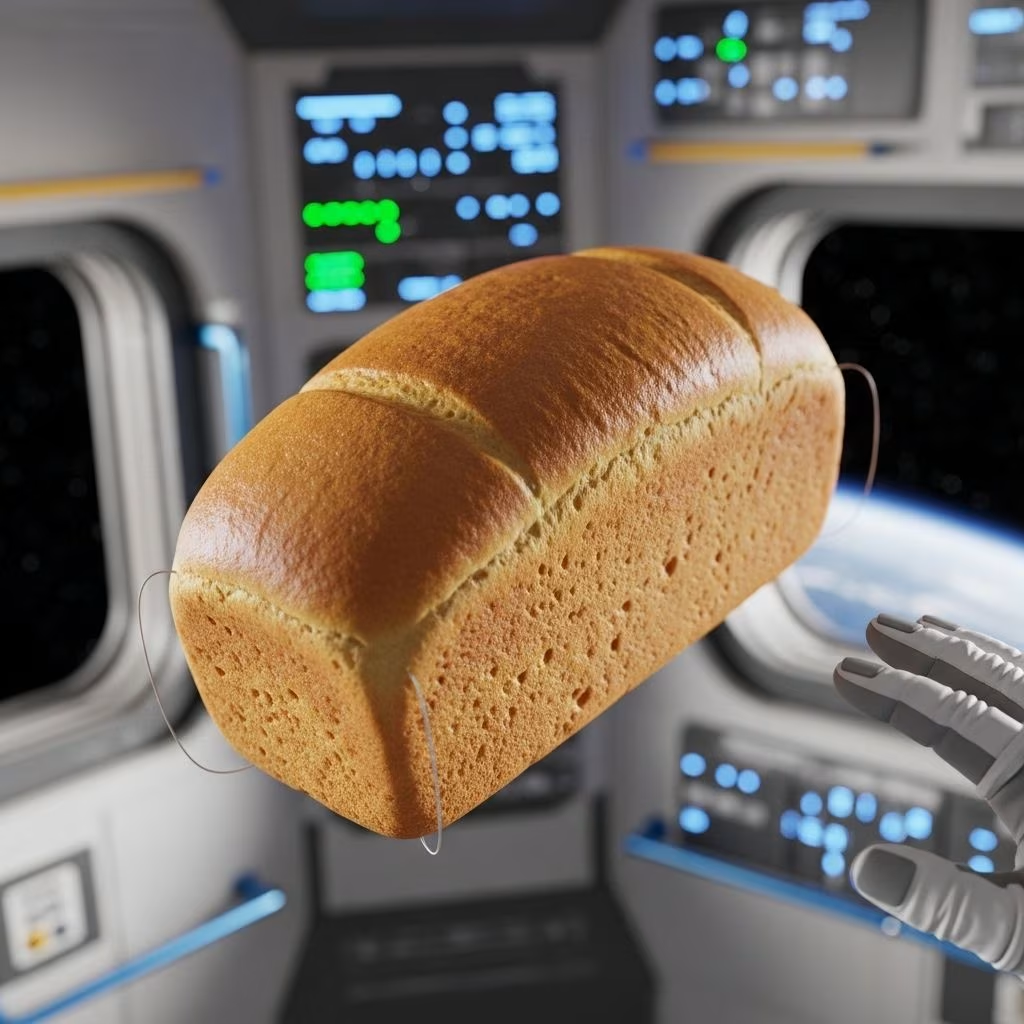
Crumb-Free Bread: A Breakthrough in Space Food Innovation
For decades, astronauts have been denied the simple comfort of fresh bread due to the unique dangers posed by crumbs in microgravity. Traditional bread, such a staple on Earth, can become an unusual threat hundreds of kilometers above our planet. Today, new technology and food science are bringing safe, satisfying bread to space—and with it, the prospect of a more enjoyable experience for astronauts on long-duration missions.
From historical anecdotes about early space sandwiches to modern advances in recipe design and baking technology, this article explores the challenges, solutions, and future possibilities of baking crumb-free bread for space exploration.
Why Crumbs Are a Problem in Space
- Equipment Hazard: In microgravity, crumbs do not fall—they float. These tiny particles can infiltrate sensitive equipment or ventilation ducts, risking malfunctions or even fire hazards.
“Bread, as we know it, is banned in space… to avoid a catastrophic, deadly fire, should crumbs drift into a spacecraft’s electrical system.”
- Health Risk: Floating crumbs can be inhaled by astronauts, causing respiratory issues or irritation.
“Because of the microgravity environment, tiny particles, such as breadcrumbs, can be a problem if they get into electrical systems and ventilation filters.”
- Cleanliness: Crumbs cannot simply be swept away. They necessitate time-consuming cleaning protocols and increase maintenance overhead.
Historic Mishaps: Corned Beef Sandwich Incident
In 1965, astronaut John Young smuggled a corned beef sandwich onto Gemini 3. The experience highlighted the problem of floating crumbs—politicians protested, and NASA doubled down on crumb prevention.
“John Young, an astronaut on NASA’s Gemini 3, famously snuck a corned beef sandwich on his space mission. … The crumbs were left floating around the cabin as the sandwich started to break apart.”
Early Solutions: How NASA Managed Bread in the Past
- Bite-Sized Cubes: Bread was precut into cubes and coated in gelatin to trap crumbs.
“Astronauts used to pre-cut their bread into bite-size cubes and coat each with gelatin to keep crumbs at bay.”
- Tortillas: Eventually, NASA swapped bread for soft tortillas, which produce fewer crumbs and are easy to store.
“…during the space shuttle era and continuing to today on the space station, tortillas took the place of loaves as the bread-product of choice.”
While functional, these approaches sacrificed the flavor, texture, and psychological comfort fresh bread provides.
Crumb-Free Bread: The Scientific Challenge
Developing bread that is safe for space involves balancing technical constraints and culinary satisfaction:
- Texture vs. Crumb Production: Tough, chewy bread resists crumbling—but this can compromise palatability.
“Bread that is tough and chewy will not produce crumbs but also won’t be to most astronauts’ tastes. ‘This is the biggest challenge,’ Florian Stukenborg … told New Scientist.”
- Recipe Innovations: Scientists have experimented with additives and dough modifications to preserve softness while reducing loose particles.
“They started with that recipe and modified it until they had a freshly baked loaf that didn’t crumble apart when consumed.”
- Baking Technology: Oven design and controlled baking environments play an essential role—for example, vacuum baking can help produce fluffier, safer bread.
“One approach being considered is a vacuum baking system, controlled on Earth but baking the bread in space, which would make it possible to bake at lower temperatures.”
Space Bread Breakthroughs: Bake In Space and Other Initiatives
Bake In Space Project
One of the most prominent recent efforts is the German-led “Bake in Space” initiative. The project aims to produce traditional-style “German bread rolls” in microgravity by leveraging:
- A special dough designed for minimal crumb formation.
- Microgravity ovens with controlled convection or vacuum environments.
- Ground-controlled baking sequences for precision and safety.
“Bake In Space will test a specially-devised dough with a microgravity oven to bake crumb-free, fresh bread in orbit for the first time.”
Researchers hope their approach will allow astronauts to enjoy authentic bread rolls—the first such taste of home in orbit.
Russian-French Cosmic Bread
In the late 1980s, the French company Lesaffre developed small, individually packaged “mini-buns” for Russian and French astronauts. These buns were engineered for flavor, long shelf-life, and crumb-free consumption.
“Lesaffre participated in a successfully executed cosmic challenge to satisfy the palates of Russian and French astronauts… mini-buns individually packaged in units of 6, weighing 7g each.”
Student Innovation: Team Space Bread
A team of students from the University of Florida designed a system for in-space bread making. Their approach utilized:
- Dough bags pre-filled on Earth with dry ingredients
- Hydration and mixing by massaging the bags in space
- Baking within a sealed bag to contain all potential crumbs
“To successfully bake bread in space, Team Space Bread first focused on a bag that could store the bread-making ingredients, mix them, allow the … The second component needed to successfully create bread for space missions was a crumb-less recipe.”
Technology and Methods for Baking Bread in Space
- Dough Engineering: Adjusting flour, yeast, and hydration to alter bread structure and reduce crumb formation.
- Vacuum or Convection Ovens: Specialized ovens that work in microgravity and can bake at lower temperatures to preserve moisture and structure.
“The scientists … said it will test several approaches during a European Space Agency mission to the International Space Station next year.”
- Packaging Solutions: Individual portions and sealed containers to ensure crumbs do not escape during consumption or storage.
| Feature | Traditional Bread | Crumb-Free Space Bread |
|---|---|---|
| Texture | Variable, often light and crumbly | Engineered to resist crumbling; denser or gelatin-coated |
| Flavor | Widely customizable | Optimized for palatability without crumbs |
| Packaging | Loose slices or loaves | Sealed, portioned mini-buns or rolls |
| Shelf Life | Short (days) | Extended (months) |
| Risk in Space | Significant (crumbs pose hazards) | Minimal, designed for safety |
The Psychological Importance of Bread in Space
Bread is more than a nutritional staple—it represents comfort, tradition, and morale. Providing astronauts with familiar foods helps support psychological wellbeing during extended missions and is vital for long-term space habitation.
- Cultural Rituals: Sharing bread is a universal tradition, and the deprivation of such simple pleasures can impact mood and social cohesion.
- Variety: Enhanced menu options improve dietary satisfaction and decrease monotony, helping astronauts cope with isolation and stress.
Extreme Applications: Beyond Space
The technology behind crumb-free bread has relevance not only for space but also for extreme environments and everyday products:
- Military rations where preservation, portability, and crumb control are essential.
- Sports nutrition for endurance athletes.
- Snack products for general consumers—e.g., individually wrapped “mini-buns” with extended shelf life.
“It serves as a reference for ‘extreme’ long-lasting bread… where food safety, portability, preservation, and enjoyment must be reconciled.”
Frequently Asked Questions (FAQs)
Q: Why can’t astronauts simply eat regular bread in space?
A: Regular bread produces crumbs, which float in microgravity and can damage equipment, pose health risks if inhaled, and create cleaning challenges.
Q: What makes crumb-free bread different from standard bread?
A: Crumb-free bread has a modified recipe and often denser texture, is sometimes coated in gelatin, and may be baked in special ovens or packaged to prevent loose particles.
Q: Has crumb-free bread been eaten on the International Space Station (ISS)?
A: Experiments such as “Bake in Space” and earlier collaborations have tested crumb-free breads on the ISS, aiming for flavorful, safe options for astronauts.
Q: Are there commercial uses for space bread technology?
A: Yes, innovations are used for military rations, sports nutrition, and long-life snack products. In China, individual mini-brioches inspired by space bread are widely sold.
Looking Ahead: The Future of Bread in Space Missions
The development of crumb-free bread represents a significant milestone in making space food safer, tastier, and more psychologically supportive. As missions become longer and private spaceflight expands, the demand for “comfort foods” will only grow.
Future advancements may include:
- Customizable recipes for personal and cultural tastes
- Automated baking modules on spacecraft
- Integration with life support and agriculture systems on long-duration missions
The ongoing pursuit to reintroduce real bread to space reflects not just technological ingenuity, but a deep understanding of human needs beyond mere survival. The journey from banned loaves to vacuum-baked, crumb-free rolls is a testament to our desire for home—even among the stars.
References
- https://www.mainstreetdailynews.com/education/uf-student-creates-space-bread_id_efe1be14-5513-11ec-8cfe-9b412344e611
- https://www.atlasobscura.com/articles/crumb-free-bread-space-gravity
- https://www.clickorlando.com/news/2017/06/13/scientists-devoloping-crumb-free-bread-on-iss/
- https://www.lesaffre.com/newsroom/partnership/bread-conquering-space-remember/
- https://www.space.com/37165-bake-in-space-microgravity-bread.html
- https://www.specialitybreads.co.uk/2017/06/20/at-last-special-bread-for-astronauts/


