


What Is Assimilation in Psychology?
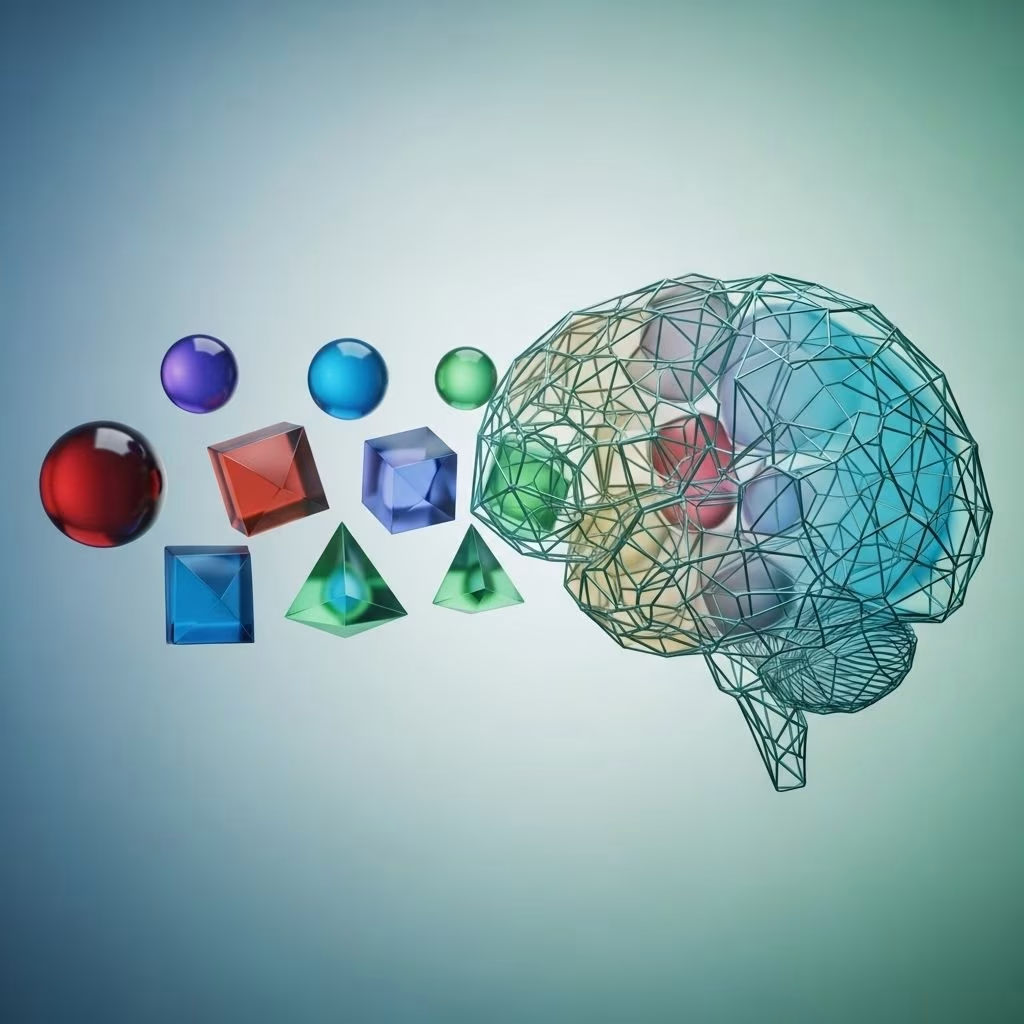
Assimilation is a core process in psychology, describing how individuals integrate new experiences and information into their existing mental frameworks or schemas. By connecting unfamiliar concepts or details to prior knowledge, assimilation allows us to quickly make sense of what we encounter in life. This mechanism plays a crucial role in learning, adaptation, and cognitive development.
- Assimilation is filing new information into pre-existing mental categories.
- It works together with accommodation, helping us adapt to new or challenging experiences.
- Introduced by psychologist Jean Piaget, assimilation explains part of how children and adults grow intellectually.
Key Concepts of Assimilation
Imagine your mind as a vast library of categorized folders: as you encounter something new—such as a friendly golden retriever—you naturally sort the experience under your existing concept of ‘dogs.’ If a new experience fits comfortably into your current understanding, you assimilate it with minimal effort. Assimilation makes it easier for us to process information quickly and efficiently.
- Assimilation is most effective when new experiences closely resemble what we already know.
- If new knowledge does not fit, cognitive discomfort or disequilibrium occurs—prompting us to change our mental categories through accommodation.
- Assimilation promotes equilibrium in our thinking by reinforcing stable frameworks for understanding the world.
How Assimilation Works in Everyday Life
Assimilation isn’t restricted to childhood—it happens throughout our lives. Here are some common examples:
- Learning that dolphins are mammals, you incorporate that fact into your existing understanding of mammals, rather than creating a new mental category.
- Tasting a new fruit and relating its sweetness to other sweet flavors you’ve already experienced.
- Encountering a new word and linking it to similar words you already know.
- A child calls a zebra a ‘horse,’ sorting based on familiar features (assimilation), until they learn the distinct differences (requiring accommodation).
Assimilation vs. Accommodation
Understanding assimilation requires a grasp of its counterpart, accommodation. Both are vital to learning and cognitive growth, but they serve distinct functions within our mental processing:
| Assimilation | Accommodation |
|---|---|
| Integrates new information into existing schemas by modifying it to fit | Changes existing schemas or creates new ones to match new information |
| Keeps existing categories stable and unchanged | Adjusts mental categories or builds new ones when old categories are insufficient |
| Used when discrepancies with existing knowledge are minor | Employed when faced with major differences or contradictions in information |
| Promotes cognitive equilibrium | Drives cognitive development by resolving disequilibrium |
Both processes often operate together, guiding us through more complex learning and adaptation. When information fits well, assimilation prevails; when it challenges existing beliefs, accommodation takes over.
Jean Piaget’s Theory: Assimilation in Cognitive Development
Jean Piaget, the pioneering Swiss psychologist, placed assimilation at the heart of his theory of cognitive development. He proposed that children and adults actively organize the world through schemas—mental structures built by experience.
- Assimilation helps individuals incorporate new details into their existing knowledge base with little effort.
- When new data conflicts with existing schemas, a state of cognitive dissonance occurs, alerting us to a gap or error.
- This motivates the person to accommodate the new information, reshaping or creating schemas as needed.
- Through both assimilation and accommodation, intellectual growth and learning progress over time.
Piaget’s model emphasizes the importance of active exploration and continued adaptation—assimilation fuels intellectual expansion, while accommodation fosters true cognitive change and development.
Examples of Assimilation in Childhood
Children are especially adept at using assimilation when interpreting new information. Common scenarios include:
- A toddler who has only seen small house dogs may call a pony encountered at a petting zoo ‘dog,’ assimilating the sight into their ‘four-legged-animal’ schema.
- A student may apply the formula for the area of a rectangle to solve for a triangle—demonstrating assimilation (though possibly resulting in error if the formula does not apply).
- A child learning to use a new word does so by associating it with similar-sounding words they’ve used before.
In these examples, assimilation offers speed and efficiency but may also lead to mistakes when the old schema no longer fits. The process of correcting and adjusting through accommodation leads to deeper understanding.
Real-World Applications of Assimilation
Assimilation’s reach extends far beyond childhood learning—it influences our daily decisions, professional growth, and social integration.
- Education: Teachers build upon students’ prior knowledge, helping them assimilate new concepts more effectively.
- Workplace: Professionals adapt new skills by comparing them to familiar tasks, easing transitions and ongoing learning.
- Intercultural Communication: Individuals moving to new countries often assimilate elements of the dominant culture into existing cultural frameworks.
- Error Correction: When assimilation leads to mistakes, reflection and feedback prompt accommodation, supporting long-term mastery.
Assimilation in Sociological Contexts
Assimilation is also a key concept in sociology and anthropology, describing how individuals or groups with different ethnic backgrounds become integrated into a dominant culture. The process may involve adopting new customs, beliefs, and social norms, though modern theories highlight how identities can coexist or blend without full absorption.
Progressive Inclusion Theory
The Progressive Inclusion Theory of Assimilation proposes that minority groups can integrate with the dominant society while maintaining elements of their original culture.
- Unlike the melting pot model—where minority identities dissolve entirely—the progressive theory recognizes cultural preservation within an inclusive society.
- Sociologists such as Milton Gordon and Talcott Parsons suggest that full assimilation includes various stages, such as acculturation and structural integration, without losing unique identities.
- This pluralistic perspective supports shared citizenship and collective identity, accommodating diversity and promoting harmony.
Differentiating Assimilation: Psychology vs Sociology
| Psychological Assimilation | Sociological Assimilation |
|---|---|
| Integrates new knowledge into existing mental schemas | Involves individuals/groups adopting dominant cultural norms |
| Focuses on cognitive development and adaptation | Focuses on social integration, identity, and citizenship |
| Driven by learning and experience | Driven by social interaction, acculturation, and inclusion |
Factors Influencing Assimilation
- Mood: Studies indicate positive mood enhances assimilation (relying on existing schemas), while negative mood prompts accommodation and schema adjustment.
- Complexity of New Information: High similarity to prior knowledge favors assimilation; major discrepancies trigger accommodation.
- Prior Experience: The richness of one’s mental frameworks accelerates assimilation in related domains.
Benefits and Drawbacks of Assimilation
While assimilation accelerates learning, it has its limitations:
- Benefits:
- Efficient incorporation of new information.
- Promotes stability and quick decision-making.
- Reduces cognitive load when facing familiar situations.
- Drawbacks:
- May result in errors or misunderstandings if new details do not fit existing schemas.
- Can limit creativity or openness to novel concepts.
- Requires accommodation for genuine development and adaptation.
Frequently Asked Questions (FAQs)
Q: What is assimilation in psychology?
Assimilation in psychology is the mental process of incorporating new information into existing schemas or knowledge frameworks.
Q: How does assimilation differ from accommodation?
Assimilation modifies new information to fit current schemas, while accommodation changes schemas to match new, often conflicting information.
Q: Who introduced the concept of assimilation?
Jean Piaget, the Swiss developmental psychologist, introduced assimilation as part of his theory of cognitive development.
Q: Can assimilation lead to errors?
Yes. If new experiences do not truly fit existing schemas, assimilation can cause misunderstandings that require accommodation to resolve.
Q: How is assimilation viewed in sociology?
In sociology, assimilation refers to the process by which individuals or groups of different ethnic background are absorbed into the dominant culture, either fully or partially. Modern theories allow for the preservation of cultural identity within inclusive societies.
Summary Table: Assimilation Highlights
| Aspect | Description | Examples |
|---|---|---|
| Definition | Incorporating new information into existing schemas | Calling a pony ‘dog’, learning new words |
| Origin | Concept by Jean Piaget | Developmental psychology |
| Benefits | Quick sense-making, cognitive stability | Fast learning and decision-making |
| Drawbacks | May perpetuate errors, limits flexibility | Misidentifying animals, incorrect application of knowledge |
| Sociological Impact | Cultural integration and identity | Acculturation, pluralistic societies |
Conclusion: The Lasting Impact of Assimilation
Assimilation is a fundamental process enabling learning, adaptation, and social cohesion across multiple domains. Whether in the development of a child, the adaptation of professionals, or the integration of diverse cultures, assimilation works hand-in-hand with accommodation—helping humans forge meaningful understanding and grow intellectually. Recognizing its strengths and limits allows educators, parents, and leaders to foster environments that encourage balanced growth and genuine personal change.
References
- https://www.explorepsychology.com/assimilation-in-psychology-definition-and-examples/
- https://www.britannica.com/science/cognitive-equilibrium
- https://www.ebsco.com/research-starters/sociology/progressive-inclusion-theory-assimilation
- https://www.britannica.com/topic/assimilation-society
- https://thedecisionlab.com/reference-guide/psychology/schemas


