


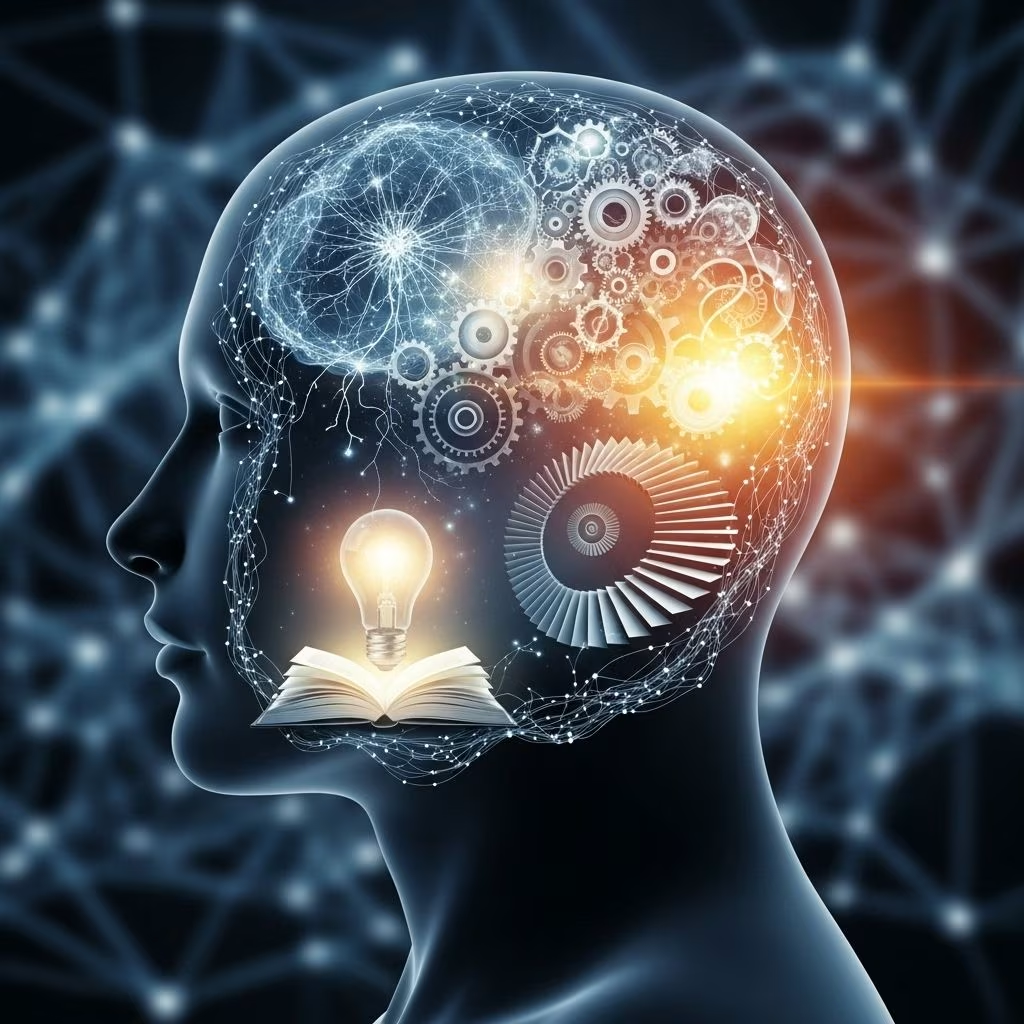
Cognitive Psychology: Exploring How We Think and Learn
Cognitive psychology is the branch of psychology focused on understanding mental processes such as perception, learning, memory, language, problem-solving, and decision-making. It studies how people receive, process, store, and retrieve information—and how these processes shape behavior and emotion.
What is Cognitive Psychology?
At its core, cognitive psychology seeks to answer how the mind operates, posing crucial questions such as:
- How do we interpret and make sense of the information around us?
- In what ways do we remember, forget, and recall experiences?
- How do our thoughts influence our emotions and actions?
- How are language and thinking connected?
- How do we solve problems and make decisions?
Cognitive psychologists study both normal and abnormal mental processes, aiming to illuminate the hidden mechanisms behind our everyday experiences.
Main Areas of Study in Cognitive Psychology
- Perception: The process by which we interpret sensory information from the environment.
- Attention: How we selectively focus on particular stimuli while ignoring others.
- Memory: The methods by which we encode, store, and retrieve information.
- Language: How we understand, produce, and use language to communicate and process information.
- Problem-Solving: Strategies and processes involved in finding solutions to challenges.
- Creativity: How new ideas and novel solutions emerge from mental processes.
Key Assumptions of Cognitive Psychology
- Humans process information consciously before deciding on a response.
- Mental processes can and should be studied scientifically, using objective experiments and evidence.
- Behavior and emotion are determined and shaped by thoughts and beliefs.
The History and Evolution of Cognitive Psychology
The exploration of mental processes dates back to ancient times, with philosophical inquiries into the mind–body distinction (dualism), the role of experience (empiricism), and the presence of innate mental faculties (nativism). However, cognitive psychology’s roots as a scientific discipline began to develop more robustly in the 20th century, as outlined below:
| Era | Focus |
|---|---|
| Ancient Times | Philosophical concepts; Plato on mind–brain connections, dualism, empiricism, nativism. |
| Pre-1950s | Behaviorism dominates; focus is on observable behavior, treating mind as a ‘black box’. |
| 1950s–1970s | The “cognitive revolution”; shift toward the scientific study of internal mental processes, influenced by advances in computer science and information theory. |
| 1980s Onwards | Integration of cognitive psychology into related fields, expansion into neuroscience, artificial intelligence, linguistics, and economics. |
This revolution allowed researchers to ask not only what people do, but how and why internal experiences shape those actions.
The Cognitive Approach: Mind as an Information Processor
The cognitive approach likens the mind to a computer—information is received, processed, and output in ways that can be mapped and understood. Unlike behaviorism, which focused solely on actions, cognition is about what happens inside the brain between receiving a stimulus and making a response. These mediating processes include:
- Encoding: Transforming external stimuli into mental representations.
- Storage: Maintaining this information in various memory systems.
- Retrieval: Accessing stored information for use.
- Decision-making: Utilizing processed information to guide behavior.
Major Cognitive Processes Explored
Perception
Perception refers to the interpretation of sensory input (sight, sound, touch, taste, and smell). Cognitive psychologists study how this information is selected, organized, and made meaningful—influencing everything from recognizing faces to reading words.
Attention
Attention determines which information we focus on and how we prioritize stimuli in complex environments. The field investigates selective attention, divided attention, and how attention impacts learning and memory.
Memory
Memory encompasses several stages:
- Sensory Memory: Brief storage of sensory information.
- Short-Term Memory (Working Memory): Holding and manipulating information for temporary use.
- Long-Term Memory: Enduring storage of knowledge, ranging from facts to skills and personal experiences.
Research in memory includes how people encode, store, recall, and sometimes forget information—with applications ranging from understanding learning disorders to treating amnesia.
Language
Language is a core topic—cognitive psychologists examine how people comprehend, produce, and learn language, as well as its relationship to thought and social interaction. This work has shaped understanding in linguistics and artificial intelligence.
Problem-Solving and Decision-Making
Problem-solving involves using existing knowledge to address new or challenging situations. Cognitive psychology explores different strategies people use, such as algorithms (step-by-step procedures) and heuristics (rules of thumb), as well as factors that contribute to errors or biases in thinking.
Creativity
This process examines how novel ideas and solutions emerge, how divergent and convergent thinking operate, and what contributes to creative breakthroughs in individuals.
Important Figures and Theories in Cognitive Psychology
- Jean Piaget: Pioneered research in developmental cognitive psychology, especially on how children construct knowledge (stages of cognitive development).
- Ulric Neisser: Considered a father of cognitive psychology, author of the influential book ‘Cognitive Psychology’ (1967).
- Aaron Beck: Developed cognitive therapy and the cognitive theory of depression, focusing on the role of negative beliefs about self, world, and future.
- Albert Ellis: Created Rational Emotive Behavior Therapy (REBT), emphasizing the impact of internal beliefs and self-statements on emotional problems.
- Noam Chomsky: Revolutionized linguistic theory by proposing that the ability to develop language is innate and universally present in humans.
Research Methods in Cognitive Psychology
- Experiments: Controlled studies testing theories about cognition through tasks and measurements.
- Neuroimaging: Technologies (e.g., fMRI, PET) allow direct observation of brain activity during cognitive processes.
- Computational Modeling: Simulating mental processes with computer algorithms to test hypotheses.
- Case Studies: Detailed investigations often involving patients with brain injury or disease (e.g., Alzheimer’s).
- Surveys and Observational Studies: Gathering data through self-report and naturalistic observation.
Applications of Cognitive Psychology
- Mental Health: Cognitive therapy uses understanding of mental processes to help treat anxiety, depression, personality disorders, substance abuse, trauma, and autism spectrum disorder.
- Education: Insights into memory and learning drive techniques for improving academic achievement and educational design.
- Artificial Intelligence: Cognitive psychological models underpin AI’s ability to recognize patterns, process language, and learn from experience.
- Neuropsychology: Studying changes in cognition resulting from brain injury or disease informs rehabilitation and care.
- Human Factors and Ergonomics: Applying cognitive research to improve user interfaces and workplace safety.
The Relationship Between Cognitive Processes and Behavior
Cognitive psychology posits that thoughts precede and inform emotions and behavior. By changing false or negative beliefs, individuals can alter their feelings and actions. This principle is foundational to cognitive-behavioral therapies and has been validated across countless studies.
Criticisms and Limitations of Cognitive Psychology
- Some argue that cognitive processes are too abstract and difficult to measure directly without relying on subjective reports.
- Critics highlight the importance of emotions, unconscious factors, social context, and learned behaviors that may not be easily explained by cognitive models alone.
- Integration with neuroscience and behavioral psychology has addressed many of these limitations, fostering a holistic approach to understanding human behavior.
The Future of Cognitive Psychology
Research continues to expand the discipline’s reach through:
- Advances in neuroimaging enabling real-time observation of brain activity.
- Growth in artificial intelligence and machine learning powered by cognitive models.
- Integration with genetics and biology for a complete picture of mind–brain interactions.
- Cross-disciplinary collaboration with linguistics, economics, philosophy, and more.
Cognitive psychology remains vital for understanding learning, innovation, clinical intervention, and the future of human–machine interaction.
Frequently Asked Questions (FAQs)
Q: What topics does cognitive psychology study?
A: Cognitive psychology explores perception, attention, memory, language, problem-solving, creativity, and decision-making.
Q: What is the difference between cognitive psychology and behaviorism?
A: Behaviorism focuses on observable behavior, while cognitive psychology investigates how internal mental processes shape both behaviors and emotions.
Q: Who are some important cognitive psychologists?
A: Jean Piaget, Ulric Neisser, Aaron Beck, Albert Ellis, and Noam Chomsky made significant contributions to cognitive psychology theories and research.
Q: How does cognitive psychology help people?
A: It guides treatments for mental health conditions such as depression, anxiety, and trauma and improves learning, memory, and problem-solving skills.
Q: What scientific methods are used in cognitive psychology?
A: Researchers use experiments, neuroimaging, computational modeling, case studies, and observational research to study cognitive processes.
Q: What are current trends in cognitive psychology?
A: The field is expanding into artificial intelligence, brain imaging, and interdisciplinary research with biology, economics, and linguistics.
References
- https://www.webmd.com/mental-health/what-is-cognitive-psychology
- https://study.com/academy/lesson/what-is-cognitive-psychology-definition-theories-quiz.html
- https://www.amu.apus.edu/area-of-study/arts-and-humanities/resources/what-is-cognitive-psychology-and-why-is-it-so-important/
- https://www.apa.org/education-career/guide/subfields/brain-science
- https://dictionary.apa.org/cognitive-psychology
- https://www.simplypsychology.org/cognitive.html
- https://en.wikipedia.org/wiki/Cognitive_psychology
- https://nmoer.pressbooks.pub/cognitivepsychology/front-matter/introduction/


