


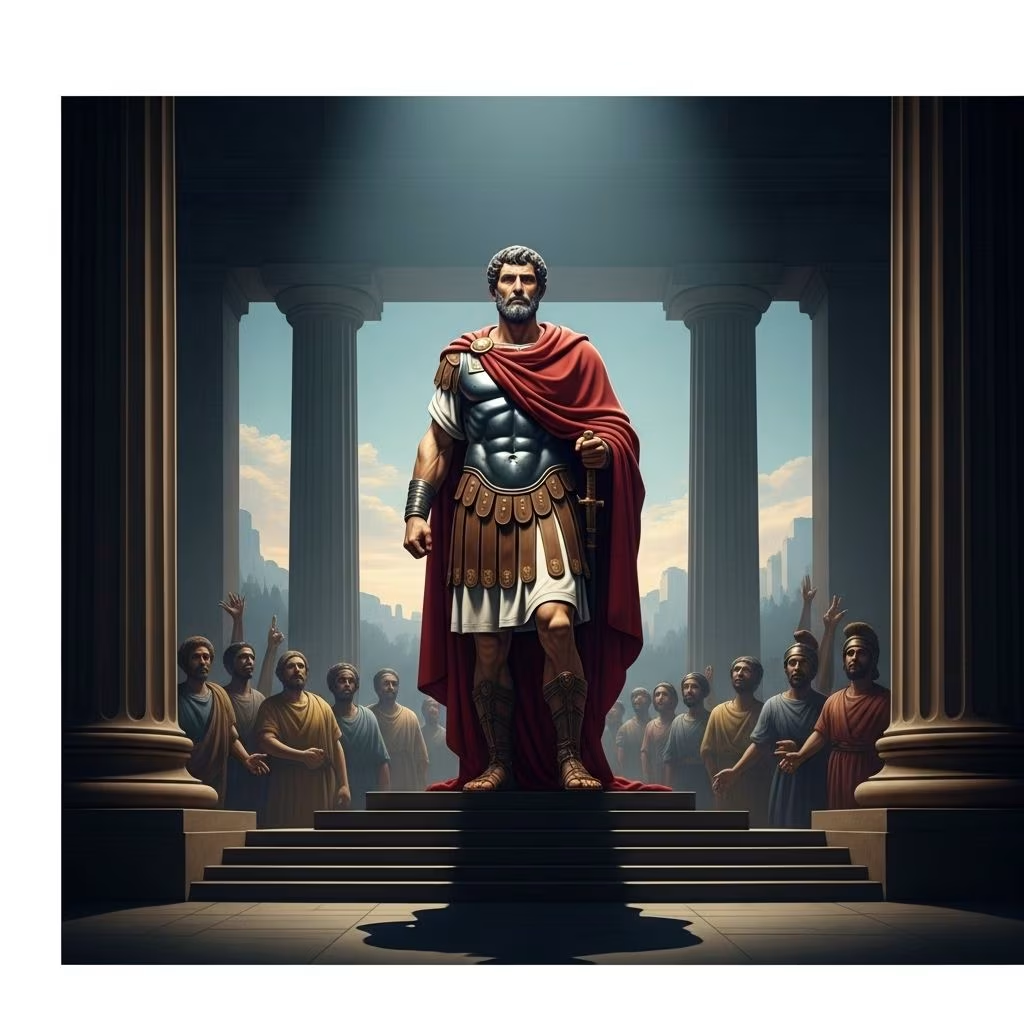
The question of what makes a great leader has fascinated historians, psychologists, and organizational theorists for centuries. Among the earliest and most influential explanations is the Great Man Theory of Leadership, a concept that has shaped how civilizations view leadership and history. This article explores the origins, fundamental ideas, notable examples, strengths, criticisms, and the enduring legacy of this influential theory.
What Is the Great Man Theory of Leadership?
The Great Man Theory of Leadership posits that leaders are born, not made. According to this perspective, individuals ascend to positions of power not through their actions, experiences, or environment, but because they possess inherent traits and qualities that predispose them to authoritative roles. These supposedly innate characteristics—such as intelligence, charisma, courage, and decisiveness—define someone as a “great man” destined for leadership.
- Leadership as an inborn trait rather than a learned skill
- Focuses on qualities granted at birth, not acquired through life experience
- Historical approach to understanding why certain individuals influence major events
According to the Great Man Theory, the course of history is largely shaped by the actions and decisions of these remarkable individuals, who emerge as leaders during pivotal moments12.
Origins and Historical Context
Thomas Carlyle, a 19th-century Scottish historian, philosopher, and writer, is widely credited with popularizing the Great Man Theory. His influential work, On Heroes, Hero-Worship, and the Heroic in History (1841), laid the groundwork for viewing history through the lens of outstanding individuals whose unique characteristics allow them to rise above their peers.
The theory took hold in the context of 19th-century historical studies, an era attuned to the impact of singular figures—in politics, religion, philosophy, and warfare—on the arc of civilization. Carlyle suggested that the biographies of these heroes, rather than social movements or widespread trends, could explain the shape of history4.
- Thomas Carlyle’s lectures introduced the hero archetypes: Divinity, Prophet, Poet, Priest, King, and Man of Letters
- Emphasized the “deity-like” perception of leaders
- Aligned with the prevailing belief in inherent superiority among noble or exceptional individuals
Key Proponents
- Thomas Carlyle: Originator and principal advocate
- Herbert Spencer: Later challenged the theory, emphasizing the role of societal context
- 19th-century historians and social commentators
Core Principles and Assumptions
The Great Man Theory is underpinned by several core ideas:
- Innate Leadership Qualities: Leaders possess natural attributes—such as charisma, intelligence, and courage—that set them apart from ordinary people.
- Deterministic View: Destiny or fate compels these gifted individuals to positions of authority when circumstances require extraordinary action.
- Universal Applicability: The theory does not confine leadership ability to any one era, society, or profession; “Great Men” can arise as military commanders, political leaders, religious figures, or innovators.
- Nature over Nurture: Environmental influences and education play a secondary role compared to inherent traits12.
Examples of the Great Man Theory in Practice
Carlyle and other proponents cited historical figures as evidence that great leadership springs from natural endowment. Some commonly referenced examples include:
| Name | Field | Key Traits | Historical Impact |
|---|---|---|---|
| Abraham Lincoln | Political Leadership | Integrity, determination, compassion, eloquence | Led the United States through Civil War; abolished slavery |
| Napoleon Bonaparte | Military Leadership | Strategic genius, ambition, charisma | Redrew the map of Europe; influenced legal codes and military strategy |
| Steve Jobs | Business/Innovation | Vision, drive, ability to inspire | Transformed technology and design at Apple Inc. |
| Mahatma Gandhi | Political/Philosophical | Resolve, charisma, nonviolent philosophy | Led India’s independence movement |
| Alexander the Great | Military Leadership | Tactical brilliance, boldness, leadership presence | Conquered vast territories across three continents |
These figures are remembered as individuals whose traits seemed to predestine them for leadership and whose insights or abilities allowed them to alter the course of history12.
Strengths of the Great Man Theory
Despite modern criticism, the Great Man Theory offers several points in its favor:
- Simplicity and Clarity: Offers an easily understandable framework for why some people become leaders.
- Inspiration: Encourages admiration and emulation of admired qualities in notable leaders.
- Historical Focus: Emphasizes the powerful impact of individual agency and decision-making in shaping world events1.
- Promotes Heroism: Positions leadership as a calling or destiny, which can motivate those who identify with these archetypes to pursue meaningful change.
Criticisms and Limitations
The Great Man Theory has drawn significant criticism, both in its original era and today, for a number of fundamental shortcomings:
- Overly Deterministic and Individualistic: The theory ignores the influence of context, environment, and societal structures on the development of leaders.
- Exclusionary Perspective: Views leadership through a masculine and elitist lens. Historically, it excluded women and anyone not born into certain classes or backgrounds.
- Lack of Empirical Support: Research suggests that leadership can be taught and that situational factors often produce leaders from ordinary circumstances.
- Ignores Skill Development: Devalues learning, experience, skill acquisition, and mentorship as pathways to leadership.
- Underestimates Collective Effort: Fails to recognize the contributions of groups, social movements, or cultural forces in shaping outcomes23.
As leadership studies evolved, theorists began to emphasize traits, behaviors, context, and diverse leadership models, moving away from the “great man” paradigm.
Legacy and Influence on Modern Leadership Theories
Although the Great Man Theory is considered outdated, it has played a pivotal role in the evolution of leadership theory. Its legacy includes:
- Foundation for Trait Theories: Inspired early 20th-century research into specific characteristics shared among successful leaders.
- Contrast with Modern Approaches: The shortcomings of the Great Man Theory prompted the rise of behavioral, situational, and transformational leadership models, which recognize the importance of learning and adaptation.
- Enduring Popularity in Culture: The idea of “natural-born leaders” continues to influence popular discourse and how leadership is portrayed in history books, media, and professional settings.
Today, leadership is often viewed as a complex interplay of personal attributes, environmental influences, social context, and acquired skills.
Comparison: Great Man Theory vs. Other Leadership Theories
| Theory | Key Features | Strengths | Weaknesses |
|---|---|---|---|
| Great Man Theory | Leadership as inborn trait; “leaders are born, not made” | Simple, focuses on individual agency | Overly deterministic, ignores situational and social factors |
| Trait Theory | Identifies specific personality traits common among leaders | Acknowledges variation among leaders, more flexible | Traits not always predictive; ignores learning and environment |
| Behavioral Theory | Leadership is about actions and behaviors, not just traits | Highlights learnable skills | May downplay personality or context |
| Situational Theory | Leadership effectiveness depends on situational factors | Adapts to context and diversity | Complex, hard to generalize |
Frequently Asked Questions (FAQs)
What is the core idea behind the Great Man Theory?
The core idea is that leadership qualities are innate and that individuals are born with the traits necessary to become great leaders, rather than acquiring them through education or experience.
Who developed the Great Man Theory?
The theory was first articulated and popularized by Thomas Carlyle in the mid-19th century, particularly in his book On Heroes, Hero-Worship, and the Heroic in History.
Can anyone become a leader according to the Great Man Theory?
No, the theory holds that only those born with exceptional inherent traits can rise to true leadership, implicitly excluding the majority of people.
Why is the Great Man Theory criticized today?
Modern critics argue that it is overly simplistic, exclusionary, and ignores the role of environment, learning, and collective effort in the development of leadership abilities.
Is the Great Man Theory still relevant in leadership studies?
While no longer accepted as a complete explanation, its influence can still be seen in discussions that emphasize natural talent over cultivated skill. It serves primarily as a historical reference in the evolution of leadership theory.
Key Takeaways
- The Great Man Theory asserts that leaders are born, not made, and that history is shaped by “great men” with unique traits.
- Popularized in the 19th century, especially through the writings of Thomas Carlyle.
- Has inspired the development of other leadership theories while also attracting criticism for ignoring context and inclusion.
- Modern leadership studies take a more nuanced and multifaceted view, balancing traits, behaviors, situations, and collaborative influences.
Understanding the Great Man Theory offers valuable insights into how perceptions of leadership have evolved and highlights the complexities of what it truly means to lead.


