


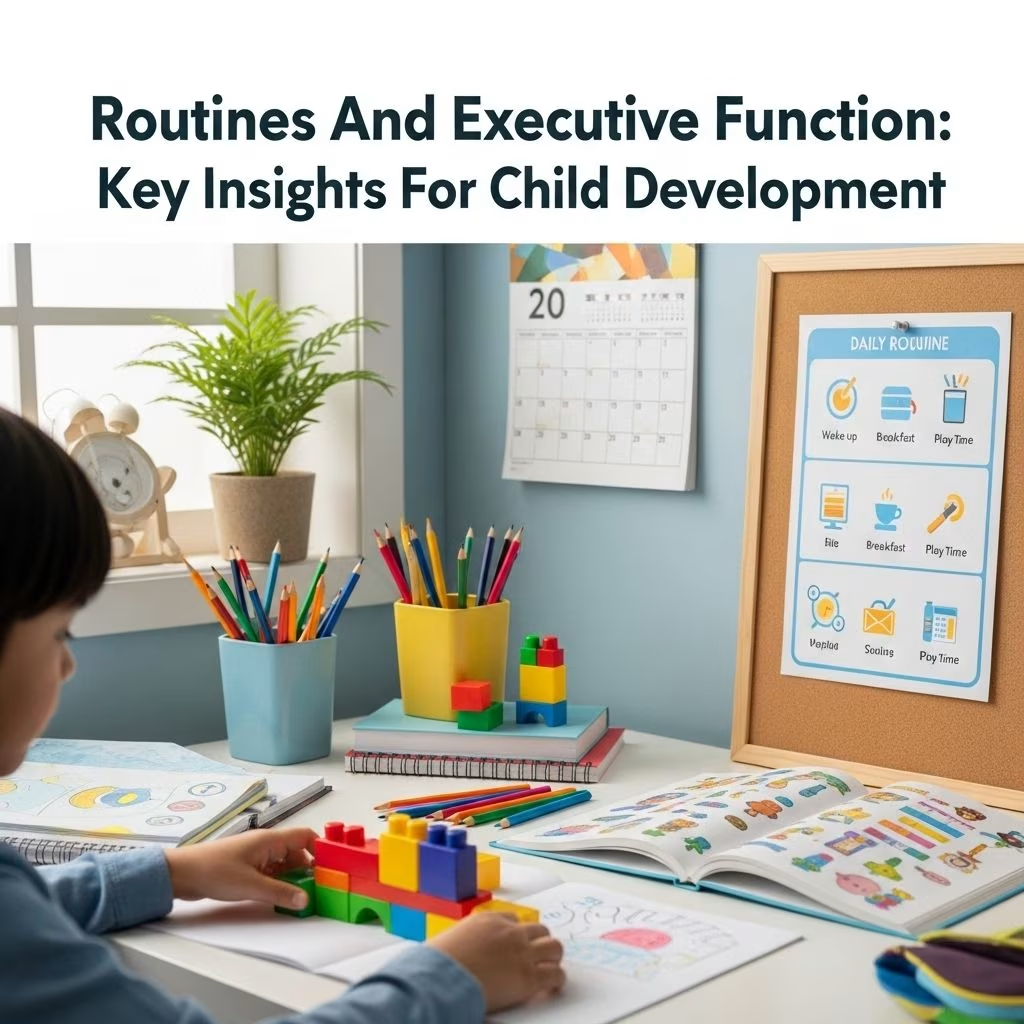
Executive function is a foundational set of cognitive abilities that allow children to regulate their thoughts, emotions, and behaviors, enabling successful adaptation to everyday challenges. Recent research increasingly illustrates the pivotal influence of daily routines on executive function development, impacting academic, socio-emotional, and long-term life outcomes.
Introduction
Executive function (EF) comprises various cognitive processes essential for self-regulation, decision-making, and problem-solving in children. These skills underlie the child’s ability to follow instructions, control impulses, remain focused, and adapt to new situations. Establishing healthy daily routines has emerged as a practical, research-backed pathway for scaffolding the development of these crucial abilities, with implications spanning education, family life, and clinical intervention.
Understanding Executive Function in Children
Executive function in childhood is typically recognized as a multidimensional construct with three primary components:
- Working memory: The capacity to hold and manipulate information in mind over short periods.
- Inhibitory control: The ability to suppress automatic, impulsive responses in favor of more appropriate behaviors.
- Cognitive flexibility: The skill to switch perspectives, change approaches, and adapt strategies according to shifting demands and rules.
In addition, more complex or “hot” executive functions, such as affective decision-making and delay of gratification, interact with emotions and motivation, adding layers of regulation to children’s experiences in everyday life.
Key Outcomes Linked to Strong Executive Function
- Enhanced academic achievement (especially in math and literacy)
- Improved social-emotional competence
- Greater ability to set and achieve goals
- Better long-term mental health and life success
Research consistently finds that children with well-developed executive function are more engaged in positive learning and social opportunities, as well as less likely to exhibit disruptive behaviors.
Executive Function: Neuroscientific Foundations
Neuroscience research identifies the prefrontal cortex (PFC) as the brain region most involved in executive function. This area undergoes rapid development in childhood, but does not reach full maturity until late adolescence or early adulthood. Connections between the PFC and other brain regions (such as the amygdala) support emotion regulation and adaptive behavior.
Key neuroscientific findings on executive function development:
- The PFC matures gradually; young children are less able to adapt flexibly or inhibit impulses compared to older children.
- Children’s ability to adjust to new rules or contexts (such as changes in a card game’s rules) improves with age.
- Biological and environmental factors, including the presence of supportive adults and structured experiences, shape the pace and trajectory of EF development.
The Relationship Between Routines and Executive Function
Routines consist of predictable, structured sequences of activities embedded in daily life—such as morning rituals, mealtimes, transitions, homework sessions, and bedtime preparations. Research demonstrates that consistent routines foster developmentally appropriate opportunities for practicing executive function skills in authentic contexts.
Mechanisms Linking Routines and Executive Function
- Repetition creates predictability, reducing stress and cognitive overload, and allowing children to better focus on mastering tasks.
- Sequencing routines encourages planning, working memory, and cognitive flexibility as children recall and execute multi-step procedures.
- Adhering to routines requires self-control and adjustment to external expectations, building inhibitory control over time.
- Routines structure transitions, supporting children in switching from one activity to another—a direct application of cognitive flexibility.
- Routines enable self-directed action as children internalize steps and gradually require less external prompting, supporting self-regulation and autonomy.
Without consistent routines, children may face excessive unpredictability, undermining their ability to develop core executive skills, regulate their emotions, and manage daily responsibilities.
Developmental Trajectory of Executive Function Skills
Executive function abilities develop swiftly in early childhood and continue strengthening through adolescence:
- Infancy to Preschool: Simple routines like feeding, napping, and play promote anticipation and basic regulatory capacities.
- Preschool Years: Children begin to remember rules, suppress impulses, and plan basic sequences (e.g., getting dressed). Those with better inhibitory control show higher social-emotional competence and classroom engagement.
- Middle Childhood: Working memory, cognitive flexibility, and complex inhibition improve, allowing children to tackle multi-step academic and social challenges. Routines such as homework time, chores, and extracurricular activities fuel more advanced executive processes.
- Adolescence: Skills are fine-tuned as routines become more internally managed; the role of external structure shifts toward self-motivation and goal-setting.
Profiles and Individual Differences in Executive Function
A person-oriented approach recognizes that children vary widely in their executive function strengths and growth patterns. Recent research categorizes EF profiles into subgroups based on performance across core domains:
| Profile | Defining Features | Long-term Outcomes |
|---|---|---|
| All-average | Balanced abilities across all EF facets | Generally positive development |
| Low-delay | Struggles mainly with delay of gratification | Potential impulsivity, social-emotional challenges |
| Regulated-decision-making | Strong decision-making, but later difficulties in planning/organizing | May require scaffolding for complex tasks |
| Low-inhibition | Difficulty resisting distractions/impulses | Risk for behavioral challenges and academic struggles |
Individual differences can be observed as early as preschool and are shaped by age, gender, socioeconomic status, language background, and processing speed. Personalized support is crucial in designing effective routines that address these unique profiles.
Interventions and Strategies: How Routines Enhance Executive Function
Examples of Routine-Based Executive Function Supports
- Creating visual schedules or checklists for morning, after-school, and bedtime routines.
- Practicing role-play or games involving turn-taking, waiting, and rule-switching to foster cognitive flexibility.
- Assigning age-appropriate chores that require planning, remembering steps, and completing tasks to build working memory and self-monitoring.
- Implementing transition rituals (e.g., songs, countdowns) between activities to smooth shifts and boost adaptability.
- Gradually increasing responsibility as children demonstrate competence, reducing external prompts to foster self-regulation.
Practical Tips for Parents and Educators
- Maintain consistent bedtime and wake-up routines to anchor the day and support circadian regulation.
- Break down tasks into manageable steps with visual or verbal cues.
- Encourage reflection after routine completion (“What helped you remember each step?”).
- Provide positive feedback and gentle reminders rather than punitive responses to lapses.
- Adapt routines as the child grows, promoting both challenge and achievable independence.
Cultural and Environmental Considerations: Home and School Connections
Executive function and the routines that support its development do not occur in a vacuum. Rather, cultural values, family structure, and environmental stability play influential roles:
- Home: Family rituals and predictable mealtime, leisure, and bedtime patterns provide children with security and “practice fields” for executive skill-building.
- School: Predictable routines help children focus on learning and navigate social interactions; flexible adaptation by educators bridges the gap between home and classroom expectations.
- Socioeconomic context: Children from disadvantaged backgrounds may face disruption in routines, requiring schools and community organizations to provide enriched, structured exposures that compensate for instability.
A balanced, responsive approach recognizing each child’s context is essential for promoting equitable executive function development.
Implications for Research, Policy, and Practice
Understanding the interplay of routines and executive function in childhood has several key implications:
- Research: More studies are needed on how specific routine elements (e.g., timing, sequencing, flexibility) relate to EF growth across cultural and socioeconomic settings.
- Policy: Early childhood education policies should prioritize routine-based skill building and professional development for caregivers and educators.
- Practice: Schools and families can integrate research-based strategies to foster EF, tailor interventions for children with distinct profiles, and ensure long-term support for regulatory skill development.
Emerging evidence even challenges the view of executive function as entirely “innate,” instead underlining the transformative role of environment and education—placing daily routines at the heart of developmental science and intervention.
Frequently Asked Questions (FAQs)
Q: What are the three core executive function skills?
A: The three core executive function skills are working memory, inhibitory control, and cognitive flexibility. These are essential for goal-directed behaviors and adapting to new situations.
Q: How do routines help children develop executive function?
A: Routines offer consistent, repetitive opportunities for children to practice EF skills such as planning, following steps, transitioning between activities, and controlling impulses in supportive, low-stress contexts.
Q: At what age do executive function skills start to develop?
A: EF skills emerge in infancy and develop rapidly through the preschool years, continuing to mature into adolescence and early adulthood, shaped by both biology and environment.
Q: Are there differences in executive function development among children?
A: Yes, children differ due to genetics, temperament, family routines, socioeconomic factors, and educational experiences. Personalized support is crucial for optimal EF development.
Q: What can parents and teachers do to help improve executive function in children?
A: Parents and teachers can provide predictable routines, model goal-oriented behavior, use visual schedules, encourage self-reflection, and tailor challenges to the child’s development level.
References
- https://www.naeyc.org/resources/pubs/yc/summer2024/executive-function-games
- https://www.tandfonline.com/doi/full/10.1080/15248372.2023.2188946
- https://www.frontiersin.org/journals/psychology/articles/10.3389/fpsyg.2024.1379126/full
- https://pmc.ncbi.nlm.nih.gov/articles/PMC6051751/
- https://developingchild.harvard.edu/resource-guides/guide-executive-function/
- https://www.nature.com/articles/s41562-024-02000-9
- https://news.harvard.edu/gazette/story/2025/07/taking-a-second-look-at-executive-function/


