


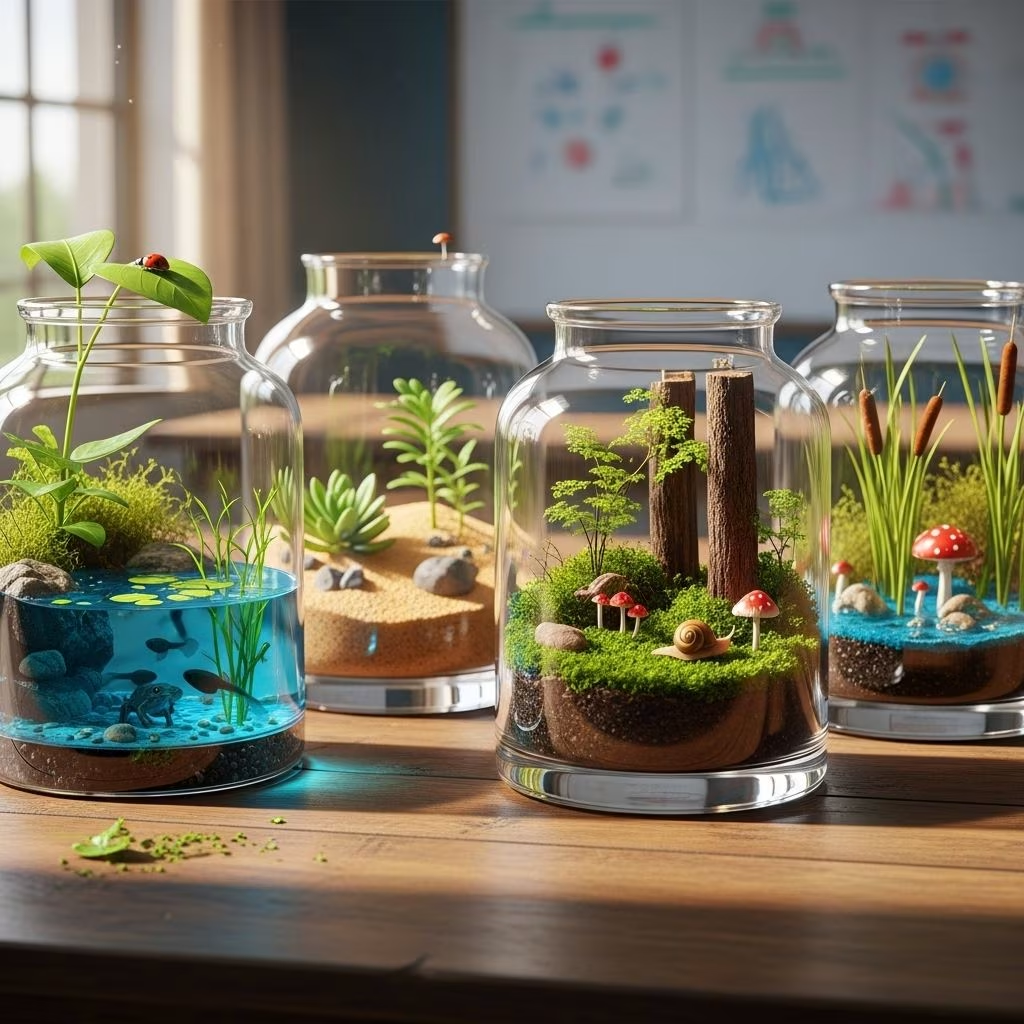
Teaching fourth-grade students about micro-ecosystems opens a fascinating window into the natural world that exists right beneath their feet. Micro-ecosystems, or small-scale ecological communities, provide an accessible and engaging way for young learners to understand complex ecological concepts. This comprehensive lesson explores how educators can effectively introduce micro-ecosystem concepts to fourth graders through hands-on exploration, observation, and scientific inquiry.
Understanding Micro-Ecosystems in Elementary Education
A micro-ecosystem represents a small, self-contained ecological unit where living organisms interact with their non-living environment. For fourth-grade students, these miniature worlds serve as perfect laboratories for understanding broader ecological principles. Whether examining a rotting log, a small pond, a patch of soil, or even a classroom terrarium, students can observe the intricate relationships between organisms and their environment on a manageable scale.
The study of micro-ecosystems aligns perfectly with fourth-grade science standards, which emphasize understanding how living things interact with their environment. Students at this developmental stage possess the cognitive ability to grasp cause-and-effect relationships while still maintaining the wonder and curiosity necessary for scientific exploration. By focusing on micro-ecosystems, educators can bridge abstract ecological concepts with concrete, observable phenomena that students can investigate firsthand.
Micro-ecosystems contain the same fundamental components as larger ecosystems: biotic factors like plants, animals, and microorganisms, and abiotic factors such as water, sunlight, temperature, and soil. The difference lies in scale, making these systems ideal for classroom study. Students can manipulate variables, conduct experiments, and witness ecological processes unfold in real-time, providing invaluable learning experiences that textbooks alone cannot deliver.
Essential Concepts for Fourth Grade Learning
Before embarking on micro-ecosystem exploration, students must grasp several foundational concepts. The distinction between living and non-living components forms the bedrock of ecological understanding. Living things require food and water and go through birth, growth, and death cycles. Seeds, insects, and plants exemplify living organisms, while rocks, water, and sunlight represent non-living elements that nonetheless play crucial roles in ecosystem function.
Fourth graders should understand that ecosystems consist of interconnected parts where each component influences others. This systems thinking represents a significant cognitive leap for students accustomed to linear cause-and-effect relationships. Micro-ecosystems provide tangible evidence of these connections, allowing students to trace how changes in one component ripple through the entire system.
Energy flow and matter cycling constitute another critical concept. Students learn that energy originates from the sun and flows through ecosystems via food chains and food webs, while matter cycles continuously through decomposition and nutrient recycling. Producers, consumers, and decomposers each play distinct roles in maintaining ecosystem balance, and micro-ecosystems showcase these roles in miniature.
Planning Your Micro-Ecosystem Lesson
Effective micro-ecosystem lessons require thoughtful planning and preparation. Begin by establishing clear learning objectives that align with grade-level standards and your curriculum goals. Students should be able to identify biotic and abiotic components, explain interactions between organisms, describe energy flow through food chains, and recognize the importance of decomposers in nutrient cycling.
Materials preparation involves gathering both observational tools and ecosystem samples. Students need magnifying glasses, observation journals, rulers, thermometers, and data collection sheets. For ecosystem samples, consider multiple options: sealed terrariums, open compost bins, aquatic micro-ecosystems in jars, or designated outdoor plots on school grounds. Each type offers unique learning opportunities and challenges.
Safety considerations merit careful attention when working with living organisms and outdoor environments. Establish clear protocols for handling organisms respectfully, washing hands after outdoor activities, and identifying potentially harmful plants or insects. Create guidelines for ethical treatment of living things, emphasizing observation over disruption and returning organisms to their natural habitats when studies conclude.
Hands-On Exploration Activities
The heart of micro-ecosystem education lies in direct student engagement with living systems. Start with a schoolyard exploration where students identify biotic and abiotic components in their immediate environment. Provide boundary markers for small study plots approximately one square meter in size. Students work in teams to catalog everything they observe within their designated area, distinguishing between living and non-living elements.
Extend this initial exploration by having students select specific micro-habitats for deeper investigation. Options include examining leaf litter, investigating soil samples, studying puddles or small water features, or observing the underside of logs or rocks. Students should document their observations through drawings, written descriptions, photographs, and data tables. Encourage them to record not just what they see, but also questions that arise during their investigations.
Building classroom micro-ecosystems provides ongoing observation opportunities. Worm composters offer excellent examples of decomposition in action. Students can construct simple composters using plastic containers, bedding material, red wiggler worms, and fruit and vegetable scraps. Over several weeks, they observe how worms break down organic matter, converting garbage into nutrient-rich soil. This tangible demonstration of matter cycling helps students understand the critical role decomposers play in ecosystem function.
Aquatic micro-ecosystems in jars present another engaging option. Students collect pond water, aquatic plants, and small invertebrates, then maintain these ecosystems in clear containers. Daily observations reveal population changes, organism behaviors, and the delicate balance required to sustain life. These closed or semi-closed systems demonstrate how ecosystems require specific conditions and how disruptions can cascade through the entire community.
Developing Scientific Observation Skills
Micro-ecosystem exploration provides ideal opportunities for cultivating scientific observation and documentation skills. Teach students to distinguish between observations and inferences, helping them recognize the difference between what they directly perceive and what they conclude based on evidence. Model detailed observation by describing color, size, shape, texture, movement, and behavior using specific, measurable terms rather than vague generalizations.
Implement structured observation protocols using field journals or data sheets. Students should record the date, time, location, weather conditions, and specific observations for each investigation session. Encourage them to use drawings alongside written descriptions, as visual representations often capture details that words miss. Teach proper scientific illustration techniques, including labels, scale indicators, and attention to accurate proportions.
Incorporate quantitative data collection to develop mathematical skills alongside scientific ones. Students can count organism populations, measure temperature and moisture levels, calculate percentages of ground cover by different plant species, and graph changes over time. These quantitative methods transform casual observation into rigorous scientific investigation, preparing students for more advanced science work in higher grades.
Teaching Food Chains and Energy Flow
Micro-ecosystems provide concrete contexts for understanding abstract energy flow concepts. Begin by identifying producers within the micro-ecosystem, the organisms that manufacture their own food through photosynthesis. Plants, algae, and some bacteria fulfill this role, converting solar energy into chemical energy stored in organic compounds.
Next, help students identify consumers at various levels. Primary consumers, or herbivores, eat producers directly. Secondary consumers, carnivores or omnivores, eat primary consumers. Students can construct food chains representing energy transfer within their micro-ecosystem, using arrows to show the direction of energy flow. Emphasize that energy moves from producers to consumers but decreases at each level, with most energy lost as heat.
Expand the concept from simple food chains to complex food webs, reflecting the reality that most organisms eat multiple food sources and are eaten by multiple predators. Have students create food web diagrams for their micro-ecosystems, drawing connections between all feeding relationships they identify or infer. Discuss what might happen if one organism disappeared from the web, helping students understand interdependence and ecosystem stability.
Exploring Organism Relationships
Within micro-ecosystems, organisms engage in various relationships beyond simple predator-prey interactions. Introduce students to three key relationship types: mutualism, where both organisms benefit; commensalism, where one benefits and the other remains unaffected; and parasitism, where one benefits at the expense of the other. Challenge students to identify examples of each relationship type within their study ecosystems.
Competition represents another crucial interaction affecting ecosystem dynamics. Organisms compete for limited resources including food, water, space, and sunlight. Students can design simple experiments to demonstrate competition, such as planting seeds at different densities and observing how crowding affects plant growth and survival.
Decomposition deserves special attention as a process often overlooked in elementary science education. Set up decomposition experiments where students bury different materials, both organic and inorganic, then periodically excavate and examine them. Apple cores, leaves, paper, and plastic provide interesting comparisons. Students discover which materials decompose and begin understanding how decomposers recycle nutrients back into ecosystems.
Integrating Technology and Research
Modern technology enhances micro-ecosystem exploration in numerous ways. Digital cameras and tablets allow students to document their observations with photographs and videos, creating multimedia presentations of their findings. Time-lapse photography can capture slow processes like plant growth or decomposition, making invisible changes visible and engaging.
Online research supplements direct observation by providing information about organism identification, life cycles, and ecological roles. Students can use field guides, educational websites, and apps to identify unknown organisms in their micro-ecosystems. This research integration teaches valuable information literacy skills while expanding knowledge beyond what direct observation alone reveals.
Data visualization tools help students analyze and present their findings. Simple graphing programs allow students to create charts showing population changes, temperature fluctuations, or decomposition rates over time. These visual representations make patterns and trends evident, supporting data-driven conclusions about ecosystem function.
Assessment Strategies and Learning Evaluation
Comprehensive assessment of micro-ecosystem learning encompasses multiple approaches. Pre-assessment establishes baseline knowledge and identifies misconceptions requiring attention. Simple surveys asking students to define ecosystems, distinguish living from non-living things, and explain food chains reveal existing understanding and guide instructional focus.
Formative assessment occurs throughout the unit, providing ongoing feedback to both teachers and students. Observation journals serve as formative assessment tools, showing whether students accurately identify organisms and their interactions. Teacher conferences during exploration time allow educators to probe student thinking through targeted questions and provide immediate guidance.
Performance-based assessments evaluate practical skills and application of knowledge. Task students with creating accurate food webs for their micro-ecosystems, designing experiments to test ecosystem variables, or explaining what might happen if specific organisms were removed. These authentic assessments measure deeper understanding than traditional tests can capture.
Summative assessment at the unit’s conclusion measures overall learning gains. Compare pre and post-assessment results to document growth in student understanding. Include multiple question types addressing different cognitive levels, from simple recall of vocabulary to complex application and analysis of ecosystem scenarios.
Differentiation and Inclusive Instruction
Effective micro-ecosystem lessons accommodate diverse learners through thoughtful differentiation. For students requiring additional support, provide graphic organizers that structure observations, vocabulary lists with visual representations, and simplified data collection sheets. Pair struggling students with peer mentors during outdoor investigations and offer frequent check-ins to ensure comprehension.
Challenge advanced learners with extension activities that deepen investigation. These students might research specific organisms in greater depth, design and conduct independent experiments, create detailed ecosystem models, or investigate how human activities affect local ecosystems. Encourage them to develop and answer their own research questions rather than simply completing assigned tasks.
English language learners benefit from vocabulary support, visual aids, and opportunities to demonstrate understanding through multiple modalities. Pre-teach key vocabulary with visual representations and real examples before introducing concepts. Allow students to label diagrams, create visual food webs, or explain concepts in their native language before translating to English.
Connecting to Broader Environmental Concepts
Micro-ecosystem study provides a springboard for exploring larger environmental issues appropriate for fourth-grade understanding. Discuss how the principles observed in micro-ecosystems apply to larger systems, from local forests and wetlands to global biomes. Help students recognize that the same fundamental processes operate at all scales, though complexity increases with system size.
Introduce age-appropriate discussions about human impacts on ecosystems. Students can investigate how pollution affects micro-ecosystems through simple experiments, examine how habitat destruction influences organism populations, or explore conservation efforts protecting local ecosystems. These connections foster environmental awareness and stewardship attitudes essential for future conservation.
Emphasize sustainability concepts by examining how healthy ecosystems maintain balance over time. Discuss limiting factors that control population growth, the importance of biodiversity for ecosystem resilience, and how disruptions can trigger cascading effects throughout interconnected communities. These foundational concepts prepare students for more sophisticated environmental science in later grades.
Extending Learning Beyond the Classroom
Micro-ecosystem exploration naturally extends beyond classroom walls. Assign home investigations where students examine micro-ecosystems in their yards or neighborhoods, sharing findings with classmates. This homework engages families in science learning and demonstrates that ecology exists everywhere, not just in pristine natural areas.
Partner with local nature centers, parks, or environmental organizations for field trip opportunities and expert visits. Scientists or naturalists can share their expertise, demonstrate advanced observation techniques, and inspire students to pursue environmental careers. These connections show students that ecosystem science represents real work performed by real people, not just academic exercises.
Citizen science projects offer authentic research opportunities for elementary students. Programs monitoring water quality, tracking seasonal changes, or documenting local biodiversity welcome student contributions. Participating in genuine scientific research elevates engagement and demonstrates that even young learners can contribute meaningful data to important environmental questions.
Frequently Asked Questions
Q: What makes a micro-ecosystem different from a regular ecosystem?
A: A micro-ecosystem is simply a smaller version of a regular ecosystem, containing the same components like producers, consumers, decomposers, and abiotic factors but at a reduced scale. The primary difference lies in size and scope, making micro-ecosystems ideal for classroom study because students can observe the entire system and witness ecological processes in manageable timeframes.
Q: How long should students observe their micro-ecosystems?
A: Effective micro-ecosystem study typically spans several weeks, allowing students to observe changes over time. Initial observations should occur daily or every other day, with the frequency decreasing as the ecosystem stabilizes. A minimum of three to four weeks provides sufficient time to witness population changes, organism interactions, and ecosystem processes like decomposition.
Q: What safety precautions should teachers take during micro-ecosystem exploration?
A: Teachers should establish clear guidelines for handling organisms respectfully and safely, ensure students wash hands thoroughly after outdoor activities, teach identification of potentially harmful plants or insects in the local area, supervise all investigations closely, and emphasize observation over disruption. Students should understand never to taste or smell unknown substances and to report any injuries immediately.
Q: Can micro-ecosystem lessons work in urban schools without access to natural areas?
A: Absolutely. Micro-ecosystems exist everywhere, including urban environments. Students can investigate cracks in sidewalks, planters, vacant lots, or even indoor terrariums and aquariums. Many compelling micro-ecosystems can be created in classrooms using soil, water, and organisms obtained from science suppliers or local sources.
Q: How do I help students understand that removing organisms from ecosystems can be harmful?
A: Address this concept directly by discussing ecosystem balance and interdependence. Demonstrate through food web activities how removing one organism affects many others. When possible, conduct observations without removing organisms, or if collection is necessary for study, establish protocols for returning organisms safely to their habitats. Emphasize that scientists observe and document but minimize their impact on natural systems.
Q: What are the most important learning outcomes from micro-ecosystem exploration?
A: Key outcomes include understanding the distinction between biotic and abiotic factors, recognizing that organisms interact within ecosystems through feeding relationships and other connections, grasping how energy flows and matter cycles through ecosystems, developing scientific observation and documentation skills, and cultivating respect and appreciation for living things and their environments.
Conclusion and Next Steps
Micro-ecosystem exploration represents a powerful pedagogical approach for teaching fourth-grade students fundamental ecological concepts. Through hands-on investigation of small-scale natural systems, students develop scientific skills, ecological understanding, and environmental awareness that serve as foundations for lifelong learning. The concrete, observable nature of micro-ecosystems makes abstract concepts tangible while engaging students’ natural curiosity about the living world.
Successful implementation requires thoughtful planning, appropriate materials, clear learning objectives, and flexible instruction that meets diverse learner needs. By combining direct observation with structured documentation, guided inquiry with independent exploration, and classroom learning with outdoor investigation, educators create rich learning experiences that resonate with students long after the unit concludes.
As students progress to higher grades, the foundational concepts and skills developed through micro-ecosystem exploration prepare them for increasingly sophisticated environmental science. The sense of wonder and connection to nature cultivated during these formative experiences often sparks lifelong interests in ecology, conservation, and environmental stewardship. For many students, examining a rotting log or observing worms transform garbage into soil represents their first genuine encounter with the intricate beauty of ecological systems, a memory that shapes their understanding of and relationship with the natural world for years to come.
References
- https://keckscience.weebly.com/uploads/3/9/1/7/3917756/ecosystems_lesson_plans_1-8_1_per_pl_and_sc.pdf
- https://www.elementaryschoolscience.com/ecology-lesson-plan-ecosystems
- https://sbsciencematters.com/lesson-units/4th-grade/4life-ecosystems/
- https://gaftp.epa.gov/region10/EcoLearn/4th%20Grade%20Lessons/4th%20Grade%20Ecosystems/4th%20Grade%20Ecosystems%20Lesson%20Plan%20(FINAL).docx
- https://www.teacherspayteachers.com/browse?search=ecosystem+unit+lesson+plans
- https://thesciencepenguin.com/2015/01/7-ideas-teach-ecosystems-food-webs.html
- https://stripedbassmagic.org/ecosystem-based-lesson-plans-developed-for-this-site-table/
- https://inspire.gadoe.org/lesson/1452
- https://www.teacherspayteachers.com/Product/FREE-Backyard-Ecosystem-Observations-Family-Home-Science-5348375
- https://www.generationgenius.com/ecosystems-for-kids/


