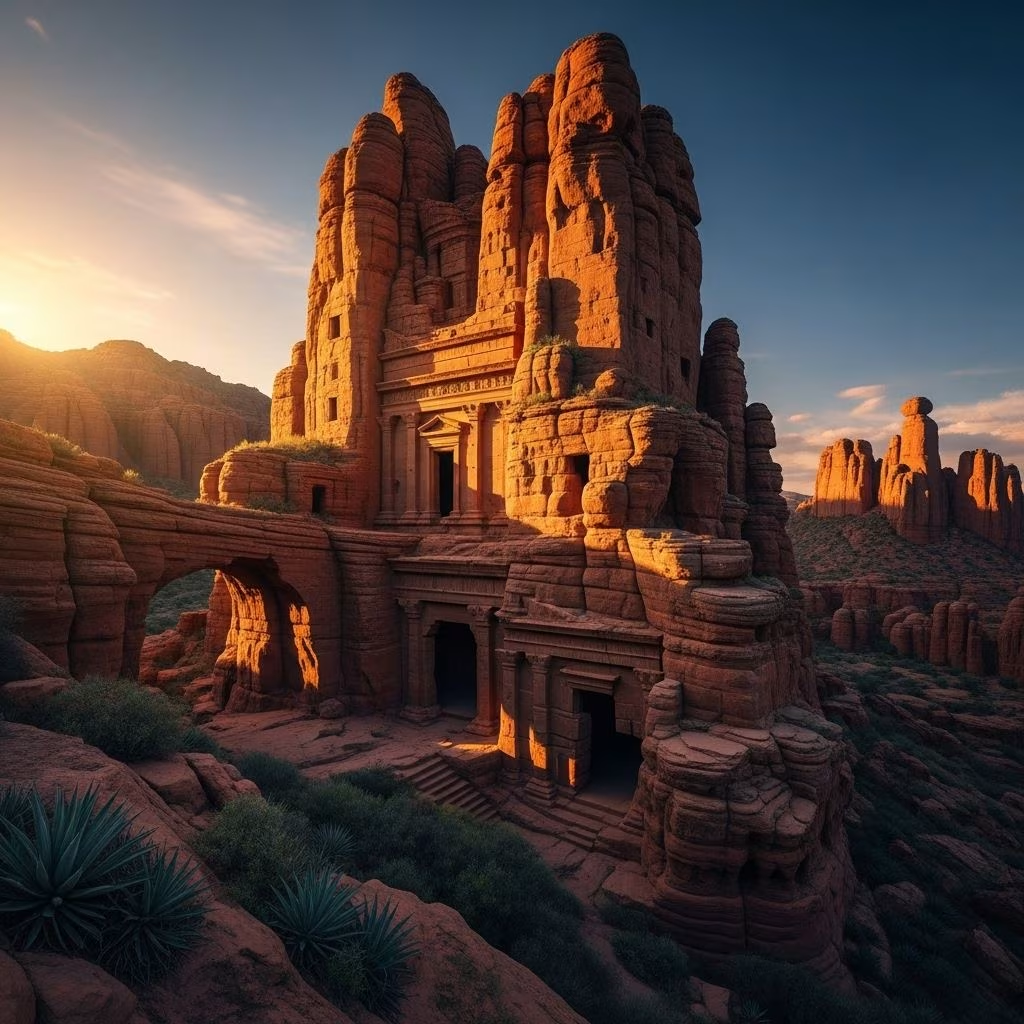
All around the globe, the relentless forces of nature—erosion, weathering, tectonic activity, and time—have sculpted stone into phenomenal formations that appear to defy probability. Many of these natural monuments look so precise or artistic that it’s difficult to believe they aren’t the work of ancient civilizations or meticulous sculptors. Yet, these stunning landscapes owe their existence solely to the patient artistry of geological processes. Here, we explore some of the world’s most remarkable natural rock formations that seem almost too perfect to be purely natural.
An Introduction to Nature’s Stonework
Rock formations have fascinated and mystified humans for millennia. While human-built marvels such as the Pyramids of Giza or Stonehenge attract global admiration, the truly awe-inspiring aspect of some geological formations is that they were crafted not by people, but by millions of years of natural forces. Some appear so organized, geometric, or animate that the line between nature and artifice becomes blurred. Below, we examine striking examples from every continent, highlighting the science behind their formation and the cultural legends that often surround them.
Giant’s Causeway, Northern Ireland
Giant’s Causeway is Northern Ireland’s most celebrated natural wonder and perhaps the most famous example of nature’s precision. This UNESCO World Heritage Site consists of around 40,000 interlocking basalt columns, most of which have striking hexagonal sides, forming giant stepping stones that lead from the cliff foot and disappear under the sea.
- Formed 50-60 million years ago from cooling lava flows
- Pristine geometric shapes caused by the fracturing of basalt as it cooled rapidly
- Most columns are hexagonal, but some have as few as four or as many as eight sides
- Celtic myth credits the formation to the Irish giant, Finn McCool, who built the causeway to reach Scotland
The scientific explanation is as impressive as the myth. Volcanic activity forced molten basalt through chalk beds, where it rapidly cooled, contracted, and cracked in a pattern similar to drying mud, forming the tidy columns.
Brimham Rocks, England
Situated on the heather-clad moors of North Yorkshire, Brimham Rocks is a collection of extraordinary, gravity-defying rocks balanced atop one another or shaped into fantastical forms. Despite their carved, stacked appearance, these bizarre rocks are entirely natural.
- Sculpted by ice, wind, and rain over 320 million years
- Sandstone formed in river deltas, then exposed and weathered
- Features include balancing stones, arches, and mushroom shapes
Local folklore conjured tales of druids or giants shaping these rocks, but erosion processes and freeze-thaw cycles are responsible for their forms. Today, Brimham Rocks is a protected National Trust site and a popular spot for hiking and photography.
Devils Tower, Wyoming, USA
Rising dramatically from the rolling plains of northeast Wyoming, Devils Tower is a colossal monolith that looms 386 meters above the surrounding landscape. The vertical grooves and fluted columns make it appear as if it was crafted by ancient stonemasons.
- Composed of phonolite porphyry, a type of igneous rock
- Formed through the intrusion of magma, then exposed by erosion
- Columnar jointing produced the vertical fluting
- Sacred to several Native American tribes, featuring in creation stories and rituals
Declared the first U.S. National Monument in 1906, Devils Tower remains both a geologist’s puzzle and a spiritual symbol.
Stone Forest (Shilin), Yunnan, China
The Stone Forest in Yunnan province, China—known as “Shilin”—is a sprawling landscape of towering limestone pillars that look like fossilized trees. Walking through the dense maze, visitors feel as though they are in a petrified woodland from a fantasy world.
- Over 300 square kilometers of stone spires, carved by erosion
- Formed over 270 million years from marine limestone
- Karst processes—dissolution by water—shaped deep gorges and pinnacles
- Local legend tells of the love story of Ashima, a Yi maiden turned to stone
This UNESCO Heritage Site is not only a geological marvel but also a site steeped in local myth and tradition.
Wave Rock, Western Australia
True to its name, Wave Rock resembles an enormous surfable wave frozen in time, poised over the wheat fields east of Perth.
- Approximately 15 meters high and 110 meters long
- Composed of 2.7-billion-year-old granite
- Curvaceous form carved by weathering over millions of years
- Distinctive stripes caused by water cascading down the face, leaching minerals and leaving colorful streaks
Local Ballardong people hold the site sacred, and the rock is central to Aboriginal heritage in the region.
The Pinnacles, Western Australia
Within Nambung National Park, The Pinnacles rise from the yellow sands like an army of columns, some several meters high. Their eerie presence at sunrise or sunset makes for a mesmerizing landscape that feels otherworldly.
- Formed from ancient seashells over millions of years
- Once covered by shifting sand dunes, then exposed by erosion
- Pillars range from smooth to jagged, with a variety of shapes
Debate continues about their precise origin, but their haunting beauty is undisputed.
Devil’s Wall (Teufelsmauer), Germany
Stretching for nearly 20 kilometers across the landscape of Saxony-Anhalt, the Devil’s Wall is a jagged sandstone ridge resembling a vast, ancient barrier. The rough, eroded forms of the wall are so striking that local folklore claims the devil himself built it in a single night.
- Approximately 85 million years old, initially created underwater
- Formed from sandstone uplifted by tectonic forces, then sculpted by erosion
- Legend tells of a bet with God that left part of the wall standing when the devil failed
In reality, the Devil’s Wall owes its fractured, dramatic shapes to millions of years of weathering and the slow movement of Earth’s crust.
Manpupuner Rock Formations (Seven Strong Men), Russia
Remote and windswept, the Manpupuner Rock Formations—also known as the Seven Strong Men—stand atop a flat plateau in Russia’s Ural Mountains. These massive pillars, up to 42 meters tall, resemble ancient statues or sentinels.
- Formed of hard quartzite 200 million years ago
- Originally part of a mountain range, with softer rock eroded away
- Significant in Nenet and Mansi indigenous folklore as spiritual guardians
- Visitors often describe the site as profoundly peaceful and mystical
These natural monoliths are so imposing and regular, it’s easy to see why they have inspired tales of giants and spirits.
Moeraki Boulders, New Zealand
Scattered along Koekohe beach on New Zealand’s Otago coast, the Moeraki Boulders are remarkable for their near-perfect spherical shape and enormous size, looking uncannily like gigantic marbles or ancient cannonballs.
- Formed from mud and fine silt over millions of years—known as natural concretions
- Some boulders measure more than 2 meters in diameter
- Maori legend attributes their origin to the remains of gourd containers from a wrecked ancestral canoe
These mysterious balls are gradually revealed by coastal erosion, with their cracked surfaces adding to the impression of ancient artifacts.
Balancing Rocks: Earth’s Natural Gravity-Defying Sculptures
Throughout the world, gravity-defying balancing rocks can be found, each looking like it needs only a slight nudge to come tumbling down. Despite appearances, they are naturally stable formations, created by eons of weathering and erosion.
- Idol Rock at Brimham Rocks, England, is a notable example
- Balanced Rock in Arches National Park, Utah, stands as a striking stone pillar topped by a massive boulder
These occurrences happen when harder rock overlays softer, which slowly erodes away, leaving the more resistant stone perched precariously. Their improbable positioning captures imaginations and attracts visitors from around the world.
Other Noteworthy Rock Formations
- Uluru (Ayers Rock), Australia: A colossal monolith rising 348 meters, renowned for its changing colors at sunrise and sunset and great spiritual significance to Aboriginal Australians
- The Old Man of Storr, Scotland: A jagged pinnacle atop the Isle of Skye, central to regional folklore
- Antelope Canyon, Arizona, USA: A slot canyon famed for its flowing, wave-like shapes and luminous colors formed from Navajo sandstone
While not all of these have the appearance of human sculpture, their forms and symmetry make them icons of the landscapes they inhabit.
Comparison of Iconic Natural Rock Formations
| Formation | Country | Main Rock Type | Distinctive Look | Estimated Age |
|---|---|---|---|---|
| Giant’s Causeway | Northern Ireland | Basalt | Hexagonal stone columns | 50–60 million years |
| Stone Forest | China | Limestone | Towering stone spires | Over 270 million years |
| Moeraki Boulders | New Zealand | Mudstone Concretions | Huge stone spheres | 60 million years |
| Brimham Rocks | England | Sandstone | Stacked, fantastical shapes | 320 million years |
| Wave Rock | Australia | Granite | Curved wave shape | 2.7 billion years |
| Manpupuner | Russia | Quartzite | Tall, thin stone pillars | 200 million years |
Why Do These Formations Look Man-Made?
The striking shapes and patterns found in these formations arise from the interplay of several geological processes:
- Erosion: Wind, water, ice, and gravity wear away softer materials, leaving harder rock behind in unusual shapes.
- Weathering: Chemical and physical breakdown of rock accentuates natural planes of weakness.
- Jointing and Fracturing: As rocks cool or flex, they crack in predictable geometric patterns—such as hexagons, cubes, or columns.
- Biological Activity: Lichens, moss, and microbial mats sometimes accentuate erosion or deposit minerals that add color and texture.
Over thousands to millions of years, minor differences in hardness, climate conditions, and underlying geology create wildly different natural sculptures—many of which rival human creativity in design and complexity.
Frequently Asked Questions (FAQs)
Are these formations protected or preserved?
Most notable rock formations are designated as protected areas, including UNESCO World Heritage Sites, national parks, or reserves. This helps ensure their preservation for future generations and prevents damage from tourism or development.
Can new formations like these still arise today?
Yes. The processes that shaped today’s grandest rock sculptures—erosion, weathering, tectonics—are ongoing. Given enough time, new, equally astonishing formations will appear, though the human timescale is much shorter than the geological one.
What inspires myths and legends about these rocks?
The dramatic appearance and mysterious origins of such rocks often spurred ancient peoples to craft stories—like giants, gods, or spirits shaping the earth—tying these places to local religious or folklore traditions.
Can visitors climb or explore these sites?
Accessibility and rules vary. Some sites like Brimham Rocks permit responsible climbing, while others, such as Uluru, have protections in place due to cultural or conservation reasons. It is vital to respect regulations and local customs.
What is the rarest or least understood formation?
Formations like the Manpupuner Pillars are remote and difficult to study, while some, such as the Moeraki Boulders, still inspire debate about their precise origins. The combination of geological rarity and mystery makes these sites especially captivating.
Appreciating Nature’s Surreal Architecture
Natural rock formations that resemble human handiwork challenge our perceptions and deepen our appreciation for Earth’s slow and persistent creativity. The formations showcased here are only a glimpse into nature’s vast portfolio—testaments to the planet’s ability to surprise, inspire, and mystify.
References
- https://www.youtube.com/watch?v=fVyina0V–Y
- https://www.trafalgar.com/real-word/weird-rock-formations/
- https://www.centralparknyc.org/articles/geology-influenced-design
- https://theculturemap.com/unique-rock-formations-from-around-the-world/
- https://en.wikipedia.org/wiki/List_of_rock_formations
- https://www.realyorkshireblog.com/post/brimham-rocks-man-made-or-natural-how-this-iconic-rock-formation-came-to-be