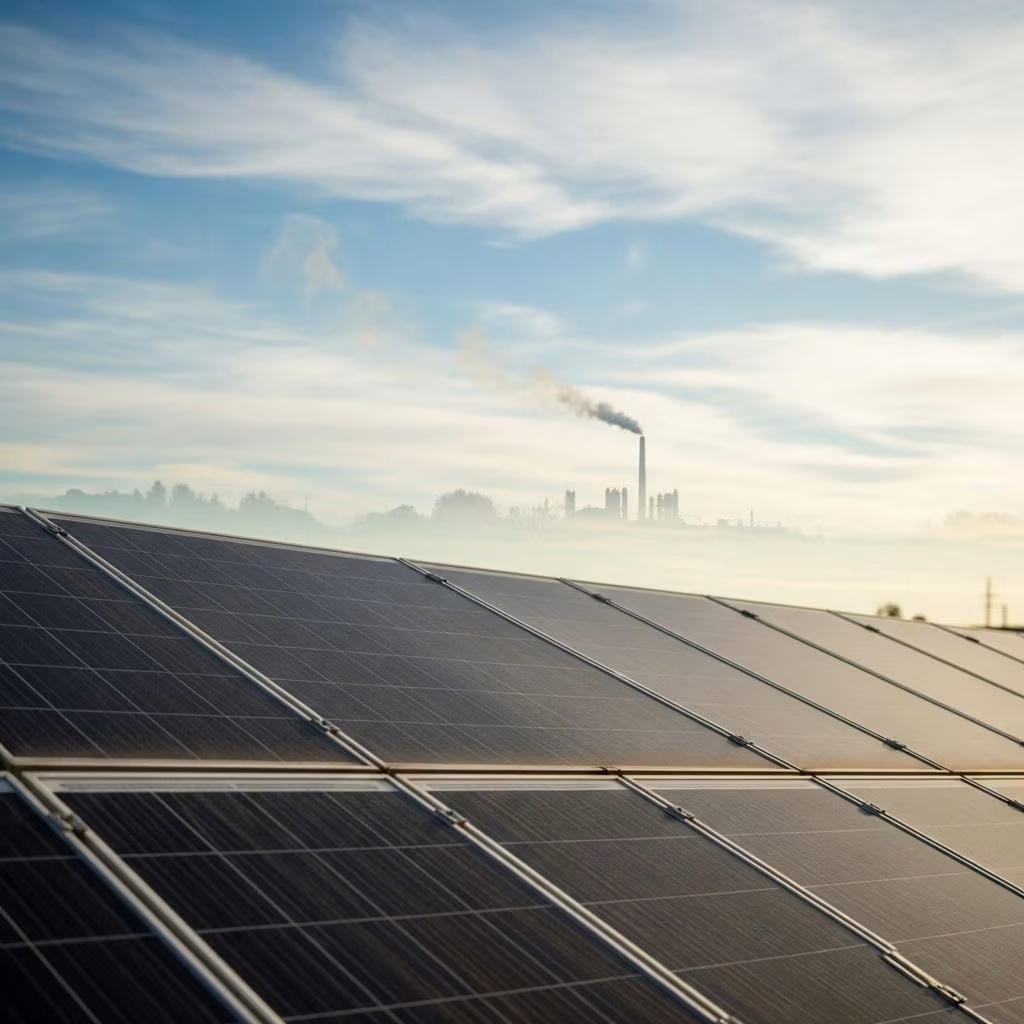
Do Solar Panels Actually Contribute to Climate Change?
Solar panels are widely celebrated as a key technology for fighting climate change, but an important question remains: Do solar panels themselves contribute to climate change? To answer this, we must examine the complete lifecycle of solar panels—from raw material extraction and manufacturing, through years of clean energy production, to end-of-life disposal. Understanding the net environmental and climate impacts ensures that transitioning to solar is truly supporting a greener future.
The Climate Case for Solar Panels
Solar panels drastically reduce greenhouse gas emissions compared to fossil fuel energy sources. Once installed, they convert sunlight directly into electricity, producing virtually no emissions for decades. The rapid expansion of solar energy worldwide demonstrates its crucial role in meeting global climate targets and limiting the effects of global warming .
- Clean, on-site energy: Solar panels supply emission-free electricity where it is generated, offsetting carbon-heavy grid power.
- Global reach: Solar power can be utilized anywhere the sun shines, benefiting both urban and rural communities .
- Longevity: Most modern solar panels have lifespans of 25 years or more, providing consistent clean energy for decades .
Understanding Solar Panels’ Carbon Footprint
No technology is entirely without environmental impact. The main sources of emissions from solar panels occur before they begin generating electricity:
- Raw material extraction: Mining of silicon, metals (like silver, copper, and aluminum), and glass involves energy-intensive processes that release carbon dioxide .
- Manufacturing: The biggest contributor to a solar panel’s carbon footprint is the manufacturing stage, requiring energy and producing emissions. This impact varies by country, depending on how clean their electricity grids are .
- Transportation & installation: Shipping solar panels from factories to installation sites consumes energy, as does mounting them on rooftops or in solar farms.
The result is a measurable “carbon debt” that must be paid off through zero-emission operations over time. Most scientific assessments calculate a solar panel’s lifecycle greenhouse gas emissions in grams of CO2-equivalent per kilowatt-hour (g CO2e/kWh) generated.
The Carbon Payback Period: How Quickly Solar Panels Go Green
The carbon payback period is the time it takes for a solar panel to “repay” its initial emissions through clean energy generation. After this period, all further electricity from the panel is essentially carbon-free.
- Coal-fired power: 700–1,000 g CO2e/kWh .
- Solar power (lifecycle): ~40 g CO2e/kWh .
According to the National Renewable Energy Laboratory (NREL) and other sources, most rooftop solar systems repay their carbon debt in 1.5–3.5 years (18–40 months), depending on installation location and grid cleanliness . With typical lifespans of 25 years or more, the vast majority of energy generated is net-zero emissions.
Example Calculation: Lifetime Emissions Savings
Suppose a 1-kilowatt (kW) solar system in a sunny region produces 1,460 kWh/year (about 4 kWh/day). Over 25 years, even accounting for some degradation, it will generate approximately 29,000 kWh. Compared to coal power:
- Coal electricity (25 years): ~20,300 kg CO2
- Solar electricity (25 years): ~1,160 kg CO2
This equates to a roughly 17-fold reduction in carbon emissions over the system’s lifecycle .
Global Impact of Solar Energy on Mitigation
When scaled globally, the climate benefits of solar are profound. Model-based studies indicate that aggressive rooftop solar photovoltaic (RPV) adoption by 2050 could alone reduce global warming by 0.05–0.13°C, a substantial chunk of the remaining allowable rise under international targets .
- In the absence of rooftop solar deployment, electricity grid emissions would add another 0.13°C to global warming by 2050 .
- Full realization under ambitious climate policy could cut this further, helping meet 1.5°C or 2.0°C warming thresholds.
Comparison Table: Solar vs. Fossil Fuels vs. Trees
| Energy/Sequestration Method | Lifespan Emissions Rate (g CO2e/kWh or kg CO2/year) | Land Use Efficiency | Summary Effect |
|---|---|---|---|
| Coal Power | 700–1,000 g CO2e/kWh | High emissions, low efficiency | Major emitter |
| Solar PV (rooftop/lifecycle) | ~40 g CO2e/kWh | Very high (especially on rooftops) | Major CO2 reducer |
| Mature Trees | 21 kg CO2/year avg (sequestration) | Depends on local conditions | Important, but less acreage-efficient than solar for emissions |
Solar panels reduce CO2 emissions much more per acre than tree planting or corn ethanol, partly because they displace fossil-fuel-generated electricity so efficiently .
Factors That Influence a Solar Panel’s Climate Impact
- Panel efficiency: More efficient panels generate more electricity for the same carbon debt.
- Production location: Panels manufactured with clean energy (e.g., hydro, wind) have lower embodied emissions.
- Panel type: Different panel chemistries (monocrystalline, polycrystalline, thin-film) have slightly varying impacts.
- Installation angle and tracking: Using optimal tilt or tracking boosts electricity output, improving the emissions payback ratio .
- Panel degradation: Gradual decline in output is minimal with modern high-quality systems.
- Recycling at end-of-life: Recovering silicon, glass, and metals further reduces net impact.
Solar Panels and Their Regional Climate Effects
Some have raised concerns that large-scale solar installations could affect local or even regional climates by altering land surface properties. However, it’s crucial to note:
- The dominant benefit at the global scale is still the large reduction of greenhouse gas emissions .
- Localized changes in surface energy balance (e.g., reflectivity, heat retention) are real, but minor compared to the climate-warming effects of power plant emissions they displace.
The Myth of “Emission-Free” Solar
It can be tempting to call solar panels “zero emission.” In reality:
- Solar panels do carry an upfront carbon footprint due to manufacturing and raw materials.
- After installation, they rapidly offset these initial emissions, providing decades of emission-free electricity.
- No power source, not even solar, is completely emission-free when considering mining, logistics, and manufacturing, though solar is among the lowest-impact choices .
Addressing Common Questions and Misconceptions
Frequently Asked Questions (FAQs)
Q: Do solar panels pollute during their operational life?
A: Once installed, solar panels produce electricity without generating emissions, pollution, or noise. The primary emissions are “embodied” from manufacturing, not operation.
Q: Can solar panels have a negative environmental impact?
A: The main impacts are from material extraction, energy used in manufacturing, and eventual disposal. Responsible sourcing, advances in recycling, and use of clean energy during production minimize these effects.
Q: What happens when solar panels reach end-of-life?
A: Panels are increasingly being recycled to recover glass, silicon, and metal. Modern practices aim to recover up to 95% of materials, reducing long-term waste.
Q: Is there enough sunlight to power the world with solar?
A: Yes. Global studies indicate that rooftop photovoltaic potential alone—using existing buildings—could generate nearly 20,000 TWh/year, massively slashing overall emissions .
Q: Which is better for climate—solar panels or planting trees?
A: Both approaches help, but solar panels typically avoid more CO2 per acre than trees by offsetting fossil-fuel electricity directly .
Q: Does solar panel manufacturing negate the climate benefits of solar?
A: No. Manufacturing emissions are paid back in only several years, after which panels generate clean electricity for decades, creating immense net reductions in atmospheric CO2 .
Key Takeaways
- Solar panels have a measurable but small lifecycle carbon footprint, mostly from manufacturing and materials.
- Panels typically repay their carbon debt in less than 3 years and generate carbon-free energy for the remainder of their lives.
- Net climate impact is overwhelmingly positive, with massive emissions avoided compared to fossil fuel power plants.
- Solar outperforms tree planting (per acre) for avoided CO2 emissions, though both are important for a balanced strategy.
- Continuous improvements in materials, manufacturing, and recycling will keep shrinking solar’s environmental footprint further over time.
Final Thoughts
While no energy technology is perfectly clean, solar photovoltaics are among the most effective, scalable, and climate-friendly solutions we have. Their long service life, rapid carbon payback, and exceptionally low emissions profile make them essential in the transition away from fossil fuels. By embracing solar energy at home, at work, and at the societal level, we accelerate progress toward a cooler, more sustainable planet.
References
- https://www.nature.com/articles/s41558-025-02276-3
- https://palmetto.com/climate/climate-action-at-home-how-solar-panels-contribute-to-a-greener-planet
- https://connectsolar.com.au/a-breath-of-fresh-air-retracing-the-carbon-footprint-of-a-solar-panel/
- https://www.discovermagazine.com/treehuggers-vs-solar-supporters-who-cares-more-about-the-environment-27897
- https://news.climate.columbia.edu/2022/10/26/solar-panels-reduce-co2-emissions-more-per-acre-than-trees-and-much-more-than-corn-ethanol/
- https://www.wipo.int/web/wipo-magazine/articles/photovoltaic-technology-sunny-side-up-36797
- https://thetreehuggersguide.wordpress.com