


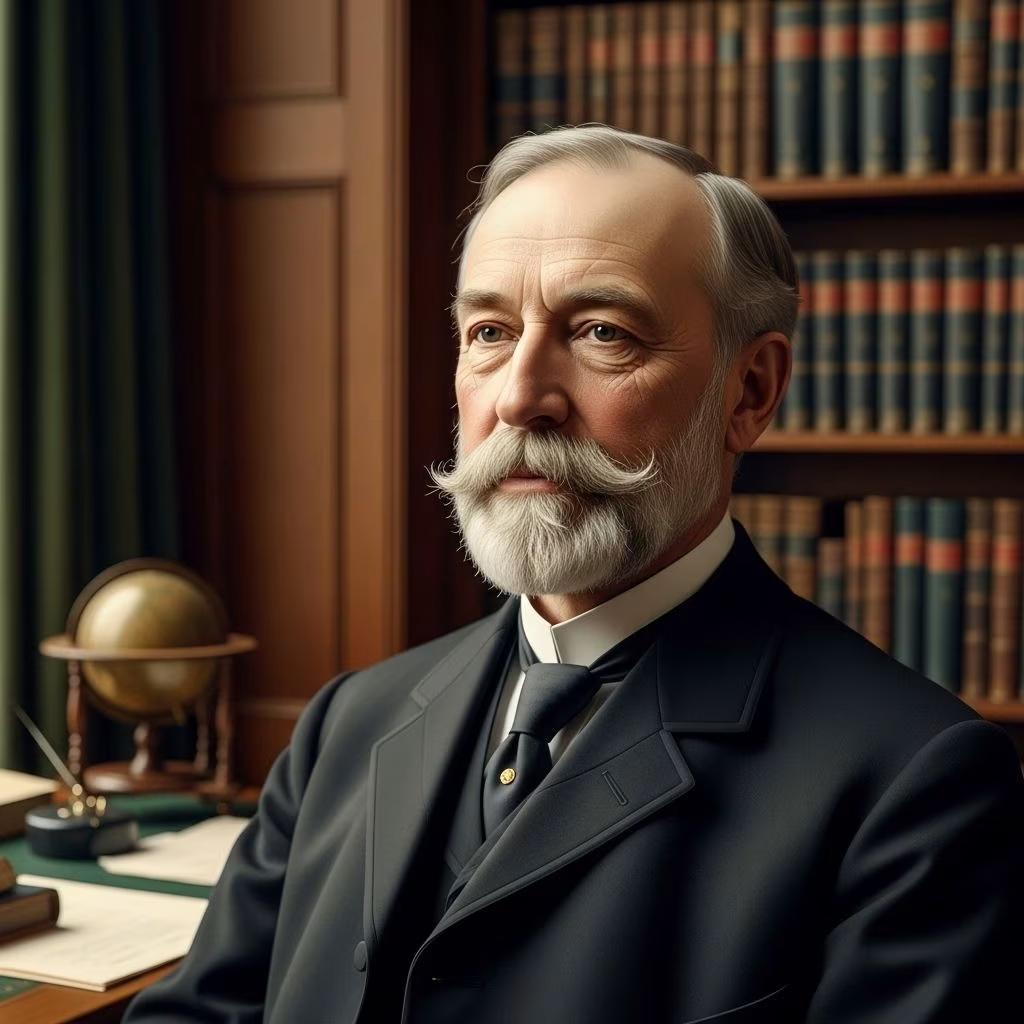
William James: The Father of American Psychology
William James (1842–1910) stands as one of the foremost pioneers of modern psychology and philosophy. Often hailed as the “Father of American Psychology”, his profound work shaped the direction of psychological thought in the United States and continues to influence contemporary theory and practice. Through his innovative teachings, groundbreaking writings, and founding philosophies, James established the foundations for functional psychology and pragmatism, leaving an indelible mark on the discipline.
Who Was William James?
Born into a well-known intellectual family in New York City, William James was the eldest son of the theologian Henry James Sr. and brother to the novelist Henry James and diarist Alice James. He pursued a medical degree at Harvard but gravitated more towards the mysteries of the mind than clinical practice. This curiosity led him to teach anatomy at Harvard University, ultimately offering the first psychology course in the United States and laying the groundwork for an academic discipline.
- Birth: January 11, 1842
- Death: August 26, 1910
- Fields: Psychology, Philosophy, Education
- Major Works: The Principles of Psychology, The Varieties of Religious Experience, Essays in Radical Empiricism
Why Is William James Considered the Father of American Psychology?
James earned this title through his foundational role in shaping psychology as a scientific and philosophical enterprise in the United States. His approach combined empirical investigation with philosophical rigor, distinguishing him from his European contemporaries. Key factors in this recognition include:
- First to Teach Psychology in America: James offered the nation’s first psychology course at Harvard in 1875, entitled “The Relations between Physiology and Psychology”.
- Established One of the First US Psychology Labs: His Harvard laboratory pioneered psychological research in America.
- Groundbreaking Literary Contributions: His 1890 book, The Principles of Psychology, synthesized experimental findings, introspective insights, and philosophical discussions, rapidly becoming a foundational text.
- Influential Teaching: James mentored notable scholars including G. Stanley Hall and Mary Whiton Calkins, shaping generations of psychologists.
The Major Contributions of William James
William James’s influence spans several major developments and schools of thought in psychology and philosophy:
- Functionalism: James developed a functionalist perspective, emphasizing how mental processes function to help individuals adapt to their environments.
- Pragmatism: He co-founded the philosophical school of pragmatism, focusing on the practical value and usefulness of ideas, rather than their abstract or metaphysical truth.
- Stream of Consciousness: James pioneered the concept of stream of consciousness, describing thought not as discrete elements but as a continuous flow.
- James-Lange Theory of Emotion: He developed, concurrently with Carl Lange, the influential theory that emotions arise from physiological changes, fundamentally shaping how emotion is understood.
- Radical Empiricism: James advocated for a theory of knowledge rooted strictly in empirical experience, influencing later philosophical thought.
Functionalism: Adapting to the Environment
At the core of James’s psychological perspective lies functionalism. This school of thought diverges from structuralism, which focuses on analyzing the components of consciousness, by examining the functions served by mental processes in enabling adaptation to the surrounding world.
- Focus on Adaptation: Functionalism asks: “What is the purpose of thinking and behavior? How do they help us survive and thrive?”
- Integration with Evolution: Inspired by Darwin’s evolutionary theory, James connected mental processes and behavior to evolutionary adaptation.
- Causal Relationships: He investigated the links between internal mental states and outward behaviors, searching for scientific explanations.
Pragmatism: The Utility of Ideas
James’s pragmatism revolutionized American philosophy by arguing that the value of an idea lies in its usefulness, or “cash value,” not in its philosophical proof. In his famous lectures and writings, James asserted that:
- The “truth” of an idea should be measured by its practical impact in everyday life.
- Philosophy should focus on outcomes and effects, rather than speculative abstractions.
- The meaning of ideas and beliefs is found in how they help navigate real-world problems.
Pragmatism became a foundational American philosophy, influencing fields from psychology to education and law.
The Principles of Psychology: A Landmark Work
James’s masterpiece, The Principles of Psychology, was published in 1890 as a two-volume work that fundamentally altered the course of psychological science. Covering over 1,200 pages, this book:
- Explored mental phenomena through historical context, personal introspection, and experimental findings.
- Introduced the idea of stream of consciousness: the mind as an ongoing, blending flow of experience.
- Examined emotions, habits, attention, and will, merging literary style with scientific depth.
- Was praised for its accessible, often humorous tone, and its ambitious synthesis of knowledge.
Stream of Consciousness: The Flow of Thought
James’s concept of stream of consciousness posited that thought is experienced not as isolated points but as a continuous, ever-changing flow. This idea profoundly influenced psychology, literature, and philosophy by emphasizing:
- The blending of internal perception and external reality.
- The impossibility of fully separating individual thoughts.
- The subjective richness and variety of consciousness.
James’s insight later inspired writers such as Virginia Woolf and William Faulkner to develop narrative techniques reflecting this fluidity.
James-Lange Theory of Emotion: Feeling Before Understanding
Together with Carl Lange, James formulated a novel theory of emotion. The James-Lange theory states:
- Emotion arises as a mental response to physiological changes triggered by a stimulus, not directly from the stimulus itself.
- For example, we feel afraid because we run from danger; our body’s reaction precedes our emotional awareness.
This perspective marked a crucial shift in studying emotion by putting bodily responses at the center of psychological experience.
Teaching and Mentoring: Shaping Future Minds
James’s legacy extends through his remarkable influence as a teacher and mentor. At Harvard, he supervised the first psychology Ph.D. in America (G. Stanley Hall), mentored Mary Whiton Calkins, and advised Gertrude Stein on consciousness studies.
- Students guided by James went on to establish important fields, such as child psychology and educational psychology.
- He encouraged exploration beyond conventional boundaries, inspiring innovation and independent thought.
William James vs. Wilhelm Wundt: The European Pioneer
| Feature | William James | Wilhelm Wundt |
|---|---|---|
| Nationality | American | German |
| Approach | Functionalism, Pragmatism | Structuralism, Experimental Method |
| First Psychology Course | Harvard (USA) | Leipzig (Germany) |
| Main Contribution | Emphasis on adaptation, usefulness, consciousness as flow | Analysis of elements of consciousness, laboratory experimentation |
| Legacy | Founder of American psychology | Founder of experimental psychology |
Later Life, Philosophy, and Turn from Psychology
After years deeply invested in psychology, William James shifted his focus to philosophy and religious experience. His dissatisfaction with the limits of psychological research led him to refer to it as “a nasty little subject.” Nevertheless, he continued to teach at Harvard until his retirement in 1907 and contributed extensively to discussions on consciousness, metaphysics, and mysticism. James’s philosophical works, notably Essays in Radical Empiricism and The Varieties of Religious Experience, broadened his impact across multiple disciplines, touching on spirituality, epistemology, and human potential.
Enduring Influence and Recognition
William James remains widely honored as an intellectual giant:
- Ranked as the 14th most eminent psychologist of the 20th century by the American Psychological Association.
- Regarded second only to Wilhelm Wundt in terms of historical importance in psychology.
- Influenced leading figures in philosophy, psychology, education, and literature.
- Pioneered approaches that remain foundational in today’s psychological science.
Frequently Asked Questions (FAQs)
Who is considered the father of psychology worldwide?
Wilhelm Wundt is often cited as the father of experimental psychology due to his laboratory work in Germany. William James, however, is recognized as the father of American psychology for his founding role in the United States.
What is William James known for?
James is best known for his theories of functionalism and pragmatism, his concept of stream of consciousness, and formulating the James-Lange theory of emotion. He authored foundational texts and taught the first psychology courses at Harvard.
What impact did The Principles of Psychology have?
James’s two-volume work became the definitive psychology textbook of its time, blending scientific investigation with introspective and philosophical insight. It helped establish psychology as an independent academic field.
What is functionalism in psychology?
Functionalism focuses on how mental processes operate in helping individuals adapt to their environments, emphasizing the purposes of thought and behavior over their structure.
What is the James-Lange theory of emotion?
This theory suggests that emotions are experienced as a result of physiological responses, such as changes in heart rate or sweating, that occur in reaction to external stimuli.
Legacy: How William James Continues to Shape Psychology
The ideas and approaches developed by William James laid the foundation for modern psychology and philosophy. His charismatic teaching, literary prowess, and open-minded inquiry encouraged generations to pursue the study of mind, experience, and meaning. Today, researchers explore consciousness, emotion, adaptation, and utility—concepts James helped introduce to science.
- Modern neuroscience builds on the idea of consciousness as a dynamic flow.
- Therapies and interventions value practical outcomes, echoing James’s pragmatism.
- Educational and child psychology trace roots to his teachings and mentoring.
In summary, William James stands as a multidimensional pioneer—uniting science, philosophy, and humanity in his quest to understand the mind. His enduring legacy makes him, unmistakably, the father of American psychology.
References
- https://study.com/academy/lesson/william-james-psychology-theories-lesson-quiz.html
- https://en.wikipedia.org/wiki/William_James
- https://psychology.fas.harvard.edu/people/william-james
- https://www.britannica.com/biography/William-James
- https://pmc.ncbi.nlm.nih.gov/articles/PMC7283131/
- https://www.neh.gov/humanities/2018/winter/feature/the-thinker-who-believed-in-doing-0
- https://plato.stanford.edu/entries/james/


