


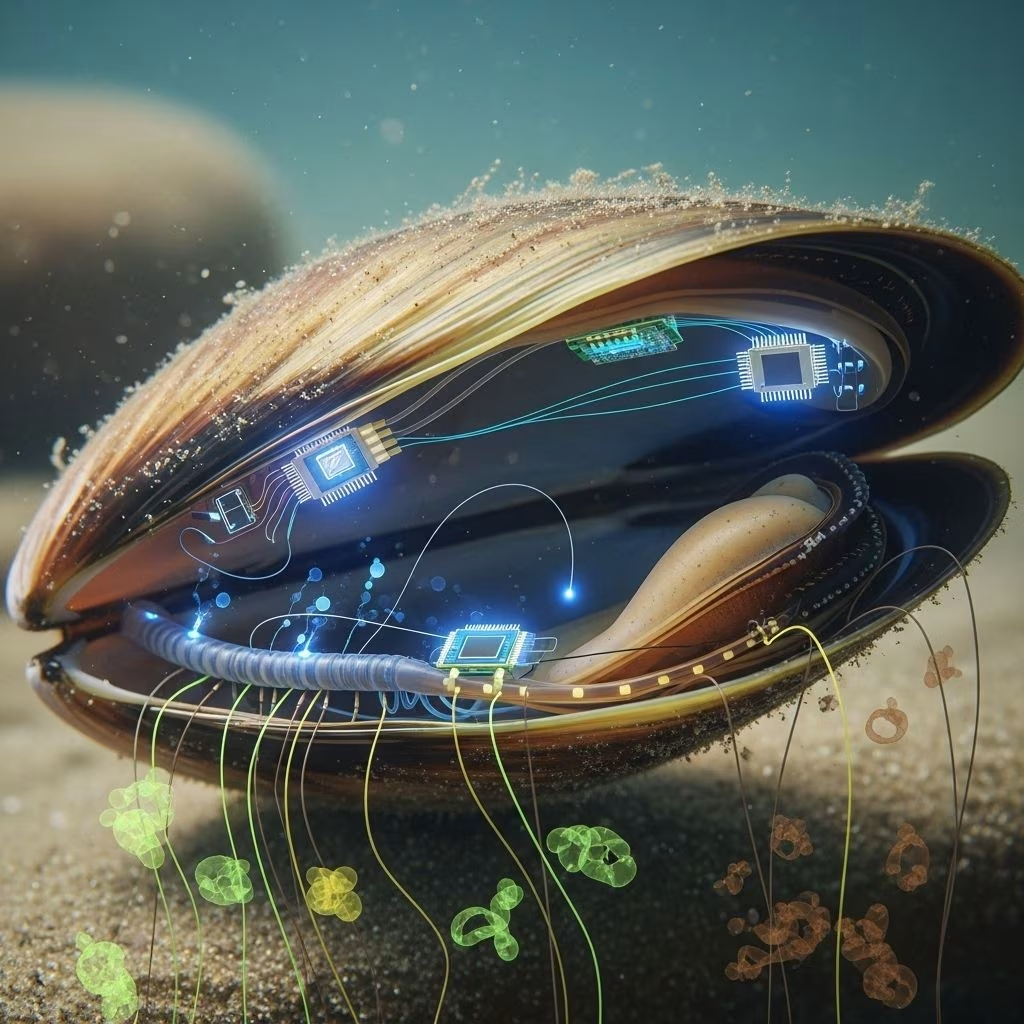
Cyborg Mussels: The Next Generation of Environmental Warning Systems
Environmental monitoring has traditionally relied on mechanical sensors and chemical tests to track water quality. However, the advance of cyborg mussel technologies marks a revolutionary shift: blending the instinctive biological responses of mussels with precision electronics, scientists can now achieve real-time, highly sensitive environmental monitoring on an unprecedented scale. These living biosensors form the backbone of increasingly deployed early-warning systems aimed at safeguarding aquatic ecosystems worldwide.
Why Mussels? The Science of Biological Sensing
Mussels and other filter-feeding mollusks are natural sentinels of water health. By feeding through the filtration of water, their behavior—in particular, the way they open and close their shells—reflects the chemical and physical properties of their environment. When harmful substances enter the water, mussels often react by closing their shells in coordination, offering a clear and rapid indicator of pollution or other stressors.
- Biological filtration: A single mussel can filter several liters of water per hour, continuously sampling for contaminants.
- Sensitive to pollution: Mussels’ shell movement is highly responsive to toxins, altered temperature, turbidity, microbial contaminants, and other environmental changes.
- Non-invasive monitoring: Mussels offer an ethical and effective alternative to purely mechanical sensors, as they already reside in natural water bodies.
How Do Cyborg Mussel Systems Work?
The concept of a cyborg mussel sensor combines live animals with miniature electronic components and remote data transmission. The key steps include securing delicate sensors to mussel shells, tracking shell motions, and transmitting interpreted data to researchers or stakeholders in real time.
- Miniature sensors (accelerometers, magnetometers) attached to each mussel’s shell detect the degree and frequency of opening.
- Sensor data is collected by a data acquisition module, sometimes powered by solar energy and positioned on a nearby stake or platform.
- Collected data is wirelessly relayed (via cellular or hardwired connections) to cloud-based servers or local monitoring systems.
- Clients or scientists can then access the water quality status via smartphones, tablets, or dashboards, allowing immediate response to pollution events.
Commercial implementations like the molluSCAN-eye system utilize clusters of 16 mollusks per unit, deploying two electromagnets on each shell to measure opening width, duration, speed, and frequency.
Key Features of Advanced Mussel Monitoring Systems
| Feature | Description | Benefits |
|---|---|---|
| High-frequency sensors | Measure shell movement with angular precision below one degree | Accurately detect subtle behavioral changes signaling stressors |
| Cloud connectivity | Remote and real-time data transmission | Allows rapid response, wide accessibility, and long-term monitoring |
| Biosignal processing | Analysis of biological rhythms, agitation, egg-laying cycles | Tracks both environmental health and mussel welfare |
| Non-invasive installation | No harm to native mollusk populations | Maintains ecological integrity while leveraging natural sensors |
| Low maintenance | Mussels self-clean, minimizing human intervention | Reduces operating costs and ensures system reliability |
From Research to Field Deployment: Global Initiatives
Originally conceived in the laboratory, cyborg mussel technologies (sometimes dubbed the “internet-of-mussels”) are rapidly being scaled for use in rivers, lakes, ports, and industrial outlets across the world.
Case Study: North Carolina State University Mussel Sensor Network
Researchers at NC State developed a customized system using small sensors wired to several mussels and mounted in a tank or natural waterway. Powered by solar cells and connected to a cellular network, these sensors can accurately track the angle of shell openings—serving as reliable, continuous sentinels against pollution.
Case Study: molluSCAN-eye’s Commercial Success
Launched as an award-winning product, molluSCAN-eye has deployed about 90 operational monitoring systems globally. The system’s sensitivity, up to 100 times greater than traditional water sensors, offers cost-effective, robust performance with minimal maintenance requirements.
Australia’s Cybernetic Water Monitoring Project
In southwestern Australia, the Alcoa Foundation Cybernetic Water Monitoring Project uses sensor-equipped mussels to alert researchers, communities, and Indigenous ranger groups to dangerous water conditions—helping prevent catastrophic fish kills and supporting ecosystem stewardship.
Beyond Pollution: Mussels Respond to Multiple Environmental Stressors
While pollution detection remains a primary goal, research has demonstrated that mussel sensors can track a spectrum of environmental stressors. These include:
- Floods and turbidity: Rapid shell closure during flood events signals dangerous changes in flow or sediment.
- Temperature extremes: Behavioral changes indicate heatwaves or potential drought risks.
- Chemical contaminants: Mussels respond to spikes in heavy metals, toxins, or nutrient overloads from industrial, agricultural, or sewage sources.
- Microbial contamination: Natural filtration behavior makes mussels effective sentinels for detecting the presence of harmful pathogens.
A recent study suggests immobilized mussels yield even more interpretable signals, reducing noise and improving early-warning reliability in turbulent river conditions.
Advantages Over Traditional Water Quality Sensors
- Greater sensitivity: Biological sensors detect lower concentrations of pollutants.
- Lower cost: Mussel systems often cost less than high-end electronic sensors.
- Continuous monitoring: Mussels feed 24/7, offering constant data collection.
- Self-maintaining: The animals clean themselves, minimizing upkeep.
- Real-time data: Immediate alerts enable swift mitigation of harmful events (e.g., fish kills, algal blooms).
Challenges and Future Prospects
Despite major advances, deploying cyborg mussel networks at scale faces several challenges:
- Robustness in natural conditions: Ensuring sensor longevity amid debris, floods, and animal movement remains an ongoing engineering challenge.
- Species-specific calibration: Sensors must be tuned to different mussel or mollusk species, habitats, and behavioral baselines.
- Integration with other monitoring systems: As part of future “internet-of-things” water networks, combining biological, chemical, and robotic sensors will maximize data quality and coverage.
- Ethical and conservation considerations: Continuous evaluation is needed to ensure mussel welfare and ecological protection.
Future research is aimed at expanding the range of detectable stressors, refining sensor hardware, and increasing the operational resilience of bio-monitoring systems in diverse environments.
Frequently Asked Questions (FAQs)
Q: What is a cyborg mussel?
A: A cyborg mussel is a living mussel equipped with miniature electronic sensors that monitor its shell-opening behavior, allowing scientists to track environmental changes and detect water pollution in real time.
Q: How do cyborg mussels detect water pollution?
A: Mussels rapidly close their shells in response to harmful substances. Sensors attached to the shells measure this activity, and sudden synchronous closure signals the presence of pollutants or environmental stressors.
Q: Are cyborg mussel sensors more effective than traditional water quality sensors?
A: Yes. Systems like molluSCAN-eye are up to 100 times more sensitive to certain pollutants compared to conventional sensors and provide continuous, real-time monitoring at lower costs with minimal maintenance.
Q: Where are cyborg mussel systems currently used?
A: These systems are operational in rivers, industrial ports, sewage outlets, oil wells, and lakes worldwide, including deployments in North America, Europe, and Australia.
Q: What environmental threats can cyborg mussel networks detect?
A: In addition to chemical pollution, they can respond to floods, turbidity, heatwaves, droughts, and biological contamination.
Q: Do cyborg mussels harm the animals or environment?
A: No. Systems are designed to be non-invasive and do not negatively impact mussel health or native populations.
Conclusion: Nature and Technology for a Safer Water Future
Cyborg mussels stand at the vanguard of an ecological monitoring revolution. Leveraging animal biology and the power of sensor technology, these systems enable more effective, affordable, and timely protection of aquatic environments. As these “living sensors” increasingly populate waterways, they offer hope for preempting pollution crises and fostering resilient water management across the planet.
References
- https://ece.ncsu.edu/2021/mussel-sensors-pave-the-way-for-new-environmental-monitoring-tools/
- https://newatlas.com/environment/molluscan-eye-mollusk-water-pollution/
- https://hess.copernicus.org/articles/28/2297/2024/
- https://www.murdoch.edu.au/research/hbi/research/projects/water-monitoring-using-cybernetic-mussels
- https://pmc.ncbi.nlm.nih.gov/articles/PMC7472173/
- https://www.epa.gov/water-research/scientists-evaluate-potential-mussels-detect-microbial-contamination-ambient-water
- https://www.usgs.gov/centers/great-lakes-science-center/science/development-and-application-a-robot-assisted-computer


