Cyborg Mussels: Transforming Our Approach to Water Quality Monitoring
Humans have long sought reliable ways to assess the health of our aquatic environments. Traditional techniques rely on chemical testing, laboratory analysis, and occasional field sampling. However, these methods often miss rapid changes or intermittent pollution events, potentially putting entire ecosystems in danger before issues are detected and addressed. In recent years, a revolutionary approach has emerged: using cyborg mussels—living bivalves outfitted with miniature sensors—to serve as real-time, biological warning systems for water contaminants.
What Are Cyborg Mussels?
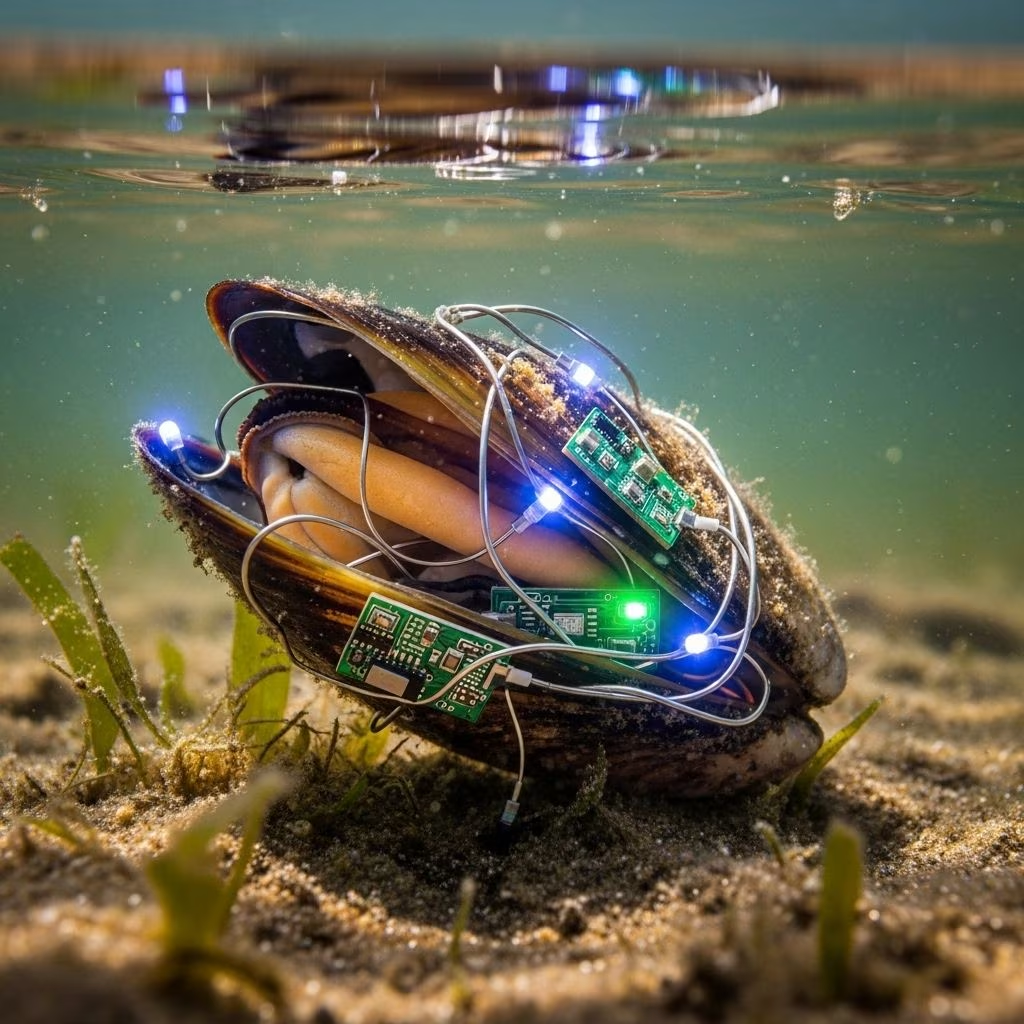
Cyborg mussels are freshwater or marine bivalves, such as oysters, clams, or mussels, equipped with electronic sensors that monitor their activity, specifically shell movement. These animals are natural filter feeders, meaning their feeding behavior provides direct insight into water quality. When exposed to toxins, mussels tend to close their shells, ceasing their feeding to avoid ingesting harmful substances. Monitoring these reactions offers an immediate biological signal that something is amiss in their environment .
- Living sentinel species: Mussels respond in real time to contaminants, behaving as ‘canaries in the coal mine.’
- Electronic augmentation: Sensors, often accelerometers or magnetometers, track changes in shell angle or opening.
- Automated data transmission: Sensor arrays transmit behavioral data wirelessly to researchers for analysis.
How Do Mussel-Based Monitoring Systems Work?
The heart of the cyborg mussel concept is behavioral monitoring: researchers track changes in the angle or degree of shell opening to detect signs of pollution or environmental stress .
- Sensor placement: Units such as inertial measurement units (IMUs) and magnetic sensors are attached to mussel shells, one on the top, one on the bottom, to record movement.
- Data acquisition: Wires connect the sensors to a stake-mounted data system, powered by solar energy, that transmits readings via cellular networks for remote analysis .
- Accuracy: Laboratory tests have shown sensors can measure shell opening angles to within less than a single degree, reliably differentiating open and closed states .
| Component | Role in Mussel Monitoring |
|---|---|
| Accelerometers | Detect angle and movement of mussel shells |
| Magnetometers | Measure proximity of shell halves and opening width |
| Microcontrollers | Process and manage sensor data |
| Wireless transmitters | Send real-time data to researchers |
| Solar power cells | Enable remote, low-maintenance operation |
Why Mussels? The Biological Logic Behind Bivalve Bio-Sensors
Mussels, oysters, clams, and scallops are ideal for environmental monitoring because of their filter-feeding behavior and sensitivity to contaminants. As they filter water to obtain food, their reaction to pollutants is immediate and instinctive. When pollutants are detected, mussels synchronize their response, often closing shells rapidly and collectively .
- Immediate behavioral feedback: Mussels close their shells quickly in presence of toxins—much faster than many chemical sensors detect changes.
- Localized measurement: Mussels used are typically native species, ensuring that responses are ecologically relevant to the specific water body.
- Long-term indicator species: Many freshwater mussel species are threatened or endangered, so tracking their health benefits conservation as well as pollution monitoring .
MolluSCAN-eye: Commercializing Cyborg Mussel Monitoring
The molluSCAN-eye system is one of the leading commercial platforms for biological water monitoring. Developed originally through research at CNRS and the University of Bordeaux, it places clusters of up to 16 electronically augmented mollusks into caged arrays at critical points in waterways such as ports, sewage outlets, and oil platforms .
- manual/automatic monitoring: Each mollusk is fitted with electromagnets on either edge of its shells; sensor signals indicate shell opening and closing behavior with precision.
- Adaptation to local conditions: Native mollusk species are used to ensure the monitoring system measures the local water threat accurately.
- Global deployment: MolluSCAN-eye units now operate in diverse aquatic environments, providing evidence-based water quality monitoring internationally .
Key Benefits of Cyborg Mussel Environmental Sensors
- Real-time detection: Behavioral changes in mussels give early warning of toxins, industrial spills, or sewer discharges long before chemical sampling would reveal a problem.
- Noninvasive: Mussel sensors do not disrupt local ecology; the animals can remain in their habitats while being monitored.
- Cost-effectiveness: Researchers note all components for the initial sensors are commercially available and affordable, lowering barriers to widespread deployment .
- Wireless connectivity: Data is transmitted live, offering instant alerts to researchers and managers.
- Increased scientific understanding: The system reveals previously invisible details about mussel biology, such as responses to temperature or feeding patterns .
Technical Innovations: From Custom ‘Fitbit’ for Mussels to ‘Internet of Mussels’
Modern mussel sensor systems represent a convergence of biology, engineering, and data science:
- Custom ‘Fitbit’ trackers: Similar to human fitness trackers, designed specifically for shell movement.
- Internet of Mussels: Vision of interconnected networks of sensor-equipped mussels across waterways, providing a decentralized, living environmental monitoring grid .
- Scalability: Current systems prototype with four mussels, but can scale to dozens, enhancing area coverage and reliability.
Beyond Pollution Detection: Conservation, Research, and New Discoveries
Cyborg mussel systems provide valuable insight not only into water pollution but also the basic biology and population health of threatened bivalve species:
- Developing baseline behavioral data: Sensor systems help researchers understand normal feeding and filtration patterns for individual mussels.
- Detection of environmental change: Responses to temperature variations, current strength, or other environmental factors can be anticipated and studied.
- Conservation benefits: Monitoring and studying endangered mussel populations with minimal intervention supports conservation strategy.
Global Applications and Future Directions
Mussel-based monitoring systems are being deployed in a variety of locations around the globe—including major river systems, ports, and industrial sites—demonstrating their versatility as a primary tool for water management.
- River health insights: Electronic mussels provide data on nitrogen and nitrate levels in rivers, addressing the causes of dead zones in ecosystem hotspots such as the Gulf of Mexico .
- Remote operation: With solar power and wireless communication, cyborg mussels can operate without daily human intervention .
- Integration with other sensors: Mussel behavior may be correlated with readings from chemical or physical water sensors, providing a comprehensive view of environmental health.
Challenges and Limitations
- Durability and lifespan: Researchers are investigating how long sensors can remain operational in real-world aquatic environments, given biofouling and wear .
- Non-toxic attachment: Ensuring sensor packs and adhesives do not harm the mussels remains a priority.
- Baseline data interpretation: Distinguishing between responses to non-harmful environmental changes and true pollution events requires thorough understanding and additional monitoring.
Table: Mussel Monitoring vs. Traditional Water Quality Monitoring
| Method | Speed of Detection | Reliability | Cost | Ecological Impact |
|---|---|---|---|---|
| Cyborg Mussels | Instantaneous (real-time) | High (biological sensitivity) | Low (commercially available parts) | Noninvasive |
| Traditional Sampling | Delayed (minutes to days) | Variable (depending on technique) | Moderate to High (lab and field costs) | Minimal (but less actionable) |
Frequently Asked Questions (FAQs)
Q: Do cyborg mussels harm the animals?
A: No, current sensor attachment methods are designed to be noninvasive and not interfere with the mussel’s natural behavior, feeding, or reproduction .
Q: Can these sensors detect all types of pollution?
A: Mussel behavior gives strong, rapid signals for toxins and pollutants affecting filtering behavior, but chemical sensors are still useful for identifying specific compounds .
Q: How are the sensors powered?
A: Most field systems use solar power to maintain autonomous, long-term operation and support wireless communication for data transfer .
Q: Are the systems scalable?
A: Yes, prototype systems start small but can scale to dozens or more mussels per site, increasing coverage and reliability .
Q: What about maintenance?
A: Mussel sensor systems are designed for minimal maintenance; however, periodic checks ensure sensor calibration and battery functionality remain optimal.
Conclusion: Cyborg Mussels and the Future of Water Protection
As ongoing research refines sensor technology, cyborg mussels are poised to reshape the world’s approach to water quality monitoring and aquatic ecosystem management. By combining biological reactivity and electronic precision, these living sensor networks offer unprecedented protection for rivers, lakes, and oceans—empowering communities to identify threats early, safeguard biodiversity, and ensure clean water for generations to come.
References
- https://ece.ncsu.edu/2021/mussel-sensors-pave-the-way-for-new-environmental-monitoring-tools/
- https://newatlas.com/environment/molluscan-eye-mollusk-water-pollution/
- https://news.ncsu.edu/2021/03/mussel-monitoring-tech/
- https://www.fondriest.com/news/cybermussels-provide-nitrogen-insights.htm
- https://www.murdoch.edu.au/research/hbi/research/projects/water-monitoring-using-cybernetic-mussels
- https://www.youtube.com/watch?v=lSv_xYVfFGQ
- https://pmc.ncbi.nlm.nih.gov/articles/PMC7472173/