


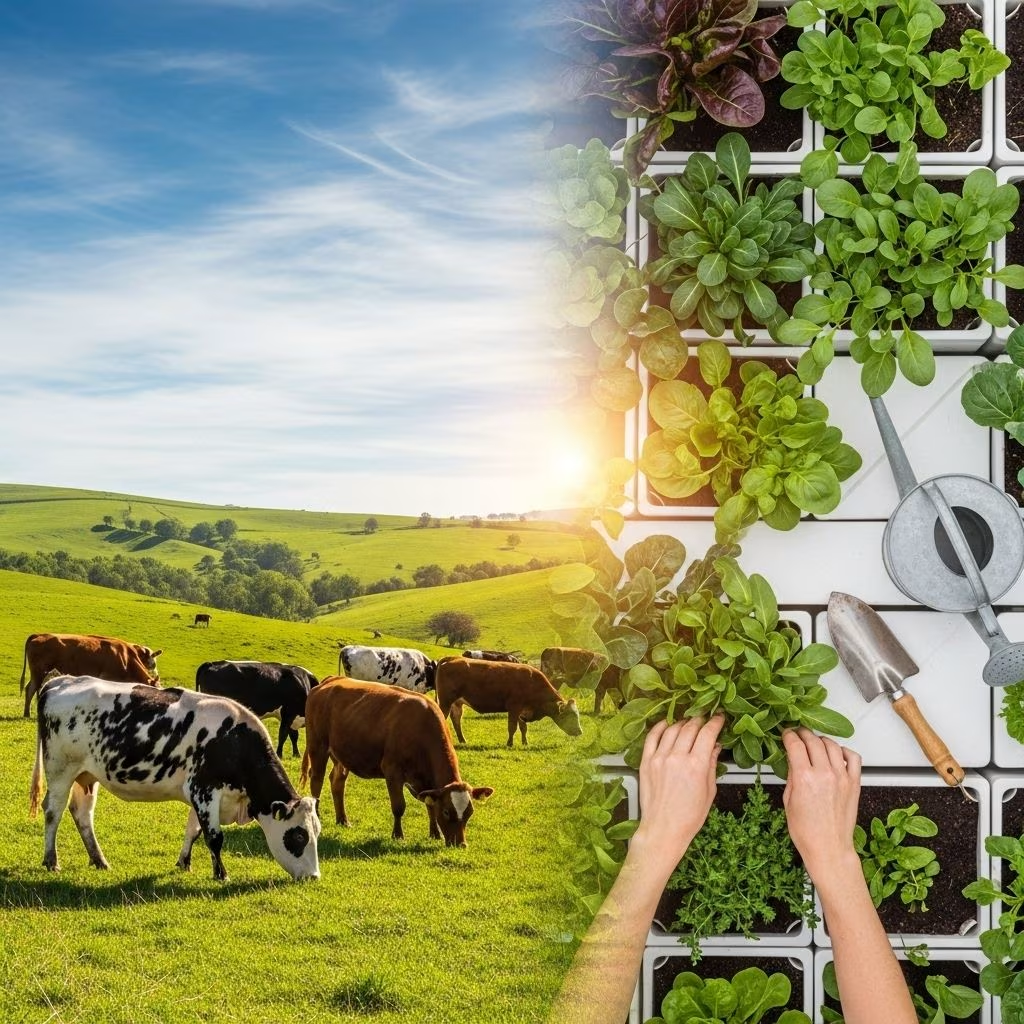
In an era where dietary choices have become increasingly polarized, the documentary Meat Me Halfway emerges as a refreshing voice advocating for nuanced conversation rather than absolutism. Directed by Brian Kateman, founder of the Reducetarian Foundation, this thought-provoking film challenges viewers to reconsider their relationship with meat consumption without demanding they abandon it entirely. The documentary’s central premise revolves around a deceptively simple yet profoundly impactful concept: reducing meat intake rather than eliminating it completely could create meaningful environmental and ethical change.
The film stands out in the crowded landscape of food documentaries by refusing to adopt the preachy, guilt-inducing tone that characterizes many of its predecessors. Instead, Kateman approaches his subject with genuine curiosity and intellectual honesty, creating space for diverse viewpoints while presenting compelling evidence for dietary reform. This balanced approach has earned the documentary praise from critics and audiences alike, with many noting its accessibility and potential to reach people who might otherwise tune out more militant advocacy.
The Reducetarian Philosophy: Finding Middle Ground
At the heart of Meat Me Halfway lies the reducetarian philosophy, a pragmatic approach to dietary change that acknowledges human nature and cultural attachment to food. Kateman argues that asking millions of Americans to adopt veganism overnight is not only unrealistic but potentially counterproductive. Food carries deep emotional significance, intertwined with family traditions, cultural identity, and personal memories. The documentary illustrates this beautifully through relatable examples, such as how giving up eggs might mean abandoning a beloved grandmother’s cookie recipe along with all the nostalgia baked into it.
The reducetarian approach recognizes these complexities while still pushing for meaningful change. Rather than viewing dietary choices as binary—either fully plant-based or complicit in environmental destruction—the philosophy embraces incremental progress. Kateman presents compelling data suggesting that if substantial portions of the population simply reduced their meat consumption, the cumulative environmental and ethical benefits would be tremendous, potentially rivaling or even exceeding the impact of converting smaller numbers to complete veganism.
This middle-ground position has not been without controversy. The documentary honestly addresses criticism from animal rights activists who view any meat consumption as morally unacceptable. By including these dissenting voices within the film itself, Kateman demonstrates intellectual integrity and allows viewers to grapple with the full spectrum of perspectives on this complex issue.
Brian Kateman: An Unconventional Guide
One of the documentary’s greatest strengths is its host and director, Brian Kateman himself. Unlike polished documentary filmmakers such as Michael Moore or Werner Herzog, Kateman brings an unvarnished, almost amateur quality to his on-camera presence. His youth and relative inexperience create an authenticity that more seasoned documentarians might struggle to achieve. He appears genuinely uncertain at times, wrestling with difficult questions rather than presenting pat answers.
This vulnerability proves strategic. Kateman’s approachable demeanor lowers viewers’ defenses, making them more receptive to challenging information about factory farming and environmental degradation. His millennial perspective resonates with younger audiences while his earnest inquiry style avoids alienating older viewers who might bristle at more confrontational approaches.
The film includes a particularly powerful scene where Kateman discusses dietary philosophy with his elderly parents. This intergenerational conversation cuts to the heart of America’s current cultural divide. His mother admits to never having tried an avocado, symbolizing a broader generational gap in food culture and environmental awareness. His parents’ skepticism toward his theories reflects the difficulty of changing deeply ingrained habits and beliefs, a challenge that extends far beyond individual families to society at large.
Inside Factory Farming: Confronting Uncomfortable Truths
Meat Me Halfway doesn’t shy away from documenting the harsh realities of industrial animal agriculture. The film provides viewers with an unflinching look at factory farming operations and their moral implications. Kateman attends protests where activists intercept trucks transporting pigs to slaughter facilities, attempting to provide the animals with water through small openings in the transport vehicles. These scenes raise fundamental questions about animal welfare and human responsibility.
One of the documentary’s most emotionally impactful sequences occurs when Kateman participates in a pig vigil organized by Toronto Pig Save founder Anita Krajnc. Krajnc predicted that witnessing animals moments before slaughter would transform Kateman into an activist, and the film captures this transformation authentically. While Kateman had always understood the intellectual arguments against factory farming, the experience of seeing frightened pigs crowded into trucks heading toward their deaths created an emotional impact that transcended abstract reasoning.
As Kateman reflects in the film, one doesn’t need to be vegan or vegetarian to recognize the profound moral problems with the factory farming system. Any thinking, feeling person would likely share his visceral reaction that this is not how a civilized society should produce food. The documentary argues that the disconnect between consumers and the sources of their food allows these practices to continue largely unexamined.
The film also explores an alternative model through visits to ethical farms where animals live in conditions approximating their natural habitats. These farmers allow pigs to roam freely, graze naturally, and express their inherent behaviors without castration, confinement, or other interventions common in industrial operations. When these animals are eventually slaughtered, it’s done as quickly and humanely as possible. While this doesn’t satisfy absolutist animal rights advocates, it represents a dramatic improvement over conventional practices and demonstrates that animal agriculture doesn’t necessarily require the cruelty endemic to factory farming.
Environmental Implications and Broader Connections
Beyond animal welfare concerns, Meat Me Halfway examines the environmental consequences of industrial meat production. The documentary presents evidence that factory farming ranks as one of the primary contributors to climate change, second only to fossil fuel consumption. This connection between dietary choices and planetary health adds urgency to Kateman’s reducetarian message.
The film ventures into related territory by addressing food justice issues, exploring how healthy food access varies dramatically across socioeconomic and racial lines. The absence of stores like Whole Foods in low-income urban neighborhoods reflects broader patterns of nutritional inequality. While these tangents occasionally diffuse the documentary’s central focus, they illustrate how meat consumption intersects with multiple social justice concerns, from environmental racism to economic disparity.
Critics have noted that these forays into adjacent topics sometimes distract from the core message about reducing meat consumption. The connection between biting into a burger and harming the planet, while scientifically valid, gets somewhat lost when the documentary pivots to discussions of food deserts and systemic inequality. Nevertheless, these explorations demonstrate the complexity of food systems and the impossibility of addressing meat consumption in isolation from larger societal structures.
Documentary Filmmaking and Structural Choices
The architecture of Meat Me Halfway contributes significantly to its effectiveness. Rather than adopting a traditional expository style, the film uses Kateman’s personal journey as its organizing principle. It opens with him explaining his beliefs directly to the camera before creating narrative tension through his conversations with family members who don’t share his views. This personal framing makes abstract policy debates concrete and relatable.
The documentary then brings in interview subjects representing various positions, including animal rights activists who strongly oppose the reducetarian philosophy. This inclusion of intelligent criticism within the film itself represents a rarity in advocacy documentaries. By acknowledging that some viewers and experts find his position insufficient or even objectionable, Kateman builds credibility and invites genuine engagement rather than passive acceptance.
The film’s low-budget aesthetic, rather than detracting from its message, enhances its grassroots authenticity. Viewers sense they’re encountering genuine inquiry rather than slickly produced propaganda. This rough-around-the-edges quality makes the documentary’s facts and arguments more digestible, less threatening to audiences who might instinctively resist more polished attempts at persuasion.
Reception and Cultural Impact
Critics have generally responded favorably to Meat Me Halfway, particularly praising its balanced approach and accessibility. Reviewers note that the documentary succeeds in presenting diverse viewpoints without becoming preachy or one-sided. The film grips viewers from the start, posing questions that demand answers while respecting audience intelligence enough to let them draw their own conclusions.
The documentary has been described as well-rounded, with professional interviews and thoughtful argumentation that elevate it above typical advocacy filmmaking. Its effectiveness lies not in overwhelming viewers with guilt or horror but in creating space for reflection about personal dietary choices and their broader implications. Many viewers report that the film made them think differently about meat consumption without making them feel attacked or judged.
Some critics have pointed out weaknesses in the film’s structure, noting that it occasionally loses focus as it branches into tangential arguments about climate change, economic inequality, and food justice. These digressions, while intellectually interesting, sometimes obscure the central message about reducetarianism. The film would perhaps benefit from tighter editing that maintains clearer connections between its various threads.
The Pragmatism Debate: Is Reduction Enough?
The most significant controversy surrounding Meat Me Halfway involves whether its pragmatic approach represents genuine progress or dangerous compromise. Animal rights activists featured in the film articulate powerful objections to the reducetarian philosophy. From their perspective, suggesting it’s acceptable to kill some animals but not others represents moral inconsistency. If killing animals for food is fundamentally wrong, they argue, then reducing consumption without eliminating it entirely fails to address the core ethical problem.
Kateman acknowledges these concerns while maintaining that perfect shouldn’t become the enemy of good. In a society where factory farming operates on a massive scale and most people consume animal products daily, even modest reductions in meat consumption would dramatically decrease animal suffering and environmental damage. The reducetarian approach prioritizes achievable change over ideological purity, betting that many people taking small steps will accomplish more than few people taking radical ones.
This utilitarian calculus frustrates absolutists but resonates with viewers looking for practical ways to align their actions with their values. The documentary suggests that dietary change exists on a spectrum and that any movement toward less meat consumption deserves recognition rather than condemnation for falling short of veganism. This flexibility and acknowledgment of human complexity may prove crucial for building broader coalitions around sustainable food systems.
Personal Transformation and Lasting Change
Throughout the documentary, viewers witness Kateman’s own evolution from intellectual understanding to emotional conviction. The pig vigil serves as the film’s emotional centerpiece, marking the moment when abstract principles became visceral reality for the filmmaker. His genuine reaction to seeing animals minutes from death—the visible distress and moral anguish—communicates more powerfully than any statistics or expert testimony could.
This transformation narrative provides a model for viewers’ own potential journeys. The film suggests that change often begins with small exposures to uncomfortable truths, building gradually toward more substantial shifts in behavior and belief. By showing rather than simply telling, the documentary invites audiences to undergo similar transformations at their own pace.
The film ultimately argues that we’re currently so far from any sustainable or ethical ideal that any positive change deserves celebration. Rather than paralyzing people with the enormity of required transformation, the reducetarian approach empowers them to take immediate, manageable steps. This psychological insight may prove as important as any environmental or ethical argument the documentary presents.
Frequently Asked Questions
Q: What is the main message of Meat Me Halfway?
A: The documentary advocates for a reducetarian approach to eating, suggesting that reducing meat consumption rather than eliminating it entirely can create meaningful environmental and ethical benefits while remaining realistic about human behavior and cultural food traditions.
Q: Who is Brian Kateman?
A: Brian Kateman is the founder of the Reducetarian Foundation, an author, and the director of Meat Me Halfway. He advocates for a pragmatic middle-ground approach to dietary reform that prioritizes achievable reduction in meat consumption over demanding complete veganism.
Q: Does the documentary only present one viewpoint?
A: No, Meat Me Halfway includes perspectives from animal rights activists who disagree with the reducetarian philosophy, providing a balanced examination of different positions on meat consumption and animal ethics.
Q: What are the environmental benefits of reducing meat consumption?
A: The film presents evidence that factory farming is one of the largest contributors to climate change after fossil fuels. Reducing meat consumption can significantly decrease greenhouse gas emissions, land use, and water consumption associated with industrial animal agriculture.
Q: Is Meat Me Halfway appropriate for viewers who enjoy eating meat?
A: Yes, the documentary specifically aims to reach meat-eaters rather than preaching to those already committed to plant-based diets. Its non-judgmental tone and practical approach make it accessible to viewers across the dietary spectrum.
References
- https://www.movieshowplus.com/reviews/review-inquisitive-doc-meat-me-halfway-offers-up-some-delicious-facts-about-the-food-industry-and-ourselves
- https://www.livekindly.com/meat-me-halfway-documentary/
- https://filmthreat.com/reviews/meat-me-halfway/2/
- https://www.youtube.com/watch?v=G_omSwB13JM
- https://www.imdb.com/title/tt14777712/
- https://www.rottentomatoes.com/m/meat_me_halfway/reviews


