


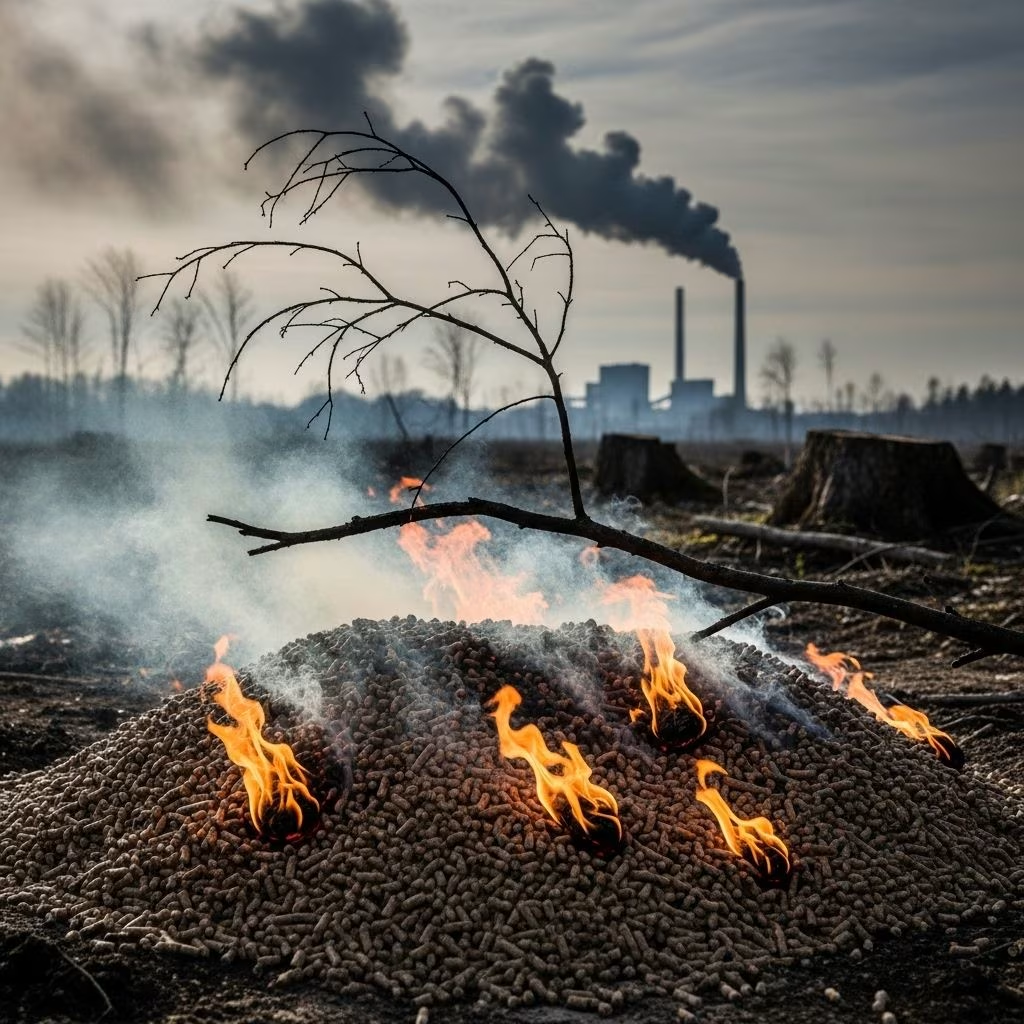
Burning Wood Pellets: Why the Carbon Neutrality Claim Falls Short
In the urgent search for viable alternatives to fossil fuels, wood pellets have surged in popularity as a source of so-called carbon-neutral energy. Promoted by energy companies and supported by regulatory policy, wood pellet-fired power plants, mainly in Europe, have come to symbolize a supposed green transition. However, mounting scientific evidence and ecological observation suggest these claims seldom withstand scrutiny, and that burning wood pellets is neither truly sustainable nor environmentally benign.
The Carbon Accounting Loophole and the Rise of Wood Pellets
Wood pellets owe their reputation to a major policy loophole that allows their counting as renewable and carbon-neutral within various international carbon accounting systems. This began with the European Union’s renewable energy guidelines, which classify woody biomass as a renewable energy source. Utilities have been incentivized to convert coal-fired generators to woody biomass, relying heavily on wood pellets to meet mandated air pollution and clean energy targets.
- Policy Incentives: Generous subsidies and regulatory credits have fueled massive growth in wood pellet imports and construction of dedicated biomass plants.
- International Supply Chain: Forests across the southeastern United States have been harvested, milled, and compressed into pellets for export to Europe, with the U.S. now a global leader in pellet production.
This policy approach is underpinned by the assertion that regrowing trees can absorb and offset the carbon released from burning wood, thereby closing the carbon cycle. Yet, as will be examined, this circularity is deeply flawed.
How Wood Pellets Are Produced and Used
The process of producing wood pellets is energy-intensive and entails multiple steps that each contribute to carbon emissions. Here’s how this supply chain unfolds:
- Raw Material Harvest: Large tracts of forest—often biodiverse native stands—are logged for wood biomass.
- Pellet Manufacturing: Wood is chipped, dried (sometimes using fossil fuels), and compressed into pellets, consuming considerable energy.
- Transportation: The finished pellets must be shipped, in bulk, across continents (e.g., from U.S. to EU), requiring additional fossil fuel use.
- Combustion: Pellets are burned in power plants, releasing CO2 and other pollutants into the atmosphere.
The pelletization process alone, before combustion, is responsible for significant greenhouse gas emissions that are routinely overlooked in official carbon accounting.
Claims of Carbon Neutrality: Industry Framing and Scientific Dispute
The wood pellet industry, typified by major players like Enviva and Drax, asserts that pellets are both renewable and carbon neutral. Their core argument relies on the carbon cycle of forests:
- As trees grow, they absorb CO2 from the atmosphere.
- When burned, they release the stored CO2.
- Planting new trees purportedly reabsorbs this carbon, supposedly achieving net zero emissions.
This logic is repeatedly echoed in industry PR and by government agencies leveraging selectively chosen studies. For example, Drax claims its fuel switch from coal to wood reduces annual emissions by 12 million tons of CO2, positioning itself as “the largest carbon-saving project in Europe” according to company statements.
However, independent research and peer-reviewed science tell a different and more nuanced story. While some studies highlight temporary increases in local forest carbon stocks—not necessarily attributable to the pellet industry itself—the broader scientific consensus notes several critical caveats:
- Carbon Accounting: The emissions from manufacturing, transport, soil disturbance, and lost carbon sequestration are excluded or underestimated in official accounting.
- Payback Time: Regrowing trees take decades (often 40–100 years) to reabsorb the released carbon, creating a long-term carbon debt.
- Ecological Impact: The conversion of old-growth forests and natural habitats into fast-growing plantations undermines biodiversity and reduces long-term carbon sink capacity.
| Claim | Industry Statement | Scientific Counterpoint |
|---|---|---|
| Carbon Neutrality | Burning pellets emits only what trees absorbed; new growth offsets emissions | Full carbon payback takes decades; immediate emissions increase atmospheric CO2 |
| Renewability | Pellets are 100% renewable; forests regrow | Forest regrowth is not guaranteed; plantations degrade biodiversity and carbon sinks |
| Emission Reduction | Pellets reduce carbon vs. coal | Life-cycle assessments can show equal or greater emissions than coal |
Environmental and Climate Impacts of Wood Pellet Energy
The environmental costs of wood pellet production extend far beyond carbon emissions. They include:
- Forest Degradation: The increased demand for biomass fuels intensive logging, disappearance of old-growth forests, and conversion to monoculture plantations.
- Biodiversity Loss: Native forests, rich in species diversity and ecological services, are replaced by fast-growing pine plantations with limited habitat value.
- Air Pollution: Combustion of pellets in power plants emits particulate matter, nitrogen oxides, and volatile organic compounds, impacting local air quality.
- Environmental Justice: Pellet mills are often sited in historically marginalized rural communities, disproportionately subjecting these populations to extraction, pollution, and poor regulatory oversight.
These impacts are particularly pronounced in the American Southeast, where much of the world’s pellet feedstock originates. Indigenous and rural communities frequently bear the brunt of extraction and industrial activity, raising concerns about the equity and justice dimensions of biomass energy policy.
The Carbon Debt Problem
One of the most severe criticisms of biomass energy is the concept of carbon debt. This refers to:
- The immediate release of carbon dioxide when wood is burned
- The loss of potential carbon sequestration had the forests been left intact
- The slow pace of regrowth—in some cases, it can take over a century for new trees to reabsorb the released carbon, undermining near-term climate goals
Because policies and industry self-reporting typically ignore these time scales, the true impact of burning pellets is, paradoxically, to increase atmospheric CO2 concentration in the coming decades—precisely when reduction is most urgently needed.
International Policy and the Paris Agreement
The EU and UK rely on woody biomass to meet their Paris climate commitments, leading to a surge in pellet production and combustion. Yet by discounting immediate emissions, these policies may threaten progress toward real climate mitigation. As one analysis of Drax’s operations notes, should forest regrowth fail to balance CO2 emissions as hoped, Europe’s climate promises “will go up in smoke”.
- Subsidies: The British government has allocated hundreds of millions of dollars to promote biomass conversion at large power plants.
- Reporting Gaps: Many emissions from production, shipping, and ecosystem loss are left out of official tallies.
- Policy Risks: U.S. efforts to revive the forestry industry by declaring biomass carbon neutral may further incentivize wood pellet expansion, compounding the problem.
Biodiversity, Forests, and Long-Term Climate Security
Preservation of intact native forests—rather than conversion to industrial wood plantations—is essential to true climate stabilization. These forests:
- Store more carbon per acre than managed plantations
- Provide critical habitat for diverse species
- Offer water, soil, and air regulation services not replicable by monocultures
The loss of old-growth forests and reduced carbon sinks undermines both climate and biodiversity goals, making pellet energy doubly problematic for planetary health.
Industry Messaging and Public Misconceptions
The wood pellet sector invests heavily in public relations, framing its operations as both renewable and essential for climate progress. Industry-funded studies often highlight limited evidence for local carbon stock declines while overlooking wider ecological and atmospheric implications.
“There is no published research that has been subjected to the rigors of independent peer review that supports these claims.” – US Industrial Pellet Association Executive Director, quoted by Enviva
Nonetheless, peer-reviewed literature consistently finds that life-cycle analyses may show net increases in carbon emissions compared to coal, especially when production and shipment are accounted for. Such selective framing risks misleading policymakers and the public about the true sustainability of pellet energy.
Frequently Asked Questions (FAQs)
Are wood pellets truly carbon neutral?
No. While wood pellet producers claim carbon neutrality by pointing to the regrowth of trees, expert analyses find that full carbon equilibrium can take decades or even centuries to re-establish, meaning emissions spike in the near term.
Does burning wood pellets reduce overall carbon emissions compared to coal?
Not necessarily. Comprehensive life-cycle assessments show that wood pellets can emit as much, or more, carbon dioxide than coal once forest loss, manufacturing, and transportation are included.
What environmental impacts do wood pellet production and use cause?
- Loss of native, carbon-rich forests
- Degraded biodiversity and ecosystem function
- Air pollution from both production and combustion
- Environmental justice impacts in marginalized communities
Can sustainable forestry solve these issues?
Sustainable forestry can mitigate some harms, but industrial-scale demand for pellets still threatens biodiversity, ecosystem resilience, and long-term carbon sequestration.
What should climate policy prioritize instead?
- Protecting intact forests as carbon sinks
- Investing in truly carbon-neutral energy sources like wind, solar, and geothermal
- Implementing accurate emissions accounting
- Reducing energy demand and improving efficiency
Conclusion: Toward Honest Accounting and Forest Protection
Despite extensive marketing and favorable policy support, burning wood pellets is neither carbon neutral nor sustainable when all impacts are considered. It triggers immediate greenhouse gas emissions, undermines forest carbon sinks, and jeopardizes biodiversity and local environmental health. For governments and energy industries committed to real climate action, honest accounting and a sharp pivot toward protecting forests are essential. Only by recognizing these realities can society ensure true progress in combating climate change and preserving ecological integrity for future generations.
References
- https://e360.yale.edu/features/carbon-loophole-why-is-wood-burning-counted-as-green-energy
- https://www.caryinstitute.org/news-insights/press-release/wood-pellets-renewable-not-carbon-neutral
- https://www.frontiersin.org/journals/communication/articles/10.3389/fcomm.2024.1237141/full
- https://www.resilience.org/stories/2024-04-09/whats-so-green-about-burning-trees-the-false-promise-of-biomass-energy/
- https://journals.library.columbia.edu/index.php/cjel/article/view/11735
- https://www.tandfonline.com/doi/full/10.1080/00963402.2022.2062933


