


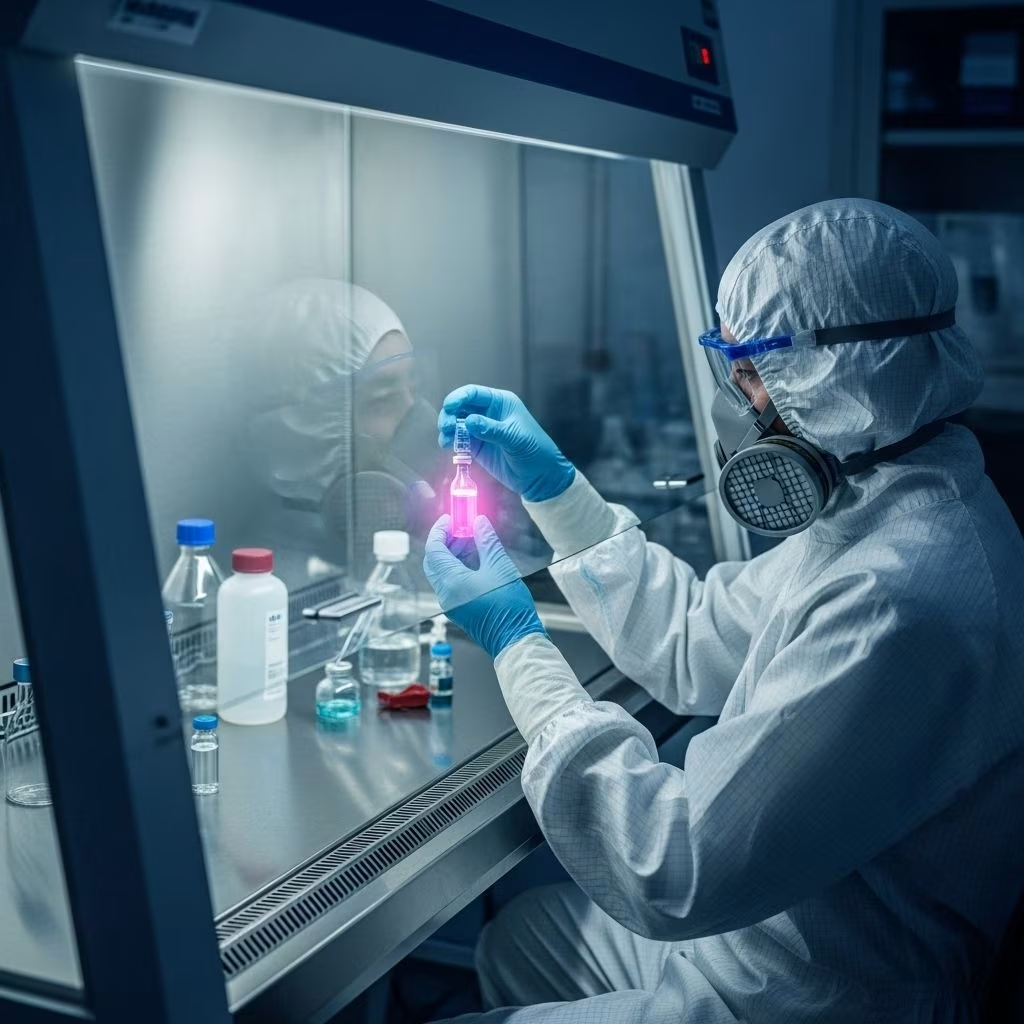
Transitioning to High-Potency Actives Safely: Risks, Protocols, and Best Practices for Secure Pharmaceutical Development
Introduction
Transitioning to the development, manufacturing, or handling of high-potency active pharmaceutical ingredients (HPAPIs) presents significant safety and operational challenges. With the rise of targeted therapies, particularly in oncology, the market for HPAPIs has expanded rapidly, necessitating rigorous strategies to minimize occupational and environmental risks. This article delivers an extensive overview of best practices for safely transitioning to high-potency actives, ensuring compliance, efficient manufacturing, and optimal operator safety.
Understanding High-Potency Actives
HPAPIs are substances characterized by high pharmacological activity at low doses, enabling targeted treatment and minimizing side effects for patients. The following attributes typically define a compound as highly potent:
- Occupational exposure limit (OEL) below 10 µg/m³ (eight-hour average)
- Therapeutic effect at doses of ≤150 µg/kg body weight
- Daily dose below 1 mg
- High selectivity for specific cellular pathways or receptors
- Potential oncogenicity or capability to cause developmental/genetic defects at very low doses
This potency allows medical professionals to deliver precision therapies, particularly in cancer treatments, resulting in a substantial proportion of new and approved drugs containing HPAPIs. However, their extremely low effective dosage means that even minute accidental exposures can have serious health consequences for workers and the environment.
Market Trends and Prevalence
More than 25% of drugs in current development and about 60% of approved oncology treatments use HPAPIs. The global market for high-potency APIs is projected to grow from $26.65 billion (2023) to $36.14 billion (2027), mainly driven by advances in precision medicine and oncology research.
Risk Assessment for HPAPIs
Effective risk assessment forms the foundation of any safe transition to high-potency actives. Before handling or incorporating HPAPIs into manufacturing workflows, organizations must:
- Conduct a comprehensive evaluation of the API’s toxicity, exposure risks, and pharmacological properties.
- Analyze factors such as physical state, formulation percentage, dustiness, and batch volume, which all influence potential exposure.
- Employ occupational hygienists and process safety experts to quantify operator and environmental risks.
- Establish an OEL monitoring program for every stage, particularly where cross-contamination is a risk.
Hazard identification alone does not suffice; managers must combine OEL data with realistic exposure scenarios to assess true risk and implement proportionate controls.
Occupational Exposure Limits and Exposure Banding
Central to occupational safety is the determination of occupational exposure limits. These scientific thresholds represent the maximum concentration of a substance to which workers can be safely exposed. HPAPIs with OEL below 10 µg/m³ are classified as highly potent, with further subdivisions into occupational exposure bands (OEBs):
| Occupational Band | OEL Range | Required Containment Level |
|---|---|---|
| OEB 1 | >1000 µg/m³ | Standard PPE and engineering controls |
| OEB 2 | 100-1000 µg/m³ | Enhanced PPE, basic containment |
| OEB 3 | 10-100 µg/m³ | Dedicated areas, advanced engineering controls |
| OEB 4 | 1-10 µg/m³ | Isolators, closed systems, full PPE |
| OEB 5 | <1 µg/m³ | Highest level isolation, complete containment |
While the OEB scheme provides guidance, definitions can vary among organizations and regulators. Early-stage APIs often require estimated banding due to paucity of toxicological data, but must be reassessed as compounds move from preclinical to clinical phases.
Containment Strategies
Containment is the cornerstone of safe HPAPI handling. It involves both physical and procedural barriers to minimize exposure risks. Key aspects include:
- Closed system processing: Utilizing isolators, high-integrity air filtration (HEPA), and automated transfer systems[10].
- Personal protective equipment (PPE): Implementing rigorously validated PPE—suits, gloves, respirators—matched and tested for chemical compatibility within process environments.
- Segregated production lines: Dedicated facilities and equipment for HPAPIs, preventing cross-contamination between potent and non-potent products[10].
- Engineering controls: Installing negative-pressure rooms, interlocking doors, and restricted access zones.
- Validated cleaning and decontamination: Proven methods for removing HPAPIs from equipment and surfaces after production cycles.
Physical containment barriers such as isolators often provide the best protection, separating operators from direct contact with substances. Environmental monitoring of airborne HPAPIs, coupled with regular equipment checks, supports containment effectiveness.
Table: Containment Hierarchy for HPAPIs
| Containment Level | Description |
|---|---|
| Primary | Direct enclosure (e.g., isolators, glove boxes) |
| Secondary | Room air handling (negative pressure, HEPA filtration) |
| Tertiary | Facility-wide zoning, restricted access, special waste handling |
Ensuring Environmental and Operator Safety
Protecting employee health and environmental integrity requires more than equipment and PPE:
- Continuous monitoring: Real-time surveillance for HPAPI leaks or breaches in containment.
- Decontamination protocols: Every batch must be followed by validated cleaning to remove or destroy all traces of potent compounds. Regulatory standards set maximum allowable residues below 1/1000th of the daily therapeutic dose.
- Process optimization: Engineering controls and closed system operations reduce manual handling and lower exposure risks.
- Waste management: Special handling, labeling, and disposal procedures for HPAPI-contaminated materials.
- Emergency response plans: Procedures for rapid containment, decontamination, and medical intervention in case of accidental release.
An often-overlooked risk is PPE, particularly gloves, whose chemical compatibility must be checked and verified for each process. Incompatible gloves can be penetrated by HPAPIs or solvents, undermining operator safety and environmental protection.
Cleaning Validation and Contamination Prevention
Because HPAPIs are active at extremely low concentrations, thorough cleaning and decontamination are vital to prevent cross-contamination:
- Adopt GMP cleaning validation protocols at every manufacturing stage.
- Industry standard: post-cleaning residual API concentrations must be below 1/1000th of daily dose for most substances.
- Particular challenges exist for therapeutic macromolecules and peptides, which are denatured by heat or pH extremes—here, efficacy is measured by log reduction rather than residual concentration.
- Routine audits and verification of cleaning effectiveness should be carried out by independent experts.
- Document and archive all cleaning validations for regulatory compliance.
Validated cleaning is not only a regulatory requirement but a critical safeguard against accidental exposures in multi-product facilities.
Training and Operational Readiness
No containment strategy is complete without comprehensive employee training:
- Mandatory hands-on training programs for all personnel handling HPAPIs.
- Regular refresher courses covering spill response, correct use of PPE, contamination risks, and emergency protocols.
- Certification and periodic competency evaluations for operators.
- Clear signage and documentation to remind staff of changing protocols and risks.
- Cultivation of a safety-first culture, where every employee feels empowered to escalate potential safety breaches.
Proactive training and readiness can significantly reduce accident rates and improve compliance throughout the organization.
Outsourcing vs In-House Capabilities
The capital investment and technical complexity of transitioning to high-potency actives often challenge in-house pharmaceutical operations:
- Dedicated HPAPI facilities demand advanced containment, validated cleaning, rigorous staff training, and constant monitoring—often cost-prohibitive for small/medium companies.
- Outsourcing to a specialized contract development and manufacturing organization (CDMO) can be a practical solution. Due diligence on the partner’s safety record, containment technology, and experience is essential.
- Mixing non-potent and HPAPI production in one facility is discouraged due to cross-contamination risk.
Transitioning requires a strategic assessment of capabilities, risks, market opportunities, and regulatory obligations.
Frequently Asked Questions (FAQs)
Q: What is a high-potency active pharmaceutical ingredient (HPAPI)?
A: An HPAPI is any active compound with pharmacological activity at low doses, typically requiring an OEL below 10 µg/m³ or producing a therapeutic effect at ≤150 µg/kg. Many HPAPIs are found in oncology drugs.
Q: How is occupational exposure measured and controlled in HPAPI settings?
A: Occupational exposure is quantified by OELs and controlled through exposure banding, engineering controls, PPE, procedural protocols, and continuous air/environment monitoring.
Q: What containment systems are recommended for HPAPIs?
A: The best practice is a multi-tier containment system: isolators or glove boxes (primary), negative pressure zones with HEPA filtration (secondary), and segregated, restricted-access facilities (tertiary).
Q: How often should cleaning validations be performed?
A: Cleaning validations should be validated before first use and routinely audited during production cycles, whenever production lines switch compounds, and after any contamination event.
Q: What are the key factors when deciding to outsource HPAPI manufacturing?
A: Assess the partner’s safety protocols, expertise with HPAPIs, regulatory compliance, and historical performance. Confirm exclusive HPAPI production lines and validated cleaning regimes.
Conclusion
Transitioning safely to high-potency actives is a multi-stage process that demands thorough risk assessment, robust containment, validated cleaning protocols, continual staff training, and strategic operational planning. As the application of HPAPIs grows in the drug industry, establishing and maintaining best practices ensures protection of personnel, the environment, and product integrity. Pharmaceutical organizations embracing these protocols will navigate the complexity of HPAPI transition safely and ethically, meeting both regulatory and therapeutic demands.
References
- https://www.pharmaceutical-technology.com/sponsored/understanding-the-rules-on-hpapi-containment-in-high-potent-manufacturing/
- https://adragos-pharma.com/what-is-hpapi/
- https://www.seqens.com/knowledge-center/enhancing-safety-and-efficiency-in-hpapi-manufacturing-best-practices-and-trends/
- https://content.siegfried.ch/insights/safety-first-considerations-when-formulating-high-potency-compounds
- https://www.pharmoutsourcing.com/Featured-Articles/331680-Handling-Highly-Potent-Actives-and-Controlled-Substances-Safely-and-Securely/
- https://www.pharm-int.com/resources/managing-risks-with-potent-pharmaceutical-products/
- https://www.gmp-journal.com/current-articles/details/safe-handling-of-highly-potent-substances.html
- https://www.aenova-group.com/content/resources/Aenova_Whitepaper_Safe-and-efficient-handling-of-high-potent-drug-products.pdf
- https://www.europeanpharmaceuticalreview.com/article/180352/handling-hpapis-safely-what-does-it-take/
- https://www.bocsci.com/resources/highly-potent-active-pharmaceutical-ingredients-safety-applications.html


