


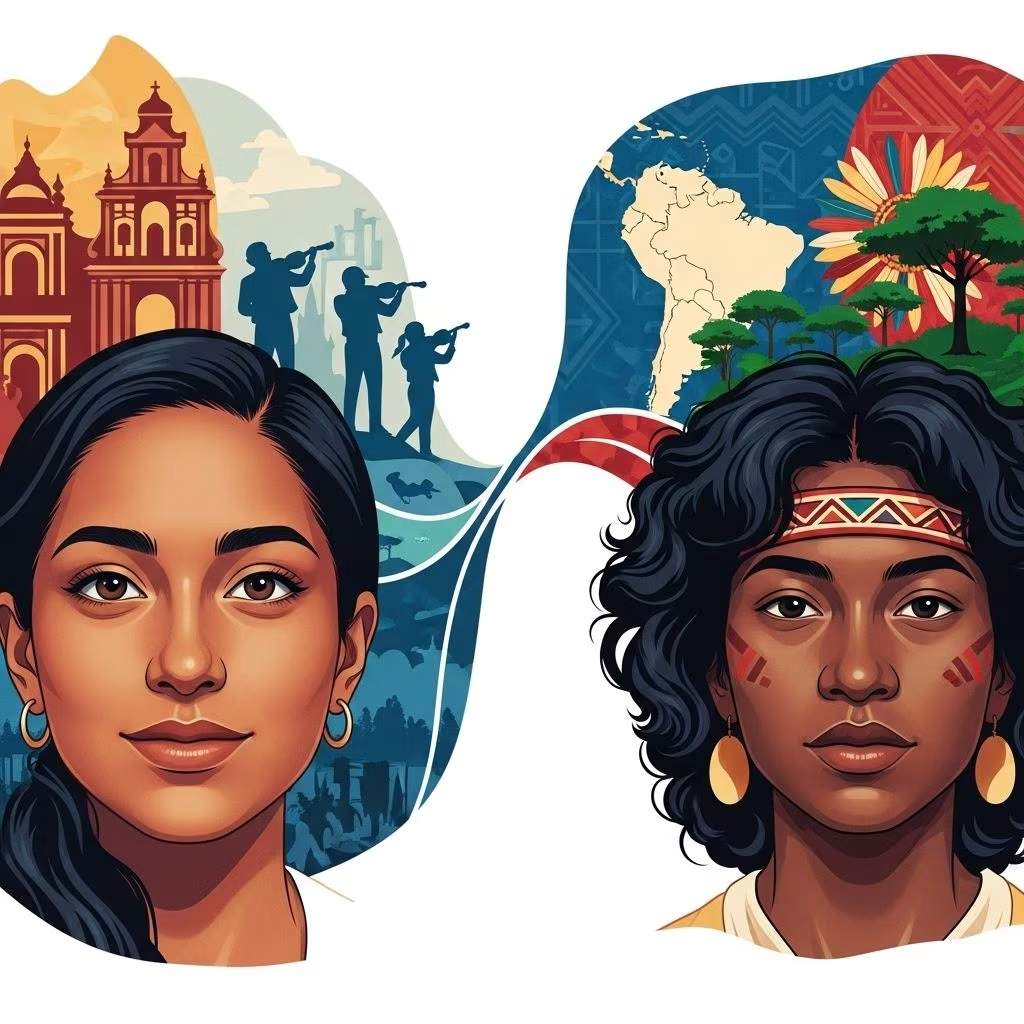
Hispanic vs. Latino: Exploring Identity, Language, and Culture
The discussion of identity within communities of Latin American and Spanish descent can be complex, shaped by history, language, geography, and personal experience. Terms such as “Hispanic” and “Latino” are often used interchangeably in the United States, but they hold distinct meanings and cultural significance depending on context. This article breaks down the key differences, origins, and evolution of these terms—and why the language we use matters for millions of people.
Defining Key Terms: Hispanic and Latino
The words Hispanic and Latino are not merely descriptors—they carry layers of history, culture, politics, and self-understanding. Grasping their differences is essential to respecting and accurately representing the identities of individuals from Latin America and the Spanish-speaking world.
What Does ‘Hispanic’ Mean?
The term Hispanic generally refers to people who come from, or have ancestry in, countries where Spanish is the primary language. This includes a wide array of nations in Latin America as well as Spain itself. The focus here is on language—specifically, connections to the Spanish language and, by extension, cultural influences rooted in Spain’s colonial legacy. For example:
- Mexico
- Colombia
- Guatemala
- Cuba
- Spain
However, it excludes countries in Latin America where Spanish is not the primary language—such as Brazil (Portuguese), Haiti (French/Creole), and Suriname (Dutch).
What Does ‘Latino’ Mean?
The term Latino (or Latina for women, Latinx as a gender-neutral form) identifies people from Latin America, regardless of the language spoken. Here, the emphasis is on geography—alluding to people from:
- Central America
- South America
- The Caribbean (Spanish, Portuguese, French, and other language influences)
- Mexico
- Brazil
Thus, the Brazilian community, for example, is considered Latino but not Hispanic, while someone from Spain is Hispanic but not Latino.
| Country | Hispanic? | Latino? |
|---|---|---|
| Mexico | Yes | Yes |
| Brazil | No | Yes |
| Spain | Yes | No |
| Cuba | Yes | Yes |
| Haiti | No | Partially (in some contexts) |
| Argentina | Yes | Yes |
Origins and History of the Terms
The origins of “Hispanic” and “Latino” reflect complex intersections of language, colonial history, and political context:
- Hispanic—Traces back to the Spanish-speaking world, and in the U.S., was promoted by government policy in the 1970s for census and administrative categorization, emphasizing ties to Spanish language and culture.
Rooted in Spain’s colonial legacy, the term has been critiqued for reinforcing the dominance of European (Spanish) influence over indigenous and African heritage. - Latino—Derived from “Latinoamericano” (Latin American), this term emerged in the mid-20th century to unite people from Latin America, regardless of language, under a shared experience of colonialism and migration.
Latino symbolizes resistance to colonial narratives, especially among those distancing themselves from the Spanish colonial identity and embracing a diverse, pan-Latin American experience.
U.S. Census and Government Usage
In the United States, the government introduced Hispanic as an official category in the 1970s, primarily based on language. Later, the term Latino gained traction, especially on the West Coast, as a way to broaden the concept of cultural and geographic heritage.
Why the Distinction Matters
Choosing between Hispanic and Latino is not a matter of semantics—it is a matter of identity, belonging, and worldview. The way these terms are used can affect:
- Personal identity and pride
- Social and political representation
- Connection to ancestry, heritage, and lived experience
For some, “Hispanic” foregrounds shared language and cultural traditions rooted in Spanish colonization. For others, “Latino” is a more inclusive term, evoking connections across Latin America, including indigenous, African, and mixed-race backgrounds, and de-centering the colonial past.
The Role of Language, Geography, and Culture
Language: The Heart of Hispanic Identity
Language, especially Spanish, plays a critical part in shaping Hispanic identity. Surveys show that many people consider speaking Spanish central to being Hispanic.1 But language as a marker is not universally agreed upon, especially as subsequent generations in the U.S. may not speak Spanish fluently or at all.
- Over 54% of foreign-born Hispanics say Spanish is an essential part of identity.
- Among second-generation Hispanics, this drops to 44%.
- Only 20% of third- or higher-generation Hispanics in the U.S. see Spanish as essential.
Yet, contrary to common assumptions, most Latinos in the U.S. do not believe that speaking Spanish or having a Spanish surname is essential for Latino identity.4
Geography: Defining Latino Identity
“Latino” is primarily a geographic descriptor, encompassing anyone from Latin America. This means that a Brazilian (whose native language is Portuguese) is Latino but not Hispanic, while a Spaniard is Hispanic but not Latino. Geographic origins often serve as a more meaningful marker for personal identity than broad pan-ethnic labels. In fact, most U.S. Hispanics/Latinos prefer to identify themselves by their family’s country of origin (e.g., Mexican, Dominican, Cuban) rather than by pan-ethnic terms.1,4
Diversity within Identity
Within the broader groups, there is immense diversity:
- Indigenous, Afro-Latino, and Asian identities
- Mixed heritage (mestizo, mulatto, etc.)
- Varied national cultures and traditions
For instance, about 25% of U.S. Latino adults identify as Afro-Latino or as having Indigenous roots,4 demonstrating the mixed and expansive nature of these communities.
Latino, Latina, Latinx, and Beyond: Evolving Terms
The terminology continues to evolve, aiming for greater inclusivity and sensitivity:
- Latino: Refers broadly to men or mixed-gender groups from Latin America.
- Latina: Specifically refers to women.
- Latinx: A modern, gender-neutral and non-binary inclusive term gaining traction in academia, media, and advocacy groups.
- Latine: An emerging gender-neutral variation favored by some Spanish speakers, seen as more linguistically natural in Spanish.
The reception of such inclusive language is mixed, with many within the communities still preferring the original gendered terms or using nationality-first identifiers.
Commonalities, Connections, and Confusion
Shared Experiences and Cultural Threads
Despite the diversity within and between these groups, there are shared experiences:
- Migration and diaspora
- Similar family values and cultural traditions
- Catholicism and religious practices (though declining and diversifying)
- Encountering and resisting discrimination and marginalization
Variety of Self-Identification
When surveyed, more than half of foreign-born Latinos in the U.S. identify themselves by their country of origin (e.g., Salvadoran, Venezuelan) rather than using “Hispanic” or “Latino” as their primary label.1 This tendency reflects the importance of local and familial connections over broad pan-ethnic groupings.
Furthermore, 77% of U.S. Latinos say their group contains many different cultures rather than one common culture.1 There is no single, unified “Hispanic” or “Latino” identity—rather, there are thousands of interconnected stories, backgrounds, and traditions.
The Impact of Identity Labels
The preference for one term over another can deeply impact how communities see themselves and how they are seen by others. These labels influence:
- Access to government resources and support
- Political mobilization and advocacy
- Recognition in media, scholarship, and public life
- Feelings of belonging or exclusion
Bearing in mind these sensitivities helps foster greater respect, empathy, and accuracy in talking about these communities.
Frequently Asked Questions (FAQs)
Q: Can someone be both Hispanic and Latino?
A: Yes. Many people are both Hispanic and Latino, such as someone from Mexico, Argentina, or Colombia. These countries are both Spanish-speaking (Hispanic) and located in Latin America (Latino).
Q: Why do some people reject the term ‘Hispanic’?
A: Some reject “Hispanic” because it ties identity directly to Spain and its colonial legacy, which many view as erasing or minimizing indigenous, African, or non-Spanish roots. Choosing “Latino” or national-origin terms can represent a reclaiming of heritage and a distancing from that colonial past.
Q: What about other related terms like ‘Latinx’ and ‘Latine’?
A: “Latinx” and “Latine” are gender-neutral alternatives to Latino/Latina, created to better reflect the diversity of gender identities and promote inclusivity. Adoption varies by region, generation, and community.
Q: Is speaking Spanish required to be considered Hispanic or Latino?
A: Not necessarily. While Spanish language is an important part of Hispanic identity, most U.S. Latinos agree that neither Spanish fluency nor a Spanish surname is required for Latino identity. Family heritage and cultural traditions are just as important.1,4
Q: How do national origin identities fit into this?
A: Many people prefer to identify with their family’s country of origin (such as Guatemalan or Peruvian) rather than broader labels like Hispanic or Latino, reflecting deep connections to their specific heritage.
Best Practices for Respectful Language Use
- Ask individuals for their preferred term. Avoid assumptions and use the identifier a person or community chooses for themselves.
- Recognize the diversity within categories. There is no one-size-fits-all label.
- Be aware of historical and regional context. What is appropriate in one setting or cohort may not be in another.
- Use nationality-specific terms when possible. This shows respect for heritage and specificity.
Key Takeaways
- Hispanic = language/connection to Spanish-speaking ancestry.
- Latino/Latina/Latinx = geography/origins in Latin America; language is not the focus.
- Identity is complex, evolving, and deeply personal, shaped by history, migration, culture, and ongoing conversation.
- Respectful communication means listening to people’s self-identification and using language thoughtfully.
References
- https://www.pewresearch.org/short-reads/2020/09/24/the-ways-hispanics-describe-their-identity-vary-across-immigrant-generations/
- https://stark.edu/hispanic-vs-latino/
- https://medschool.duke.edu/blog/ask-oedi-hispanic-latino-latina-latinx-which-best
- https://hispanicexecutive.com/for-us-latinos-identity-is-complex-and-varied/
- https://www.rw-3.com/blog/understanding-hispanic-cultural-identity
- https://www.pittwire.pitt.edu/pittwire/features-articles/hispanic-heritage-month-exploration-identity-and-celebration-culture
- https://www.universityofcalifornia.edu/news/whats-name-how-concepts-hispanic-and-latino-identity-emerged
- https://latino.si.edu/learn/latino-history-and-culture/latino-culture


