


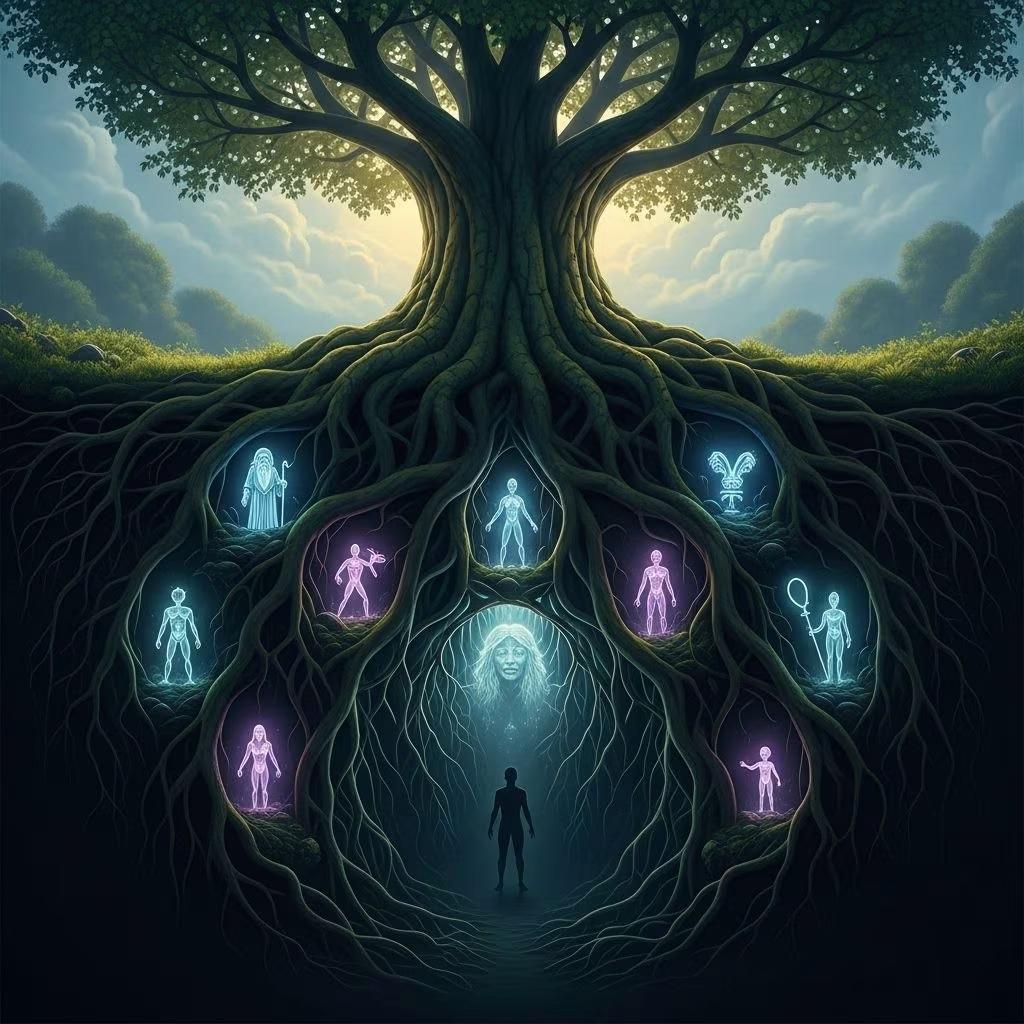
The collective unconscious stands as one of the most influential and misunderstood theories in psychology. Developed by Swiss psychiatrist Carl Gustav Jung, the concept not only reshaped how psychologists understand the mind but also continues to inform discussions about culture, creativity, and human development. This article thoroughly explores Jung’s collective unconscious: its origins, defining features, key archetypes, influence on individuals and cultures, as well as its criticisms and lasting significance.
Defining the Collective Unconscious
Carl Jung coined the term collective unconscious to describe a layer of the unconscious mind deeper than personal memories. Distinct from the personal unconscious—which contains forgotten or repressed individual experiences—the collective unconscious is shared by all humans and consists of inherited, universal psychic structures and experiences.
- Universal and Inherited: It is not shaped by personal experience but by patterns shared across humanity, passed down through generations.
- Symbolic in Nature: The collective unconscious communicates through symbols, especially in myths and dreams.
- Contains Archetypes: Its primary content is archetypes—universal, recurring images or patterns of behavior.
- Source of Shared Wisdom: It serves as a reservoir of ancestral knowledge that influences both individuals and societies.
According to Jung, the collective unconscious exists independently of individual experience and reveals itself through certain typical forms, known as archetypes, which manifest in myths, art, dreams, and religious rituals globally.
The Collective vs. Personal Unconscious
| Aspect | Personal Unconscious | Collective Unconscious |
|---|---|---|
| Source | Individual experience | Inherited, shared by all humans |
| Contents | Forgotten or repressed memories, complexes | Archetypes, primordial images, patterns |
| Nature | Unique to each person | Universal and impersonal |
| Access | Mainly through personal reflection or therapy | Manifested in myths, symbols, dreams |
Origins and Development of the Concept
Jung presented the idea of the collective unconscious in the early 20th century. He distinguished his theory from Sigmund Freud’s concept of the unconscious, which focused primarily on repressed desires and personal memories.
- First Introduction: Jung first introduced the term in his 1916 essay, “The Structure of the Unconscious,” emphasizing a universal psyche shared by all humans.
- Refinement: Over time, Jung elaborated that the collective unconscious does not arise from individual experience but from the cumulative experiences of our ancestors.
- Lecture and Writings: In prominent lectures and writings, Jung described it as a “second psychic system of a collective, universal, and impersonal nature” present in every person.
Jung saw the collective unconscious as underlying the deepest psychological processes, shaping not just individual identity but also cultural myths and religious traditions.
Key Components: Archetypes
The archetypes are the fundamental units of the collective unconscious. Jung described them as ancient, universal images and ideas that recur across cultures and civilizations. Archetypes are not memories or experiences, but rather psychic structures predisposed to organize human experiences in certain repeated ways.
Major Archetypes
- The Self: Represents unity, wholeness, and the integration of all aspects of personality.
- The Shadow: The darker, unconscious side of the self, often containing repressed weaknesses and instincts.
- The Anima/Animus: Represents the feminine inner personality in men (anima) and the masculine inner personality in women (animus).
- The Mother: Symbolizes nourishment, protection, and origin, present in stories as nurturing mothers or earth goddesses.
- The Hero: Embodies the struggle for achievement and transformation, reflected in myths and legends worldwide.
- The Wise Old Man: A symbol of knowledge, guidance, and wisdom.
- The Trickster: Brings change through cunning, humor, or chaos.
- The Child: Symbolizes innocence, new beginnings, and potential.
These archetypes manifest in literature, religion, dreams, folklore, and everyday fantasies. Every human recognizes these figures, even in widely differing cultures, highlighting the collective nature of these psychic patterns.
Expression Through Symbols
The archetypes do not appear directly but are expressed in symbolic forms. Jung emphasized that myths, dreams, and rituals are the languages through which the collective unconscious speaks.
- Dreams: Often contain universal symbolic motifs, such as falling, flying, or encounters with mysterious strangers or creatures.
- Myths & Fairy Tales: Recurring themes—like the hero’s journey or the wise guide—appear globally, beyond cultural boundaries.
- Art & Religion: Creative symbolism and ritual often echo the collective patterns embedded in the human psyche.
How the Collective Unconscious Influences Individuals
The collective unconscious shapes both the inner world of individuals and the broader society. Its influence extends to personality development, creativity, religious experience, and even personal crises.
- Self-discovery and Growth: By integrating archetypal patterns, individuals achieve greater self-understanding (a process Jung called individuation).
- Expression in Dreams: The unconscious often communicates critical guidance through dream symbols.
- Connection with Others: Shared symbols foster a sense of belonging and mutual understanding within societies.
- Inspiration: Many artists and thinkers report tapping into a collective source of inspiration, echoing Jung’s belief in the collective unconscious as a source of creativity.
Impact on Culture and Society
The collective unconscious does not only affect individuals; its effects are seen in the evolution of cultures, social norms, and spiritual traditions.
- Creation of Myths: Societies use shared symbols and archetypes to create explanatory myths and founding stories.
- Religious Rituals: Universal symbols permeate rituals, offering a sense of meaning and connection to something greater.
- Art & Literature: Recurring archetypal themes (like the hero or mother figure) appear in stories and artworks from all cultures and times.
- Shaping Culture: Unconscious patterns inform collective attitudes about morality, family, heroism, and the unknown.
Table: Examples of Archetypes in Culture
| Archetype | Common Symbol | Appears in |
|---|---|---|
| Mother | Earth, nurturing figures | Earth goddesses, fairy godmothers |
| Hero | Warrior, adventurer, protagonist | Epic sagas, legends, comics |
| Wise Old Man | Sage, wizard, mentor | Folklore, wisdom literature |
| Shadow | Monsters, antagonists, personal demons | Villains, inner struggles in literature |
| Trickster | Coyote, Loki, Hermes | World mythologies, folk stories |
Accessing the Collective Unconscious
Individuals can access the collective unconscious through several channels:
- Dream Analysis: Examining recurring symbols and themes in dreams for underlying archetypal messages.
- Active Imagination: A Jungian technique where clients dialogue with figures encountered in imagination or dreams, exploring unconscious content.
- Engagement with Myths & Stories: Identifying personally resonant themes in myths and stories can reveal archetypes influencing one’s life.
- Symbols in Art: Participation in or appreciation of symbolic art and ritual can provide insights into universal psychic dynamics.
Criticisms and Challenges
Despite its enduring influence, Jung’s concept of the collective unconscious has attracted criticism and skepticism from many psychologists and scientists.
- Lack of Empirical Evidence: Critics argue that the concept is difficult to scientifically validate, as archetypes are abstract and subjective.
- Cultural vs. Biological: Some maintain that recurring symbols reflect cultural diffusion and communication, not innate inheritance.
- Misunderstanding: The collective unconscious is often mistaken for a mystical or spiritual doctrine, whereas Jung intended it as a psychological hypothesis.
Nonetheless, Jung’s ideas find support among clinicians, writers, and spiritual thinkers who observe persistent, cross-cultural motifs in dreams and art. Jung’s work continues to shape psychoanalysis, literary criticism, anthropology, and more.
Jung’s Influence and the Legacy of the Collective Unconscious
The concept profoundly impacted psychology and popular culture.
- Psychotherapy: Jungian therapists facilitate patient self-exploration by working with archetypes and collective imagery.
- Art and Literature: Writers and artists consciously draw on collective motifs to create works with universal resonance.
- Spirituality: Jung’s ideas influenced modern spiritual movements, including interpretations of mythology and the role of symbolism in religious practices.
- Interdisciplinary Connections: The concept has been adopted in fields as diverse as management, marketing, and neuroscience (in discussions about the evolutionary roots of symbolism and emotion).
Frequently Asked Questions (FAQs)
Q: What is the collective unconscious in simple terms?
A: The collective unconscious is a part of the mind shared by all humans that contains inherited universal experiences, symbols, and patterns that shape our thoughts and behaviors.
Q: How does the collective unconscious differ from the personal unconscious?
A: The personal unconscious contains forgotten or repressed experiences unique to each individual, while the collective unconscious holds universal, inherited patterns and archetypes shared by everyone.
Q: Can I access the collective unconscious?
A: You can explore it through dream analysis, symbolic art, engaging with myths and rituals, and techniques like Jungian active imagination.
Q: What are some examples of archetypes?
A: Common archetypes include the Hero (seeking transformation), the Mother (nurturing/protective), the Shadow (repressed or feared qualities), and the Trickster (disrupting and challenging norms).
Q: Why is the collective unconscious important?
A: Understanding the collective unconscious can help individuals recognize deep motivations, find meaning, foster creativity, and connect with universal patterns that unite all humanity.
References and Further Reading
- Carl Jung, The Archetypes and the Collective Unconscious
- Simply Psychology: Carl Jung’s Theory of Personality
- Bibisco Blog: The Collective Unconscious – What It Is and How It Works
- Mathieson Art – The Collective Unconscious
References
- https://bibisco.com/blog/the-collective-unconscious-what-it-is-and-how-it-works/
- https://www.simplypsychology.org/carl-jung.html
- https://en.wikipedia.org/wiki/Collective_unconscious
- https://www.mathiesonart.co.uk/blog/the-collective-unconscious
- https://iaap.org/jung-analytical-psychology/short-articles-on-analytical-psychology/the-collective-unconscious-2/
- https://www.youtube.com/watch?v=UNBKW-yeOLM


