


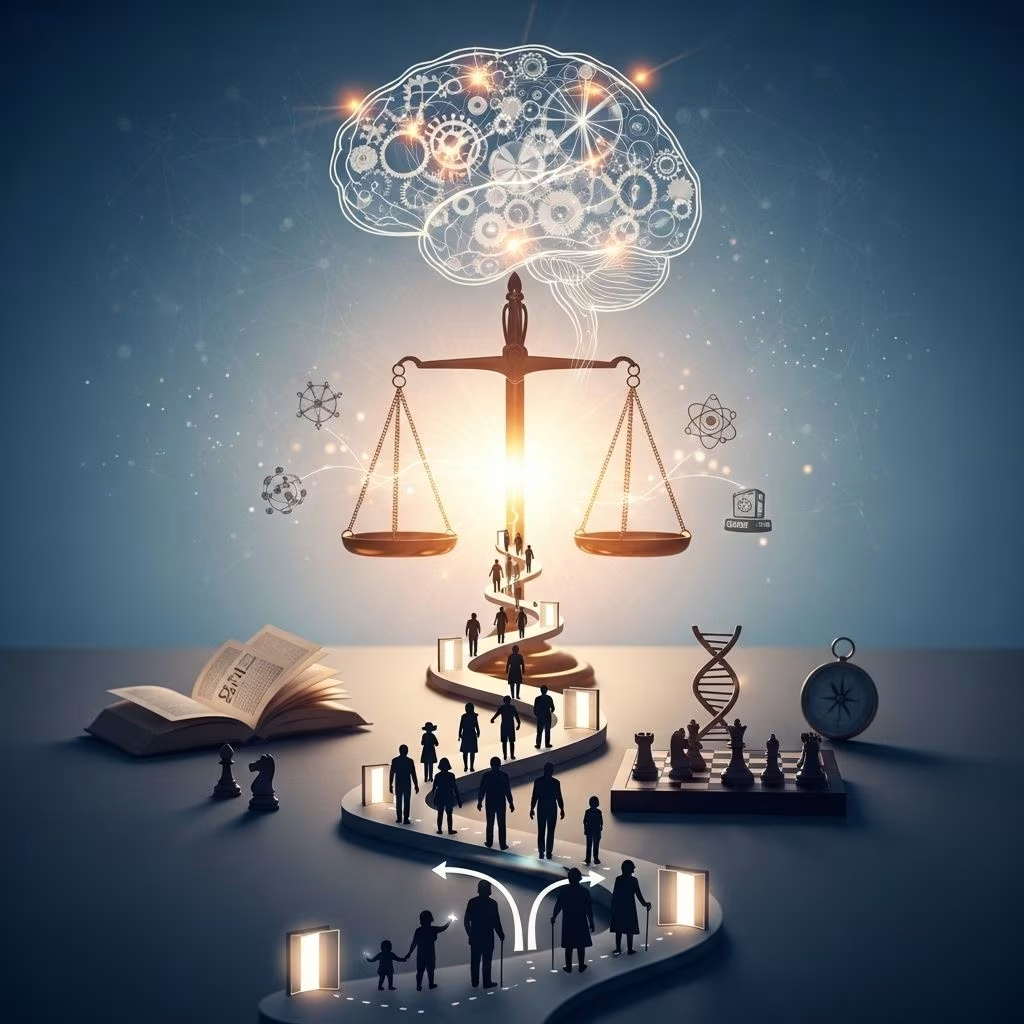
What Is Morality?
Morality refers to the principles that govern what is considered right and wrong in human behavior. These principles guide individuals in distinguishing between acceptable and unacceptable actions, influencing decisions that affect themselves and others. Morality encompasses concepts such as fairness, justice, honesty, and compassion, and it is deeply embedded in cultural, social, and psychological contexts.
At its core, morality helps people navigate complex social environments, cooperate in groups, and resolve conflicts. It is not solely a product of rules and laws but also involves internalized standards and personal beliefs about what is good and bad.
Theories of Morality
Psychologists and philosophers have developed various theories to explain how morality develops and how people make moral decisions. The most influential theories include those focusing on stages of moral development, innate moral sense, and social learning.
Lawrence Kohlberg’s Stages of Moral Development
One of the most widely cited theories in psychology is Lawrence Kohlberg’s stages of moral development. Kohlberg proposed that moral reasoning develops through a series of three levels, each with two stages, as individuals mature. These levels reflect a progression from self-interest to principled reasoning.
Level 1: Preconventional Morality
- Stage 1: Punishment/Obedience Orientation – Behavior is determined by consequences. The individual obeys rules to avoid punishment.
- Stage 2: Instrumental Purpose Orientation – Behavior is driven by rewards and personal needs.
Level 2: Conventional Morality
- Stage 3: Good Boy/Nice Girl Orientation – Behavior is influenced by the desire for approval and to be seen as a good person.
- Stage 4: Law and Order Orientation – Moral decisions are guided by respect for authority and maintaining social order.
Level 3: Postconventional or Principled Morality
- Stage 5: Social Contract Orientation – Laws are viewed as social contracts that can be changed for the greater good.
- Stage 6: Universal Ethical Principles – Behavior is governed by internalized ethical principles, such as justice, equality, and human rights.
Kohlberg’s theory suggests that individuals progress through these stages in order, though not everyone reaches the highest stages. Age, education, and social experiences all influence the rate and extent of moral development.
Innate Moral Sense and Social Development
Recent research in developmental psychology suggests that some aspects of morality may be innate, but are profoundly shaped by social and environmental interactions. Infants as young as a few months old show preferences for helpful over harmful agents, indicating a foundational moral sense.
However, as children grow, their moral understanding becomes more complex through daily social interactions, relationships, and cultural exposure. Adolescents, for example, are highly influenced by peer relationships, which play a significant role in refining their moral judgments.
Behaviorism and Morality
Behaviorist theories propose that moral behavior is learned through reinforcement and punishment. According to this perspective, children learn what is right and wrong based on the consequences of their actions, as well as by observing and imitating others. This approach emphasizes the role of the environment in shaping moral behavior.
Development of Morality
Moral development is a lifelong process that begins in early childhood and continues into adulthood. It involves both cognitive growth and social experiences.
Early Childhood
In early childhood, children begin to understand rules and consequences. They start to recognize fairness and show concern for others’ welfare. Parents, caregivers, and teachers play a crucial role in modeling moral behavior and providing guidance.
Middle Childhood and Adolescence
During the school years, children become more aware of social norms and the importance of peer approval. Friendships and group activities provide opportunities to practice empathy, cooperation, and conflict resolution.
Adulthood
In adulthood, moral reasoning becomes more abstract and principled. Adults are able to consider multiple perspectives, weigh the consequences of their actions, and make decisions based on ethical principles and societal values.
Factors Influencing Moral Development
Several factors contribute to the development of morality, including:
- Family and Caregivers: Early relationships with parents and caregivers are fundamental in shaping moral understanding and behavior.
- Peers: As children grow, their peers become increasingly influential in shaping their moral values and behaviors.
- Culture and Society: Cultural norms, religious beliefs, and societal expectations all play a role in defining what is considered moral.
- Education: Schools and educational programs provide structured opportunities for moral learning and discussion.
- Personal Experiences: Life experiences, including challenges and moral dilemmas, contribute to the ongoing development of morality.
Measuring Moral Development
Psychologists have developed several tools to assess moral reasoning and development:
- Moral Judgment Interview: A structured interview that presents moral dilemmas and assesses the reasoning behind the respondent’s choices.
- Defining Issues Test: A multiple-choice instrument that evaluates the importance individuals assign to different moral considerations in hypothetical scenarios.
These tools help researchers and educators understand how individuals think about moral issues and how their reasoning changes over time.
Moral Development Across Cultures
While Kohlberg’s stages have received some cross-cultural support, cultural differences in moral values and reasoning are evident. Different societies may emphasize various aspects of morality, such as community harmony, respect for authority, or individual rights. These differences highlight the importance of considering cultural context when studying moral development.
Moral Dilemmas
Moral dilemmas are situations in which individuals must choose between conflicting moral principles. These dilemmas are often used in research and education to explore how people reason about right and wrong. Classic examples include the trolley problem and Heinz’s dilemma, which test individuals’ willingness to break a rule to achieve a greater good.
Practical Application: Encouraging Moral Development
Parents, teachers, and community leaders can promote moral development by:
- Providing opportunities for children to practice empathy and cooperation.
- Engaging in open discussions about moral issues and dilemmas.
- Modeling ethical behavior and encouraging critical thinking.
- Creating environments that support fairness, respect, and responsibility.
Ethics vs. Morality
While the terms “ethics” and “morality” are often used interchangeably, they have distinct meanings. Ethics typically refer to the rules and customs of a particular group or profession, while morality describes individual beliefs about right and wrong. Both concepts are important in understanding how people make decisions and interact with others.
Frequently Asked Questions (FAQs)
What is the difference between morality and ethics?
Morality refers to an individual’s personal principles regarding right and wrong, while ethics are the rules and standards set by a group or society. Ethics provide guidance for professional behavior, whereas morality is more personal and internal.
At what age does moral development begin?
Moral development begins in infancy, as even young children show preferences for fairness and helpfulness. However, moral reasoning becomes more sophisticated as children grow and gain social experiences.
Can morality be taught?
Yes, morality can be fostered through education, role modeling, and social interactions. While some aspects of morality may be innate, moral reasoning and behavior are shaped by experiences and guidance from adults and peers.
Do all cultures have the same moral values?
No, moral values can vary significantly across cultures. While there may be universal moral principles, such as fairness and harm avoidance, the emphasis and expression of these values differ depending on cultural context.
What happens when people’s moral beliefs conflict?
Moral conflicts are common, especially in diverse societies. Resolving these conflicts often involves dialogue, empathy, and compromise, as well as respect for differing perspectives.
Conclusion
Morality is a complex and dynamic aspect of human psychology, shaped by innate tendencies, social interactions, and cultural influences. Theories like Kohlberg’s stages provide a framework for understanding how moral reasoning develops, while research highlights the importance of relationships and experiences in shaping moral behavior. By understanding the factors that influence moral development, individuals and communities can work together to foster ethical and compassionate societies.
References
- https://pmc.ncbi.nlm.nih.gov/articles/PMC9125330/
- https://www.britannica.com/science/Lawrence-Kohlbergs-stages-of-moral-development
- https://shodhgyan.org/shodhgyan-nu/article/view/49
- https://positivepsychology.com/self-concept/
- https://online.maryville.edu/online-bachelors-degrees/human-development-and-family-studies/resources/stages-of-human-development/
- https://thedecisionlab.com/reference-guide/neuroscience/behaviorism


