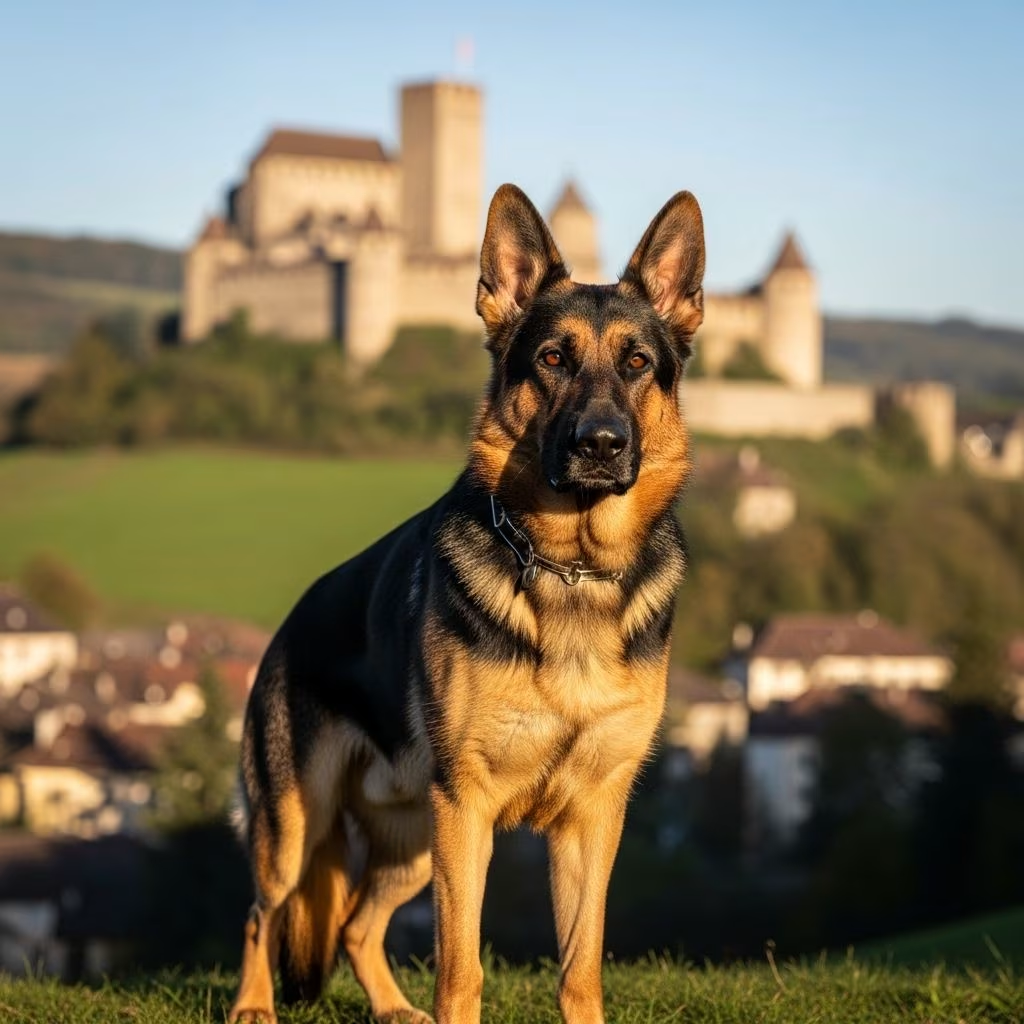
The German Shepherd Dog stands today as one of the most recognizable and beloved dog breeds in the world, serving with distinction as police dogs, military companions, service animals, and cherished family pets. Yet the story of this remarkable breed hinges on a single chance encounter at a dog show in 1899, where one man’s vision would transform regional herding dogs into a standardized breed that would capture hearts worldwide. The German Shepherd’s journey from pastoral fields to global prominence represents one of the most successful and purposeful breeding programs in canine history.
The Visionary Behind the Breed
Max Emil Friedrich von Stephanitz grew up in a wealthy family in mid-19th-century Germany with dreams that diverged from the expectations placed upon him. His true passion lay in agriculture and animal husbandry, leading him to spend time at a Berlin veterinary school where he could nurture his fascination with livestock and working animals. Despite his genuine calling, von Stephanitz ultimately succumbed to family pressure and entered military service, a decision that would ironically position him perfectly to create one of history’s most successful dog breeds.
Serving as a cavalry officer in the German countryside provided von Stephanitz with extensive exposure to the regional sheep-herding dogs that worked alongside shepherds throughout various districts. These dogs captivated him with their remarkable intelligence, lightning-fast responsiveness, and innate ability to perform complex tasks with minimal training. However, von Stephanitz observed a troubling trend: as industrialization spread and grazing lands gradually disappeared, these exceptional working dogs were declining in popularity and facing an uncertain future.
Recognizing both the value of these dogs and the threat to their continued existence, von Stephanitz made a decisive commitment. He would create a formal, standardized breed of German sheepdog that would preserve and refine the best qualities of these regional herding dogs. To pursue this ambitious goal, he purchased a large estate near the Bavarian town of Grafath, establishing the foundation for what would become a revolutionary breeding program.
The Fateful Meeting That Changed Everything
April 1899 marked the pivotal moment in German Shepherd Dog history. Von Stephanitz attended one of Germany’s largest dog shows with his friend Artur Meyer, continuing his ongoing quest to identify superior breeding stock for his vision of a standardized German sheepdog. Among the various dogs exhibited that day, one particular animal stopped him in his tracks—a four-year-old dog registered as “Hektor Linksrhein”.
Hektor possessed a striking, wolf-like appearance that immediately caught von Stephanitz’s eye, but it was the dog’s deeper qualities that truly convinced him this was the foundation he had been seeking. Von Stephanitz described Hektor as “a gentleman with a boundless zest for living,” recognizing in him an exceptional combination of intelligence, character, structural soundness, and working ability. The dog embodied the primal canine type—supple, powerful, possessing endurance, steadiness, and intelligence—while demonstrating the natural herding instinct that required only direction rather than extensive training.
Impressed beyond measure, von Stephanitz purchased Hektor on the spot for 200 German gold marks, a significant sum that reflected his conviction that he had found something extraordinary. He immediately renamed his new acquisition “Horand von Grafrath,” signaling the dog’s new destiny as the cornerstone of a breed that would change canine history.
Establishing the Foundation: The Birth of a Breed
Within a month of acquiring Horand, von Stephanitz and Meyer took the formal step that would establish the German Shepherd Dog as an official breed. They founded the Verein für deutsche Schäferhunde (Society for the German Shepherd Dog), the world’s first club dedicated exclusively to this breed. The founding membership reflected a diverse cross-section of German society, including three shepherds, two factory owners, a mayor, an innkeeper, an architect, and a magistrate—demonstrating the broad appeal of von Stephanitz’s vision.
Horand von Grafrath received the inaugural registration number SZ1, officially making him the first-ever German Shepherd Dog in the breed’s registry. Von Stephanitz assumed the role of the organization’s first president, a position from which he would guide the breed’s development with unwavering focus and scientific precision. His leadership proved instrumental in achieving the rapid standardization of form and type that would characterize the breed’s early decades.
The Breeding Strategy: Science Meets Purpose
Von Stephanitz approached German Shepherd Dog development with a clear philosophy encapsulated in his motto: “Utility and intelligence.” Unlike many dog breeders of his era who prioritized appearance, von Stephanitz believed that beauty was secondary to function. In his view, a dog lacking intelligence, proper temperament, and structural efficiency for work was essentially worthless, regardless of its aesthetic appeal. This utilitarian philosophy would shape every breeding decision and become embedded in the breed standard itself.
The breed standard developed under von Stephanitz’s guidance functioned as a comprehensive blueprint, carefully dictating the exact function and relationship of every aspect of structure, gait, and inherent attitude. Every physical characteristic was evaluated based on how it contributed to the dog’s working ability, creating a breed where form truly followed function.
To establish consistency in the bloodline, von Stephanitz employed intensive inbreeding strategies focused primarily on Horand and his brother Luchs. Horand’s best son, Hektor von Schwaben, who became the second German Sieger (champion), was mated with his half-sister and subsequently bred to daughters of his own sons, including Beowulf, Heinz von Starkenberg, and Pilot III. This concentrated breeding program fixed desirable traits but also inevitably concentrated some undesirable recessive characteristics that had originated from mixing the original regional strains.
Recognizing this challenge, von Stephanitz strategically introduced unrelated blood from dogs of proven herding origin, including Audifax von Grafrath and Adalo von Grafrath, to broaden the genetic base while maintaining the essential working characteristics he sought. This careful balance between linebreeding for consistency and outcrossing for genetic health demonstrated von Stephanitz’s sophisticated understanding of breeding principles.
The breeding program’s success exceeded even von Stephanitz’s ambitious expectations. Pilot, one of Hektor von Schwaben’s descendants, sired a total of 84 puppies, mostly through continued inbreeding with Hektor’s other offspring. From these carefully planned matings, all modern German Shepherds draw their genetic heritage, making every German Shepherd Dog today a descendant of Horand von Grafrath.
Rapid Rise to International Recognition
The German Shepherd Dog’s ascent to popularity occurred with remarkable speed. By 1923, just over two decades after the breed’s founding, the Verein für Deutsche Schäferhunde claimed an astonishing 50,000 dues-paying members organized into more than 500 branches throughout Germany alone. This explosive growth testified to the breed’s appeal and the effectiveness of von Stephanitz’s standardization efforts.
The breed’s expansion beyond German borders began in the early 20th century. In 1907, the first German Shepherd Dog was exhibited in America—Mira von Offingen, imported by Otto Gross and shown by H. Dalrymple of Port Allegheny, Pennsylvania, in the open class at shows in Newcastle and Philadelphia. The first championship titles awarded to German Shepherd Dogs in America came in 1913, marking the breed’s establishment in the American show dog world.
The German Shepherd Dog Club of America
The year 1913 proved significant for the breed’s American development with the formation of the German Shepherd Dog Club of America by Benjamin Throop and Anne Tracy, along with 26 charter members who shared enthusiasm for the breed. This organization would become instrumental in promoting and protecting the breed’s interests in the United States.
The club held its first specialty show in Greenwich, Connecticut in 1915, providing dedicated German Shepherd enthusiasts with an opportunity to showcase their dogs and advance breeding programs based on the standards established in Germany.
World War I and the Name Change
When America entered World War I in 1917, the breed faced an unexpected challenge resulting from anti-German sentiment that swept through Allied nations. Anything associated with Germany became taboo, threatening the breed’s acceptance and popularity. The American Kennel Club responded by changing the breed’s name from German Shepherd Dog to simply “Shepherd Dog,” while the German Shepherd Dog Club of America became the Shepherd Dog Club of America. Similarly, in England, the breed was rechristened the “Alsatian,” a name that would persist in Britain for many decades.
Post-War Popularity Surge
The conclusion of World War I paradoxically sparked a dramatic increase in the German Shepherd Dog’s popularity despite the wartime prejudice against German associations. The German Army had deployed the breed extensively and effectively as war dogs, and returning American soldiers brought home compelling tales of the breed’s courage, intelligence, and versatility. Some servicemen even brought German Shepherds back with them, introducing Americans to these remarkable dogs firsthand.
The breed’s intelligence and striking appearance captured public imagination, but nothing boosted the German Shepherd’s popularity quite like Hollywood. Two canine film stars—Rin-Tin-Tin and Strongheart—became household names through movies that played variations on the beloved “boy and his dog” theme. These films showcased the breed’s loyalty, intelligence, and heroic nature, propelling the German Shepherd Dog’s popularity to unprecedented heights.
The Dark Side of Popularity
Skyrocketing demand for German Shepherd Dogs created unfortunate consequences. Puppy factories proliferated to meet public appetite for the breed, with unscrupulous breeders prioritizing profit over quality. These operations flooded the American market with poorly bred dogs marketed as “German police dogs” that lacked the temperament, health, and structural soundness that von Stephanitz had worked so carefully to establish. The resulting disappointment among buyers who purchased these inferior dogs led to a significant downturn in the breed’s popularity.
Serious Breeding Continues
Despite the commercial exploitation that damaged the breed’s reputation, dedicated breeders continued producing quality German Shepherd Dogs. One notable figure was Mrs. Harrison Eustis of Fortunate Fields Kennels in Switzerland, who took a completely scientific approach to breeding. Her program involved exhaustive research of potential breedings, careful record-keeping, and systematic evaluation of results.
Mrs. Eustis’s dogs gained particular fame for their work as guide dogs for the blind at the renowned Seeing Eye organization in Morristown, New Jersey. This application demonstrated the German Shepherd’s exceptional intelligence, trainability, and temperament, helping to restore the breed’s reputation as a serious working dog rather than merely a fashionable pet.
Germany’s Breed Survey System
In 1922, Germany introduced an innovative system of regular breed surveys designed to maintain and improve breed quality. This system involved comprehensive criticism of each dog, including graded descriptions and specific recommendations for or against using the dog in breeding programs. The surveys evaluated temperament, working ability, structural soundness, and adherence to breed standards.
This systematic approach to breed improvement never gained widespread adoption in America, largely due to cultural differences in how Americans approached dog breeding and the individualistic nature of American society. However, American breeders could still access quality German bloodlines, as German dogs were readily available for American dollars, which were highly sought after in the inflationary economic climate of post-war Germany.
The Breed’s Defining Characteristics
The German Shepherd Dog that emerged from von Stephanitz’s breeding program embodied specific characteristics that distinguished it from other breeds. The dogs displayed medium size with a wolf-like appearance, combining strength with agility. Their structure emphasized endurance and efficiency of movement, with the famous “flying trot” that allowed them to cover ground effortlessly for extended periods.
Mentally, German Shepherds possessed the steadiness, intelligence, and eagerness to work that von Stephanitz had identified in Horand. They demonstrated exceptional trainability, responding quickly to commands while also showing the independent judgment necessary for herding work. The breed’s temperament combined confidence with discernment, neither shy nor aggressive without cause.
Legacy and Modern Impact
Max von Stephanitz’s achievement in creating the German Shepherd Dog represents one of the most successful examples of purposeful breed development in canine history. In less than three decades, he transformed regional variations of herding dogs into a standardized breed that achieved worldwide recognition and utility. His insistence on prioritizing working ability over appearance created a breed that could excel in diverse roles while maintaining the structural soundness necessary for a long, healthy life.
Today’s German Shepherd Dogs serve in virtually every working dog capacity imaginable—police work, military service, search and rescue, disability assistance, competitive obedience, protection work, and as devoted family companions. This versatility testifies to the soundness of von Stephanitz’s original vision and breeding philosophy. The breed consistently ranks among the most popular dogs worldwide, with the American Kennel Club regularly placing German Shepherds in the top five most registered breeds.
The breed’s enduring success also reflects the careful foundation established in those early years. Von Stephanitz’s detailed breed standard, his systematic approach to breeding, and his unwavering focus on utility and intelligence created a template that conscientious breeders continue to follow. While the breed has evolved somewhat over the decades, with regional variations developing in different countries, the essential characteristics that von Stephanitz identified and refined in Horand von Grafrath remain central to what defines a German Shepherd Dog.
Frequently Asked Questions About German Shepherd History
Q: Who created the German Shepherd Dog breed?
A: Captain Max Emil Friedrich von Stephanitz created the German Shepherd Dog breed, founding the Verein für deutsche Schäferhunde (Society for the German Shepherd Dog) in 1899 with his friend Artur Meyer. Von Stephanitz purchased Horand von Grafrath, who became the first registered German Shepherd Dog.
Q: What was the first German Shepherd Dog’s name?
A: The first German Shepherd Dog was originally named Hektor Linksrhein when von Stephanitz discovered him at a dog show in April 1899. After purchasing the dog, von Stephanitz renamed him Horand von Grafrath and registered him as SZ1, making him the foundation of the entire breed.
Q: When did German Shepherd Dogs first come to America?
A: The first German Shepherd Dog exhibited in America was Mira von Offingen in 1907, shown in Pennsylvania. The breed gained its first American championships in 1913, the same year the German Shepherd Dog Club of America was founded.
Q: Why was the breed’s name changed during World War I?
A: When America entered World War I in 1917, anti-German sentiment led the American Kennel Club to change the breed’s name from German Shepherd Dog to simply “Shepherd Dog.” In England, the breed was renamed “Alsatian” to avoid German associations during wartime.
Q: What made Horand von Grafrath special as the foundation dog?
A: Horand von Grafrath possessed the ideal combination of traits von Stephanitz sought: striking wolf-like appearance, exceptional intelligence, strong character, structural soundness, and natural herding ability. Von Stephanitz described him as “a gentleman with a boundless zest for living” and considered him the perfect foundation for standardizing the breed.
Q: How did Rin-Tin-Tin influence the breed’s popularity?
A: Rin-Tin-Tin, along with another canine film star Strongheart, dramatically increased the German Shepherd’s popularity through movies in the 1920s. These films showcased the breed’s intelligence, loyalty, and heroic qualities, causing the breed’s popularity to surge but also leading to problems with mass production by puppy mills.
Q: What was von Stephanitz’s breeding philosophy?
A: Von Stephanitz’s motto was “Utility and intelligence,” prioritizing working ability over appearance. He believed beauty was secondary and that a dog lacking intelligence, proper temperament, and structural efficiency for work was worthless. This philosophy shaped the breed standard and breeding practices.
Q: Are all German Shepherds related to Horand von Grafrath?
A: Yes, all modern German Shepherd Dogs trace their ancestry back to Horand von Grafrath through carefully planned breeding programs. Von Stephanitz used intensive inbreeding on Horand and his descendants to fix desirable traits, establishing the genetic foundation for the entire breed.
References
- https://www.akc.org/expert-advice/dog-breeds/german-shepherd-dog-history/
- https://www.akc.org/dog-breeds/german-shepherd-dog/
- https://www.akc.org/expert-advice/lifestyle/fun-facts-german-shepherd/
- https://www.akc.org/expert-advice/lifestyle/what-was-the-gsd-bred-to-do/
- https://www.gsdca.org/breed-history/
- https://www.akc.org/expert-advice/dog-breeds/breed-history/
- https://en.wikipedia.org/wiki/German_Shepherd
- https://www.animalbehaviorcollege.com/blog/pet-training/breed-spotlight-german-shepherd/