Animals in Space: Pioneers of the Final Frontier
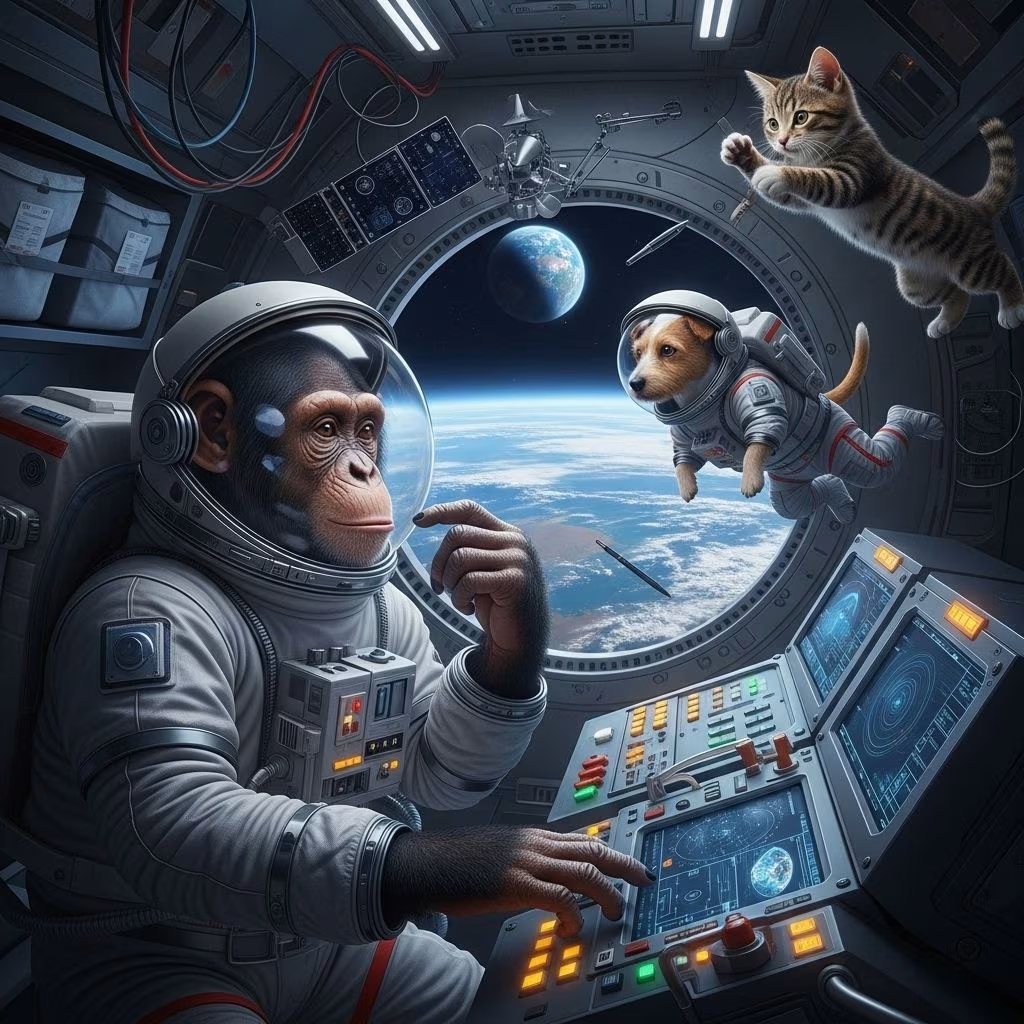
From the earliest days of space exploration, animals played a crucial role in expanding humanity’s reach into the cosmos. Long before Yuri Gagarin became the first human to orbit Earth, a diverse cast of non-human astronauts braved the unknown. Their missions helped scientists unravel the mysteries of microgravity, radiation, biological adaptation, and the challenges of safe space travel. Today, their legacy continues, shaping experiments aboard the International Space Station and inspiring future research.
Why Send Animals Into Space?
The primary motivation for sending animals into space was to study the effects of spaceflight on living organisms and better understand potential risks for humans. Animal missions allowed scientists to:
- Test life support systems and spacecraft safety
- Measure responses to microgravity, radiation, and extreme conditions
- Observe developmental and behavioral changes outside Earth’s atmosphere
- Demonstrate the possibility of surviving—and returning—from space
The invaluable data collected from animal missions has contributed to crewed missions and ensured astronaut well-being.
The Dawn of Animal Spaceflight
The journey of animals into space began not with mammals but with insects. In 1947, American researchers launched fruit flies aboard a V-2 rocket to study the impact of cosmic radiation. The successful recovery of the flies demonstrated that living beings could survive and return from the edge of space.
- 1947: Fruit flies become the first animals in space
- 1948–1951: Monkeys and mice join suborbital flights
- 1950s: The Soviet Union relies on dogs, launching dozens on suborbital and orbital missions
These missions set the foundation for rigorous biological research and the eventual launch of humans.
Milestones and Famous Animal Astronauts
Throughout the 20th century, a remarkable variety of animals contributed to space biology. Let’s explore some of the iconic missions and notable passengers:
| Year | Species | Mission/Country | Objective/Outcome |
|---|---|---|---|
| 1947 | Fruit Flies | USA | First animals in space; survived radiation exposure and recovered |
| 1949 | Albert II (Rhesus Monkey) | USA | First monkey in space; died when parachute failed |
| 1951 | Mouse | USA | Suborbital flights to study life support systems |
| 1957 | Laika (Dog) | USSR | First animal to orbit Earth; did not survive re-entry |
| 1960 | Bela & Strelka (Dogs) | USSR | Returned safely; later, Strelka’s pup was gifted to JFK |
| 1961 | Ham (Chimpanzee) | USA | Tested manual tasks in space; returned safely |
| 1973 | Spiders | USA | Aboard Skylab; built webs in microgravity |
| 2007 | Tardigrades | ESA | Survived 12 days exposed to space hazards |
Other Notable Animal Astronauts
- Guinea Pigs: Used by Soviet missions
- Cats and Frogs: French missions experimented with their physiology
- Mice and Rats: Frequent passengers on shuttles, studying neurobiology and bone density
- Bees, Ants, and Cockroaches: Provided insight into microgravity’s effect on insects and social behaviors
How Animal Involvement Evolved Over Time
Initially, animals were used as test subjects for survivability, radiation exposure, and spacecraft systems. As knowledge grew, experiments focused on more nuanced topics like muscular atrophy, bone density, reproduction, immunity, and behavior:
- Early years: Small mammals and dogs primarily tested basic flight hazards
- 1960s–80s: Expanding diversity—primates, rodents, insects, and aquatic species, exploring development and adaptation
- 1990s–Present: Large-scale experiments aboard the space shuttle and the International Space Station, including crickets, rats, spiders, and fish
The 1998 Neurolab mission, for example, included over 10,000 crickets, rats, fish, and other species to study the nervous system in microgravity. One sobering result showed that rat mothers struggled to care for their young in weightlessness, leading to high mortality rates among the pups. These finding shed light on crucial biological processes and informed preparations for long-duration human missions.
Extraordinary Survivors: The Tardigrades
Among the more resilient creatures to have traveled in space are tardigrades (water bears). In 2007, the European Space Agency launched 3,000 tardigrades into open space—subjecting them to intense radiation, vacuum, and extreme cold. Remarkably, about 68% survived for 12 days, demonstrating almost mythical hardiness. Tardigrades can even withstand total desiccation and reanimate years later. Their survival raised hope about the potential for life in extreme environments beyond Earth.
Recent and Ongoing Animal Research in Space
Animal-based research continues aboard the International Space Station (ISS). Experiments track microgravity’s effects on biology, medicine, and ecology:
- Mouse embryos have been grown on the ISS, offering insights into development in microgravity
- Ants, spiders, and cockroaches study adaptation and complex behaviors
- Fish and squid help analyze changes in motion, cellular biology, and immunity
These studies deepen our understanding of life off Earth and prepare humans for future planetary exploration.
Legacy and Impact of Animal Astronauts
The contributions of animal astronauts have been profound:
- Established fundamental safety protocols for crewed missions
- Revealed biological changes in microgravity—critical for astronaut health
- Informed improvements to spacecraft design, life support, and mission planning
- Inspired a deeper appreciation for biological science and animal welfare
While current missions use animals primarily for specialized research, the legacy of past animal astronauts continues to influence every aspect of human spaceflight.
Frequently Asked Questions (FAQs)
Q: Why were dogs such prominent space travelers during the early Soviet program?
A: Soviet scientists used stray dogs because they adapted better to harsh conditions and stress. The dogs’ size and temperament made them more suitable for confined spacecraft and atmospheric entry.
Q: Are animals still sent to space today?
A: Yes. The ISS continues to host mice, fish, spiders, and other creatures for research in biology, medicine, and ecology.
Q: Which animal was the first to orbit Earth?
A: Laika, a Russian dog, became the first living creature to orbit Earth in 1957, but did not survive re-entry.
Q: What did experiments with primates teach us about human spaceflight?
A: Chimpanzees like Ham were trained to complete tasks in space, proving humans could operate controls and survive launch stresses.
Q: How did tardigrades demonstrate extreme resilience?
A: Tardigrades survived direct exposure to space for multiple days in 2007, enduring radiation, vacuum, and freezing temperatures—making them among the toughest space travelers ever recorded.
Conclusion: The Ongoing Watch of Space’s Animal Explorers
Animal astronauts have blazed trails for human explorers, surmounting dangers and answering foundational scientific questions. Each experiment expanded our understanding of life’s limits and adaptability, ensuring safer journeys for humans on Earth and beyond. Their enduring legacy humbles and inspires, prompting us to honor their role in one of humanity’s greatest adventures.
Further Reading & Related Resources
- NASA History: A Brief History of Animals in Space
- Space.com: Celebrating the animal astronauts who paved the way for human spaceflight
- Orbital Today: The Full Story of Non-human Astronauts
- Infographic: The History of Animals in Space
References
- https://en.wikipedia.org/wiki/Animals_in_space
- https://www.nasa.gov/history/a-brief-history-of-animals-in-space/
- https://www.space.com/animals-in-space-history-human-spaceflight
- https://www.space.com/20648-animals-in-space-history-infographic.html
- https://www.discoverwildlife.com/animal-facts/animals-in-space
- https://thatjoescott.com/2023/05/08/the-complete-list-of-animals-that-have-been-to-space/
- https://orbitaltoday.com/2024/04/16/animals-in-space-the-full-story-of-non-human-astronauts/
- https://www.youtube.com/watch?v=DKncvlhelsE
- https://en.wikipedia.org/wiki/Category:Animals_in_space
- https://www.skyatnightmagazine.com/space-missions/animals-in-space
- https://a-z-animals.com/blog/animals-that-have-been-to-space/
- https://www.rmg.co.uk/stories/space-astronomy/what-was-first-animal-space
- https://space-india.com/animals-journeyed-through-space/
- https://cosmoyage.com/2024/08/animals-that-went-to-space/
- https://time.com/animals-space-pioneers/
- https://www.sciencefocus.com/space/animals-space-exploration
- https://aplaceforanimals.com/animals/animals-in-space/
- https://kids.kiddle.co/Animals_in_space