Among the diverse types of galaxies scattered throughout the universe, elliptical galaxies stand out as some of the oldest, largest, and most enigmatic structures known to astronomers. Characterized by their smooth, featureless appearance and ellipsoidal shapes, these cosmic behemoths provide vital clues about the history and evolution of the universe. This article delves into the origins, structure, classification, formation, and significance of elliptical galaxies, illustrating why they remain a focal point of astronomical research.
What Are Elliptical Galaxies?
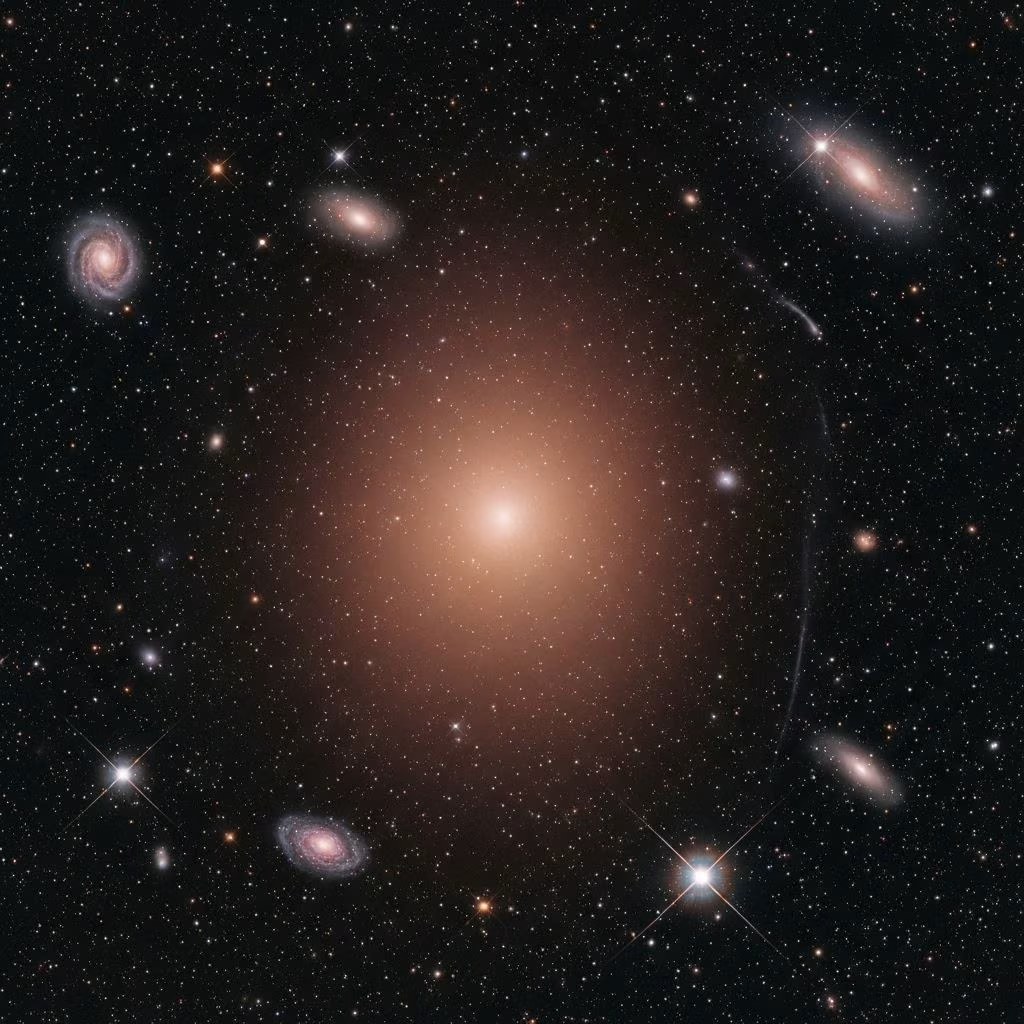
Elliptical galaxies are a major class of galaxy distinguished by their ellipsoidal shape, lack of spiral arms, and smooth, almost featureless light profiles. They appear as rounded, elongated blobs of stars, generally lacking the prominent dust lanes and visible star-forming regions found in spiral galaxies. The stars in these galaxies are typically much older, and there is very little interstellar gas and dust within them, resulting in negligible new star formation.
- Smooth, featureless structure: Elliptical galaxies lack distinct internal features and typically show an overall golden or reddish color due to the dominance of aged stars.
- Wide range of sizes: These galaxies range from dwarf ellipticals, containing millions of stars, to giants with trillions of stars.
- Stellar content: The majority of stars are ancient, generally formed over 10 billion years ago.
- Low interstellar matter: Very little gas or dust is present, which limits new star formation.
- Predominance in dense environments: Ellipticals are commonly found in the centers of massive galaxy clusters.
Defining Characteristics of Elliptical Galaxies
Elliptical galaxies are generally described by a set of shared physical and observational traits:
- Shape: True to their name, their shapes range from nearly perfect spheres to highly elongated ellipsoids. Unlike spiral galaxies, they show little to no flat disk structure.
- Brightness: Their light is distributed smoothly, and the brightness gradually fades from a dense center outward without the knots of intense brightness seen in spirals.
- Rotation: Elliptical galaxies show less organized rotation than spiral types. The orbits of their stars are randomly oriented rather than neatly aligned within a disk.
- Stellar Populations: Dominated by older, redder stars with few young, blue stars present.
- Supermassive Black Holes: Nearly every giant elliptical galaxy hosts a supermassive black hole at its core, tightly correlating with the galaxy’s overall mass.
Classification Scheme: E0 to E7
Elliptical galaxies are classified according to the Hubble Sequence, developed by Edwin Hubble. The classification employs a numerical index (En), which reflects how elongated the galaxy appears when viewed from Earth:
| Class | Description | Ellipticity (e = 1 – b/a) |
|---|---|---|
| E0 | Nearly spherical | 0.00 |
| E1 – E4 | Moderately elongated | 0.10 – 0.40 |
| E5 – E7 | Highly elongated | 0.50 – 0.70 |
The coefficients a and b are the lengths of the semi-major and semi-minor axes of the ellipse, respectively. E0 types appear round, while E7 types are most stretched-out.
Sizes and Masses: From Dwarfs to Giants
Elliptical galaxies span a vast range of sizes and masses:
- Dwarf Ellipticals: Much smaller than the Milky Way, containing a few million stars and masses generally below a billion solar masses.
- Giant Ellipticals: The largest known galaxies, sometimes a hundred times larger than the Milky Way, with trillions of stars and masses exceeding a trillion suns.
These giants can dominate the centers of galaxy clusters, while dwarfs are often found orbiting larger galaxies or dispersed throughout clusters.
Internal Structure and Dynamics
Inside elliptical galaxies, most stars travel along elongated, random orbits. Unlike spirals, where stars tend to orbit in the same plane, ellipticals exhibit little net rotation, resulting in their three-dimensional and amorphous appearance. Advanced observations show that the velocity distribution of stars (stellar velocity dispersion) is a key tool for estimating the mass of elliptical galaxies, including their hidden dark matter component.
Additionally, most giant ellipticals are surrounded by extensive systems of globular clusters, groups of ancient stars tightly bound by gravity. These systems can number in the thousands, compared with only a few hundred globular clusters around the Milky Way.
Star Formation and Interstellar Matter
One of the distinguishing attributes of elliptical galaxies is their lack of current star formation. This is primarily due to the absence of substantial interstellar gas—the raw material needed to produce new stars. The few gas clouds that are present rarely reach densities sufficient for star birth. As a result:
- Populations dominated by old stars: The majority of stars are red giants or other evolved types, lending ellipticals their reddish hue.
- Minimal dust and gas: Compared to spirals, ellipticals have very little interstellar matter.
- Occasional starbursts: Elliptical galaxies can, under rare circumstances such as galactic mergers, experience brief episodes of star formation.
Notable Examples of Elliptical Galaxies
- M87: Located near the center of the Virgo Cluster, M87 is a giant elliptical, renowned for housing a supermassive black hole recently imaged by the Event Horizon Telescope. Its massive jet of energetic particles stretches thousands of light-years into space.
- M49: Another dominant elliptical galaxy in the Virgo Cluster, rich in globular clusters.
- M32: A compact dwarf elliptical, satellite of the Andromeda Galaxy (M31), and a key example of how small ellipticals can reside in larger galactic systems.
Distribution in the Universe
Elliptical galaxies are not evenly scattered throughout space. They are preferentially found in dense environments:
- At the centers of massive galaxy clusters
- Within compact galaxy groups
- Rarely as isolated field galaxies
Their frequency in these environments suggests a connection with galactic mergers and dynamic interactions, phenomena common in cluster cores.
Origins and Formation Theories
The formation of elliptical galaxies is a subject of ongoing research and debate. The prevailing view is that most are the result of galactic mergers, especially those involving spiral galaxies in the early universe. Key theories include:
- Major collision and merger scenario: When two or more spiral galaxies collide, their interstellar gas and dust is rapidly consumed in a burst of star formation. Once the gas is exhausted and the system stabilizes, the remnant structure relaxes into an elliptical galaxy with a smooth, featureless profile.
- Galaxy harassment: Frequent gravitational encounters in dense clusters can strip galaxies of their gas and deform their structure, encouraging the transformation to an elliptical.
- Dissipationless (dry) mergers: Collisions between gas-poor galaxies produce large, red ellipticals with little new star formation, matching observations of giant ellipticals at cluster centers.
Simulations and deep-sky surveys both support the major merger model for massive elliptical galaxies, while dwarf ellipticals may form through a variety of processes including gas loss by supernova-driven winds and tidal interactions.
Role of Supermassive Black Holes
At the heart of nearly every massive elliptical galaxy lies a supermassive black hole. These objects have masses ranging from millions to billions of solar masses. The presence of such black holes is tightly linked to the stellar mass and velocity dispersion of the galaxy’s central region—a relationship known as the M–sigma relation.
- Black holes in ellipticals can produce enormous jets and active galactic nuclei (AGN), as seen in M87.
- The interplay between black hole activity and the surrounding stars and gas is thought to help regulate galaxy growth.
Elliptical vs. Spiral Galaxies: Comparison Table
| Feature | Elliptical Galaxies | Spiral Galaxies |
|---|---|---|
| Shape | Ellipsoidal, smooth | Flat disk with spiral arms |
| Stellar Population | Older, red stars | Mix of young and old stars |
| Interstellar Gas & Dust | Very little | Abundant |
| Star Formation | Minimal or none | Ongoing |
| Black Hole Presence | Supermassive at center | Central black holes (often smaller) |
| Environment | Cluster centers, dense regions | Field galaxies, less dense regions |
Why Study Elliptical Galaxies?
Understanding elliptical galaxies is crucial to unraveling the cosmic history of star and galaxy formation. Their ancient stellar populations provide a window into the early universe, and their central black holes play pivotal roles in regulating galaxy growth. Additionally, their environments reveal much about the climate and structure of galaxy clusters, including the mysterious dark matter that holds these grand systems together.
- Ellipticals serve as cosmic fossils, preserving details about past galaxy collisions and the universe’s evolution.
- Studying their lack of star formation helps astronomers understand what triggers and quenches star birth in galaxies.
Frequently Asked Questions (FAQs)
Q: How do elliptical galaxies form?
Most elliptical galaxies are believed to form from the merger of disk galaxies—especially spirals—or through repeated interactions in dense clusters, which scramble their stellar orbits and deplete their gas reservoirs.
Q: Why don’t elliptical galaxies form new stars?
Ellipticals lack significant amounts of cold gas and dust, the essential ingredients for star formation. Their interstellar material was mostly consumed in earlier starbursts or expelled by galactic winds and interactions.
Q: Where are elliptical galaxies most commonly found?
They are most frequently located in the crowded centers of galaxy clusters or within compact groups, rather than in isolation.
Q: What are some well-known elliptical galaxies?
Notable examples include M87 and M49 in the Virgo Cluster, and M32, a satellite of the Andromeda Galaxy.
Q: Do elliptical galaxies host active black holes?
Yes. Almost all large ellipticals harbor a supermassive black hole at their core; some, such as M87, exhibit powerful jets and are prominent radio sources because of their active nuclei.
Quick Facts About Elliptical Galaxies
- Comprise about 10–15% of galaxies in local clusters.
- Appear red due to their old stellar populations.
- Can be over a million light-years across in the case of giant ellipticals.
- Contain vast numbers of globular star clusters compared to spiral galaxies.
- Often used to study galaxy evolution, merger processes, and dark matter content.
References
- https://en.wikipedia.org/wiki/Elliptical_galaxy
- https://esahubble.org/wordbank/elliptical-galaxy/
- https://study.com/academy/lesson/elliptical-galaxy-definition-examples.html
- https://science.nasa.gov/universe/galaxies/types/
- https://ned.ipac.caltech.edu/level5/ESSAYS/Baum/baum.html
- https://www.teachastronomy.com/textbook/Galaxies/Elliptical-Galaxies/
- https://skyserver.sdss.org/dr1/en/proj/advanced/galaxies/characteristics.asp
- https://revolutionized.com/facts-about-elliptical-galaxies/
- https://www.vaia.com/en-us/explanations/physics/astrophysics/elliptical-galaxies/
- https://astronomy.swin.edu.au/cosmos/*/Elliptical+Galaxy
- http://astronomy.nmsu.edu/geas/lectures/lecture29/slide05.html
- https://home.ifa.hawaii.edu/users/barnes/ast626_05/peg.pdf
- https://www.astro.umd.edu/~richard/ASTRO620/Lecture15-sm.pdf
- http://www.sr.bham.ac.uk/~tjp/FEG/hand5.pdf
- https://docs.kde.org/trunk5/en/kstars/kstars/ai-ellipgal.html
- https://study.com/academy/lesson/elliptical-galaxy-definition-examples-facts.html
- https://cas.sdss.org/dr5/en/proj/basic/galaxies/ellipticals.asp
- https://www.astronomycast.com/2024/05/ep-720-galaxy-series-elliptical-galaxies/