Black Holes Transforming Matter into Dark Energy: Solving Cosmic Hiccups
The mysterious forces driving the universe’s expansion have long confounded astronomers and physicists. In a pioneering new study, scientists propose a radical theory: black holes may convert matter from dead stars directly into dark energy, potentially explaining persistent discrepancies—‘cosmic hiccups’—in cosmological models and reshaping our view of the universe’s evolution.
Introduction to the Dark Energy Mystery
Dark energy, a mysterious phenomenon that pushes the universe to expand at an accelerating rate, comprises roughly 68–70% of the universe’s content. Astrophysicists have struggled to determine its origin and nature, particularly because current models—like the Lambda Cold Dark Matter (LCDM) model—assume dark energy’s strength is constant, a notion now challenged by new observations.
- Dark energy accelerates the universe’s growth.
- Standard cosmology (LCDM) posits a constant dark energy density.
- Recent data show possible changes in dark energy strength over cosmic time.
The DESI Observations: Uncovering Hints of Change
Motivated by recent results from the Dark Energy Spectroscopic Instrument (DESI), researchers noticed the strength of dark energy may actually evolve, contradicting conventional wisdom. DESI’s data suggests cosmic expansion rates and dark energy density have not remained static, challenging fundamental aspects of standard cosmological theory.
- DESI maps the universe’s expansion via detailed spectroscopic measurements.
- Findings suggest dark energy’s influence changes with time.
- This discrepancy is dubbed a ‘cosmic hiccup’—an unexpected deviation from predictions.
Black Holes as Bubbles of Dark Energy: The Cosmologically Coupled Hypothesis
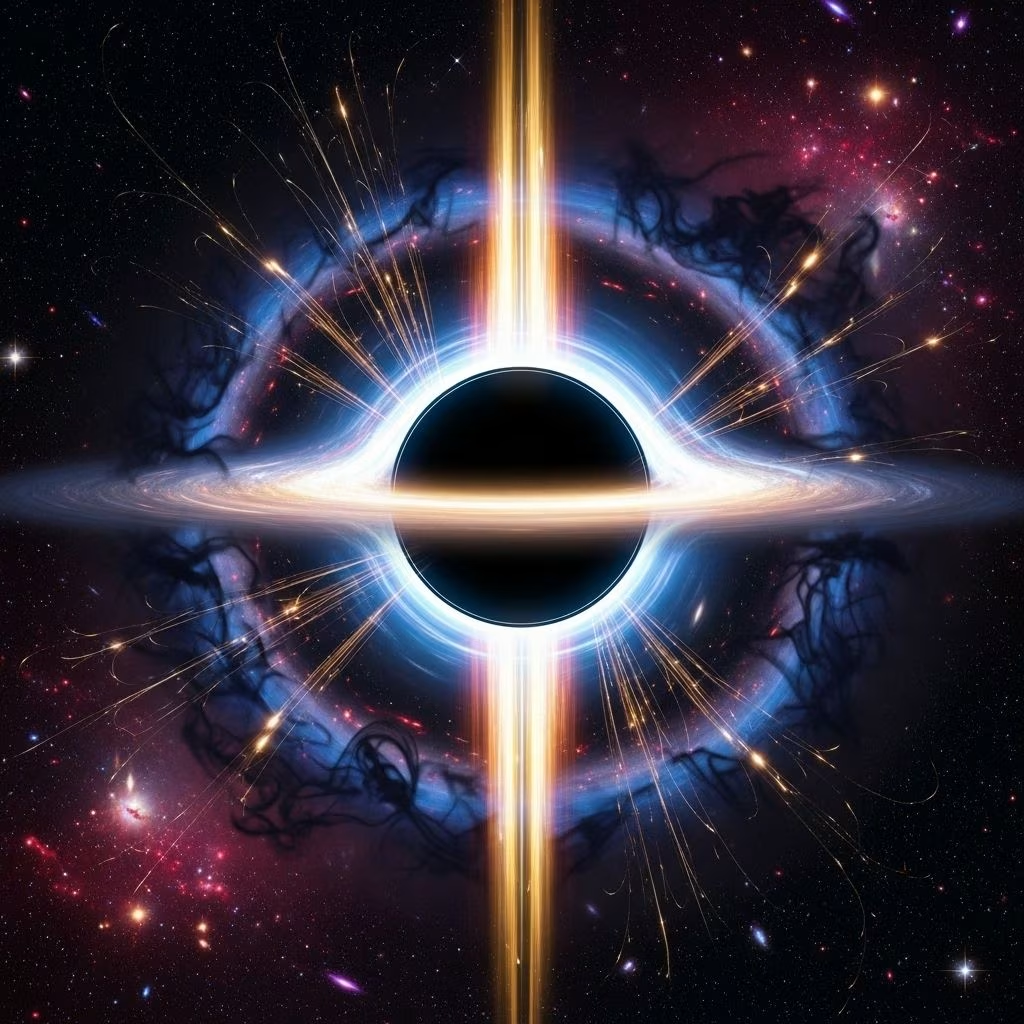
The heart of the new hypothesis rests upon cosmologically coupled black holes (CCBHs). The theory posits that when massive stars collapse, forming black holes, some of their matter is converted into dark energy rather than vanishing into a singularity. In effect, black holes may function as tiny bubbles of dark energy within the cosmic fabric.
- Black holes are born from the collapse of massive stars.
- CCBH theory: New black holes couple to the universe’s expansion, growing as dark energy increases.
- The transformation may happen because the center of a black hole mirrors early universe conditions—high density, gravity, and curvature.
How Might CCBHs Work?
The CCBH framework suggests that whenever a black hole forms, conditions may prevent a true singularity (a point of infinite density) from arising, instead allowing baryonic matter (the ordinary matter composing stars) to transform into dark energy. The process has parallels to the Big Bang reversed: matter becomes a new form of energy driving cosmic growth rather than being compressed indefinitely.
- Early universe: vacuum energy converted into matter.
- CCBH scenario: matter in collapsing stars becomes dark energy as a black hole forms.
- This requires new physics beyond Einstein’s general relativity.
Evidence and Observational Correlations
Statistical analysis using DESI data compared the formation rates of black holes with the observed change in the universe’s expansion over cosmic time. The team noticed a correlation between black hole formation events and variations in dark energy density—suggesting a possible connection.
| Phenomenon | Traditional Model | CCBH Theory |
|---|---|---|
| Black Hole Mass Growth | Only via merging or accretion | Also grows with cosmic expansion |
| Origin of Dark Energy | Mysterious ‘cosmic constant’ | Result of stellar matter conversion in black holes |
| Cosmic Expansion Rate | Predicted steady behavior | May vary due to black hole formation |
Implications for Cosmological Theory
If confirmed, the CCBH hypothesis could require revising core aspects of astrophysics:
- The expansion history and evolution of the universe
- Interpretation of cosmic background radiation and structure formation
- Constraints on other fundamental properties, such as neutrino masses
One striking implication is that the model relaxes restrictions on neutrino masses, allowing for values compatible with other observations.
Scientific Skepticism and the Need for Further Research
Though compelling, the new theory remains speculative. The physics enabling matter-to-dark-energy conversion inside black holes demands further investigation and could upend long-standing models. As lead researchers emphasize, “Historically, this is the way physics is done. You come up with as many ideas as you can and you shoot them down as fast as you can. You don’t shy away from ideas that are new and different…”
- Observational validation is crucial.
- Alternative explanations might still exist for DESI’s findings.
- The process of scientific inquiry welcomes bold hypotheses to resolve persistent mysteries.
What This Means for Our Cosmic Understanding
If black holes truly transform stellar matter into dark energy, every supernova or core-collapse event could actively shape the cosmos’s growth. The mysterious expansion ‘hiccups’ may reflect the aggregate effect of countless black holes, not just a fixed universal constant.
Key Points Summarized:
- DESI data indicates variable dark energy strength.
- CCBH theory links black hole births to increases in dark energy.
- Observational correlations support—but do not yet prove—the connection.
- If proven, this will require significant revision to current cosmology and may influence other areas like neutrino physics.
Frequently Asked Questions (FAQs)
Q: What is dark energy?
A: Dark energy is a mysterious force or pressure accelerating the universe’s expansion. Its origin and nature are among the biggest unsolved problems in modern cosmology.
Q: What is the cosmologically coupled black hole (CCBH) hypothesis?
A: The CCBH hypothesis claims that black holes formed from dead stars may convert their matter into dark energy, and that black holes grow in proportion to the universe’s expanding fabric.
Q: How was the connection between black holes and dark energy observed?
A: Scientists analyzed data from DESI, finding correlations between black hole formation rates and changes in cosmic expansion. These suggest that black holes may play a role in the universe’s dark energy dynamics.
Q: Would this theory change our universe models?
A: Yes, if validated, it could overturn core assumptions about cosmic evolution, dark energy’s source, and the role of black holes throughout time.
Q: Is this idea widely accepted?
A: No. While the theory is exciting and addresses some cosmic mysteries, it is considered speculative and awaits further observational and theoretical confirmation.
Looking Ahead: Towards a Unified Cosmic Story
As astronomers gather more data and refine their models, black holes and dark energy remain at the frontier of scientific discovery. If the CCBH hypothesis stands up to scrutiny, it promises both to solve lingering cosmic puzzles and to radically reshape the cosmic story scientists tell—from the birth of stars to the fate of the universe itself.
- Continued research using DESI and other instruments will help validate or refute these theories.
- Interdisciplinary work linking cosmology, particle physics, and astrophysics is crucial.
- Bold, creative thinking remains essential for unraveling the universe’s deepest secrets.
Related Resources
- What we do—and don’t—know about dark energy
- Could black holes create dark energy?
- Dark Energy Spectroscopic Instrument (DESI) results
References
- https://www.space.com/astronomy/black-holes-that-transform-matter-into-dark-energy-could-solve-cosmic-hiccups-mystery
- https://www.astronomy.com/science/could-black-holes-create-dark-energy/
- https://www.imperial.ac.uk/news/243114/scientists-find-first-evidence-that-black/
- https://www.youtube.com/watch?v=J7x50bq4cvs
- https://www.desi.lbl.gov/2025/08/21/black-holes-that-convert-matter-into-dark-energy-allow-for-positive-neutrino-masses/
- https://www.hawaii.edu/news/2023/02/15/evidence-linking-black-holes-to-dark-energy/
- https://news.umich.edu/evidence-mounts-for-dark-energy-from-black-holes/
- https://earthandspacenews.com/black-holes-dark-energy-connection/
- https://phys.org/news/2025-08-black-holes-universe-dark-energy.html
- https://www.durham.ac.uk/news-events/latest-news/2025/08/black-holes-may-be-the-engines-driving-the-universes-dark-energy/
- https://www.space.com/black-holes-create-dark-energy-first-evidence
- https://www.astronomy.com/science/could-black-holes-create-dark-energy
- https://phys.org/news/2024-10-links-black-holes-dark-energy.html
- https://www.rutgers.edu/news/cosmologist-aids-effort-study-dark-energy-filled-black-holes
- https://www.science.org/content/article/dark-energy-supermassive-black-holes-physicists-spar-over-radical-idea
- https://en.wikipedia.org/wiki/Black_hole
- https://www.techexplorist.com/astronomers-point-black-holes-dark-energy-ejection/91935/
- https://www.cloudynights.com/topic/864089-black-holes-as-a-source-of-dark-energy/