Blood Moon 2022: A Celestial Spectacle Captivates the World
On November 8, 2022, stargazers around the globe witnessed a total lunar eclipse, popularly called the Beaver Blood Moon. This rare celestial event drew millions of eyes to the sky and left an indelible mark in astronomical history with its stunning, copper-red lunar appearance and its broad visibility across continents. From the science of the eclipse to awe-inspiring photos, this article covers all facets of the event.
What Is a Blood Moon?
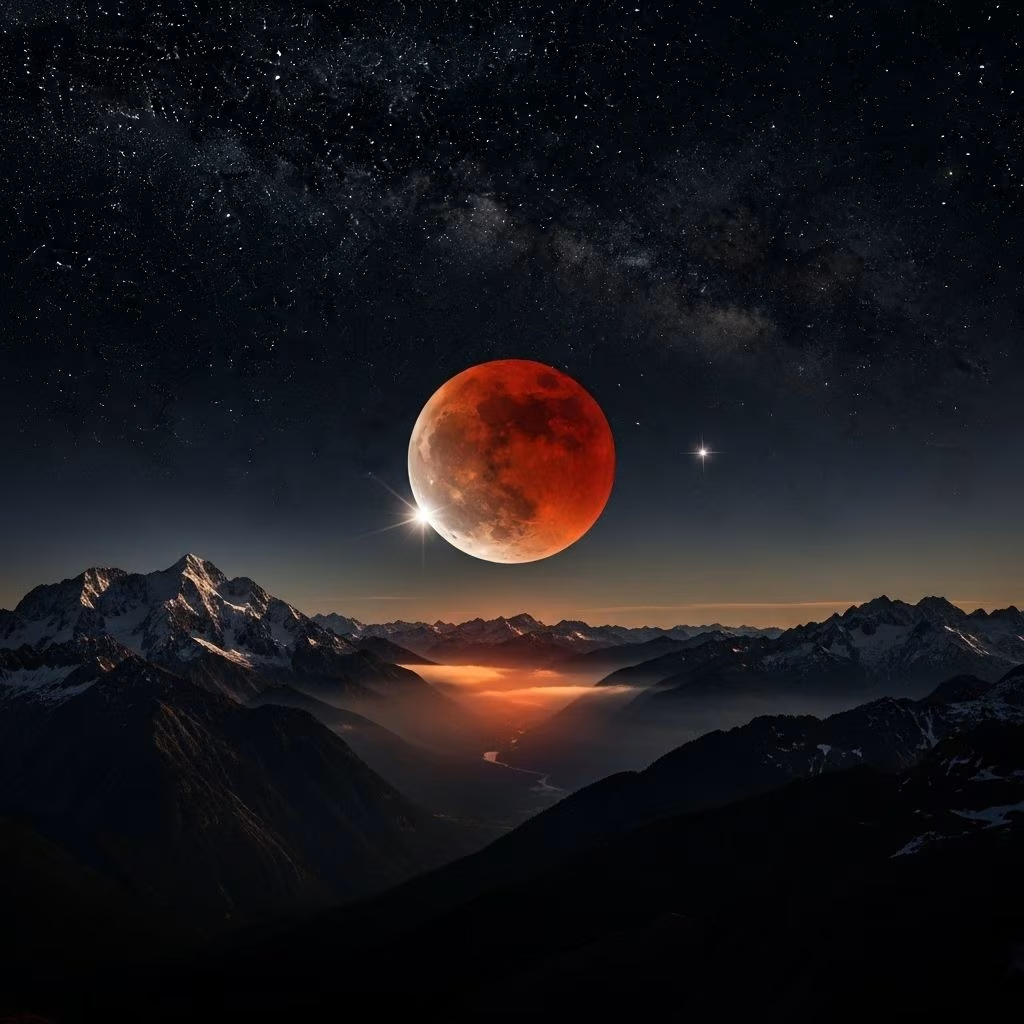
A “Blood Moon” occurs during a total lunar eclipse, when the Earth moves exactly between the Sun and the Moon, casting its shadow over the entire lunar surface. The term “Blood Moon” arises from the Moon turning a deep red or copper hue, caused by sunlight refracting through Earth’s atmosphere and only the longer, red wavelengths reaching the Moon’s surface. This phenomenon is also referred to as the Moon passing through Earth’s umbra, the darkest part of the planet’s shadow, resulting in the characteristic coloration.
- Umbra: The central, darkest part of Earth’s shadow that causes the dramatic red effect.
- Penumbral phase: A faint outer shadow, preceding and following the main event.
- Totality: When the entire face of the Moon lies within the umbra.
Highlights and Unique Features of the November 2022 Lunar Eclipse
The November 2022 lunar eclipse was remarkable for several reasons:
- Last total lunar eclipse visible until 2025: This event marked the final total lunar eclipse for nearly three years. The next full event won’t occur until March 14, 2025.
- Longest total lunar eclipse visible across much of North America since 1989: The duration and visibility made it particularly historic.
- Coincided with Election Day in the United States: Adding to its media prominence, it was the first ever total lunar eclipse on a U.S. Election Day.
- Lunar Occultation of Uranus: In some parts of Asia, observers saw Uranus hidden briefly behind the eclipsed Moon.
Scientific Explanation: How Do Lunar Eclipses Work?
Lunar eclipses occur when the Sun, Earth, and Moon align, and the Moon moves into Earth’s shadow. Depending on how deeply the Moon penetrates the shadow, observers experience a penumbral (faint), partial, or total lunar eclipse. During totality, sunlight passes through Earth’s atmosphere, which scatters shorter blue wavelengths and refracts red wavelengths onto the Moon, producing the dramatic color shift.
The November 2022 eclipse was a central lunar eclipse—the Moon passed through the middle portion of the Earth’s shadow (umbra), resulting in significant reddening and a lengthy totality.
Phases and Timing of the November 2022 Lunar Eclipse
The eclipse unfolded in a series of stages, each contributing to the overall spectacle:
| Phase | Start Time (EST) | End Time (EST) | Description |
|---|---|---|---|
| Penumbral Eclipse Begins | ~3:00 a.m. | — | The Moon enters the Earth’s faint outer shadow. The effect is subtle. |
| Partial Eclipse Begins | 4:44 a.m. | — | Earth’s umbra begins taking a “bite” out of the lunar surface. |
| Totality Begins | 5:17 a.m. | — | The Moon is fully immersed in the umbra, turning red. |
| Totality Ends | 6:42 a.m. | — | The Moon starts leaving Earth’s shadow, color fades. |
| Partial Eclipse Ends | 8:05 a.m. | — | The last part of the umbra leaves the Moon’s surface. |
Depending on location, observers saw the full sequence, while others caught only parts of the eclipse due to moonset or daylight.
Where Was the Blood Moon Visible?
This exceptional lunar eclipse was visible from:
- North America: Most U.S. and Canadian residents saw the entire eclipse. In Alaska and Hawaii, observers enjoyed every stage from start to finish.
- Central and South America: Portions of the eclipse, especially totality, were visible in Ecuador, Colombia, Venezuela, Peru, and other regions.
- Asia, Australia, New Zealand: Skywatchers in these regions witnessed totality, though for some, the eclipse began or ended before moonrise or after moonset.
- Puerto Rico: The Moon set just after totality began, offering only a partial view.
Unlike solar eclipses, lunar eclipses can be observed from anywhere on Earth’s night side, making them accessible to billions worldwide.
Why Does the Moon Turn Red?
The red or copper color during a total lunar eclipse is due to a physical process called Rayleigh scattering. As sunlight passes through Earth’s atmosphere, shorter wavelengths are scattered out, while red and orange wavelengths continue through and cast a glow on the Moon. The result is a breathtaking red moon that has inspired the moniker “Blood Moon”.
First Views and Global Reactions: A Social Media Sensation
As the eclipse unfolded, skywatchers around the world shared striking images, videos, and reactions via social media and observatory livestreams. Photographers captured the Beaver Blood Moon from city rooftops, observatories, rural outposts, and even urban parks, showcasing the eclipse’s beauty and dramatic transformation.
- Astrophotographers in North America posted composite shots showing the Moon’s changing color throughout the phases.
- Asian observers documented the occultation of Uranus, a rare alignment with the eclipsed Moon, particularly visible in Hong Kong and neighboring regions.
- Live streams from science organizations and news outlets enabled millions more to tune in from locales clouded or out of range.
Other Noteworthy Astronomical Coincidences
- Lunar Occultation of Uranus: During the eclipse, Uranus was visible close to the Moon. In select regions, the Moon appeared to pass right in front of Uranus, creating a brief occultation — a rare double treat for astronomers.
- The “Beaver Moon”: November full moons were historically called Beaver Moons (named for the time when beavers were actively preparing for winter). Thus, this event earned the nickname “Beaver Blood Moon.”
- Part of an almost-tetrad: The event followed a series of recent lunar eclipses (May 2021, November 2021, and May 2022), making this the last of the cycle until 2025.
Tips: How to Photograph a Blood Moon Lunar Eclipse
The Blood Moon offers excellent opportunities for amateur and professional photographers. Here are key tips for capturing the next lunar eclipse:
- Use a tripod: Stability is crucial for clear long-exposure shots that capture shadow detail.
- Manual exposure settings: The Moon’s brightness changes throughout the eclipse, so be ready to adjust ISO, aperture, and shutter speed.
- Telephoto lens: A longer focal length helps showcase lunar features and enhances dramatic color effects.
- Bracketing: Take several images at different settings during totality to preserve color nuances.
- Foreground interest: Compose your shots with trees, buildings, or skylines for a sense of place and scale.
Observing a Lunar Eclipse: Safety and Simplicity
One of the best features of a lunar eclipse is its safety: no special eye protection is required. The event can be enjoyed with the naked eye, though binoculars or a small telescope reveal additional color and surface detail. For the best experience, seek dark, clear skies away from city lights and allow your eyes to adjust.
Historic Context and Records
- Longest Total Lunar Eclipse for North America since 1989: This eclipse’s duration was notable and will remain unmatched until June 2029.
- First on U.S. Election Day: The unique timing generated fascination and spurred increased public attention and media coverage.
- Follows and Precedes Notable Eclipses:
- May 26, 2021: Total lunar eclipse
- November 19, 2021: Partial lunar eclipse
- May 16, 2022: Total lunar eclipse
- March 14, 2025: Next total lunar eclipse
Frequently Asked Questions (FAQs)
Q: What is a ‘Beaver Blood Moon’?
A: The term “Beaver Blood Moon” refers to the November 2022 total lunar eclipse. “Beaver Moon” is the traditional name for November’s full moon, and “Blood Moon” refers to the reddish tint during totality.
Q: Was the eclipse visible everywhere?
A: The eclipse was visible across most of North and South America, Asia, Australia, and New Zealand. Observers farther west saw the partial phases at moonset, while some in Asia saw moonrise during totality.
Q: Why does the Moon appear red?
A: During a total lunar eclipse, sunlight passing through Earth’s atmosphere scatters blue wavelengths and allows red wavelengths to reach the Moon, resulting in its copper glow.
Q: How long did the totality last?
A: The Moon remained fully red for approximately 85 minutes, making it one of the longest recent total lunar eclipses.
Q: Was it safe to view this eclipse with the naked eye?
A: Yes, unlike solar eclipses, lunar eclipses are completely safe to observe with the naked eye.
When Is the Next Total Lunar Eclipse?
After the November 2022 event, the next total lunar eclipse will occur on March 14, 2025. However, partial and penumbral eclipses will continue in the interim, offering more opportunities for skywatchers to observe the Moon’s subtle shadow play.
Continuing the Legacy: The Wonder of Lunar Eclipses
The November 2022 Blood Moon left a lasting impression on all who witnessed it, blending beauty and science in a spectacle accessible to the naked eye. As humanity continues to look upward, each eclipse links us with our planet’s natural rhythms, inspires curiosity, and invites future explorations. Whether you missed the Beaver Blood Moon or observed it in awe, rest assured: the Moon will shine red again, captivating generations to come.
References
- https://science.nasa.gov/solar-system/moon/what-you-need-to-know-about-the-nov-2022-lunar-eclipse/
- https://en.wikipedia.org/wiki/November_2022_lunar_eclipse
- https://www.space.com/blood-moon-lunar-eclipse-november-2022-guide
- https://www.space.com/blood-moon-lunar-eclipse-phases-explained
- https://en.wikipedia.org/wiki/Lunar_eclipse
- https://www.usatoday.com/story/news/nation/2025/03/09/last-total-lunar-eclipse-2022-election-day/81639412007/
- https://www.timeanddate.com/eclipse/lunar/2022-november-8
- https://www.youtube.com/watch?v=lU6sKVJ24RI
- https://science.nasa.gov/moon/eclipses/
- https://www.timeanddate.com/eclipse/2022
- https://www.thesuntoday.org/eclipses-transits/total-lunar-eclipse-november-7-8-2022/
- https://sites.rowan.edu/planetarium/blog/2022/11/lunar-eclipse-nov2022.html
- https://www.youtube.com/watch?v=11qqyuyOaYw
- https://www.weather.gov/fsd/suneclipse
- https://www.axios.com/2022/11/07/lunar-eclipse-blood-moon-november-2022
- https://starwalk.space/en/news/total-lunar-eclipse-time-november-2022
- https://timesofindia.indiatimes.com/gadgets-news/lunar-eclipse-2022-everything-you-need-to-know-about-the-last-blood-moon-of-the-year/articleshow/95323624.cms