Orion Nebula: Facts and Wonders of Earth’s Closest Stellar Nursery
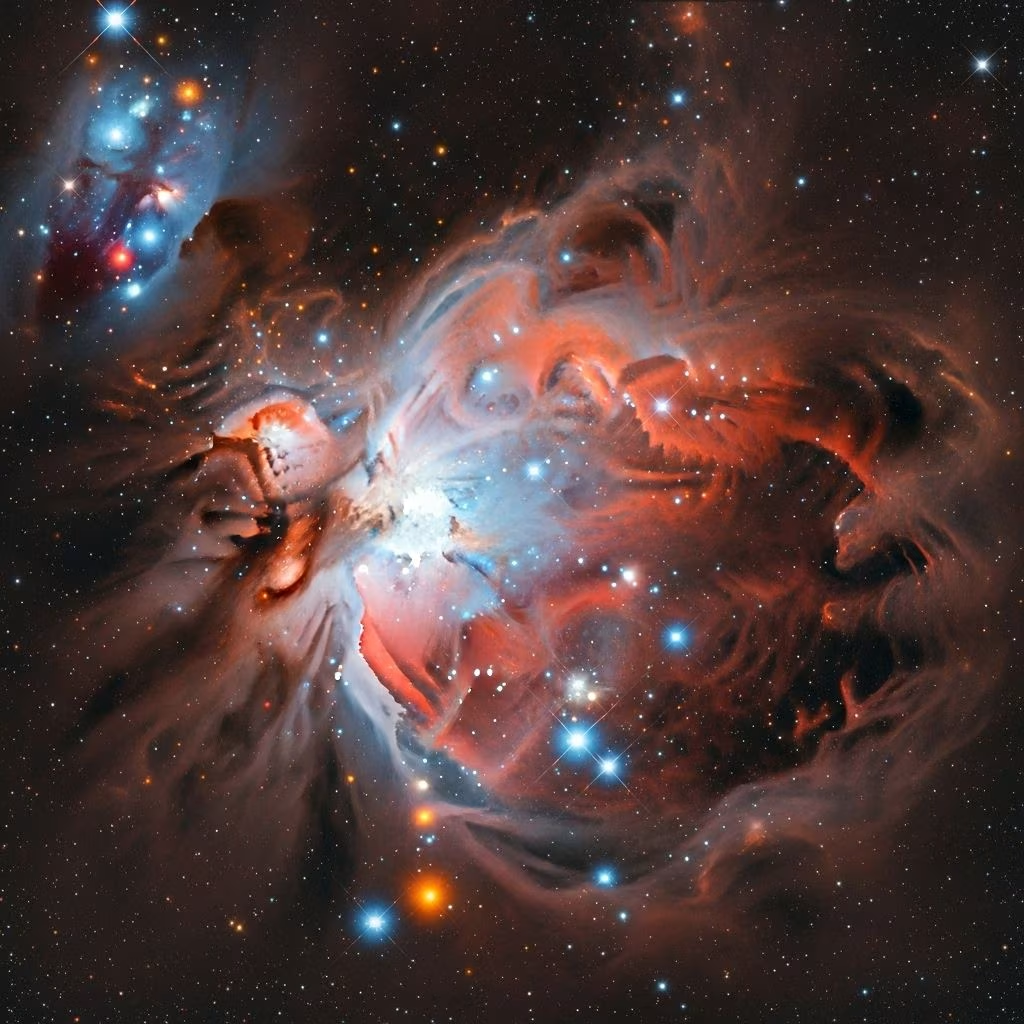
The Orion Nebula, cataloged as Messier 42 (M42) and NGC 1976, captivates astronomers and stargazers as the brightest diffuse nebula visible from Earth. Located in the constellation Orion, it is best known for its dazzling appearance and its role as the closest massive star-forming region to our planet, making it a cosmic laboratory for understanding how stars and solar systems are born.
Quick Facts About the Orion Nebula
- Type: Diffuse emission nebula and stellar nursery
- Designation: Messier 42 (M42), NGC 1976
- Location: In Orion’s sword, below Orion’s Belt
- Distance from Earth: ~1,344 light-years
- Apparent Magnitude: ~4.0 (visible to the naked eye)
- Approximate Diameter: 24 light-years
- Estimated Mass: 2,000 solar masses
What Is the Orion Nebula?
The Orion Nebula is a vast, glowing cloud of ionized gas and dust stretching around 24 light-years across. It stands out as the middle “star” in Orion’s sword and appears as a fuzzy patch to the unaided eye, but telescopes unravel its rich structure, color, and activity. As one of the most intensely studied objects in the night sky, Orion Nebula has become a reference point for research into the birth and evolution of stars and planets, serving as an accessible showcase for cosmic processes occurring throughout our galaxy.
Location and How to Find the Orion Nebula
The nebula is embedded within the Orion constellation, recognized by its iconic “Belt” of three bright stars. The nebula itself sits just below this belt, marking the middle “star” of Orion’s sword. Its visibility is highest during winter nights in the Northern Hemisphere, when Orion dominates the southern sky. Even from moderately light-polluted locations, binoculars or small telescopes will reveal its luminous core and the Trapezium Cluster.
- Right ascension: 05h 35m 16.8s
- Declination: –05° 23′ 15″
Stellar Nursery: The Heart of Star Formation
Orion Nebula is not just a cosmic landmark; it’s a highly active stellar nursery. It represents the closest, richly populated region where massive young stars are being born from swirling clouds of molecular gas and dust. Thousands of protostars, protoplanetary disks, and brown dwarfs occupy this nebula, offering astronomers a front-row seat to the earliest stages of stellar evolution. The most prominent young stars reside in the Trapezium Cluster, supplying the energy and ultraviolet radiation that causes the surrounding gas to glow.
The Trapezium Cluster
At Orion Nebula’s center lies the Trapezium Cluster, a tight grouping of four massive, blazing-hot young stars less than a million years old. These stars interact gravitationally, sculpting the nebula’s structure and illuminating its gases. Their intense radiation ionizes the hydrogen clouds, producing the nebula’s bright emission and rich color palette, ranging from pinks to vivid purples in images captured by large telescopes and the Hubble Space Telescope.
Structure of the Orion Nebula
The nebula is only the brightest component of a far more extensive complex: the Orion Molecular Cloud Complex (OMC). This region comprises several neighboring nebulae and molecular clouds, encompassing famous targets such as the Horsehead Nebula, Flame Nebula, and Barnard’s Loop. Astronomers divide the OMC into OMC-1 and OMC-2; Orion Nebula (M42) and its nearby neighbor M43 reside in OMC-1.
| Feature | Description |
|---|---|
| H II Region | Core region of ionized hydrogen, illuminated by young stars like Theta1 Orionis C |
| Neutral Molecular Cloud | Massive reservoir of cold gas and dust surrounding the ionized region, serving as a cradle for new stars |
| Trapezium Cluster | A compact group of bright, massive, young stars energizing the nebula |
| Sinus Magnus (‘Fish’s Mouth’) | Dark bay biting into the bright core, separating nebular regions |
| The Wings | Bright areas flanking the Fish’s Mouth, part of the illuminated gas clouds |
| The Sword | Refers to Orion’s sword asterism, which contains M42 |
The Orion Molecular Cloud Complex: A Vast Star-Forming Arena
Orion Nebula is only the most visible tip of a much vaster body called the Orion Molecular Cloud Complex. This complex spans hundreds of light-years, home to several nebulae and thousands of young stars in various stages of evolution. Famous nearby objects within the complex include:
- Barnard’s Loop: A giant arc of glowing hydrogen gas stretching across Orion
- Horsehead Nebula: A dark dust cloud silhouetted against a bright emission nebula
- M43 (De Mairan’s Nebula): A close neighbor, essentially a separate lobe of the same gas cloud, divided by a dark lane
- Flame Nebula: A bright region near Alnitak, one of Orion’s belt stars
Stars are continuously forming throughout the complex, concentrated in dense clusters like those within the Orion Nebula and its immediate surroundings. Astronomers estimate the overall mass of the molecular cloud complex at several hundred thousand times the Sun’s mass, with turbulent regions fueling ongoing stellar births.
Physical Characteristics and Composition
Made predominantly of hydrogen gas (about 70%) and helium (about 28%), the nebula also contains traces of heavier elements and cosmic dust, which provide the raw material for planet formation. The average temperature in the ionized H II region reaches up to 10,000 Kelvin, gradually cooling toward the edges and deeper, denser cloud regions.
Velocity and Turbulence
The nebula’s gas clouds exhibit velocity gradients and turbulence. At the core, gas moves at rates up to 10 km/s (22,000 mph), with much greater local variations in certain regions. These turbulent motions are tied to star formation, stellar winds from young stars, and the occasional supernova explosion in the broader Orion region.
Observing the Orion Nebula: A Target for All
The Orion Nebula is arguably the most accessible deep-sky object for amateur astronomers and one of the most spectacular objects to photograph. Here’s how to observe it:
- Unaided eye: Visible as a fuzzy patch below Orion’s Belt
- Binoculars: Reveal its size and faint surrounding glow
- Small telescopes: Show texture and details, such as the Trapezium Cluster at the heart of the nebula
- Long-exposure photography: Captures the nebula’s intricate shapes and vibrant colors, invisible to the naked eye
Advanced telescopes and the Hubble Space Telescope have provided close-up images showing protoplanetary disks (“proplyds”), pillars of gas, and evidence for ongoing planet formation within the nebula.
The Significance of the Orion Nebula in Astronomy
The Orion Nebula is a cornerstone for both professional and amateur astronomy, providing insights into the following key scientific areas:
- Star and Planet Formation: A natural laboratory for observing the earliest stages of star and planet genesis, including protoplanetary disks and brown dwarfs
- Stellar Evolution: Offers valuable data on how massive stars impact their environment and trigger the creation of new generations of stars
- Cosmic Chemical Processes: Yields information about the chemical enrichment of interstellar space and origins of complex molecules
- Astrophotography and Public Engagement: Inspires the public and has driven innovation in imaging and telescope technology
It also holds historical importance. Astronomers have chronicled its appearance for centuries, from telescopic sketches in the 17th century up to modern, multi-wavelength observations using space-based telescopes.
Famous Features Within the Orion Nebula
- Protoplanetary Disks (Proplyds): Sites where dust and gas are forming into new planetary systems
- Bok Globules: Dense clumps of dust that could collapse to form stars
- Herbig–Haro Objects: Bright jets and shocks created when young stars blast streams of gas into the surrounding medium
Timeline: The Orion Nebula Through History
- 1610: First telescopic description of the Orion Nebula
- 1774: Charles Messier catalogs it as M42
- 20th-21st Century: Modern observations reveal protoplanetary disks, turbulent gas flows, and dynamic star formation in action
- Today: Continues as a major subject for studies in multi-wavelength astronomy and stellar physics
Comparative Table: Orion Nebula vs. Other Famous Nebulae
| Nebula | Type | Distance (light-years) | Key Feature |
|---|---|---|---|
| Orion Nebula (M42) | Emission, stellar nursery | 1,344 | Closest massive star-forming region |
| Eagle Nebula (M16) | Emission, stellar nursery | 7,000 | Pillars of Creation |
| Horsehead Nebula | Dark absorption nebula | 1,500 | Dramatic silhouette shape |
| Crab Nebula (M1) | Supernova remnant | 6,500 | Supernova explosion debris |
Frequently Asked Questions (FAQs)
Q: What makes the Orion Nebula so important for astronomers?
A: It is the closest region of massive star formation to Earth, letting astronomers study how stars and planets form in detail across various astronomical techniques.
Q: Is the Orion Nebula visible to the naked eye?
A: Yes, it appears as a bright, diffuse patch below Orion’s Belt and can be observed with even basic equipment.
Q: What is the Trapezium Cluster, and why is it significant?
A: The Trapezium Cluster is a group of four massive, young stars at the nebula’s core, responsible for energizing the nebula’s gas and driving star formation.
Q: How old is the Orion Nebula?
A: The Orion Nebula and its stars are very young on cosmic timescales, with an age of around 300,000 years—making it a snapshot of a very early stage of stellar evolution.
Q: Are new planets forming in the Orion Nebula?
A: Yes, astronomers have identified many protoplanetary disks (proplyds) within the nebula, where planet formation is actively underway.
Q: How is the Orion Nebula studied?
A: It is observed across the spectrum, from visible light to infrared and X-ray, using space telescopes, ground-based observatories, and even amateur instruments, allowing astronomers to uncover its structure, composition, and star-forming activity.
Conclusion: Orion Nebula’s Ongoing Legacy
The Orion Nebula stands as an accessible gateway to the mysteries of the universe, reflecting the drama of stellar birth that shapes galaxies and seeds new solar systems. As observations continue to probe deeper, M42 remains both a cosmic wonder and an engine of discovery, inviting both astronomers and all who gaze at the night sky to contemplate our place in the cosmos.
References
- https://www.space.com/orion-nebula
- https://en.wikipedia.org/wiki/Orion_Nebula
- https://www.space.com/orion-nebula-video-stellar-death-rebirth
- https://science.nasa.gov/mission/hubble/science/explore-the-night-sky/hubble-messier-catalog/messier-42/
- https://www.astronomy.com/observing/inside-the-orion-nebula/
- https://www.britannica.com/place/Orion-Nebula
- https://www.skyatnightmagazine.com/astrophotography/nebulae/the-orion-nebula-m42
- https://www.allthingspace.com/general/exploring-the-wonders-of-the-orion-nebula-a-celestial-nursery-in-space/
- https://science.nasa.gov/asset/hubble/hubbles-sharpest-view-of-the-orion-nebula/
- https://theplanets.org/nebula-facts/orion-nebula/
- https://esahubble.org/images/heic0601a/
- https://spaceref.com/science-and-exploration/an-utterly-stunning-look-deep-inside-the-orion-nebula/
- https://www.telescopenerd.com/celestial-objects/orion-nebula.htm
- https://astrobackyard.com/orion-nebula/
- https://spacevoyageventures.com/the-wonders-of-the-orion-nebula-a-nursery-for-new-stars/
- https://www.astronomy.com/observing/101-must-see-cosmic-objects-the-orion-nebula/
- https://www.sciencefocus.com/space/how-to-spot-the-orion-nebula
- https://cosmosatyourdoorstep.com/2019/01/27/the-orion-nebula-a-stellar-nursery/