Ceres: The Mystery and Science of the Closest Dwarf Planet
Ceres stands as the largest object in the asteroid belt between Mars and Jupiter, a mysterious world that blurs the boundary between asteroid and planet. Once thought to be a planet, Ceres is now classified as a dwarf planet, one of the linchpins in understanding our solar system’s formation and evolution. Ongoing research and exploration, particularly by NASA’s Dawn spacecraft, continue to reveal surprising aspects about Ceres—its icy crust, curious bright spots, possible water reservoirs, and even its potential for harboring ancient life.
What Is Ceres?
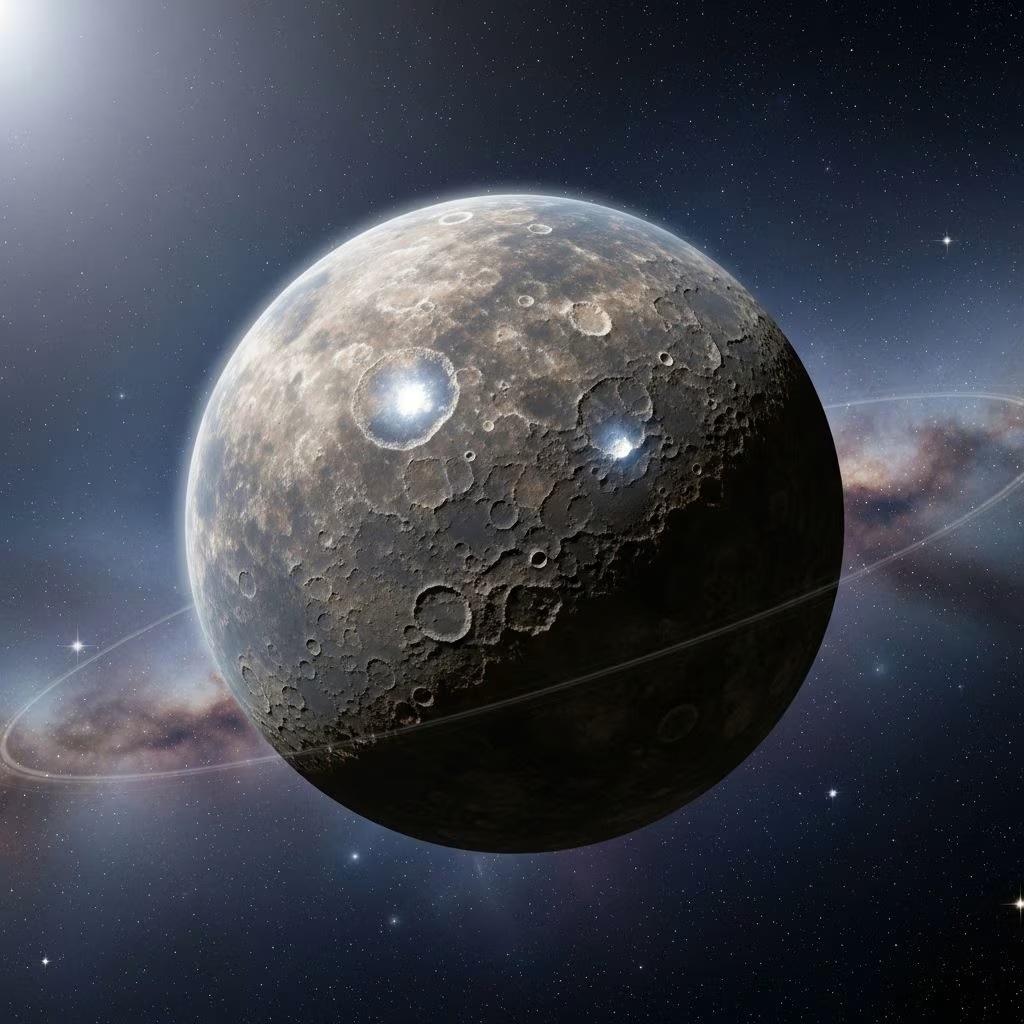
Ceres is the smallest recognized dwarf planet in our solar system, but it is also the largest object in the asteroid belt, accounting for about a third of the belt’s total mass. With a mean diameter of approximately 940 km (585 miles), Ceres is large enough for its gravity to shape it into a spheroid, distinguishing it from the smaller, irregularly shaped asteroids that share its orbital region.
- Location: Inner solar system (asteroid belt between Mars and Jupiter).
- Diameter: ~940–950 km.
- Mass: Around 1/3 or more of the total mass of the asteroid belt[11][12].
- Status: Planet (1801–1850s), asteroid (mid-1800s–2006), reclassified as a dwarf planet in 2006[12].
The Discovery and Naming of Ceres
Ceres was discovered on January 1, 1801 by Italian astronomer Giuseppe Piazzi in Palermo, Sicily. Piazzi’s discovery was significant: astronomers had predicted, thanks to Bode’s Law, a missing planet between Mars and Jupiter. Ceres fit that gap perfectly—initially hailed as a new planet[12].
Ceres is named after the Roman goddess of agriculture, a reflection of its perceived importance at the time. For the first 50 years after its discovery, Ceres was frequently referred to as a planet; however, following the discovery of many similar objects, its status shifted to “asteroid” and later to “dwarf planet” as official definitions evolved[11][12].
Classification: From Planet to Dwarf Planet
- 1801–1850s: Considered a planet after its discovery.
- 1850s–2006: Reclassified as an asteroid accompanied by discoveries of other similar objects in the same region[12].
- 2006: Defined as a “dwarf planet” by the International Astronomical Union (IAU), alongside Pluto, Haumea, Makemake, and Eris.
This reclassification reflects a more nuanced understanding of what constitutes a planet, reserving full planet status for bodies that have “cleared their neighborhood” of other debris—a criterion Ceres does not meet, as it coexists with thousands of asteroids.
Physical Characteristics of Ceres
- Shape: Spherical, evidence of hydrostatic equilibrium.
- Surface: A mix of rock and ice with numerous craters of varying size[12].
- Density: About 2.16 g/cm³—lower than that of most rocky bodies, indicating a significant fraction of water ice[12].
- Surface features: Craters, mysterious bright spots, possible ancient cryovolcanoes.
Ceres’ low density suggests an interior that may be differentiated, possibly with a rocky core and an outer icier shell. Some models even predict a subsurface reservoir of briny liquid water, making Ceres a fascinating candidate for astrobiological study[11].
Table 1: Basic Data on Ceres
| Parameter | Value |
|---|---|
| Diameter | ~940–950 km |
| Mass | ~9.4 × 10²⁰ kg |
| Orbital Period | 4.6 Earth years |
| Day Length | 9 hours |
| Mean Distance from Sun | ~2.77 AU |
| Moons | None |
Mysteries and Unique Features: Bright Spots and Water Plumes
One of Ceres’ most enigmatic features is the presence of bright spots (faculae) within some of its craters, especially the large Occator Crater. These spots were initially imaged by the Hubble Space Telescope and further detailed by Dawn. They are primarily composed of sodium carbonate and other salts, likely deposited by briny water seeping to the surface and sublimating in the thin exosphere.
- Mysterious bright spots: Composed of reflective salts, indicating past or ongoing geological activity.
- Water vapor plumes: Observed by the Herschel Space Observatory; up to 6 kg of water may be lost as vapor each second, suggesting active surface or near-surface processes[11].
These water vapor eruptions may be the result of seasonal warming of the surface or impact events that expose ice and release trapped vapors.
Internal Structure and Possibility of Water
Analyzing gravity and topography data from Dawn, scientists infer that Ceres might be differentiated—a rocky core beneath a thick mantle rich in ice. An estimated quarter of its total mass could be water, potentially more fresh water by volume than all of Earth’s surface lakes and rivers combined[11].
- Ice-rich outer layer, possibly including a subsurface brine ocean or mixtures of ice and hydrated minerals[11][12].
- Surface minerals indicative of past interaction with liquid water, including clay minerals and carbonates.
Historic and Scientific Importance
- First asteroid discovered: Ceres was the first object in the asteroid belt discovered and provided evidence for the belt’s existence[12].
- Understanding planet formation: As a “protoplanet,” studying Ceres helps scientists reconstruct how building blocks in the early solar system accreted or failed to become major planets[11].
- Role in modern taxonomy: Ceres was the first object to undergo planetary demotion, underlining how scientific definitions evolve over time.
NASA’s Dawn Mission: Unlocking Ceres’ Secrets
The Dawn spacecraft, launched by NASA, was the first to visit and orbit Ceres in 2015, following a successful study of asteroid Vesta. The Dawn mission aimed to compare and contrast these two distinct protoplanets and to study:
- Surface composition and mineralogy
- Craters and evidence of resurfacing
- Internal structure using gravity data
- Presence and source of water and bright spots
Dawn provided unprecedented close-up images, revealing the variety and complexity of surface features that challenged prior assumptions about small solar system bodies.
Key Discoveries by Dawn
- Surface geology: Detection of probable cryovolcanic features such as Ahuna Mons, a mountain possibly formed by ice volcanoes.
- Occator Crater bright spots: Mapped and chemically characterized as evaporite deposits.
- Exposed ice and minerals: Widespread on the surface, suggesting ongoing or recent geological activity.
- Hints of a brine ocean: Gravity and surface data suggest a partially liquid layer may still persist deep underground[11].
Could Ceres Harbor Life?
Scientific models and Dawn measurements indicate that Ceres has (or had) several factors potentially favorable to microbial life:
- Abundant water ice
- Chemical energy sources (such as brine and organic compounds)
- Occasional resurfacing or cryovolcanism that could transfer material from the interior to the surface
While Ceres is not in the traditional habitable zone, its combination of water and chemistry has made it a major target in the search for extraterrestrial habitability, similar to Jupiter’s moon Europa or Saturn’s Enceladus.
Moons, Rings, and Neighbors
- No moons: Unlike the other recognized dwarf planets (Pluto, Haumea, Makemake, and Eris), Ceres does not have any natural satellites[11].
- Location among asteroids: Resides in a crowded region but dominates the mass distribution of the asteroid belt
Role in Planetary Science and Human Exploration
- Solar system formation: Ceres is a “fossil” from early solar system history, providing a snapshot of chemical and physical conditions from 4.5 billion years ago[12].
- Resource potential: The presence of water ice, minerals, and energy sources makes Ceres a hypothetical waystation for future manned missions or even colonization.
- Research laboratory: Ceres allows for comparison with other small bodies, challenging our understanding of planetary geodynamics, surface modification, and the solar system’s geochemical diversity.
Quick Facts about Ceres
- First observed: January 1, 1801.
- Named after: The Roman goddess of agriculture.
- Orbital period: 4.6 Earth years (~1,681 days).
- Day length: 9 hours.
- No atmosphere: Only a thin exosphere composed partly of water vapor.
- No moons or rings observed.
- Bright spots: Composed of salt deposits from briny water sources.
- Potential for ancient or subsurface water: Supported by multiple missions and models.
Comparison Table: Dwarf Planets in the Solar System
| Name | Location | Diameter (km) | Moons | Notable Features |
|---|---|---|---|---|
| Ceres | Asteroid Belt (between Mars & Jupiter) | ~940 | 0 | Bright spots, water ice, closest dwarf planet |
| Pluto | Kuiper Belt (beyond Neptune) | 2,377 | 5 | Nitrogen ice, complex atmosphere, heart-shaped region |
| Haumea | Kuiper Belt | ~1,632 | 2 | Ellipsoidal shape, rapid rotation, ring system |
| Makemake | Kuiper Belt | ~1,430 | 1 | Bright surface, methane ice, thin atmosphere |
| Eris | Scattered Disk (beyond Kuiper Belt) | 2,326 | 1 | Very reflective, similar to Pluto |
Frequently Asked Questions (FAQ)
Q: Why is Ceres considered both an asteroid and a dwarf planet?
A: Ceres occupies the asteroid belt, which defines it as an asteroid by location, but its spherical shape and geological complexity give it enough planetary characteristics to be officially classified as a dwarf planet as well.
Q: Does Ceres have water or an ocean?
A: Models, observations, and mineralogical data suggest that Ceres contains abundant water ice—possibly even a frozen or briny subsurface ocean. Surface features and water vapor plumes strongly support this scenario.
Q: What are the bright spots on Ceres?
A: The famous bright spots, especially those in Occator Crater, are mainly deposits of sodium carbonate and other salts, left behind when brine from Ceres’ subsurface seeped upwards and quickly evaporated in space.
Q: Can Ceres support life?
A: While hostile to known complex life, the combination of water, organic chemistry, and internal heat raises the possibility that microbial life could have existed in Ceres’ past, or could persist deep underground today. However, there is no direct evidence of life yet.
Q: Has Ceres been visited by spacecraft?
A: NASA’s Dawn mission orbited and studied Ceres from 2015 to 2018, returning high-resolution images, maps, and chemical data that have transformed our understanding of this unique world.
Q: How does Ceres compare to Pluto?
A: Ceres is much smaller than Pluto and is found in the inner solar system’s asteroid belt, whereas Pluto resides far beyond Neptune in the icy Kuiper Belt. Both are officially recognized dwarf planets, but their origins, compositions, and environmental conditions differ significantly.
Q: Why does Ceres have no moons?
A: No natural satellites have ever been observed orbiting Ceres. This is likely due to its lower gravitational influence within the densely populated asteroid belt[11].
Conclusion
Ceres is far more than an unremarkable space rock: its hybrid identity as both asteroid and dwarf planet, rich chemistry, and scientific significance make it a primary focus for planetary scientists. Ongoing research will continue to unlock the secrets of this ancient world, deepening our understanding of the solar system’s formation and the potential for life elsewhere in our cosmic neighborhood.
References
- https://www.space.com/astronomy/dwarf-planets/dwarf-planet-ceres-may-have-once-been-suitable-for-life-new-study-suggests
- https://www.space.com/dwarf-planet-ceres-origins-nasa-dawn-spacecraft
- https://science.nasa.gov/dwarf-planets/ceres/
- https://en.wikipedia.org/wiki/Ceres_(dwarf_planet)
- https://science.nasa.gov/dwarf-planets/ceres/facts/
- https://space-facts.com/ceres/
- https://www.youtube.com/watch?v=KyHG3IQZQMM
- https://www.skyatnightmagazine.com/space-science/dwarf-planet-ceres
- https://www.britannica.com/place/Ceres-dwarf-planet
- https://www.universetoday.com/articles/the-dwarf-planet-ceres
- https://www.solarsystemscope.com/spacepedia/handbook/ceres
- https://www.ebsco.com/research-starters/astronomy-and-astrophysics/ceres-dwarf-planet
- https://www.rmg.co.uk/stories/space-astronomy/dwarf-planets-pluto-ceres-haumea-makemake-eris
- https://www.youtube.com/watch?v=ERoetJxJLQI
- https://www.spacedaily.com/reports/Dwarf_planet_Ceres_was_formed_in_coldest_zone_of_Solar_System_and_thrust_into_Asteroid_Belt_999.html
- https://astrobiology.com/2025/01/dwarf-planet-ceres-building-blocks-of-life-delivered-from-space.html
- https://www.livescience.com/space/astronomy/nasa-reveals-the-dwarf-planet-ceres-had-a-hidden-energy-source-that-may-have-sparked-alien-life