Zoozve: Venus’ Curious Quasi-Moon
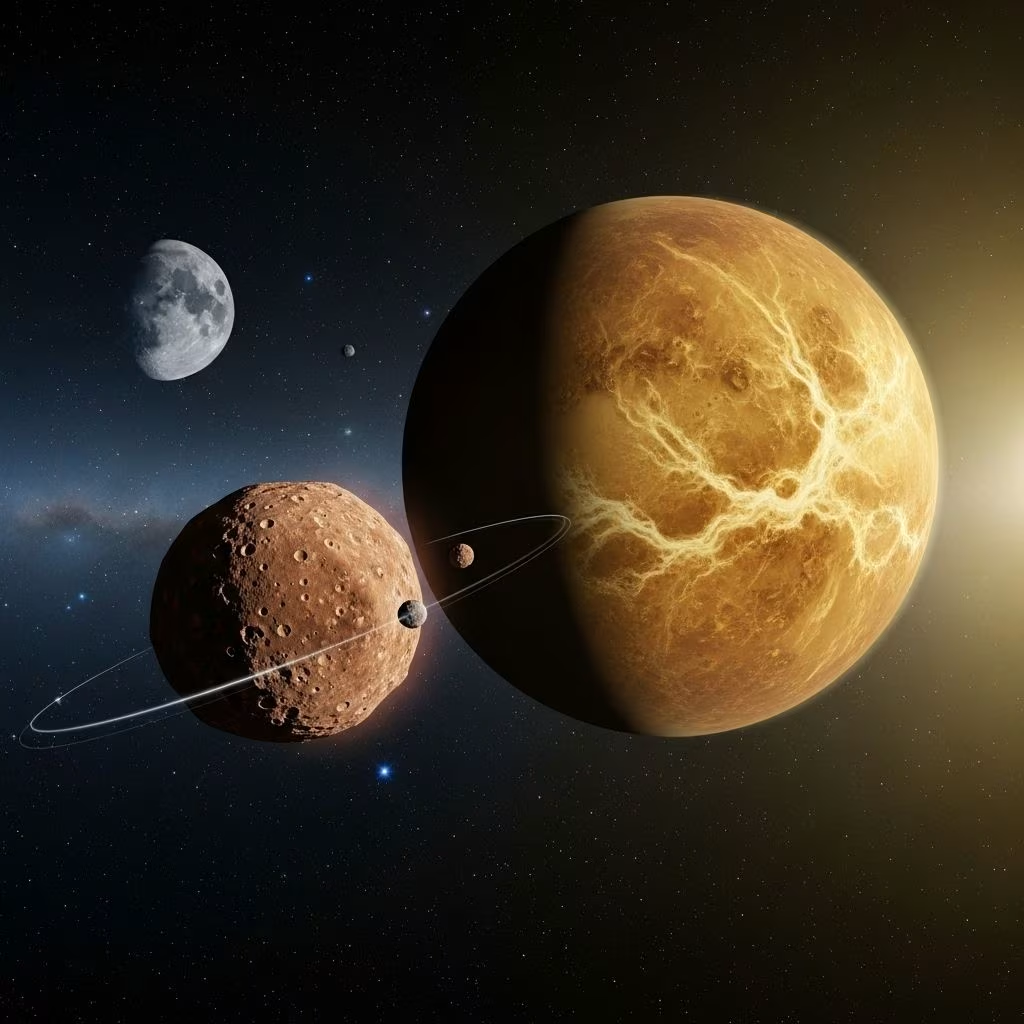
For decades, Venus and Mercury have stood out as the only planets in the solar system without moons. But in 2002, astronomers stumbled upon a mysterious object looping near Venus, challenging our long-held assumptions. This is the story of Zoozve: not a typical moon, but something even stranger—a quasi-moon whose peculiar journey spotlights the dynamic, unpredictable nature of our cosmic neighborhood.
What Are Quasi-Moons?
Quasi-moons are celestial objects—usually asteroids—that appear to orbit a planet but are not gravitationally bound like traditional moons. Instead, their orbits are intricately intertwined with both the planet and the Sun, following a shared path around our star but occasionally swinging ahead of or behind the planet in a delicate cosmic dance.
- Quasi-moons are also called “quasi-satellites.”
- They share the planet’s orbital period, making them appear to shadow the planet over long stretches of time.
- Despite their proximity, they can drift away after thousands or millions of years due to their unstable orbits.
In the early 2000s, planetary scientists had predicted such objects could exist, but Zoozve was the first quasi-moon found near Venus, revealing new surprises even in our own solar system’s ‘backyard.’
The Discovery of Zoozve
In 2002, astronomer Brian Skiff at Lowell Observatory detected an object now cataloged as 2002 VE68. It seemed to loop near Venus but wasn’t truly a moon. Tracking and orbital analysis revealed a peculiar pattern—this asteroid followed a path that repeatedly brought it near Venus, yet its trajectory was dictated mainly by the Sun’s gravity.
- Zoozve’s orbit overlaps with those of both Venus and (occasionally) Earth.
- It periodically becomes an Earth-crossing asteroid, technically classifying it as a near-Earth object (NEO).
- Its unusual path makes it unstable in the long term—eventually, gravitational tugs will eject it from its quasi-moon status.
Zoozve’s physical characteristics:
- Approximate diameter: 230 meters (about 750 feet)
- Reflectivity and color suggest a rocky, asteroid-like nature
- Visibility only with powerful telescopes and detailed orbital analysis
Why Venus?
Out of all the planetary orbits, Venus rarely hosts such companions. Unlike Jupiter, Saturn, or even Earth (which have both traditional moons and several quasi-moons), Venus operates in a dynamically challenging zone. Its proximity to the Sun, lack of large gravitational “shepherd” moons, and the energetic interplay with Mercury and Earth mean that any companion object, especially a small body like Zoozve, is likely to be a temporary visitor.
Zoozve’s Journey from Numbers to a Name
Originally known by its unwieldy designation—2002 VE68—this cosmic wanderer was a fixture in orbital simulations and asteroid watchlists. But the question arose: Should such objects get names, and if so, how?
- Under astronomical convention, objects get names only after their orbits are well-defined and persistent.
- For years, 2002 VE68’s odd status as neither a true planet-satellite nor a permanent fixture meant it languished in nomenclature limbo.
Everything changed in February 2024, when its name was officially updated to Zoozve. The moniker reflects both the object’s numeric label and a sense of whimsy, highlighting its in-between status in the lexicon of solar system bodies.
The Radiolab Connection: A Podcast Mystery Becomes Cosmic News
The story of Zoozve’s naming underscores the fascinating interplay between science, public curiosity, and media. It began innocuously enough: during a bedtime routine, Radiolab co-host Latif Nasser spotted the supposedly moonless Venus sporting an unfamiliar companion—labelled “Zoozve”—on a solar system poster in his child’s room.
- Nasser’s curiosity led him to consult NASA, only to discover that, according to official records, Venus had no moons at all.
- Digging deeper, he unraveled the existence of an object that was, paradoxically, both “moony” and not—a quasi-moon.
- The resulting Radiolab episode didn’t just explain a scientific oddity; it made naming history by popularizing Zoozve’s name and sparking global public engagement.
Radiolab teamed up with the International Astronomical Union (IAU), inviting the public to name a quasi-moon—not just for Venus, but, in a new effort, for one of Earth’s own quasi-satellites.
What Makes Zoozve a Quasi-Moon?
Cosmically speaking, the line between a “moon” and a “quasi-moon” is more dramatic than it appears. A moon is gravitationally bound to its host planet, moving in a clear path around it, while a quasi-moon is:
- Technically bound to the Sun, not the planet
- Following an orbit that closely matches the planet’s period, ensuring proximity over extended timescales
- Looming near its adopted planet from the point of view of the solar system’s orbital dance
- Subject to eventual ejection from its position by gravitational influences
| Traditional Moon | Quasi-Moon |
|---|---|
| Bound by planet’s gravity | Bound to Sun, appearing near planet |
| Stable, well-defined orbit | Complex, unstable orbital path |
| Long-term companions | Temporary visitors (thousands to millions of years) |
| Classic examples: Earth’s Moon, Phobos, Deimos | Examples: Zoozve (Venus), 3753 Cruithne (Earth) |
Not Alone: Quasi-Moons Across the Solar System
Zoozve isn’t the only quasi-moon dotting the solar system:
- Earth has at least seven quasi-moons documented to date, including 3753 Cruithne and Kamoʻoalewa.
- Neptune also hosts a known quasi-satellite.
Still, Zoozve stands out as the first discovered quasi-moon of Venus, and its orbit, while unstable, has focused astronomers’ attention on the dynamic nature of small body populations around planets.
Zoozve’s Orbit: The Polyamorous Path
One of the enchanting metaphors radiolab explores is that Zoozve is “in a polyamorous relationship” with both Venus and the Sun:
- As Zoozve orbits the Sun, its motion causes it to loop periodically around Venus, sometimes appearing to circle the planet before darting ahead or lagging behind.
- This delicate gravitational interplay means that, over tens of thousands of years, Zoozve’s path can be profoundly altered by close approaches to Venus, Earth, or even Mercury.
- Eventually, it will be “ejected” from its quasi-satellite state by subtle gravitational tugs.
This raises a big question: How predictable is the Solar System? Far from a cosmic clockwork, these quirks highlight how chaos and randomness shape planetary systems—and why even our maps and textbooks must be periodically revised.
Potential Hazards and Scientific Value
Because Zoozve’s orbit periodically crosses Earth’s path, it’s labeled a potentially hazardous object. However, orbital simulations show that there’s no imminent risk of collision.
Zoozve’s scientific value is considerable:
- It allows astronomers to study unstable orbits and migration of small bodies across the inner solar system.
- Probes and missions planning for Venus flybys now monitor such objects for trajectory calculations and safety.
- Understanding these relationships can also shed light on how planets acquire, lose, or temporarily “borrow” small companions—and even the possible delivery of organic materials or water across planetary boundaries.
Naming and the Power of Public Engagement
Radiolab’s campaign to name Zoozve is part of a growing movement to engage the public in astronomical discovery. The IAU naming contest for Earth’s quasi-moons lets anyone make their mark on the scientific atlas of the skies.
- Public participation helps raise awareness of modern astronomy’s collaborative spirit.
- Names like Zoozve give personality and narrative to otherwise technical designations, making space more accessible and memorable to non-specialists.
Why Quasi-Moons Capture the Imagination
The tale of Zoozve is more than an astronomical footnote—it’s a symbol of how discovery often lies in the margins between “well-known” facts. It prompts us to wonder:
- What else lurks undetected in our own solar system?
- How many more quasi-moons, horseshoe orbits, or temporary companions have yet to earn names or attention?
- How does chaos shape the stories we tell about our place among the stars?
Frequently Asked Questions About Zoozve and Quasi-Moons
What is a quasi-moon?
A quasi-moon is an object that orbits the Sun along a path similar to a planet’s orbit, staying near that planet for long periods but not gravitationally bound to it as a true moon would be.
How was Zoozve discovered?
Zoozve was discovered in 2002 by astronomer Brian Skiff using the facilities at Lowell Observatory. Its odd orbit quickly flagged it as an anomaly worthy of further study.
Can Zoozve ever collide with Venus or Earth?
While Zoozve does cross Earth’s orbital path and comes near Venus periodically, current simulations indicate it poses no impact threat in the foreseeable future. Its chaotic orbit means eventual ejection, not collision, is the most likely outcome.
Why does Venus usually have no moons?
Venus’s proximity to the Sun, lack of a large gravitational shepherd, and dynamic interactions with neighboring planets make it difficult for natural satellites to be captured or remain for long.
Are there more quasi-moons?
Yes. Several are known near Earth, and at least one with Neptune. As telescope and detection technology improves, astronomers expect to find many more quasi-moons throughout the solar system.
Who names quasi-moons?
The International Astronomical Union (IAU) is responsible for naming these objects, often incorporating public input and astronomers’ proposals, as seen with last year’s campaign involving the Radiolab community.
Zoozve in Context: The Evolving Solar System
Zoozve’s story shows that charts and posters—those familiar guides to our cosmic neighborhood—are snapshots, not eternal realities. Moons come and go. Orbits weave and unravel. New discoveries, like quasi-moons, keep challenging the stories we tell about our place in the universe.
- Our maps must evolve as new observations and insights reshape our knowledge.
- Public engagement—from science podcasts to classroom posters—can fuel the next big discovery.
As Venus dances with Zoozve, and as Earth’s quasi-moons await new names and stories, the cosmos beckons: there’s always more to learn, more to explore, and more to question about the ever-changing skies above.
References
- https://www.planetary.org/articles/venus-quasi-moon-zoozve
- https://www.youtube.com/watch?v=AA-1Xg2t0wQ
- https://www.youtube.com/watch?v=PVYGFtDnT1I
- https://radiolab.org/podcast/zoozve
- https://www.space.com/venus-quasi-moon-zoozve-radiolab-nasa
- https://radiolab.org/podcast/29c6b09eb19650a2e2feb7a1
- https://www.planetary.org/planetary-radio/2024-radiolab-helps-name-a-quasi-moon
- https://skyandtelescope.org/astronomy-news/how-venus-ended-up-with-a-mini-moon-named-zoozve/
- https://www.geo.tv/latest/530298-zoozve-unraveling-the-tale-of-venus-accidentally-mamed-quasi-moon
- https://kottke.org/24/02/meet-venuss-newly-named-quasi-moon-zoozve
- https://www.theweathernetwork.com/en/news/science/space/venus-quasi-moon-asteroid-zoozve-gets-an-official-astronomical-name
- https://podcast.standaard.be/episode/82579963
- https://www.space.com/earth-quasi-moon-naming-radiolab-iau
- https://audio.nrc.nl/episode/82579963
- https://sherwood-observatory.org.uk/does-venus-have-a-moon-called-zoozve/
- https://www.slashgear.com/1525936/zoozve-venus-quasi-moon-details/
- https://podscripts.co/podcasts/radiolab/zoozve
- https://www.hindustantimes.com/lifestyle/art-culture/over-the-quasi-moon-what-is-zoozve-and-how-did-it-get-its-name-101710519454613.html