Constellations: Mapping the Night Sky’s Ancient Patterns
For thousands of years, constellations have represented humankind’s efforts to interpret and organize the stars above. These groupings are more than arbitrary patterns; they are deeply woven into our culture, astronomy, and history. Today, astronomers officially recognize 88 constellations, each helping us navigate and understand the vast expanse of the night sky.
What is a Constellation?
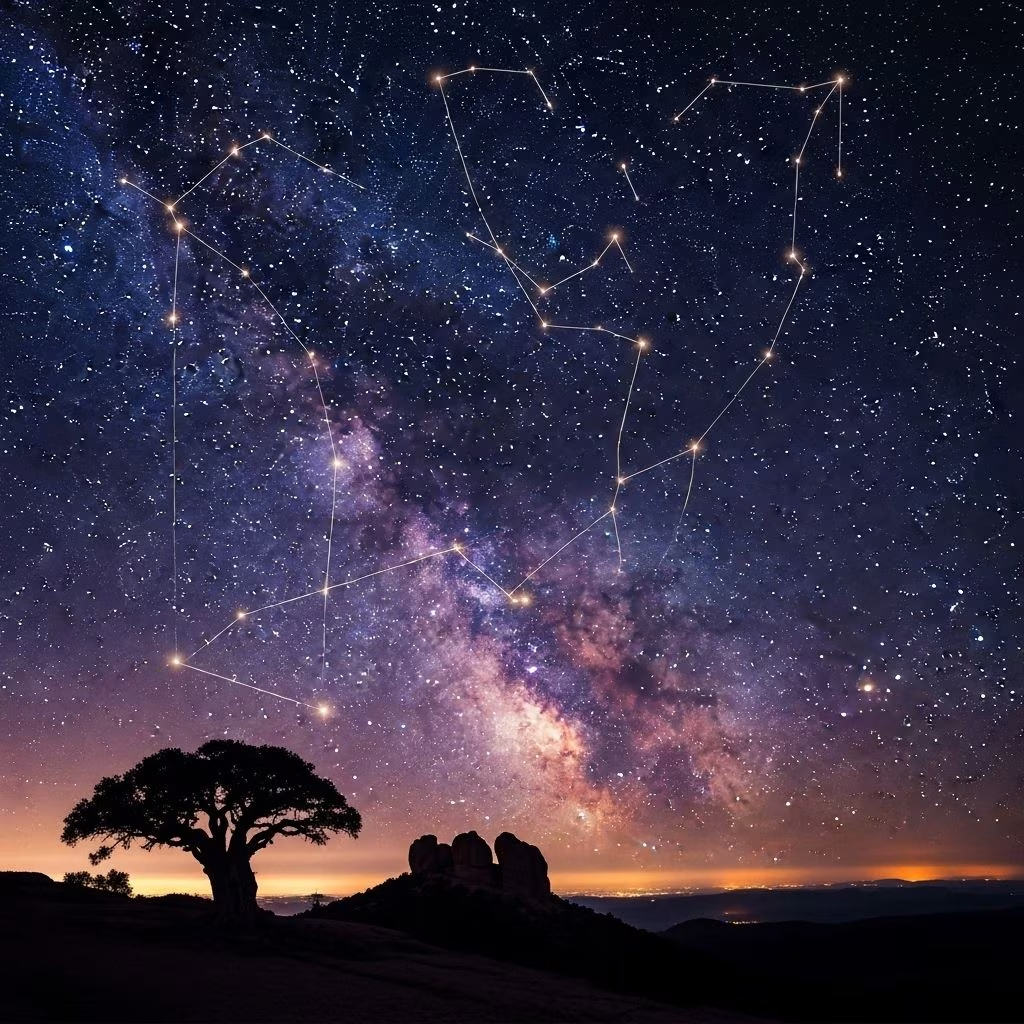
A constellation is an area of the sky with defined boundaries, encompassing specific star patterns that often resemble mythological figures, animals, or objects. Unlike simple clusters, constellations may include stars that are not physically related but from Earth appear grouped together. Astronomers use these divisions to locate celestial objects efficiently.
- The International Astronomical Union (IAU) established 88 official constellations in 1922, standardizing celestial mapping across cultures and sciences.
- Each constellation covers a distinct area of sky, making it possible to assign any visible star to one of these sectors.
- Popular constellations often feature prominent star shapes or patterns known as asterisms, like Orion’s Belt or the Big Dipper within Ursa Major.
Constellations Through History
Conceptions of constellations stretch across civilizations and timeframes. Ancient Greeks, Babylonians, Chinese, Arabs, and indigenous cultures all mapped their own constellations, reflecting their unique stories and sky lore[10].
- Greek mythology linked each constellation to legends—for example, Orion the hunter or Andromeda the chained princess.
- Other cultures identified star groupings differently—Chinese sky maps divided the heavens into 283 constellations with distinct meanings.
- The translation of these patterns into Western astronomy began largely in Alexandria, where Ptolemy cataloged 48 classical constellations.
Though star patterns vary by tradition, the drive to impose order and meaning on the night sky is universal, blending practical navigation with rich mythology.
The Zodiac: Twelve Celestial Signs
The Western zodiac is built around twelve constellations lying along the apparent path the Sun traces through the sky—the ecliptic. These zodiac signs have shaped fortune-telling, calendars, and cultural symbolism since antiquity.
- Aries (the ram)
- Taurus (the bull)
- Gemini (the twins)
- Cancer (the crab)
- Leo (the lion)
- Virgo (the maiden)
- Libra (the scales)
- Scorpius (the scorpion)
- Sagittarius (the archer)
- Capricornus (the sea-goat)
- Aquarius (the water bearer)
- Pisces (the fish)
Because the Earth’s axis wobbles over thousands of years—an effect called precession—the position of the zodiac constellations shifts slowly over time, changing the dates on which the sun enters each sign.
How Do Astronomers Define Constellations?
Modern astronomy treats constellations as clearly bounded regions rather than vague shapes. In 1922, the IAU finalized the official borders and names, ensuring that every point in the sky belongs to exactly one constellation[11].
- Right ascension and declination, celestial equivalents of longitude and latitude, specify the position of stars within constellations[10][11].
- This system simplifies finding stars, planets, and deep-sky objects for both amateurs and professionals.
- Many constellations contain notable asterisms: the Big Dipper in Ursa Major, the Three Stars of Orion’s Belt, and the Southern Cross in Crux.
Famous Constellations and Star Patterns
Among the 88 constellations, several stand out for their brightness, position, or cultural significance. These patterns help stargazers orient themselves and mark the changing seasons.
- Orion: Recognized worldwide for its distinctive belt of three stars and association with Greek legend.
- Ursa Major: Contains the Big Dipper, a key northern navigation aid.
- Scorpius: Marked by the bright star Antares, prominent in summer skies.
- Crux: The Southern Cross, vital for southern hemisphere navigation.
- Cygnus: The Northern Cross, visible in summer skies.
Table: Notable Constellations and Their Main Features
| Constellation | Asterism | Main Star | Season |
|---|---|---|---|
| Orion | Belt (Alnitak, Alnilam, Mintaka) | Betelgeuse | Winter |
| Ursa Major | Big Dipper | Dubhe | All year (N. Hemisphere) |
| Scorpius | Curved body | Antares | Summer |
| Crux | Southern Cross | Acrux | All year (S. Hemisphere) |
| Cygnus | Northern Cross | Deneb | Summer |
| Leo | Sickle (head, mane) | Regulus | Spring |
Constellations in Science and Navigation
For centuries, constellations served as celestial guides, helping sailors, explorers, and farmers track time and traverse the globe. Today, their importance extends into scientific research and education.
- Many cultures relied on rising and setting constellations to mark planting or harvest times.
- Early navigators used the stars to determine latitude and direction, especially by the Pole Star in Ursa Minor.
- Astronomers use constellations for cataloging stars, galaxies, and other deep-sky objects.
- Modern star catalogs and planetarium software typically use the official IAU boundaries to organize sky maps[11].
Cultural Constellations Around the World
While the IAU’s 88 constellations dominate Western astronomy, other cultures created entirely different star maps, emphasizing their own lore and environment[10].
- Chinese constellations divide the sky into hundreds of unique groups, focusing on imperial and mythological themes.
- Arabic, Egyptian, and Korean traditions interpreted star patterns independently, with asterisms that sometimes overlap, like Orion’s Belt[10].
- Indigenous Australians recognized the Emu in the sky, a constellation formed largely from dark nebulae rather than stars.
How Constellations Are Formed: Science vs. Imagination
Most stars in a constellation are not physically related; instead, they only appear close from Earth’s viewpoint. Scientific understanding reveals that:
- Stars within a constellation can be vastly different distances away.
- Star patterns shift very slowly over time due to stellar motion, but most constellations remain recognizable for thousands of years.
- Asterisms are unofficial patterns—smaller and easier to spot, but not formal constellations.
For astronomers, mapping constellations is a matter of practical boundaries, but for cultures, it is a blending of imagination, storytelling, and sky lore.
Stargazing Tips: Spotting Constellations
Even if you have no telescope, finding constellations is an accessible way to begin astronomical observation. Here’s how to start:
- Use a star map or app to locate major constellations at your latitude and season.
- Identify prominent asterisms (Big Dipper, Orion’s Belt) first—they’re visible in light-polluted areas.
- Look for bright stars that anchor constellations: Betelgeuse (Orion), Sirius (Canis Major), Polaris (Ursa Minor).
- Notice seasonal changes; different constellations rise and set as Earth orbits the Sun.
Constellation Catalog: The 88 Official Patterns
Below are some of the best-known constellations from the IAU list, each with unique features and stories:
- Andromeda: home to the nearest major galaxy outside the Milky Way.
- Gemini: marks the twin brothers Castor and Pollux in Greek legend.
- Pisces: symbol of two fish tied together, prominent in autumn skies.
- Aquila: the eagle, associated with Jupiter in Roman lore.
- Libra: the scales, representing balance and justice.
Frequently Asked Questions (FAQs)
Q: How many constellations are officially recognized today?
A: The International Astronomical Union recognizes 88 official constellations that map the entire night sky.
Q: What’s the difference between a constellation and an asterism?
A: A constellation is an official region of the sky including all stars within its borders; an asterism is a recognizable star pattern that may be part of one or more constellations, like the Big Dipper[10].
Q: Do stars in a constellation belong together physically?
A: Generally, no. Stars in a constellation appear close from Earth but may be separated by vast distances in space.
Q: Why do different cultures have different constellations?
A: Different cultures formed their own sky maps based on local myths, navigation needs, and the seasonal motions of stars visible from their region[10].
Q: What is the zodiac, and how does it relate to constellations?
A: The zodiac is a belt of 12 constellations along the Sun’s apparent path through the sky, each named after ancient figures or animals.
Conclusion
From navigation to mythology, constellations embody humanity’s creative urge to chart the cosmos. Today, they serve as both scientific frameworks and windows into the rich heritage of skywatching cultures. Whether you’re seeking direction, stories, or simply the joy of stargazing, learning your way among the patterns of the stars opens up a universe—one constellation at a time.
References
- https://www.space.com/15722-constellations.html
- https://www.space.com/stargazing/constellations
- https://www.ebsco.com/research-starters/astronomy-and-astrophysics/constellation
- https://www.space.com/21597-libra-constellation.html
- https://www.sciencelearn.org.nz/resources/635-constellations-in-the-night-sky
- https://spaceplace.nasa.gov/constellations/en/
- https://www.space.com/23309-constellations-night-sky-star-patterns-images.html
- https://en.wikipedia.org/wiki/Constellation_program
- https://lovethenightsky.com/ursa-major-constellation-guide/
- https://github.com/eleanorlutz/worldstars_atlas_of_space
- https://github.com/eleanorlutz/western_constellations_atlas_of_space
- https://rtatel.com/satellite-constellations-revolutionizing-space-connectivity-and-observations/
- https://theskylive.com/sky/constellations/
- https://astronomyexplained.com/what-are-constellations-understand-and-unlock-the-stars/
- https://astrorover.com/why-cant-i-see-constellations/
- https://pvpnews.com/526/constellations-space-exploration/
- https://dotcommagazine.com/2023/08/satellite-constellations-top-ten-things-you-need-to-know/
- https://spaceplace.nasa.gov/search/constellations/
- https://www.iflscience.com/new-star-constellations-honor-celebrities-like-usain-bolt-and-sir-david-attenborough-45126
- https://www.vice.com/en/article/spacexs-satellite-megaconstellations-are-astrocolonialism-indigenous-advocates-say/
- https://www.newspace.im/constellations/sky-and-space-global