


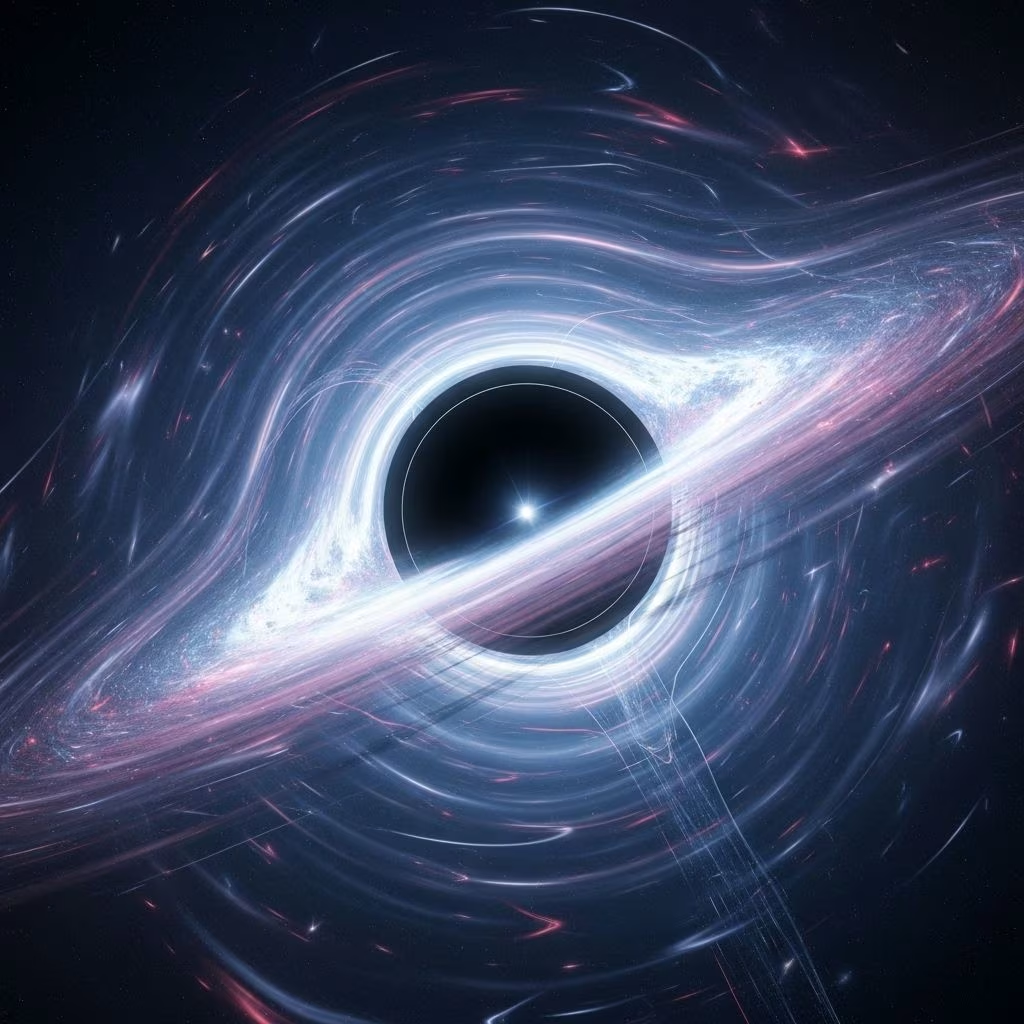
The enigmatic core of a black hole represents one of the most captivating mysteries in modern astrophysics. These cosmic objects, which lurk at the hearts of galaxies—including our own Milky Way—stretch the laws of physics to their limits and challenge our understanding of space, time, and matter. In this article, we break down what current science says about the black hole center, discuss the concepts of the event horizon and singularity, and spotlight the latest discoveries shaping this fascinating field.
Defining a Black Hole
Black holes are regions in space where gravity is so powerful that nothing—not even light—can escape. They form when massive stars exhaust their fuel and collapse under their own weight, or by other means such as direct collapse from immense gas clouds. The boundary separating a black hole from the rest of the universe is called the event horizon. Beyond this horizon, the known laws of physics break down.
- Event Horizon: The point of no return. Once an object crosses it, escape is impossible.
- Singularity: The theoretical heart of a black hole, where matter is thought to be compressed to an infinitely small, infinitely dense point.
- Supermassive Black Holes: Giants found at the centers of galaxies with masses millions or billions of times that of the Sun.
The Event Horizon: The Unseeable Boundary
The event horizon represents the surface surrounding a black hole at which the escape velocity equals the speed of light. It marks the boundary between causally connected regions of spacetime and those forever cut off:
- From the outside, the event horizon appears as a perfectly spherical surface.
- This surface is not a solid structure but a mathematical boundary; nothing, not even light, can come back from within it.
- The size of the event horizon is proportional to the mass of the black hole; for a stellar-mass black hole, it’s only a few kilometers across, while for a supermassive black hole, it can be wider than our solar system.
This region is of immense interest because anything that happens within it is hidden from view, leaving only indirect clues through gravitational effects or radiation emitted just outside the event horizon.
The Singularity: The Central Mystery
At the absolute center of a black hole, theory predicts a singularity—a point where density and gravitational forces become infinite and space-time itself is infinitely curved. This is a theoretical prediction, as the singularity lies deep inside the event horizon, forever hidden from view. According to equations from Einstein’s general relativity:
- The singularity is the ultimate endpoint for any matter or radiation that falls into a black hole.
- At this point, known physics breaks down, and quantum effects are believed to become crucial.
- No observer, not even those falling in, can witness or describe the singularity in detail—information vanishes from the universe as it crosses the event horizon.
Falling In: What Do Theories Predict?
Imagine what happens as you fall into a black hole:
- Passing the event horizon is undramatic; you wouldn’t notice the transition at first.
- As you approach the center, extreme gravitational forces—known as tidal forces—become intense. These forces stretch your body vertically and compress it horizontally, a process sometimes called “spaghettification.”
- Finally, you reach the singularity itself—if it exists—where all known physics ceases to operate.
For supermassive black holes, the tidal forces near the event horizon may be less dramatic, possibly allowing an observer to pass unharmed through the horizon before ultimately encountering the singularity deep within.
Supermassive Black Holes: Giants at the Galaxy Centers
In the heart of most galaxies, including our own, resides a supermassive black hole. For the Milky Way, this is Sagittarius A*, a black hole about four million times more massive than the Sun and spanning a volume roughly the size of Mercury’s orbit.
- Supermassive black holes influence the dynamics of their host galaxies, affecting star formation and galactic evolution.
- Sagittarius A* has been directly imaged via the Event Horizon Telescope, observing emissions from the superheated material spiraling around it.
- The existence and behavior of such black holes provide real-world laboratories for testing theories of gravity and quantum physics.
Table: Stellar-Mass vs. Supermassive Black Holes
| Type | Origin | Mass | Event Horizon Size | Location |
|---|---|---|---|---|
| Stellar-mass | Collapse of massive stars | 3–100 solar masses | A few kilometers | Throughout galaxies |
| Supermassive | Unclear (possibly direct collapse or mergers) | Millions–billions solar masses | Up to billions of kilometers | Galactic centers |
The Latest Discoveries: JWST and the Infinity Galaxy
The development of cutting-edge instruments like the James Webb Space Telescope (JWST) is continually reshaping what we know about black hole centers. For instance, JWST has recently discovered an unusual entity now dubbed the Infinity Galaxy, which may host a “direct collapse” black hole—a new formation method proposed for supermassive black holes.
- This black hole sits between the two nuclei of colliding galaxies rather than at their hearts.
- This could mark the first observational evidence for a black hole that formed directly from a massive gas cloud, not a collapsing star.
- Such findings help address lingering mysteries about how supermassive black holes appeared so early in the universe—less than a billion years after the Big Bang.
Life Around the Center: Accretion Disks and Relativistic Effects
Just outside the event horizon, infalling matter forms a whirling accretion disk. The immense gravity heats gas and dust to millions of degrees, causing this material to emit X-rays, gamma rays, and sometimes powerful jets of particles along the black hole’s poles.
- Accretion disks power the most luminous objects in the cosmos—quasars and active galactic nuclei.
- Their structure and emissions allow scientists to infer properties of the invisible black hole within.
- Close to the event horizon, extreme relativistic effects predicted by Einstein—like gravitational redshift and the bending of light—become measurable and have been confirmed via observations, such as those conducted with the Very Large Telescope and the Event Horizon Telescope.
Binary Black Holes and Dynamic Centers
Not all galactic centers contain a solitary black hole. Astronomers have evidence that binary black holes—pairs orbiting one another—can exist, the product of galaxy mergers where two central black holes converge. Detecting such pairs is difficult due to their proximity and the extreme environment, but their mergers generate powerful gravitational waves detectable by observatories on Earth.
- Binary and merging black holes shape galaxy growth and can eject one member from the galactic center, altering cosmic architecture.
- These cataclysmic mergers are now observable thanks to instruments like LIGO and Virgo, which opened a new era of gravitational wave astronomy.
Do Black Holes Lead to Other Universes?
The strange nature of the singularity and event horizon has led to wild speculation—including ideas that black holes could be gateways to other universes or dimensions via so-called wormholes. However, no experimental evidence supports such claims. Most physicists agree that any such passageways, if they exist, would be inherently unstable and non-traversable by matter as we know it.
Open Questions and the Future of Black Hole Physics
- What is the real nature of the singularity—does it exist, or is it a placeholder for a deeper quantum theory of gravity?
- Will quantum effects smooth out the singularity, as predicted by some models of quantum gravity?
- Is information truly lost in a black hole, or does it persist in a way that preserves the laws of physics, as the “information paradox” debate suggests?
- Do all galaxies host supermassive black holes at their centers, and how do these giants grow so quickly after the Big Bang?
As our observational tools improve, and as physicists continue probing the union of relativity and quantum theory, answers to these profound questions may one day emerge.
Frequently Asked Questions (FAQs)
Q: Is the singularity a real point of infinite density?
A: According to general relativity, the singularity is a region of infinite density and zero volume. However, physicists suspect that a consistent theory of quantum gravity may reveal a different, less paradoxical structure at black hole centers.
Q: What’s inside the event horizon—can we observe it?
A: Nothing inside the event horizon can be observed directly. We infer the presence and properties of black holes via their effects on nearby matter and by imaging the regions just outside this boundary.
Q: What do black holes at the center of galaxies do?
A: They play a major role in regulating the growth and behavior of galaxies—controlling star formation, driving powerful jets, and influencing the movement of stars and gas in galactic cores.
Q: Could our solar system ever be swallowed by Sagittarius A*?
A: No—our solar system is too far from the Milky Way’s center to risk being pulled in. Sagittarius A* and other supermassive black holes pose no threat to the stability of stars and planets at such distances.
Q: Have we ever seen a black hole form?
A: Astronomers have observed the aftermath of black hole births following gamma-ray bursts, but only recently, with cases like the Infinity Galaxy, are we gaining insight into supermassive black holes forming directly or shortly after galactic mergers.
Key Takeaways
- The center of a black hole is where known physics breaks down, posing major unsolved problems for science.
- The event horizon marks an invisible, one-way boundary—beyond it, nothing escapes.
- Sagittarius A*—the Milky Way’s central black hole—has been directly imaged via its accretion disk, but its interior remains hidden.
- Next-generation telescopes and gravitational wave detectors continue to revolutionize our understanding of these cosmic enigmas.
References
- https://www.space.com/astronomy/black-holes/jwst-finds-unusual-black-hole-in-the-center-of-the-infinity-galaxy-how-can-we-make-sense-of-this
- https://www.space.com/the-universe/some-black-holes-at-the-centers-of-galaxies-have-a-buddy-but-detecting-these-binary-pairs-isnt-easy
- https://www.livescience.com/what-happens-at-black-hole-center.html
- https://en.wikipedia.org/wiki/Black_hole
- https://www.youtube.com/watch?v=OkaMIVGMpB0
- https://www.astronomy.com/science/what-happens-at-the-center-of-a-black-hole/
- https://science.nasa.gov/universe/black-holes/
- https://en.wikipedia.org/wiki/Sagittarius_A*
- https://www.youtube.com/watch?v=eqZNxEahPGY
- https://science.slashdot.org/story/02/10/16/2046200/theres-a-hole-in-the-middle-of-it-all
- https://bigthink.com/hard-science/inside-of-a-black-hole/
- https://www.pmsutter.com/shows/askaspaceman-archive/2020/10/6/aas-137-whats-at-the-center-of-a-black-hole
- https://www.britannica.com/science/black-hole
- https://news.uchicago.edu/explainer/black-holes-explained
- https://www.nasa.gov/universe/what-are-black-holes/
- https://ground.news/article/massive-black-hole-explosion-creates-15-galaxy-wide-cavity-in-space
- https://futurism.com/universe-trapped-inside-black-hole


