Stephen Hawking: Exploring the Frontiers of Space, Time, and Thought
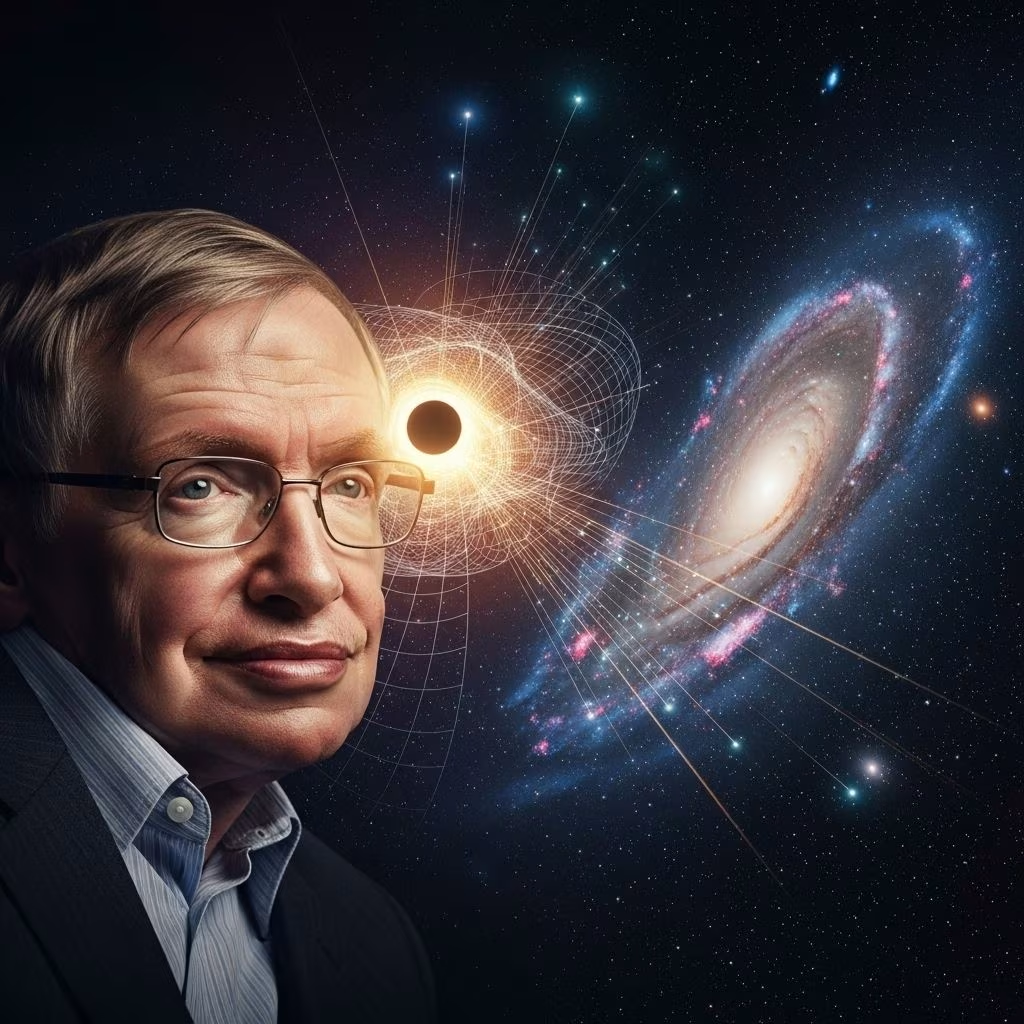
Stephen Hawking was one of the most brilliant minds of modern science, renowned for revolutionizing our understanding of black holes, the origins of the universe, and the very nature of reality. His life story, marked by immense scientific achievement in the face of adversity, continues to inspire scientists and the broader public alike.
Early Life and Education
Born on January 8, 1942, in Oxford, England, Stephen William Hawking demonstrated a fascination with science from a young age. His father, a biologist, and his mother, a University of Oxford graduate, nurtured a home environment rich in intellectual curiosity. Although not an exceptional student at first, Hawking’s critical thinking and problem-solving abilities soon became apparent.
- Attended St Albans School, where he built computers from spare parts with classmates.
- Won a scholarship to University College, Oxford, graduating with a first-class degree in Physics in 1962.
- Continued to Trinity Hall, Cambridge, for his doctorate in cosmology, the study of the universe’s origins and structure.
Diagnosis with ALS: Overcoming Adversity
While at Cambridge, at just 21 years old, Hawking was diagnosed with amyotrophic lateral sclerosis (ALS), a progressive neurodegenerative disease. Doctors initially gave him just a few years to live. Despite the overwhelming challenges, Hawking defied medical expectations:
- Gradually lost control of voluntary muscle movements, eventually requiring a wheelchair and computer-based voice synthesizer.
- Maintained a full schedule of research, teaching, and public engagement for more than five decades.
Hawking’s determination and wit became legendary, making him a symbol of perseverance in the face of adversity.
Scientific Legacy and Major Contributions
Stephen Hawking’s research revolutionized both theoretical physics and our conception of the cosmos. He excelled in the complex realms of general relativity and quantum mechanics, bridging these two fundamental yet often incompatible aspects of modern science.
1. Black Holes and Hawking Radiation
- Hawking proposed the existence of Hawking radiation, showing that black holes are not entirely black; instead, they emit particles due to quantum effects near their event horizons.
- This process implies that black holes can slowly lose mass and eventually evaporate and explode, overturning previous beliefs that nothing could ever escape a black hole’s gravitational grip.
- Linked black hole physics to the laws of thermodynamics, specifically to entropy and temperature.
2. Big Bang and Singularity Theorems
- With mathematician Roger Penrose, Hawking employed advanced mathematics to suggest that the universe began as a singularity — a point of infinite density and gravity, where the conventional laws of physics break down.
- These singularity theorems augmented the credibility of the Big Bang theory as the universe’s most probable origin.
3. Mini Black Holes and the Early Universe
- In the early 1970s, Hawking theorized that small, primordial black holes could have formed in the first moments after the Big Bang, possessing enormous mass within a microscopic volume.
- Such black holes, subject to quantum effects, would rapidly evaporate — a phenomenon that, if detected, would provide unique insights into the universe’s earliest phases.
4. Unification of Physics
- Hawking spent much of his later career seeking a unified theory that combines general relativity (which describes gravity on cosmic scales) and quantum mechanics (which governs the subatomic realm).
- His efforts paved the way for ongoing research in string theory, quantum gravity, and the quest for a “theory of everything.”
Popular Science and Communication
Beyond academic circles, Hawking was a transformative communicator of science, making complex ideas accessible to a wider audience and inspiring generations to explore the mysteries of existence.
Key Publications
- A Brief History of Time (1988): Hawking’s seminal book introduces general readers to concepts such as the Big Bang, black holes, the nature of time, and the search for unified physical laws. It became a best-seller, translated into dozens of languages, with millions of copies sold worldwide.
- The Universe in a Nutshell (2001), Black Holes and Baby Universes and Other Essays, and many others further elaborated on modern cosmology in engaging prose and graphics.
- Children’s books co-authored with his daughter Lucy, including George’s Secret Key to the Universe, introduced young audiences to space science and cosmological thinking.
Personal Life
Hawking’s remarkable ability to overcome physical limitations was matched by an active and engaging personal life.
- Married Jane Wilde in 1965; had three children: Robert, Lucy, and Timothy.
- Later divorced Jane, then married and divorced Elaine Mason.
- Maintained friendships and collaborations with leading scientists, and regularly attended conferences worldwide.
Despite frequent hospitalizations and reliance on assistive technology, Hawking’s energy and humor shone through in interviews, public speaking, and even light-hearted appearances on television and in film.
Honors and Awards
Stephen Hawking’s groundbreaking work earned him widespread recognition:
- Elected Fellow of the Royal Society (1974).
- Received the Albert Einstein Medal, the Copley Medal, the Wolf Prize, and the Presidential Medal of Freedom, among many other distinctions.
- Appointed Lucasian Professor of Mathematics at Cambridge (1979–2009), a position formerly held by Isaac Newton.
Hawking in Popular Culture
Stephen Hawking’s larger-than-life personality and distinctive voice synthesizer made him a global cultural icon.
- Featured on television programs like The Simpsons, Star Trek: The Next Generation, and The Big Bang Theory.
- Subject of the acclaimed biographical film The Theory of Everything (2014), which dramatizes his early career, relationship with Jane Wilde, and battle with ALS.
- Frequent commentary on science, philosophy, and the future of humanity, including the challenges of artificial intelligence and extraterrestrial life.
Lasting Impact and Legacy
Stephen Hawking died on March 14, 2018, but his legacy remains profound. His work continues to inform research in cosmology, quantum gravity, and physics. He is universally remembered not just for his extraordinary intellect, but for his unwavering optimism and drive to pursue knowledge, regardless of obstacles.
Key Aspects of Hawking’s Legacy
- Pioneering insights into black holes, singularities, and the first moments of the universe.
- Advancement of popular science education.
- Enduring example of resilience and determination for people with disabilities and aspiring scientists worldwide.
Selected Timeline of Stephen Hawking’s Life
| Year | Milestone |
|---|---|
| 1942 | Born in Oxford, England |
| 1962 | Graduated from University College, Oxford (Physics) |
| 1963 | Diagnosed with ALS |
| 1966 | Earned Ph.D. from Cambridge (Cosmology) |
| 1974 | Proposed Hawking radiation; Elected Fellow of the Royal Society |
| 1979 | Became Lucasian Professor of Mathematics at Cambridge |
| 1988 | Published A Brief History of Time |
| 2018 | Died in Cambridge, England |
Frequently Asked Questions (FAQs)
Q: What is Hawking radiation, and why is it significant?
A: Hawking radiation is the prediction that black holes emit thermal radiation due to quantum effects near their event horizon. This discovery suggests that black holes can eventually evaporate and disappear, connecting black hole physics to thermodynamics and challenging previously held notions about matter and energy conservation.
Q: How did Stephen Hawking communicate after losing his voice?
A: After losing the ability to speak, Hawking used a computer-based speech synthesizer operated by a small hand-held switch, and later by a cheek muscle, allowing him to write and give lectures.
Q: Did Hawking ever win a Nobel Prize?
A: Despite several major accolades, Stephen Hawking did not receive a Nobel Prize, as his most groundbreaking predictions, such as Hawking radiation, have yet to be confirmed by direct experimental evidence.
Q: What is a singularity, according to Hawking?
A: In Hawking’s work, singularities are points in space-time where density and gravity become infinite, such as at the heart of black holes and at the origin of the universe (the Big Bang).
Q: What are some recommended books by Hawking for general readers?
A: Key accessible works include A Brief History of Time, The Universe in a Nutshell, Black Holes and Baby Universes and Other Essays, and the children’s book George’s Secret Key to the Universe (co-authored with Lucy Hawking).
Glossary
- Physics: The science of matter, energy, and their interactions.
- Cosmology: The branch of astronomy that studies the origin and evolution of the universe.
- Black Hole: A region of space with a gravitational pull so strong that not even light can escape from it.
- Singularity: A point in space-time where density becomes infinite, and existing physical laws break down.
- ALS (Amyotrophic Lateral Sclerosis): A neurodegenerative disease affecting voluntary muscle movement.
Quick Facts Table
| Fact | Details |
|---|---|
| Full Name | Stephen William Hawking |
| Birth/Death | 1942 (Oxford, England) / 2018 (Cambridge, England) |
| Fields | Theoretical Physics, Cosmology |
| Main Achievements | Hawking radiation, singularity theorems, popular science outreach |
| Notable Awards | Fellow of the Royal Society, Albert Einstein Medal, Wolf Prize, Presidential Medal of Freedom |
| Famous Books | A Brief History of Time, The Universe in a Nutshell |
| ALS Diagnosis | 1963 (age 21) |
Further Reading
- A Brief History of Time (1988)
- The Universe in a Nutshell (2001)
- Black Holes and Baby Universes and Other Essays (1993)
- George’s Secret Key to the Universe (2007, with Lucy Hawking)
Stephen Hawking’s work and life continue to inspire ongoing exploration of the universe’s deepest mysteries, demonstrating that intellectual curiosity and courage can overcome even the greatest challenges.
References
- https://en.wikipedia.org/wiki/Stephen_Hawking
- https://www.space.com/15923-stephen-hawking.html
- https://www.britannica.com/biography/Stephen-Hawking
- https://www.hawking.org.uk/biography
- https://www.space.com/the-universe/what-were-stephen-hawkings-greatest-contributions-to-science
- https://www.biography.com/scientists/stephen-hawking
- https://royalsocietypublishing.org/doi/10.1098/rsbm.2019.0001
- https://www.scribd.com/document/488973615/stephen-hawking-biography
- https://www.famousscientists.org/stephen-hawking/
- https://www.maths.cam.ac.uk/features/stephen-hawking-milestones-life-physics
- https://www.stephenhawking.net/p/home.html
- https://www.vedantu.com/biography/stephen-hawking
- https://www.ebsco.com/research-starters/biography/stephen-hawking
- https://www.youtube.com/watch?v=VkWy-xvNo1c
- https://byjus.com/physics/stephen-hawking/
- https://nss.org/stephen-hawking-why-we-should-go-into-space-video/
- https://cosmosmagazine.com/science/physics/a-brief-history-of-stephen-hawking/
- https://www.youtube.com/watch?v=kiJfkdUx27Y
- https://blog.byjus.com/the-learning-tree/science-feed/brief-history-hawking/
- https://hawking.weebly.com/biography.html