


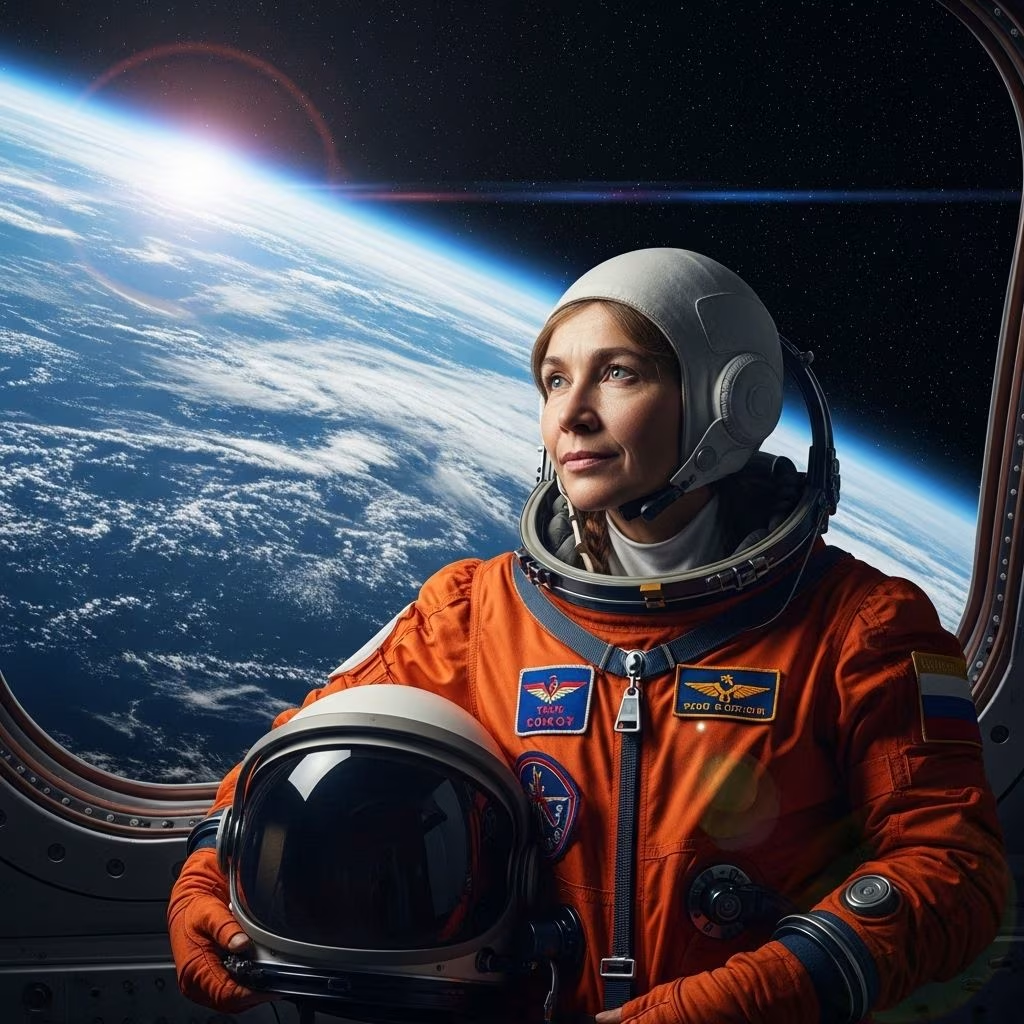
Valentina Tereshkova: The Trailblazing First Woman in Space
On June 16, 1963, Valentina Tereshkova shattered global barriers and made history as the first woman to travel into space. Her solo flight aboard Vostok 6 not only solidified her legacy as a pioneer of exploration but also spotlighted the potential of women in science, technology, engineering, and mathematics (STEM).
Category: Space Exploration
Early Life and Humble Beginnings
Tereshkova was born on March 6, 1937, in Makannikovo village near Yaroslavl, Russia, then part of the Soviet Union. Her father, a truck driver, tragically died during the Finno-Russian War, leaving her mother to raise Valentina and her siblings alone. The family faced economic hardship, and Valentina began working in a textile factory at an early age to help support them.
- Education came late – She did not attend school until she was ten years old, yet developed a lifelong desire to learn.
- Factory work shaped her discipline and perseverance.
- Parachuting hobby – She was introduced to parachuting as a teenager, which would later become pivotal for her space training.
From Factory Worker to Cosmonaut Candidate
Tereshkova’s path toward space began in local skydiving clubs, where she completed over 90 parachute jumps before being considered for cosmonaut training. Inspired by Yuri Gagarin’s successful flight, she applied to join the Soviet space program in 1961. Her experience as a skilled parachutist made her stand out among other candidates.
- Selected for the first group of female cosmonauts in 1962.
- Intensive training included physical conditioning, technical instruction, and simulated flights.
- Tereshkova was one of five candidates who would compete for a spot on the historic mission.
The Historic Vostok 6 Mission
On June 16, 1963, Valentina Tereshkova launched into orbit aboard Vostok 6, marking a triumph for the Soviet Union and women everywhere. At just 26 years old, she became the youngest and only woman to fly solo in space.
- Flight duration: 70 hours and 48 orbits around Earth.
- Altitude reached: Over 143 miles above Earth.
- Endurance: Faced symptoms of physical stress, but remained focused on the completion of scientific tasks.
- Landing: Used her parachuting skills to land safely upon return.
Her achievements were made more remarkable by the hands-on nature of the early Soviet space program, and the technological limitations of the time. During her flight, Tereshkova maintained radio contact with ground crews and reported on personal well-being and technical performance.
Key Milestones and Achievements
- First woman in space: Broke gender barriers globally.
- Solo mission: No other woman has flown solo since.
- Most Earth orbits by a woman (at the time): 48 orbits.
- Youngest female cosmonaut: 26 years at the time of flight, still unmatched.
Table: Vostok 6 Mission Summary
| Mission Name | Launch Date | Duration (Hours) | Orbits Completed | Crew |
|---|---|---|---|---|
| Vostok 6 | June 16, 1963 | ~70 | 48 | Valentina Tereshkova (Solo) |
Global Impact and Recognition
After her return, Tereshkova instantly became a national hero and a symbol of Soviet scientific achievement. Her mission had manifold impacts:
- Elevation to Hero of the Soviet Union: The highest honor in the country.
- Order of Lenin: Received twice for her exceptional contributions.
- International acclaim: Became a global ambassador, touring worldwide to promote Soviet achievements in space and the Communist system.
- Role model: Inspired generations of women to pursue careers in science and engineering.
Life After Space: Political and Academic Career
Tereshkova’s journey did not end with her return to Earth. She remained deeply involved in the Soviet space program as an instructor and furthered her education in aeronautical engineering. Her life took new directions:
- Political leadership: Served as a member of the Presidium of the Supreme Soviet (1974–1989).
- Educator and Instructor: Contributed to training future cosmonauts after dissolution of the original female group in 1969.
- Graduated from Zhukovsky Air Force Engineering Academy: Demonstrated academic excellence and scientific curiosity.
- Transitioned to Russian politics: Active in regional and national Dumas, current position in Yaroslavl Oblast Duma and State Duma.
Civic and State Honors
- Federal civil service rank: 1st class Active State Councillor of the Russian Federation.
- Received numerous awards and honors from both Russia and other nations.
Personal Life: Strength Through Adversity
Tereshkova’s personal journey has been marked by challenges and achievements:
- Marriage: Married fellow cosmonaut Andrian Nikolayev; the union later dissolved.
- Family: Raised a daughter and maintained a low public profile regarding family life.
- Resilience: Overcame political and personal adversities to remain engaged in public service and advocacy.
Pioneering Science and Advocacy
Beyond politics, Tereshkova is renowned for her advocacy in science and technology:
- Passionate supporter of STEM initiatives: Continues to inspire girls and women to pursue scientific careers.
- Space advocacy: Champions international cooperation in space research.
Controversies and Modern Political Role
In recent years, Tereshkova has held important political office but faced criticism and international sanctions for her support of controversial legislation and her 2022 vote in favor of the Russian invasion of Ukraine. This aspect of her legacy highlights the complexities of her public life and enduring presence.
The Enduring Legacy of Valentina Tereshkova
Tereshkova’s flight proved women were capable of facing the rigors of space exploration, setting the stage for future milestones. She remains the last surviving Vostok cosmonaut and continues to advocate for science and equality.
- Role model for gender equality in science and technology.
- Her legacy inspires continued discussion of women’s representation in space exploration.
Frequently Asked Questions (FAQs)
Q: Who was the first woman in space?
A: Valentina Tereshkova became the first woman in space, flying on the Soviet spacecraft Vostok 6 on June 16, 1963.
Q: How long did Valentina Tereshkova spend in space?
A: She spent almost three days in space, completing 48 orbits around Earth.
Q: What did Tereshkova do after her space flight?
A: She continued her career as a cosmonaut instructor, completed engineering studies, and became a prominent political leader in Russia.
Q: Did she ever fly to space again?
A: No, Tereshkova never returned to space but stayed deeply involved in the space program and advocacy work.
Q: Why is Valentina Tereshkova significant for women?
A: Tereshkova’s historic flight shattered gender barriers and inspired subsequent generations of women to pursue careers in STEM, research, and space exploration.
Top Five Facts About Valentina Tereshkova
- Became the first woman to ever travel in space on June 16, 1963.
- Orbited Earth 48 times in almost three days on her solo mission.
- Was the youngest woman to fly in space and the only woman to complete a solo space flight.
- Transitioned from textile work and parachuting to an international icon of science and politics.
- Left a legacy of advocacy for women in STEM and global space cooperation.
Notable Awards and Recognition
- Hero of the Soviet Union
- Order of Lenin (twice)
- Order of Merit for the Fatherland
- Gold Medal of the Federation Aeronautique Internationale
- Many other international awards and decorations
Conclusion: A Legend for All Humanity
The bold journey of Valentina Tereshkova on Vostok 6 not only set records and broke barriers but also signaled a new era in human spaceflight. Her resilience and enduring advocacy in science, politics, and gender equality have secured her place as a cultural and scientific icon whose impact continues to resonate around the world.
References
- https://en.wikipedia.org/wiki/Valentina_Tereshkova
- https://www.britannica.com/biography/Valentina-Tereshkova
- https://nmspacemuseum.org/inductee/valentina-v-tereshkova/
- https://starchild.gsfc.nasa.gov/docs/StarChild/whos_who_level2/tereshkova.html
- https://sheheroes.org/heroes/valentina-tereshkova/
- https://www.ebsco.com/research-starters/biography/valentina-tereshkova
- https://www.biography.com/scientists/valentina-tereshkova
- https://kids.britannica.com/kids/article/Valentina-Tereshkova/631716
- http://ifeminist.org/tereshkova.html
- https://www.schoolsobservatory.org/learn/history/firsts/tereshkova
- https://www.imdb.com/name/nm0855547/bio/
- https://sco.wikipedia.org/wiki/Valentina_Tereshkova
- https://www.imdb.com/name/nm0855547/
- https://www.worldatlas.com/feature/valentina-tereshkova-biography.html
- https://www.itaerea.com/valentina-tereshkova
- https://www.youtube.com/watch?v=t9sQ9YF36gE
- https://russiancouncil.ru/en/valentina-tereshkova/
- https://arttechnically.org/2021/01/27/valentina-tereshkova-biography/


