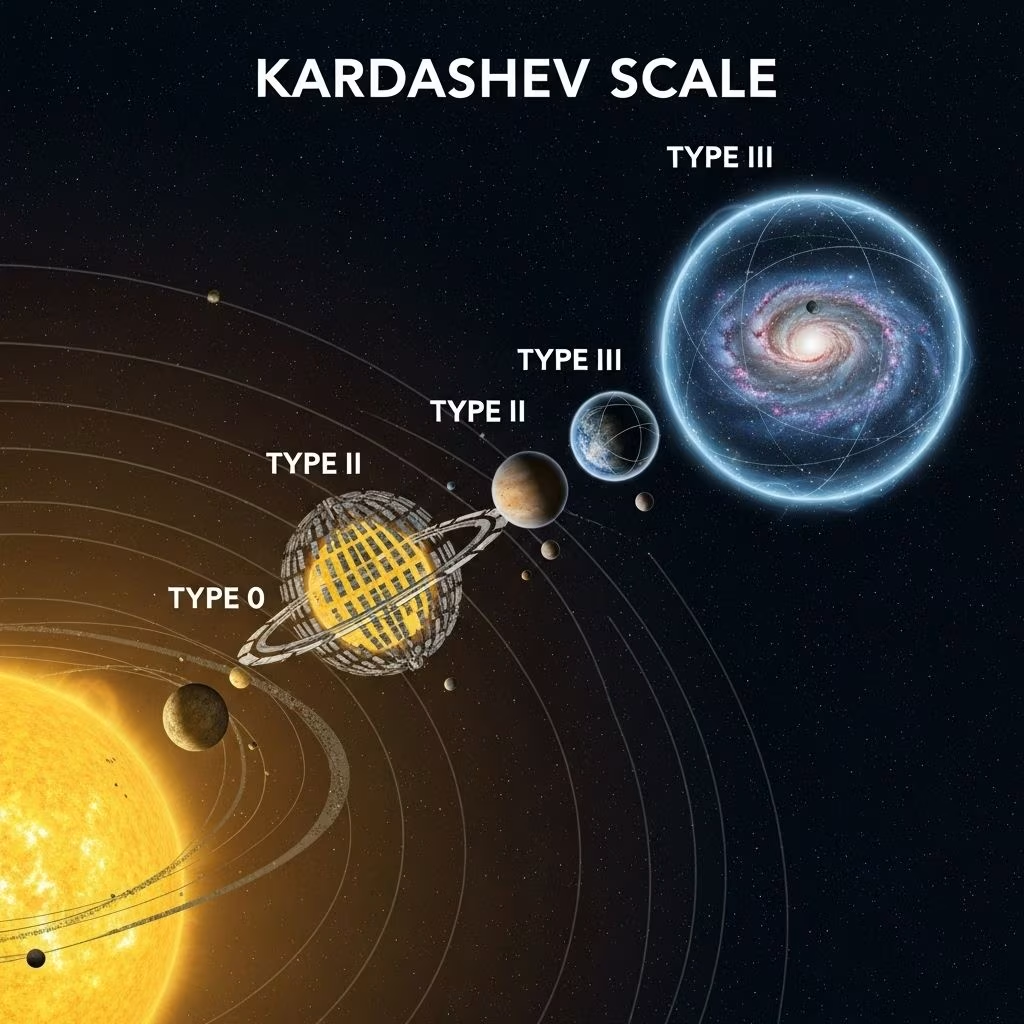
The Kardashev Scale: A Cosmic Measure of Civilization
For decades, astronomers and futurists have wondered how to compare civilizations spread across the cosmos. In 1964, Soviet astronomer Nikolai Kardashev addressed this challenge, devising a framework that classifies civilizations by the total energy they can harness and consume. The Kardashev Scale remains a cornerstone of cosmic anthropology and the ongoing search for extraterrestrial intelligence, offering a way to measure our own progress—and dream of our potential futures.
What Is the Kardashev Scale?
The Kardashev Scale is a method for measuring a civilization’s level of technological advancement based on the amount of energy it is capable of harnessing and using. Kardashev’s core idea was that as civilizations evolve, their energy needs skyrocket, and the more energy they are able to gather and put to use, the more advanced they must be.
His initial model had three main categories, each representing a vast increase in possible technological capability, defined around planetary, stellar, and galactic scales:
- Type I: Harnesses all energy available on its home planet.
- Type II: Taps the full energy output of its home star.
- Type III: Accesses the energy of its entire home galaxy.
This scale is logarithmic—each jump represents an almost unimaginable leap in technological achievement and energy control.
Origins of the Scale
Kardashev proposed the scale at the 1964 Byurakan Conference in Armenia, originally aiming to estimate how powerfully an alien civilization could broadcast radio signals detectable from Earth. His premise: as civilizations grow, their ability to use energy—and thus to signal across cosmic distances—increases dramatically.
Later, astronomers such as Carl Sagan refined the scale, introducing intermediate levels and quantifying energy thresholds more precisely, adapting the scale beyond its original focus on communication to broadly represent technological potential.
The Three (and More) Types: Energy Thresholds Explained
| Type | Description | Estimated Energy Use | Hypothetical Mechanisms |
|---|---|---|---|
| Type I | Planetary civilization—uses all energy available on its planet | ~1016 watts | Geothermal, solar, wind, tidal, nuclear, all fossil fuels |
| Type II | Stellar civilization—uses all energy its star emits | ~1026 watts | Dyson sphere/shell; direct stellar energy extraction |
| Type III | Galactic civilization—uses all energy from its galaxy | ~1036 watts | Star harvesting; galactic-scale engineering; energy from black holes |
Type I: Planetary Civilizations
A Type I civilization can marshal and use all of the energy available on its home planet—that means not only fossil fuels, but also all solar, wind, hydroelectric, geothermal, and even massive geological sources like volcanoes.
- Total use: Approx 1016 watts.
- This level includes global weather control, earthquake and volcano management, and potential full planetary communication networks.
- We are not currently at Type I yet; our total planetary power consumption is orders of magnitude lower.
Type II: Stellar Civilizations
A Type II civilization advances far beyond its planet, building the technology to capture and use the entire luminosity of its host star—often imagined as constructing a massive Dyson sphere encasing the star.
- Total use: Approx 1026 watts (nearly 10 billion times all energy used on present-day Earth).
- Would allow nearly unlimited resource access for gigantic projects—from stellar system alteration to interstellar travel and mega-scale computing.
- Requires engineering on a scale far beyond anything current humanity can accomplish.
Type III: Galactic Civilizations
The apex of Kardashev’s original scale: a species able to utilize the total energy output of an entire galaxy—from all its stars, gas clouds, and even black holes.
- Total use: Approx 1036 watts.
- Implies interstellar colonization, control of black hole energy, and potentially civilization-wide consciousness spanning the entire galaxy.
- Such a species would be visible across the universe—if it exists.
Extensions: Beyond the Original Scale
Later theorists extended the Kardashev Scale to consider even greater levels of energy use—prompted by speculation about the ultimate fate and reach of civilizations:
- Type IV: Harnesses energy on the scale of an entire universe (e.g., drawing from every galaxy present).
- Type V: Controls the energy of multiple universes or even the multiverse; a concept existing almost purely in theoretical and philosophical speculation.[11]
| Type | Energy Harnessed | Conceptual Reach |
|---|---|---|
| Type IV | ~1046 watts | Universal—every galaxy, across all spacetime |
| Type V | Above 1046 watts | Multiversal—beyond the observable universe |
Where Are We? Earth’s Place on the Kardashev Scale
A frequently-asked question: what type are we?
- Humanity is not yet on the Kardashev scale; we are considered a Type 0 civilization—using only a fraction of the energy available on Earth.
- Current estimates: humanity taps roughly 0.16 on the scale—meaning we use less than 1/6th of what it would take to be called a true Type I civilization.
- Carl Sagan devised a formula for fractional types: K = (log10(W) – 6)/10, where W is energy usage in watts.
- Our civilization relies heavily on unsustainable energy sources (fossil fuels), but the transition to renewables may, over centuries, push us closer to Type I status.
- Michio Kaku and other physicists speculate that, given current trends, we may achieve Type I in roughly 100–200 years. This will require harnessing all forms of energy available on our planet in a sustainable way.
Technological Milestones: What’s Needed to Rise Up the Scale?
- For Type I:
- Global weather and disaster control
- Peaceful and sustainable global energy grid (solar, wind, geothermal, nuclear fusion)
- Comprehensive planetary communications network
- Efficient worldwide transportation and instant communication
- For Type II:
- Engineering megastructures capable of capturing the full output of the Sun (i.e., a Dyson sphere)
- Advanced planetary and interstellar travel
- Elimination of planetary resource limitations; burgeoning space industry
- For Type III:
- Rapid interstellar colonization
- Communication and energy transfer across galactic distances
- Transformation and harvesting of energy from black holes, pulsars, and entire star clusters
Dyson Spheres: The Key to Type II Civilization
One of the most famous theoretical megastructures tied to the Kardashev Scale is the Dyson sphere: a colossal arrangement of solar-collecting satellites or structures fully surrounding a star to capture its energy.
- Originally proposed by Freeman Dyson, not for habitation but for energy collection.
- Would require more raw material than available on most planets—prompting the concept of mining entire planets, moons, or asteroids.
- No direct evidence of Dyson spheres or similar structures has yet been observed by astronomers, but the search for their possible infrared signatures continues.
Implications for SETI and the Search for Alien Civilizations
The Kardashev Scale has become a powerful tool for the search for extraterrestrial intelligence (SETI). The underlying reasoning is that the most advanced civilizations, especially at Type II or III, might produce energy signatures—such as huge artificial infrared outputs—that could be detected across the galaxy or even universe.
- SETI programs scan for anomalous energy signals and radio patterns potentially indicating civilizations far more advanced than our own.
- So far, there is no confirmed evidence for civilizations above Type I.
- The scale helps focus searches on cosmic phenomena—like the unexplained dimming of certain stars—that might indicate the presence of alien megastructures.
Cultural and Philosophical Impact
The Kardashev Scale has far-reaching cultural and philosophical value. It invites us to imagine what the future holds for humanity, both in terms of technological advancement and in how we relate to our planet, star, and galaxy.
- Raises questions about sustainability, risk, and responsible energy use.
- Encourages thinking on the stewardship of planetary resources, management of risks like climate change, and the potential ethical implications of manipulating entire stellar systems or galaxies.
- Highlights the possibility that advanced civilizations may destroy themselves—or choose paths that never increase energy usage so dramatically, complicating SETI assumptions.
Limitations & Alternatives
While influential, the original Kardashev Scale focuses solely on energy consumption as a metric of advancement. Critics and modern thinkers have proposed new metrics or extensions, including:
- Information processing or computational capacity
- Mastery over matter at the nanotechnological or even subatomic level
- Ecosystem management, planetary health, or technological sustainability as alternative measures
Even so, the scale’s simplicity and cosmic perspective continue to shape debate and drive imagination.
Frequently Asked Questions (FAQs)
Q: How close is humanity to becoming a Type I civilization?
A: We are currently at about 0.16 on the logarithmic scale; estimates suggest reaching true Type I status may take another 100–200 years, assuming sustainable advances in energy harvesting continue.
Q: Are there any signs of Type II or Type III civilizations in our galaxy?
A: No confirmed signs have been found. Some projects search for “waste heat” or anomalies that might indicate such activity (like Dyson spheres), but none have been conclusively detected.
Q: What comes after Type III?
A: Theoretical types (Type IV, V) involve harnessing the energy of entire universes or multiverses, but these remain speculative and beyond current scientific capability or observation.
Q: Could a civilization skip directly to Type II or III?
A: It’s extremely unlikely—enormous technological, social, and resource challenges make stepwise progress through the scale far more plausible.
Q: Why do we use energy as a benchmark for measuring civilizations?
A: Energy availability directly links to a civilization’s technological abilities—controlling more energy means unlocking new possibilities for technology, communication, travel, and influence.
Conclusion: Humanity’s Future on the Scale
The Kardashev Scale continues to captivate scientists and laypeople alike, encouraging humanity to reflect on its place in the cosmos—and the vast potential that may await us if we master new forms of energy. As we struggle with energy, climate, and technological dilemmas on Earth, the prospect of advancing even to Type I is both an enormous challenge and an inspiring vision for the future of our civilization.
References
- https://en.wikipedia.org/wiki/Kardashev_scale
- https://www.universetoday.com/articles/what-is-the-kardashev-scale
- https://www.sciencefocus.com/future-technology/kardashevs-scale
- https://www.britannica.com/science/Kardashev-scale
- https://www.youtube.com/watch?v=OB6Vzgwt7ac
- https://www.youtube.com/watch?v=M72ExJuCml0
- https://futurism.com/the-kardashev-scale-type-i-ii-iii-iv-v-civilization
- https://beyond-universe.fandom.com/wiki/Kardashev_Scale
- https://astrobites.org/2016/03/15/classifying-civilisations-an-introduction-to-the-kardashev-scale/
- https://kardashev.fandom.com/wiki/Kardashev_scale
- https://www.fromquarkstoquasars.com/post/https-www-fromquarkstoquasars-com-the-kardashev-scale-of-civilization-types
- https://www.scienceabc.com/nature/universe/what-is-kardashev-scale.html
- https://openexo.com/insight/kardashev-scale-exponential-civilizations
- https://futurism.com/the-kardashev-scale-of-civilization-types
- https://www.wikiwand.com/en/articles/Kardashev_scale
- https://handwiki.org/wiki/Astronomy:Kardashev_scale
- https://tilln.com/season-4/the-kardashev-scale-this-scientist-figured-out-how-to-measure-success/
- https://arxiv.org/pdf/2204.07070.pdf