


Earth’s Atmosphere: Structure, Composition, and Significance
The atmosphere is a dynamic, multi-layered envelope of gases that surrounds our planet, shielding it from harmful solar radiation, regulating temperature, and enabling the existence of life. This article provides an in-depth look at the structure, composition, and crucial functions of Earth’s atmosphere, delving into each layer’s characteristics and its role in supporting and protecting life on Earth.
What Is the Earth’s Atmosphere?
Earth’s atmosphere is a layer of gases held by gravity, extending from the planet’s surface and gradually thinning out into space. This gaseous blanket not only sustains life by providing oxygen and carbon dioxide for respiration and photosynthesis but also helps stabilize the climate and weather, and serves as a buffer against harmful cosmic and solar radiation.
- Composition: Mostly nitrogen (78%) and oxygen (21%). Argon, carbon dioxide, water vapor, and trace gases make up the rest.
- Extent: Gradually transitions to space at around 10,000 km but most of the mass resides within the first 50 km.
- Main Functions: Supports breathable air, regulates temperature, protects against radiation, and allows weather and water cycles.
Layers of Earth’s Atmosphere
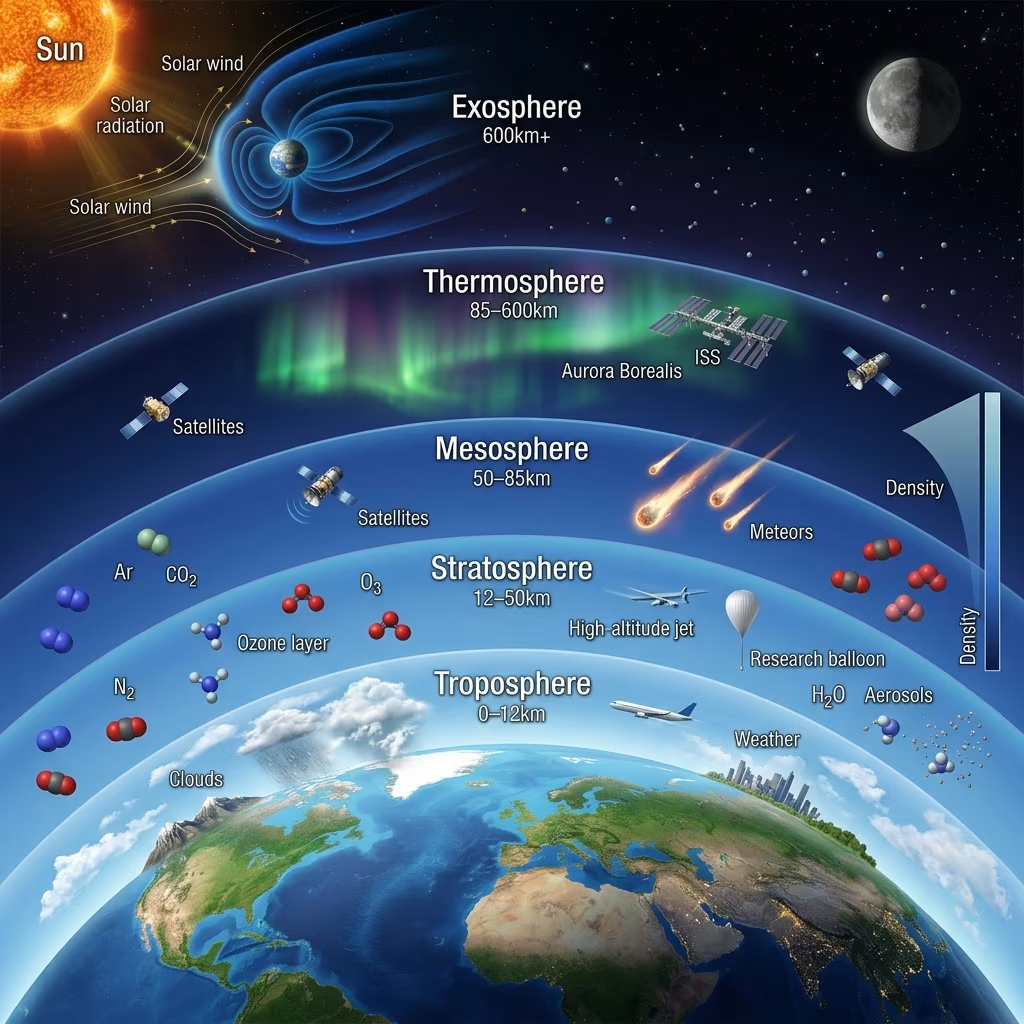
The atmosphere is divided into distinct layers based on temperature gradients, composition, and phenomena occurring within each. These layers, from the ground upwards, are the troposphere, stratosphere, mesosphere, thermosphere, and exosphere.
| Layer | Approximate Altitude Range | Main Features |
|---|---|---|
| Troposphere | Surface to ~12 km | Weather, clouds, densest air, most water vapor |
| Stratosphere | ~12 km to 50 km | Ozone layer, jet aircraft cruise, temperature increases with altitude |
| Mesosphere | 50 km to 85 km | Coldest region, meteors burn up, low pressure |
| Thermosphere | 85 km to 600 km | Auroras, ISS orbit, temperature rises sharply |
| Exosphere | 600 km to ~10,000 km | Edge of space, extremely thin, satellites orbit here |
Troposphere
The troposphere is the lowest, densest layer, containing about 75-80% of the atmosphere’s total mass and nearly all its water vapor and aerosols. It ranges from the surface up to about 12 km (7.5 miles), though its upper limit varies with latitude and season.
- Temperature: Decreases with altitude; most heat comes from the Earth’s surface.
- Weather: All weather phenomena, clouds, and precipitation occur here.
- Life Support: Provides necessary gases (oxygen, CO₂) for living organisms.
The boundary above, called the tropopause, marks a temperature inversion and transition to the stratosphere.
Stratosphere
Above the troposphere lies the stratosphere, extending from about 12 km to 50 km (7.5–31 miles).
- Temperature: Rises with altitude due to the absorption of ultraviolet (UV) radiation by ozone molecules.
- Ozone Layer: Located within the stratosphere, the ozone layer protects life by absorbing harmful UV-B and UV-C radiation from the Sun.
- Aircraft: Jet airplanes and weather balloons often cruise at the lower stratosphere to avoid turbulence common in the troposphere.
At the top, the stratopause marks another boundary before the mesosphere.
Mesosphere
The mesosphere extends from about 50 km up to 85 km (31–53 miles). Compared to other layers, it is not well studied due to its inaccessibility – too high for aircraft and balloons, too low for most satellites.
- Temperature: Decreases with altitude, reaching the coldest temperatures in Earth’s atmosphere (down to -90°C or lower).
- Meteors: Most meteors entering Earth’s atmosphere vaporize in this layer, creating visible streaks in the night sky.
- Low Pressure: Air density is less than 1% that of ground level.
The mesopause separates it from the thermosphere above.
Thermosphere
The thermosphere stretches from about 85 km up to 600 km (53–373 miles) and experiences a rapid rise in temperature, with values exceeding 2,000°C (even though the air is so thin, it would not feel hot). This layer is highly responsive to solar activity.
- Auroras: Northern and Southern Lights (aurora borealis and aurora australis) are seen here due to interactions between solar wind and atmospheric particles.
- Ionosphere: The lower thermosphere is part of the ionosphere, where solar radiation ionizes atmospheric gases, enabling long-distance radio communication.
- Satellites: Many satellites and the International Space Station (ISS) orbit within or near this region.
The thermopause marks the upper boundary before fading into the exosphere.
Exosphere
The outermost layer, the exosphere, extends from about 600 km to nearly 10,000 km (6,200 miles). This is where the atmosphere thins into space, with molecules so far apart they can travel hundreds of kilometers before colliding.
- Air Density: Extremely low; primarily hydrogen and helium.
- Satellites: Some satellites orbit in the lower exosphere, technically within the atmosphere but operating in near-vacuum conditions.
- Transition to Space: Considered the boundary where Earth’s atmosphere blends into the solar wind and interplanetary medium.
Composition of the Atmosphere
The atmosphere consists mainly of nitrogen and oxygen, with other components present in much smaller quantities[11].
| Gas | Percentage by Volume |
|---|---|
| Nitrogen (N2) | 78.08% |
| Oxygen (O2) | 20.95% |
| Argon (Ar) | 0.93% |
| Carbon Dioxide (CO2) | ~0.04% |
| Other (neon, helium, krypton, hydrogen, etc.) | Trace amounts |
| Water Vapor | Variable (0–4%) |
- Water vapor varies with altitude, temperature, and location.
- Trace gases (ozone, methane, nitrous oxide) play important roles in climate and atmospheric chemistry.
Functions and Importance of Earth’s Atmosphere
The atmosphere is essential for life as we know it, providing several vital services:
- Oxygen and Respiration: Supplies animals and humans with oxygen, plants with carbon dioxide.
- Protection from UV Radiation: Ozone layer in the stratosphere absorbs harmful ultraviolet rays.
- Temperature Regulation: Traps heat (greenhouse effect), moderating temperature extremes between day and night.
- Weather and Precipitation: Evaporation and condensation cycles enable rain, storms, and climate patterns. The troposphere holds almost all weather phenomena.
- Shield from Meteors and Space Debris: Most meteors burn up due to friction with atmospheric particles in the mesosphere.
- Distribution of Water: Drives the water cycle, moving moisture over vast distances to nourish ecosystems worldwide.
The Ozone Layer
The ozone layer is a region within the stratosphere that contains a high concentration of ozone (O3) molecules. Its ability to absorb ultraviolet radiation is critical to protecting DNA and organic molecules on Earth’s surface from debilitating mutations and damage.
- Ozone concentration peaks between 15 and 35 km in altitude.
- Depletion from chemicals (chlorofluorocarbons, CFCs) has thinned the ozone, leading to increased UV exposure in some regions.
The Ionosphere and Atmospheric Phenomena
Starting at about 50 km, the ionosphere overlaps the mesosphere, thermosphere, and lower exosphere. Solar and cosmic radiation ionizes atmospheric particles, creating an electrically charged region vital for radio communication and navigation.
- Permits long-range radio transmission through ionized layers.
- Home to phenomena like auroras (aurora borealis and aurora australis).
- Contributes to ‘airglow’—a faint emission of light noticeable from space.
Human Impact on the Atmosphere
While the atmosphere is shaped by natural processes, human activities are increasingly altering its composition and behavior.
- Greenhouse Gases: Emissions of CO2, methane, and nitrous oxide from industry, agriculture, and energy production have enhanced the greenhouse effect, driving climate change.
- Ozone-Depleting Substances: CFCs and related compounds have caused measurable depletion of the ozone layer, especially above polar latitudes.
- Pollution: Aerosols and smog can diminish air quality, impact health, and contribute to regional and global climate shifts.
Interesting Facts about the Atmosphere
- If Earth were the size of a ball, the atmosphere would be thinner than the skin of an apple in proportion.
- More than half of the air’s mass lies below 5.6 km in altitude.
- Commercial aircraft generally fly within the lower stratosphere, above the turbulence of the troposphere.
- Atmospheric pressure at sea level is about 101,325 Pascals (1 atmosphere, or 14.7 psi).
- The exosphere does not have a defined upper boundary—it gradually merges into outer space.
Frequently Asked Questions (FAQs)
Q: Why does Earth’s atmosphere have layers?
A: Layers form due to differences in temperature gradients, chemical composition, and solar energy absorption at different altitudes, which create stratification with unique properties and behaviors.
Q: What is the purpose of the ozone layer?
A: The ozone layer absorbs much of the Sun’s harmful ultraviolet radiation, protecting living organisms from DNA damage and supporting the stability of ecosystems.
Q: How far does the atmosphere extend?
A: While there’s no rigid outer boundary, the atmosphere gradually thins into space and becomes negligible above 10,000 km. Most of the mass lies within 50 km of the surface.
Q: What are auroras, and where do they occur?
A: Auroras are luminous displays seen near polar regions, created when charged solar particles interact with ions in the thermosphere and ionosphere, producing green, red, and purple lights.
Q: How does the atmosphere affect weather and climate?
A: The atmosphere enables weather by circulating air and water vapor, driving temperature extremes, storms, and rainfall patterns. Long-term changes in atmospheric composition can shift Earth’s climate.
Glossary
- Atmospheric Pressure: The weight of the air above a given point on Earth’s surface.
- Tropopause / Stratopause / Mesopause / Thermopause: Boundaries between atmospheric layers, typically marked by changes in temperature gradients and composition.
- Ozone (O3): A molecule made of three oxygen atoms, crucial in the stratosphere for absorbing UV radiation.
- Ionosphere: A region of charged particles critical for radio communications, extending from the upper mesosphere to the exosphere.
- Aurora: A natural light display in Earth’s sky, prevalent near the poles, caused by collisions between energetic charged particles and atoms in the atmosphere.
Further Exploration
- Weather and Climate Systems: How the troposphere drives clouds, wind, storms, and climate cycles.
- Space Exploration: Interaction between Earth’s upper atmosphere, satellites, and the solar wind.
- Environmental Protection: Efforts to mitigate human impact on atmospheric layers, such as reducing greenhouse gases and ozone-depleting chemicals.
References
- https://en.wikipedia.org/wiki/Atmosphere_of_Earth
- https://science.nasa.gov/earth/earth-atmosphere/earths-atmosphere-a-multi-layered-cake/
- https://scied.ucar.edu/learning-zone/atmosphere/layers-earths-atmosphere
- https://niwa.co.nz/atmosphere/layers-atmosphere
- https://chem.libretexts.org/Bookshelves/Introductory_Chemistry/Chemistry_for_Changing_Times_(Hill_and_McCreary)/13:_Air/13.02:_Earth’s_Atmosphere-_Divisions_and_Composition
- https://www.nasa.gov/general/what-is-earths-atmosphere/
- https://www.tutoroot.com/blog/what-are-layers-of-atmosphere-structure-importance/
- https://byjus.com/physics/atmosphere/
- https://content.atmospheremooc.org/monitoring-atmospheric-composition/week-1-our-fragile-atmosphere-and-the-challenges-we-face/topic-1d-unravelling-the-complex-structure-of-the-atmosphere
- https://www.youtube.com/watch?v=OzTEjZVUHZY
- https://study.com/academy/lesson/earths-atmosphere-components-structure.html
- https://www.ebsco.com/research-starters/earth-and-atmospheric-sciences/atmospheric-structure-and-evolution
- https://courses.lumenlearning.com/suny-astronomy/chapter/earths-atmosphere/
- https://sustainabilityunlocked.com/discover/insights/layers-of-the-atmosphere-comprehensive-guide
- https://www.albert.io/blog/earth-atmosphere-composition-ap-environmental-science-review/
- https://www.drishtiias.com/to-the-points/paper1/composition-and-layers-of-earth-s-atmosphere


