Ursa Major: An Introduction to the Great Bear Constellation
Ursa Major, also known as the Great Bear, is one of the most prominent and easily recognizable constellations in the northern hemisphere’s night sky. With a storied history in myth and science, Ursa Major has guided stargazers, travelers, and storytellers for millennia. Its brightest stars form the famous Big Dipper asterism, making it a celestial landmark for observers worldwide.
Quick Facts About Ursa Major
- Latin Name: Ursa Major (“Great Bear”)
- Abbreviation: UMa
- Symbolism: The Bear
- Location: Northern Hemisphere
- Right Ascension: 10h 40m
- Declination: +55°
- Area: 1,280 square degrees (3rd largest constellation)
- Brightest Star: Alioth (Epsilon Ursae Majoris)
- Number of Main Stars: 7 (Big Dipper); over 120 in total
- Visibility: Circumpolar in mid-northern latitudes; visible throughout the year
The History and Significance of Ursa Major
Ursa Major’s mythology, symbolism, and name date back to ancient civilizations. The constellation is one of the original 48 catalogued by Ptolemy in the 2nd century CE and remains one of the 88 modern constellations recognized today.
- Ancient Connections: The great bear motif is found in Greek, Roman, Native American, Hindu, Chinese, and other mythologies.
- Cultural Importance: The Big Dipper part of Ursa Major has appeared in stories and art for many cultures, often linked to navigation, hunting, and the passage of time.
- Modern Symbolism: The flag of the U.S. state of Alaska features the Big Dipper alongside Polaris, highlighting its navigational significance.
How to Find Ursa Major in the Night Sky
Ursa Major is visible throughout the year in much of the northern hemisphere and serves as a key reference point for identifying other stars and constellations. Its characteristic Big Dipper asterism is central to its easy identification.
- In spring, the Big Dipper is high in the northeastern sky after sunset.
- In summer, it moves toward the northwestern sky.
- Throughout the night and year, its orientation changes due to Earth’s rotation and orbit, but it never sets below the horizon in latitudes above 41°N—thus, it’s called “circumpolar.”
To locate the North Star (Polaris), extend an imaginary line from the two outer stars in the Dipper’s bowl—Dubhe and Merak—and follow it about five times the distance between them upward; this leads you straight to Polaris, anchoring Ursa Minor.
Table: Seasonal Position of Ursa Major
| Season | Approximate Sky Location | Orientation |
|---|---|---|
| Spring | Northeast to overhead | Bowl upright, handle curving east |
| Summer | Northwest | Bowl upside down |
| Autumn | Low in north | Bowl to the left |
| Winter | Rising in northeast | Bowl to the right |
The Big Dipper: Ursa Major’s Iconic Asterism
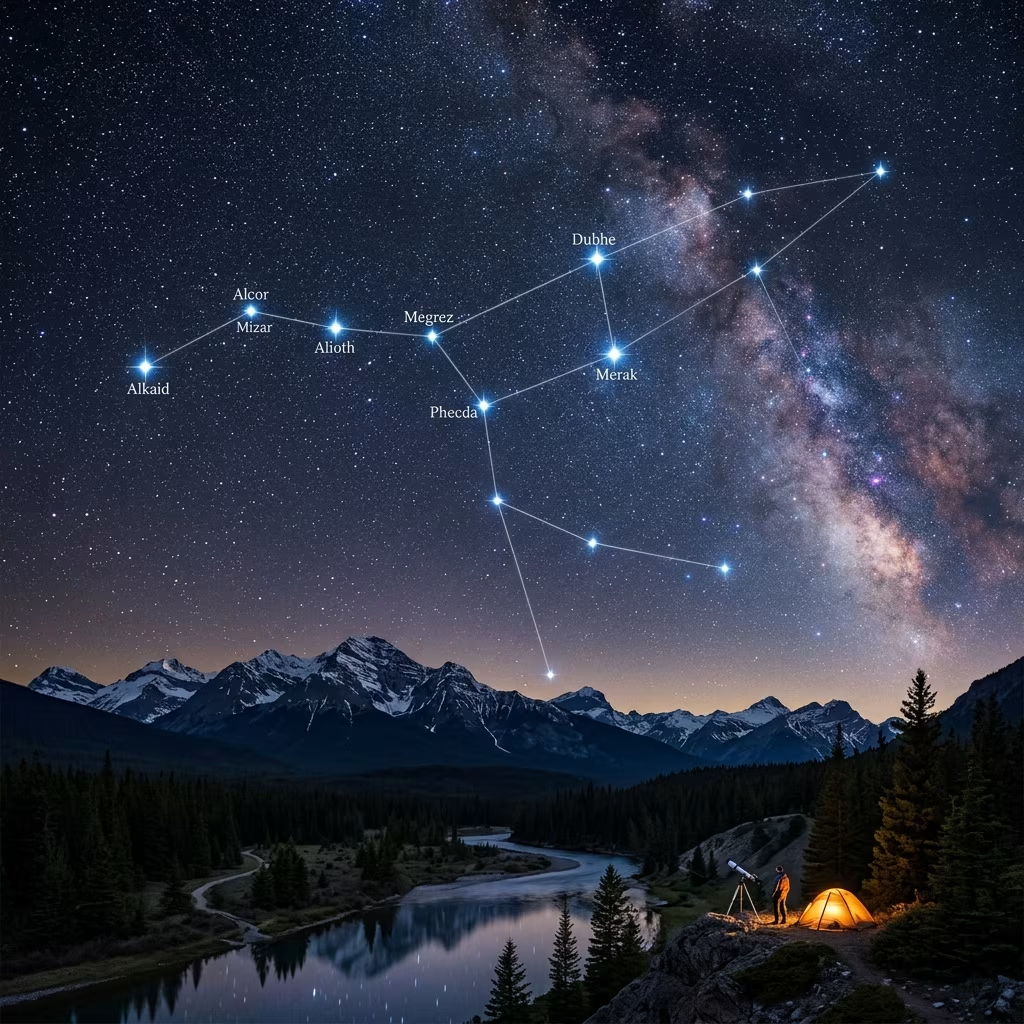
The Big Dipper is not a constellation itself, but an asterism—an easily recognizable star pattern. Its distinctive shape resembles a ladle or plough and is composed of seven bright stars:
- Dubhe (Alpha UMa)
- Merak (Beta UMa)
- Phecda (Gamma UMa)
- Megrez (Delta UMa)
- Alioth (Epsilon UMa)
- Mizar (Zeta UMa)
- Alkaid (Eta UMa)
The Big Dipper’s orientation shifts with the season and time of night, but the configuration remains easy to spot in the northern sky.
Navigation and Star Paths
- Polaris Pointer: Draw a line through Dubhe and Merak to locate Polaris (the North Star).
- Arcturus and Spica: Follow the curve of the Dipper’s handle to “arc to Arcturus” and “spike to Spica,” identifying two more bright stars in the Spring Triangle.
The Seven Bright Stars of Ursa Major
| Star Name | Bayer Designation | Magnitude | Notable Features |
|---|---|---|---|
| Dubhe | Alpha Ursae Majoris | 1.79 | Red giant, points to Polaris |
| Merak | Beta Ursae Majoris | 2.37 | Main sequence star, pointer star |
| Phecda | Gamma Ursae Majoris | 2.44 | Links bowl and handle, part of Dipper base |
| Megrez | Delta Ursae Majoris | 3.32 | Faintest in Dipper, joins bowl and handle |
| Alioth | Epsilon Ursae Majoris | 1.76 | Brightest in Ursa Major, white giant |
| Mizar | Zeta Ursae Majoris | 2.23 | Double star (with Alcor), test of eyesight |
| Alkaid | Eta Ursae Majoris | 1.85 | Hot blue, marks tip of Dipper’s handle |
Other Notable Stars and Features
- Mizar and Alcor: These form a famous naked-eye double in the Dipper’s handle. Many cultures use them as a test of eyesight. Mizar itself is a quadruple star system, making it one of the first binary stars studied with a telescope.
- Tania Australis and Tania Borealis: These stars, outside the Dipper, mark the Bear’s legs in the classical rendition.
- Talitha and Muscida: Less prominent stars used in the outline of the bear’s feet and face.
Mythology and Cultural Meanings
The legends surrounding Ursa Major span continents and centuries:
- Greek mythology: Ursa Major is associated with Callisto, a maiden transformed into a bear by Zeus and placed into the sky. The story often links the constellation with Ursa Minor, her son Arcas or the lesser bear.
- Roman tales: The Latin name itself, Ursa Major, means Great Bear. Ovid and other Roman writers described its mythic ascent.
- Native American cultures: Many North American tribes see the Dipper as a bear, sometimes chased by hunters (the handle stars) or associated with the cycle of seasons and hunting fortunes.
- Asian traditions: Chinese astronomy refers to these stars as the “Northern Dipper,” attributing to them control over life, death, and the seasons.
- Middle Eastern stories: Interpretations include a bier and mourners, with the stars marking the pallbearers.
Deep-Sky Objects in Ursa Major
Apart from its famous stars, Ursa Major hosts a wealth of deep-sky objects prized by amateur and professional astronomers, including:
- Galaxies:
- M81 (Bode’s Galaxy): A bright spiral galaxy, easily viewed through small telescopes.
- M82 (Cigar Galaxy): A striking edge-on galaxy noted for its starburst activity.
- M101 (Pinwheel Galaxy): A large face-on spiral galaxy rich in detail for astrophotographers.
- M108, M109: Additional spiral galaxies for experienced stargazers to seek out.
- Planetary Nebula:
- M97 (Owl Nebula): A faint, round nebula with features that resemble owl’s eyes under medium telescopic power.
Meteor Showers Linked to Ursa Major
The Ursa Major constellation is associated with several meteor showers, notably:
- Alpha Ursae Majorids (peaking in late March or early April)
- Leonids-Ursids (sometimes referenced during late-year meteor activity)
While these are not among the most prolific meteor showers, Ursa Major’s position can assist observers in orienting themselves to the night sky during peak meteor activity.
The Role of Ursa Major in Astronomy and Navigation
- Stellar Reference: The Big Dipper’s stars help astronomers and amateur stargazers locate other constellations, like Boötes, Leo, and Draco.
- Celestial Clock: The Dipper’s orientation changes with the seasons, helping ancient cultures track time and agricultural cycles.
- Circumpolar Nature: Its never-setting path above the horizon for much of the Northern Hemisphere aligns it with north and navigation.
Fun Facts and Trivia
- The names of Ursa Major’s seven brightest stars are derived from Arabic, Latin, and Greek roots.
- Ursa Major contains over 15 stars brighter than magnitude 4.0, making it easy to pick out even in light-polluted skies.
- The Big Dipper is called the Plough in the United Kingdom, the Great Wagon in Germany, and the Drinking Gourd in African-American folklore.
- Galileo was the first to distinguish that Mizar itself is a double star when viewed through a telescope.
Frequently Asked Questions (FAQs)
Q: Is Ursa Major visible everywhere in the world?
A: Ursa Major is visible throughout the year from most of the Northern Hemisphere, particularly above 41°N latitude. It is not visible in its entirety from mid-southern latitudes.
Q: What is the difference between Ursa Major and the Big Dipper?
A: Ursa Major is the full constellation, which covers a large area and includes many stars. The Big Dipper is a well-known asterism made up of only seven of Ursa Major’s brightest stars.
Q: Why is Ursa Major important in navigation?
A: The two outer stars of the Big Dipper’s bowl, Dubhe and Merak, point directly to Polaris, the North Star, which helps in finding true north.
Q: Are there any interesting objects to observe in Ursa Major?
A: Yes, Ursa Major hosts several standout galaxies like M81 and M82, and the Owl Nebula (M97), all popular targets for amateur astronomers with modest telescopes.
Q: What is the myth behind Ursa Major?
A: In Greek mythology, Ursa Major is Callisto, a nymph changed into a bear by Zeus and placed in the sky. In various other cultures, it is seen as a bear, wagon, plough, or group of hunters.
References
- https://en.wikipedia.org/wiki/Ursa_Major
- https://www.space.com/ursa-major-constellation-great-bear
- https://www.constellation-guide.com/constellation-list/ursa-major-constellation/
- https://theskylive.com/sky/constellations/ursa_major-constellation
- https://www.aavso.org/myths-uma
- https://astrobackyard.com/ursa-major-constellation/
- https://www.ebsco.com/research-starters/astronomy-and-astrophysics/ursa-major
- https://en.wikipedia.org/wiki/Ursa_Maior
- https://www.britannica.com/place/Ursa-Major
- https://www.youtube.com/watch?v=G0ViprWeqT8
- https://peecnature.org/ursa-major-and-ursa-minor/
- https://www.centreofexcellence.com/ursa-major-constellation/
- https://chandra.harvard.edu/photo/constellations/ursamajor.html
- https://starwalk.space/en/news/ursa-major-constellation-guide
- https://www.go-astronomy.com/constellations.php?Name=Ursa+Major
- https://star-name-registry.com/blog/item/mythology-ursa-major
- https://www.underthenightsky.com/constellations/ursa-major/