


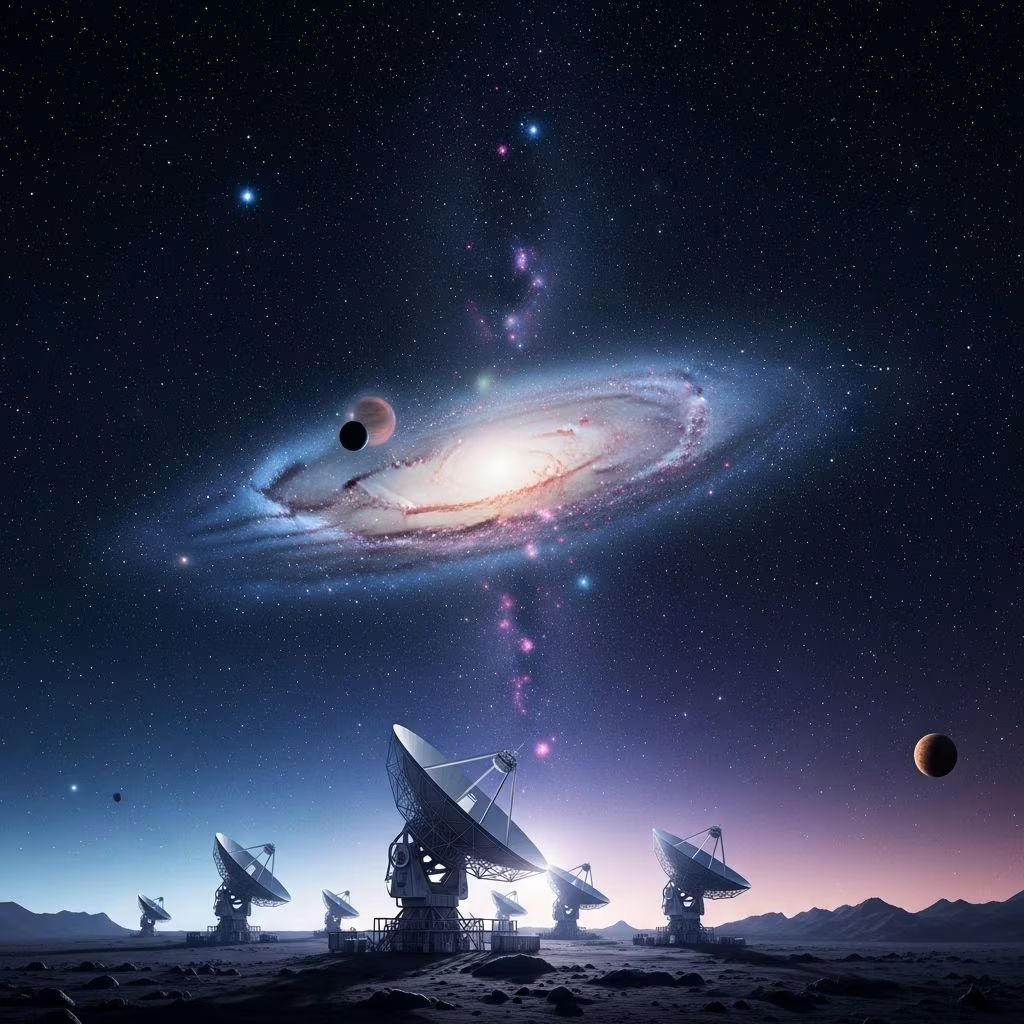
Fermi Paradox: Where Are All the Aliens?
The Fermi Paradox encapsulates one of humanity’s greatest scientific mysteries: If the cosmos is filled with billions of stars and countless planets, why have we detected no signs of advanced extraterrestrial life? The paradox was named after physicist Enrico Fermi, who famously asked, “Where is everybody?” in 1950 while pondering the existence of intelligent life beyond Earth. Through a chain of reasoning grounded in astronomical observations and probability, the paradox confronts the staggering likelihood of alien civilizations—contrasted with the deafening silence we observe.
Contents
- What Is the Fermi Paradox?
- The Chain of Reasoning
- Implications and Core Issues
- Potential Explanations for the Paradox
- Searching for Cosmic Signals
- The Drake Equation
- Where Are the Aliens?
- Frequently Asked Questions
What Is the Fermi Paradox?
The Fermi Paradox highlights a fundamental contradiction:
- Given the vastness and age of the universe, advanced extraterrestrial civilizations should be both numerous and detectable.
- Yet, no convincing evidence of their existence has ever been found.
Enrico Fermi’s inquiry came during a discussion of interstellar travel and the likelihood of cosmic visitors. Though he did not formalize the paradox in science literature, his question was quickly adopted by the astronomical community and refers broadly to our inability to detect alien life, despite the presumption that it should be abundant.
The Chain of Reasoning
The logic underlying the Fermi Paradox follows a set of compelling astronomical facts and hypotheses:
- There are hundreds of billions of stars in the Milky Way galaxy, many of which are structurally similar to our Sun.
- A substantial fraction of these stars likely possess Earth-like planets within their habitable zones, making them prime candidates for life.
- Many planets and moons would have had stable, habitable conditions for billions of years, perhaps well preceding the formation of Earth.
- If Earth is not unique, then other worlds should have developed life long ago. That life plausibly could have become intelligent and technologically capable of interstellar communication or travel.
- Given the age and size of the galaxy, some civilizations ought to be vastly older and potentially far more advanced than humanity.
In summary, if these conditions exist, the galaxy ought to be teeming with life—some of which should have been detectable or reached Earth by now.
Implications and Core Issues
The Fermi Paradox splits into two core lines of thinking:
- Scale and Probability: With hundreds of billions of stars and planets in the Milky Way alone, the odds seem overwhelming that intelligent life should be commonplace.
- Observational Silence: Despite these odds, searches for alien technology—whether radio signals, artifacts, or visits—have turned up nothing convincing to date.
This contradiction demands possible explanations. Are intelligent civilizations rare? Are our assumptions about the development and behavior of life wrong? Is our scientific understanding of the universe incomplete?
Potential Explanations for the Paradox
Numerous resolutions to the Fermi Paradox have been suggested. The following are among the most prominent:
- Intelligent Life is Rare: Life itself may be common, but evolution to intelligence and technological capability may be exceedingly rare.
- Short-Lived Civilizations: Technological civilizations could destroy themselves or collapse before developing the means for significant interstellar communication or travel.
- Hidden or Non-Communicative Civilizations: Alien societies may deliberately avoid detection, observing or ignoring us, or simply not use technologies we can detect.
- Lack of Interstellar Travel: Even with advanced technology, practical interstellar colonization may be far more difficult or less desirable than assumed.
- Earth Is Unique: Life’s evolution may depend on an extraordinarily rare combination of circumstances only Earth provides—a view known as the “Rare Earth Hypothesis.”
- Signals Are Undetectable to Us: Alien life may be communicating in ways, frequencies, or mediums we cannot yet observe or comprehend.
- We Are Early Arrivers: Humanity might be among the first civilizations in the galaxy or the universe.
Searching for Cosmic Signals
Efforts to detect extraterrestrial civilizations fall under the banner of SETI (Search for Extraterrestrial Intelligence). SETI projects use radio astronomy, optical surveys, and other technologies to search for “technosignatures”: signs of alien technology such as radio or laser emissions, artificial structures, or signals not attributable to natural sources.
- Radio SETI: Scans the sky for narrow-bandwidth signals at frequencies commonly used for human radio/TV transmission.
- Optical SETI: Searches for brief flashes or constant signals of laser light that could be sent intentionally from distant civilizations.
- Artifact Searches: Looks for evidence of advanced engineering, such as megastructures (e.g., Dyson spheres), unexplained spacecraft, or surface modifications on exoplanets.
Despite decades of research and increasingly sensitive equipment, SETI has yet to yield positive identification of alien technosignatures.
The Drake Equation
To better quantify the odds of extraterrestrial civilizations, astronomer Frank Drake devised the Drake Equation:
| Parameter | Description |
|---|---|
| R* | Average rate of star formation in our galaxy |
| fp | Fraction of stars with planetary systems |
| ne | Average number of planets per star with conditions suitable for life |
| fl | Fraction of suitable planets where life actually appears |
| fi | Fraction of life-bearing planets where intelligent life evolves |
| fc | Fraction of civilizations that develop technologies for communication |
| L | Length of time these civilizations release detectable signals |
The equation is not strictly predictive—it highlights uncertainties in our assumptions, but also demonstrates the size of the puzzle: even conservative guesses frequently suggest numerous detectable civilizations should exist.
Where Are the Aliens?
The Fermi Paradox remains unresolved, but its key question—Where is everybody?—drives astronomy, planetary science, and astrobiology to seek new answers:
- Continued Planet Searches: Modern telescopes discover thousands of exoplanets, some seemingly Earth-like, each year.
- Mars and Outer Solar System Missions: Investigations of Mars, Europa, and Enceladus aim to uncover signs of microbial or extinct life.
- Technosignature Surveys: Future SETI efforts will explore broader frequencies and new communication mediums.
- Philosophical Reflections: Some posit that advanced life is doomed to self-destruction or that communication is staggered over epochs, missing us by millennia.
Whether silence means solitude or an invitation to look deeper, the search continues and challenges us to rigorously question what we know about life and the universe.
Frequently Asked Questions (FAQs)
Q: What is the essence of the Fermi Paradox?
A: It is the question of why, despite high statistical odds and vast cosmic scale, we have found no evidence of extraterrestrial intelligent life.
Q: Did Enrico Fermi develop the paradox as a scientific theory?
A: No, he posed the question informally. The full characterization and scientific framing came later from astronomers and authors.
Q: What is the Drake Equation?
A: The Drake Equation is a probabilistic formula to estimate the number of detectable civilizations in the galaxy, factoring multiple unknowns.
Q: What are technosignatures?
A: Technosignatures are observable signs of alien technology—such as artificial radio signals, laser bursts, or megastructures—that SETI programs seek.
Q: Could alien civilizations be avoiding us?
A: It’s possible; some theories suggest deliberate non-communication, difference in technological development, or total invisibility as explanations.
Key Takeaways
- The Fermi Paradox questions why the universe, filled with billions of ancient worlds, shows no clear evidence of intelligent extraterrestrial life.
- Numerous explanations exist, ranging from cosmic rarity and technological challenges to self-destruction and deliberate silence.
- The search for signs of alien activity continues to push scientific boundaries, improving detection technologies and deepening philosophical inquiry.
References
- https://en.wikipedia.org/wiki/Fermi_paradox
- https://www.britannica.com/science/Fermi-paradox
- https://www.space.com/25325-fermi-paradox.html
- https://www.seti.org/research/seti-101/fermi-paradox/
- https://www.youtube.com/watch?v=NbNPBcUgDTs
- https://www.planetary.org/articles/the-fermi-paradox-where-are-all-the-aliens
- https://waitbutwhy.com/2014/05/fermi-paradox.html
- https://cosmosmagazine.com/space/exploration/what-is-the-fermi-paradox/
- https://www.techtarget.com/whatis/definition/Fermi-paradox
- https://de.wikipedia.org/wiki/Fermi-Paradoxon
- https://www.youtube.com/watch?v=vAFImV0iseM
- https://www.ebsco.com/research-starters/history/fermi-paradox
- https://pages.uoregon.edu/jschombe/cosmo/lectures/lec28.html
- https://byjus.com/physics/fermi-paradox/
- https://www.britannica.com/story/the-fermi-paradox-where-are-all-the-aliens
- https://www.sciencealert.com/fermi-paradox
- https://higgs.ph.ed.ac.uk/outreach/higgshalloween-2021/fermi-paradox
- https://library.fiveable.me/key-terms/astrophysics-ii/fermi-paradox


