


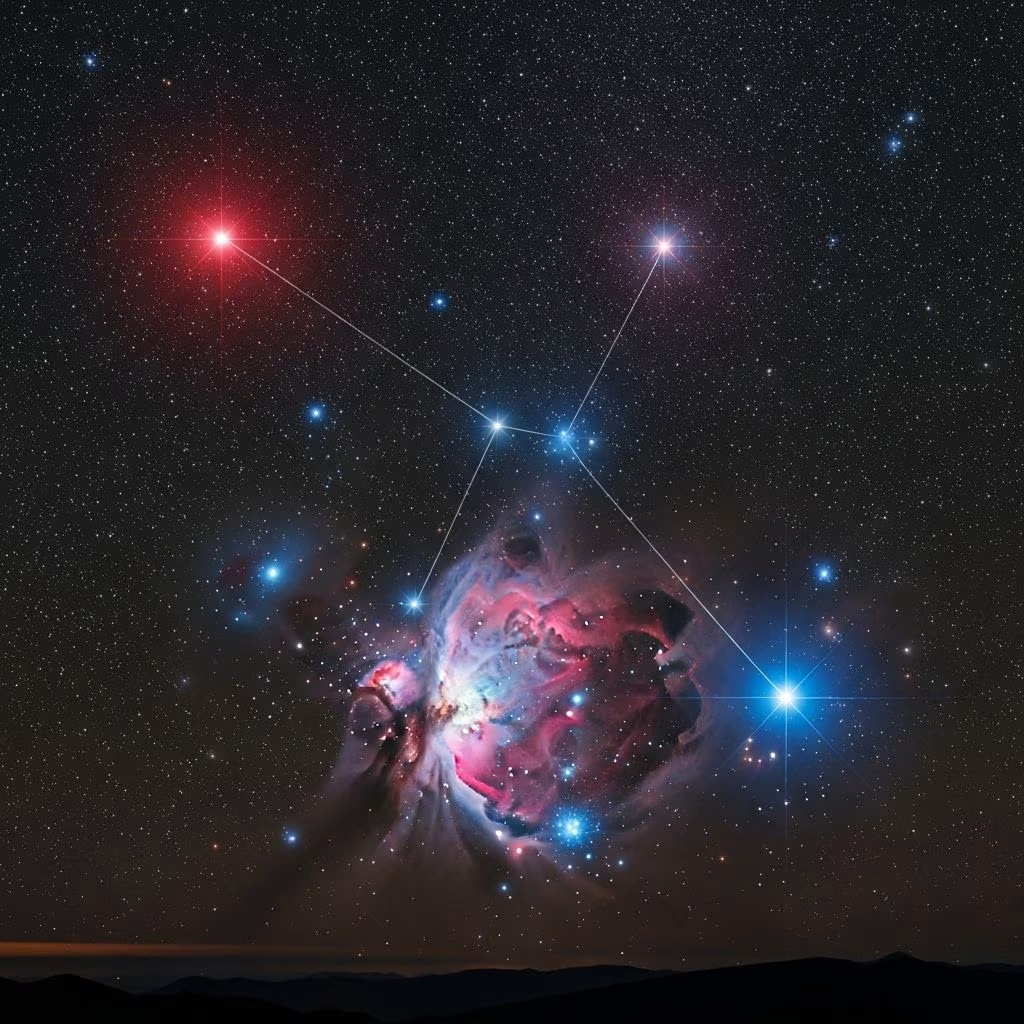
Orion stands as one of the most easily recognized constellations in the night sky. Its distinctive belt of three stars and impressive figures have inspired myth and science since ancient times. This article explores Orion’s origins, star features, nebulae, cultural significance, and tips for observing this cosmic giant.
Introduction to Orion
The constellation Orion dominates the evening sky during winter months in the northern hemisphere and summer in the southern hemisphere. It straddles the celestial equator, making it visible across most inhabited regions of Earth. Its bright stars, unique shape, and deep-sky wonders have captured human imagination for thousands of years.
Mythology and History
Named after a legendary hunter in Greek mythology, Orion is usually depicted as a warrior wielding a club and shield. Stories tell of his adventures, his pursuit of the Pleiades sisters, and eventually his placement among the stars. Orion’s presence in mythos isn’t limited to Greece; many ancient cultures recognized the star pattern and attributed their own stories and significance to it.
- Greek Myth: Orion was said to be a giant, skilled hunter, and sometimes the son of Poseidon. He met his fate through various tales—by scorpion, the wrath of Artemis, or other causes—before being placed among the stars by the gods.
- Other Cultures: The ancient Egyptians associated Orion with Osiris, the god of the afterlife. Indigenous Australians and pre-Columbian civilizations also incorporated Orion’s shape into their sky lore.
Location and Visibility
Orion’s unique shape and bright members make it an excellent celestial landmark throughout much of the year. It borders the constellations Taurus (northwest), Eridanus (southwest), Lepus (south), Monoceros (east), and Gemini (northeast).
| Characteristic | Details |
|---|---|
| Right Ascension | 04h 43.3m – 06h 25.5m |
| Declination | +22.87° to −10.97° |
| Best Visibility (Northern Hemisphere) | Late Fall to Early Spring (Nov – April) |
| Best Visibility (Southern Hemisphere) | Summer nights (Dec – Mar) |
| Size Rank | 26 of 88 constellations |
| Abbreviation | Ori |
At the equator, Orion can be seen directly overhead. Outside Antarctica, it’s visible from almost every inhabited latitude. Visibility periods shift depending on location, but it is a prime feature of the winter sky for those in the north.
Major Stars of Orion
Orion contains two of the ten brightest stars in the sky and several notable asterisms that aid in celestial navigation.
Betelgeuse (Alpha Orionis)
Betelgeuse is Orion’s upper left shoulder and a red supergiant star. It’s famous for its deep reddish hue, vast size—about 1,000 times larger than the Sun—and its variability, sometimes dimming noticeably to the naked eye. Astronomers predict Betelgeuse may one day explode in a spectacular supernova.
Rigel (Beta Orionis)
Rigel marks Orion’s lower right foot. It is a blue-white supergiant, about 860 light-years away and around 120,000 times more luminous than the Sun. Rigel is often the brightest star in the constellation.
Other Bright Stars
- Bellatrix (Gamma Orionis): The left shoulder, a blue giant about 240 light-years distant.
- Saiph (Kappa Orionis): Lower left foot, another blue supergiant, anchors the constellation’s symmetry.
Orion’s Belt
The most iconic part of Orion is a straight line of three bright stars: Alnitak, Alnilam, and Mintaka. Known together as Orion’s Belt, these stars act as a celestial landmark for locating other constellations and bright stars. They each shine at magnitude 2 or brighter and are blue or blue-white supergiants, approximately 1,200 light-years from Earth.
- Alnitak (Zeta Orionis): Easternmost, closest to Sirius and the horizon when Orion is rising.
- Alnilam (Epsilon Orionis): Center star.
- Mintaka (Delta Orionis): Westernmost, close to the celestial equator.
Orion’s Sword
Hanging beneath the Belt is Orion’s Sword, a grouping of fainter stars and spectacular nebulae. The Sword is easily distinguished, particularly by the fuzzy glow of the famous Orion Nebula embedded within.
- 42 Orionis: Powers the Running Man Nebula (NGC 1977).
- Theta1 and Theta2 Orionis: The Trapezium Cluster, at the heart of the Orion Nebula.
- Hatysa (Iota Orionis): Brightest point in the Sword, part of open cluster NGC 1980.
Deep-Sky Objects in Orion
Orion is a rich hunting ground for observers with telescopes and binoculars, boasting some of the most famous and studied nebulae in the night sky.
- Orion Nebula (M42): The brightest emission nebula visible from Earth; a region of intense star formation known as a ‘stellar nursery.’ Located about 1,350 light-years away, M42 can be glimpsed with the naked eye as a misty smudge in Orion’s Sword.
- De Mairan’s Nebula (M43): A small emission nebula just north of M42, often seen as part of the larger nebular complex.
- Horsehead Nebula (Barnard 33): A dark nebula silhouetted against a dust cloud, found south of Alnitak in Orion’s Belt and visible only in long-exposure astrophotography.
- The Flame Nebula (NGC 2024): Near Alnitak, a bright cluster of glowing gas and dust clouds.
- Running Man Nebula (NGC 1977): A reflection nebula adjacent to the Orion Nebula, surrounding star 42 Orionis.
- Messier 78: The brightest reflection nebula in Orion, about 1,600 light-years away.
- Barnard’s Loop: A large arc of glowing hydrogen gas looping around Orion, best seen in deep photographic exposures.
- Monkey Head Nebula (NGC 2174): Located on the border of Orion and Gemini, an emission nebula popular with astrophotographers.
How to Find Orion in the Night Sky
Locating Orion is easy due to its prominent shape and position. Look for three bright stars in a short, nearly straight line—the Belt—around which the rest of the constellation is framed. From mid-northern latitudes, Orion rises in the eastern evening sky by November and is highest in the south around midnight in January and February.
- Use Orion’s Belt as a guide: an imaginary line through the Belt’s stars points southeast to Sirius (the brightest star in Canis Major) and northwest to Aldebaran (Taurus).
- The bright, reddish Betelgeuse marks Orion’s left shoulder; bluish-white Rigel marks his right foot.
- Observers in the tropics see Orion pass almost directly overhead during December around midnight.
Orion in Science and Culture
Orion has fascinated both scientists and storytellers for centuries:
- Navigation: As a prominent equatorial constellation, navigators have used Orion as a reference point for centuries.
- Research: The Orion Nebula is a key laboratory for understanding how stars and planetary systems form and evolve.
- Annual Meteor Shower: The Orionids meteor shower, peaking in October, appears to radiate from this constellation and is associated with Halley’s Comet.
- Cultural Influence: Orion’s image appears in art, architecture (notably the pyramids of Egypt), and literature worldwide—and NASA named its Orion spacecraft after the constellation.
Famous Asterisms in Orion
- Orion’s Belt: Three stars in a line, among the most recognizable in all the sky.
- Orion’s Sword: The vertical row of stars and nebulae beneath the Belt.
- Winter Hexagon: A large asterism encompassing Orion, with Rigel, Procyon, Pollux, Capella, Aldebaran, and Sirius marking the six corners. Orion sits near its center.
Observing Tips
- Look for Orion after sunset during the winter (Northern Hemisphere) or summer (Southern Hemisphere).
- Even small binoculars can reveal much detail in the Orion Nebula, as well as clusters and faint stars within the Sword region.
- Dark, rural skies give the best view of Orion’s fainter members.
- Use a sky mapping app to identify Orion’s position based on your location and date.
Frequently Asked Questions (FAQs)
Q: What is the best time of year to see Orion?
A: Orion is most visible from November through April in the Northern Hemisphere, best seen on clear winter nights. In the Southern Hemisphere, it graces the evening sky in the summer months (December to March).
Q: Can I see Orion from anywhere in the world?
A: Orion is visible from most of the inhabited globe, except during the Antarctic summer when the Sun never sets.
Q: What makes Orion’s Belt so famous?
A: Orion’s Belt consists of three bright stars in a straight line, easily spotted even in city skies. Many cultures have used it for navigation and in myth.
Q: How far away are Orion’s stars?
A: Orion’s main stars range from about 240 light-years (Bellatrix) to over 1,300 light-years (Betelgeuse, Alnilam, Mintaka) from Earth. The nebulae in the Sword are about 1,350–1,600 light-years distant.
Q: What is special about the Orion Nebula?
A: The Orion Nebula (M42) is the closest region of massive star formation to Earth. Visible to the naked eye, it offers astronomers a direct window into the process of star birth.
Q: What other constellations can be found near Orion?
A: Orion is neighbored by Taurus, Gemini, Eridanus, Monoceros, and Lepus. The brightest stars form part of the Winter Hexagon asterism.
Conclusion
The Orion constellation, with its rich mythology, brilliant stars, and spectacular deep-sky objects, continues to captivate both casual stargazers and professional astronomers. Its story spans continents and centuries, ensuring Orion’s place as a luminous guide across the universe and human imagination.
References
- https://www.space.com/28562-orion-constellation-stars-explained.html&rut=c9a9661789449892cb9c4d9e615bdb9eb2505ff162381ed324bf4db69f655ea0
- https://www.space.com/orion-nebula
- https://en.wikipedia.org/wiki/Orion_(constellation)
- https://science.nasa.gov/universe/discovering-the-universe-through-the-constellation-orion/
- https://theskylive.com/sky/constellations/orion-constellation
- https://stillnessinthestorm.com/2020/02/16/secrets-of-the-ancients-sacred-alignment-and-the-constellation-of-orion/13/11/02/84551/space/stillness-in-the-storm/
- https://www.constellation-guide.com/constellation-list/orion-constellation/
- https://space.fandom.com/wiki/Orion_(constellation)
- https://www.britannica.com/science/Constellation-program
- https://souls-space.com/orion-starseed/
- https://thespacereview.com/article/830/1
- https://en.wikipedia.org/wiki/Constellation_program
- https://lovethenightsky.com/orion-constellation-guide/
- https://www.constellation-guide.com/orions-belt/
- https://www.britannica.com/place/Orion-constellation
- https://www.youtube.com/watch?v=DlieWnExxt8


